

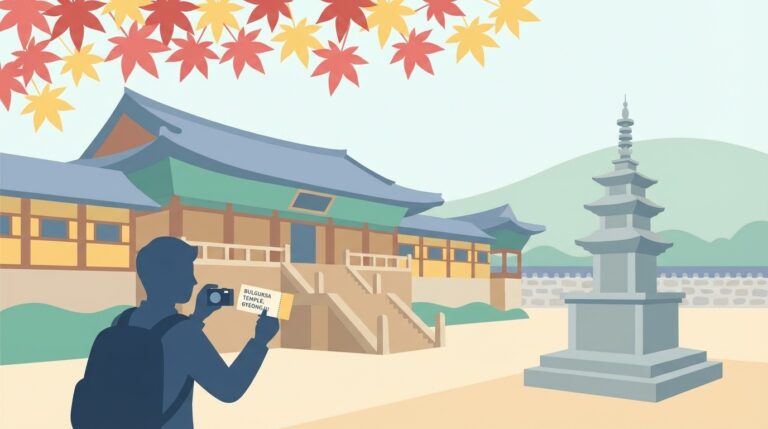
Time Travel to Silla: How to Visit Bulguksa Without Looking Like a Lost Tourist
Phase 1: The Immersive Hook
Greeting: 안녕하세요! (Annyeonghaseyo!) Your Daily Hangul editor here.
Imagine this: You’ve stepped off the KTX train and suddenly, the skyscrapers of Seoul are gone. Instead, you’re surrounded by rolling green mounds (royal tombs!) and buildings with curved tiled roofs. You are in Gyeongju, the ancient capital of the Silla Kingdom.
It feels exactly like that scene in a Sageuk (Historical K-Drama) where the protagonist travels back 1,000 years. You’re about to visit Bulguksa Temple, a UNESCO World Heritage site.
But wait—the bus map is confusing, the ticket booth line is long, and there’s a sign in front of the temple hall you can’t read. Do you take your shoes off? Can you take a photo?
Don’t worry. Today, we aren’t just learning words; we are learning how to respect history and travel smoothly. Let’s make sure your memory of Bulguksa is about inner peace, not language panic.
Phase 2: Deep Dive into Key Expressions
Here are the 3 essential phrases you need to survive your trip to Gyeongju.
1. [불국사 가는 버스예요?]
- Pronunciation: [Bulguksa ganeun beoseu-yeyo?]
- Sound-alike: Bul-guk-sa ga-neun bus-yeh-yo?
- Meaning: Is this the bus going to Bulguksa?
- Literal: Bulguksa going bus is it?
- Real Nuance: “I’m terrified of getting on the wrong bus, please confirm this goes to the temple!”
- K-Culture Moment: In Korean variety shows like 2 Days & 1 Night, cast members often ask this frantically to bus drivers when they get separated from their team.
- Editor’s Insight: Gyeongju buses (Numbers 10 and 11) are famous for driving fast! Ask this quickly as you step on.
- Situation Spectrum:
[🚫 Formal Meeting] ———— [✅ Bus Driver/Stranger] ———— [✅ Friends] -
🤔 Think About It: Notice the structure “~ganeun” (going). In English, you say “the bus that goes to…”. In Korean, the action (going) comes before the noun (bus). It’s like saying “the going-to-Bulguksa bus.” Why do you think Korean puts the description first?
2. [어른 한 명 주세요.]
- Pronunciation: [Eoreun han myeong juseyo.]
- Sound-alike: Uh-reun han myung ju-seh-yo.
- Meaning: One adult ticket, please.
- Literal: Adult one person give please.
- Real Nuance: Standard phrase at any ticket booth.
- K-Culture Moment: You’ll hear this in every movie scene where a couple goes on a date to the cinema or an amusement park.
- Editor’s Insight: You don’t need to say the word “ticket” (pyo). Just saying the number of people is enough context! “Eoreun” means adult.
-
Situation Spectrum:
[🚫 Boss] ———— [✅ Ticket Booth/Restaurant] ———— [✅ Casual] -
🤔 Think About It: We use “myeong” to count people, not just numbers like “hana, dul.” Korean has specific counters for everything (bottles, books, machines). Does this show that Korean culture places high importance on categorizing the nature of objects/beings?
3. [신발 벗어야 해요?]
- Pronunciation: [Sinbal beoseoya haeyo?]
- Sound-alike: Sin-bal buh-suh-ya heh-yo?
- Meaning: Do I have to take off my shoes?
- Literal: Shoes must take off?
- Real Nuance: “I don’t want to be rude, tell me the rule!”
- K-Culture Moment: The classic panic moment in K-Dramas when a foreigner enters a traditional home or a temple hall with shoes on, and everyone gasps!
- Editor’s Insight: At temples, you can walk around the grounds in shoes, but if you step inside a building to pray, they must come off.
- Situation Spectrum:
[✅ Everywhere there is a floor]
Phase 3: Textbook vs. Real Life
| Situation | 📖 Textbook Korean | 🗣️ Real Korean (Survival) | 💡 Why is it different? |
|---|---|---|---|
| Buying a Ticket | 티켓을 한 장 사고 싶습니다. (I would like to buy one ticket.) | 성인 하나요. (One adult.) | Real life is about speed. In a noisy line, short is better. |
| Finding the entrance | 입구가 어디에 있습니까? (Where does the entrance exist?) | 입구 어디예요? (Where’s the entrance?) | “~e issseumnikka” is too stiff for a tourist spot. |
| Taking a photo | 사진을 찍어도 됩니까? (Is taking a photo allowed?) | 사진 찍어도 돼요? (Can I take a photo?) | “~do dwaeyo?” is the magic phrase for asking permission softly. |
Bottom Note: For A2 learners, sticking to “~yeyo/aeyo” endings is perfect. It’s polite but friendly.
Phase 4: Cultural Deep Dive
4-1. The “School Trip” (Suhak Yeohaeng) Vibe
If you go to Bulguksa in spring or autumn, you will see hundreds of students in uniforms. Why? Because Gyeongju is the #1 destination for school field trips in Korea.
- K-Drama Connection: Think of the drama Reply 1988. The characters go to Gyeongju, stay in a youth hostel, and perform talent shows. Visiting Bulguksa is a rite of passage for Koreans. If you see noisy students, just smile—it’s part of the authentic Korean experience!
4-2. Silence and Nunchi (Non-verbal)
Temples are active religious sites, not just museums.
* Nunchi Tip: If you see people bowing (doing jeol) inside a hall, lower your voice to a whisper.
* Hands: If you meet a monk, you don’t wave “Hello.” You place your palms together in front of your chest and bow slightly. This is called hapjang.
Phase 5: Immersive Roleplay
Setting: It is a crisp autumn morning at the ticket office of Bulguksa. The leaves are red and yellow. You are next in line. The ticket seller (an Ajhumma in a visor cap) looks busy.
Characters:
* YOU: A tourist excited to see the Dabotap Pagoda.
* Ajhumma: Efficient ticket seller.
Dialogue:
Ajhumma: (Looking at her screen) 몇 분이세요?
(Myeot bun-iseyo?)
(English) How many people?
YOU: 안녕하세요! 어른 한 명 주세요.
(Annyeonghaseyo! Eoreun han myeong juseyo.)
(English) Hello! One adult, please.
Ajhumma: 6,000원입니다.
(Yuk-cheon-won imnida.)
(English) It’s 6,000 won.
(🎭 Stage Direction: You hand over your credit card. She gives you a paper ticket.)
YOU: 감사합니다. 아, 저기… 들어가서 사진 찍어도 돼요?
(Gamsahamnida. Ah, jeogi… deureogaseo sajin jjigeodo dwaeyo?)
(English) Thank you. Ah, excuse me… can I take photos inside?
🔀 Decision Point: The Ajhumma points to the main gate.
- Option A: “Okay, bye!” (Walk away immediately)
- Option B: “Ne, algesseumnida. Sugohaseyo!” (Polite acknowledgment + gratitude for work)
✅ Best Choice: Option B.
Why? “Sugohaseyo” (Thank you for your effort) is the magic phrase to leave a good impression on any worker in Korea. It shows you respect their labor.
Phase 6: 10-Second Shadowing Drill
Practice this sentence to ask for a photo naturally. Listen to the rhythm!
Emotion: 😊 Polite and slightly shy
KR: 여기에서 / 사진 찍어도 / 돼요?
Rom: Yeogi-eseo / sajin jjigeodo / dwaeyo?
Meaning: Is it okay / to take a photo / here?
Phase 7: K-Culture Mini Glossary
| Korean | Romanization | English | Context |
|---|---|---|---|
| 탑 | Tap | Pagoda | You will see two famous ones: Dabotap (complex) and Seokgatap (simple). |
| 단청 | Dancheong | Traditional Coloring | The colorful decorative coloring on wooden buildings (red, green, blue). |
| 템플스테이 | Tempeul-seutei | Temple Stay | A program where you sleep at the temple. Very popular in reality shows like I Live Alone. |
| 수학여행 | Suhak-yeohaeng | School Trip | The nostalgic trip every Korean student takes to Gyeongju. |
Phase 8: Traveler’s Survival Kit (Gyeongju Edition)
Visiting Bulguksa? Clip this section!
🆘 Survival Phrases
1. “불국사 입구가 어디예요?” (Bulguksa ipgu-ga eodiyeyo?) – Where is the entrance?
2. “화장실 어디예요?” (Hwajangsil eodiyeyo?) – Where is the bathroom? (Essential after a long bus ride!)
3. “경주역까지 얼마나 걸려요?” (Gyeongju-yeok-kkaji eolmana geollyeoyo?) – How long does it take to Gyeongju Station?📌 Editor’s Travel Note
* The Bus: Bus #10 and #11 are circular lines that hit all major spots (Terminal -> Bulguksa -> Museum).
* T-Money Card: Yes, your Seoul subway card works in Gyeongju buses!
* Stamping: Look for the “Stamp Tour” booth. You can collect ink stamps at historical sites (a fun souvenir!).
Phase 9: Think Deeper — Language & Space
Why is “Excuse me” different in temples?
In Western cultures, “Excuse me” is used to get attention. In Korean temple culture, silence is a form of communication. Often, you don’t need to speak to ask for directions—you just look confused, and someone will point the way. This is part of high-context communication.
Also, notice how Korean uses specific words for specific locations. You don’t just “enter.” You go into the “entrance” (ipgu). Precise spatial nouns are crucial in Korean travel.
💬 Your Turn: In your country, is it okay to take photos inside religious buildings? Or is it strictly forbidden? Let me know in the comments!
Phase 10: FAQ & Troubleshooting
- Q: Can I wear shorts to Bulguksa?
- A: Generally, yes. It is a tourist site. However, extremely short skirts or sleeveless tops might feel out of place if you plan to bow inside the prayer halls. Dress comfortably but modestly.
- Q: Can I speak English to the monks?
- A: Maybe! Many monks speak excellent English. But start with a bow and “Annyeonghaseyo” first.
- ❌ Common Mistake: Sitting on the threshold (the raised wood at the bottom of the door frame).
- ✅ Fix: Never step on or sit on the threshold (Munjibang). It is considered bad luck and disrespectful to the house/temple spirits. Step over it.
Phase 11: Wrap-up & Action Mission
One-Liner: To visit Bulguksa, you just need to know how to count people (myeong) and ask for permission (…dwaeyo?).
🚀 Action Mission:
* 🥉 Bronze: Say “Eoreun han myeong juseyo” aloud 3 times while imagining you are buying a movie ticket.
* 🥈 Silver: Look up a picture of “Dabotap” (pagoda) and describe it using one Korean adjective you know (e.g., Yeppeoyo / Keoyo).
* 🥇 Gold: If you are in Korea, find a historical site or a park ticket booth and buy your ticket in Korean!
K-Culture Mission: Watch a clip of the K-Drama Queen Seondeok. It is set in the Silla period (Gyeongju). Look at the costumes and compare them to the Dancheong colors you learned today!
Phase 12: Interactive Quiz
1. Situational Judgment:
You are standing in front of the main prayer hall. You see shoes lined up outside. What should you do?
* A) Walk in with your shoes on.
* B) Take off your shoes and place them neatly before entering.
* C) Ask the monk, “Shoe discount isseoyo?”
2. Fill in the Blank:
“Excuse me, can I take a photo?”
-> “Jeogi… sajin jjigeodo ______?”
3. True or False (Culture):
It is polite to step directly ON the wooden threshold of a temple door. (T/F)
🔑 Answers:
1. B (Always remove shoes before entering prayer halls!)
2. dwaeyo (means “is it allowed/okay?”)
3. False (Never step on the threshold! Step over it.)
Frequently Asked Questions (FAQ)
Q: What does "[불국사 가는 버스예요?]" mean in Korean and how do you pronounce it?
A: In Korean, "[불국사 가는 버스예요?]" is pronounced [Bulguksa ganeun beoseu-yeyo?] and means: Is this the bus going to Bulguksa?
Q: What does "[어른 한 명 주세요.]" mean in Korean and how do you pronounce it?
A: In Korean, "[어른 한 명 주세요.]" is pronounced [Eoreun han myeong juseyo.] and means: One adult ticket, please.
Q: What does "[신발 벗어야 해요?]" mean in Korean and how do you pronounce it?
A: In Korean, "[신발 벗어야 해요?]" is pronounced [Sinbal beoseoya haeyo?] and means: Do I have to take off my shoes?







