

Phase 1: The Immersive Hook
Hello! This is your Daily Hangul Editor.
Imagine this: You’re watching a K-Drama. The CEO protagonist walks into his penthouse overlooking the Han River. He doesn’t flip a switch. He just says, “I’m home,” and the curtains part, the lights dim to a warm amber, and jazz music starts playing.
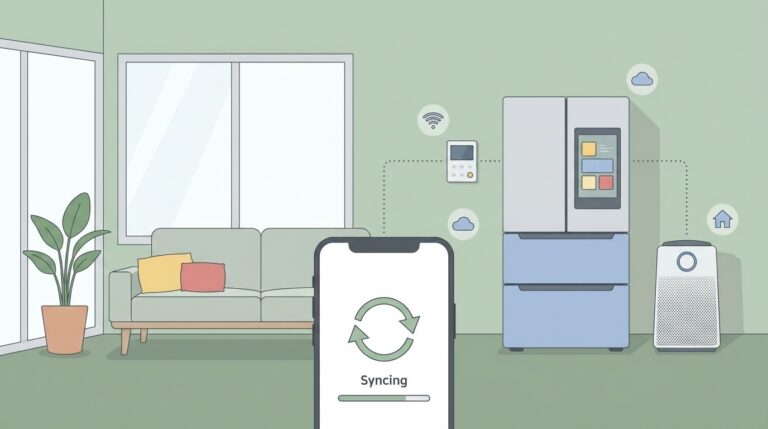
It feels like sci-fi, but in Seoul, this is becoming the standard. Korea is a hyper-connected society where your fridge talks to your phone, and your apartment’s “Wall Pad” (월패드) is the command center of your life.
But here’s the catch for advanced learners: You know how to say “Turn on the light” (불 켜 주세요). But what do you say when the app isn’t syncing with the device? Or when the AI speaker fails to recognize your voice because of your intonation?
Today, we are stepping away from the textbook and into the Internet of Things (IoT). Let’s upgrade your Korean to version 2.0.
Phase 2: Deep Dive into Core Expressions
We are looking at C1-level vocabulary. These words distinguish a “fluent speaker” from a “native-level speaker.”
1. 연동하다 (Yeondong-hada)
- Pronunciation: [yeondong-hada] Sounds like ‘yon-dong’ (think ‘beyond’ without ‘be’) + hada.
- Meaning: To interlock / To sync / To link (data or systems)
- Context: While 연결하다 means simply “connecting” (like plugging in a cord), 연동하다 implies a system integration. Your phone isn’t just plugged into the air purifier; they are working together.
- K-Culture Moment: You’ll hear this when setting up banking apps or delivery apps. “카카오톡과 연동하시겠습니까?” (Do you want to sync with KakaoTalk?)
- Editor’s Insight: If you complain about tech, use this. “아, 이거 왜 연동이 안 돼?” (Ugh, why isn’t this syncing?)
- Situation Spectrum:
[🚫 Formal Only] ———— [✅ Semi-formal/Casual](Used universally in tech contexts)- 🤔 Think About It: Why does Korean distinguish between physical connection (연결) and systemic interaction (연동)? How does this reflect the complexity of modern digital ecosystems?
2. 인식하다 (Insik-hada)
- Pronunciation: [insik-hada]
- Meaning: To recognize / To perceive
- Context: In IoT, this is critical. Face recognition (안면 인식), Voice recognition (음성 인식).
- K-Culture Moment: In variety shows, when a celebrity plays a game with an AI speaker and it keeps saying “I didn’t understand,” the caption will read: “음성 인식 실패” (Voice recognition failed).
- Editor’s Insight: This is a high-level verb. Using 알아듣다 (to understand/hear) is fine for people, but for machines, 인식하다 makes you sound tech-savvy.
- Situation Spectrum:
[✅ Universal Usage]3. 원격 제어 (Wongyeok Jeeo)
- Pronunciation: [wongyeok je-eo]
- Meaning: Remote Control (not the handheld device, but the action of controlling remotely)
- Context: Controlling your boiler (floor heating) from the subway before you get home.
- Editor’s Insight: Korea’s Ondol (floor heating) culture meets IoT. The ultimate luxury is warming your floor via 원격 제어 before you open the door.
- 🤔 Think About It: Is the desire for control (제어) over one’s environment related to the fast-paced (Pali-pali) lifestyle of Korea? We optimize every second, even heating time.
Phase 3: Textbook vs. Real Life
| Situation | 📖 Textbook Korean | 🗣️ Real Life Korean | 💡 Why the difference? |
|---|---|---|---|
| Connecting a device | 기계를 스마트폰에 연결했습니다. (I connected the machine to the smartphone.) | 앱이랑 연동시켜 놨어. (I’ve got it synced with the app.) | 연동 emphasizes the software integration, which is more relevant today. |
| AI didn’t hear you | 기계가 제 말을 이해하지 못해요. (The machine doesn’t understand my words.) | 이거 내 목소리 인식을 못 하네. (This thing can’t recognize my voice.) | We treat the machine’s failure as a technical error (recognition), not a lack of intellect (understanding). |
| Turning off lights via app | 앱으로 불을 껐습니다. (I turned off the light with the app.) | 폰으로 제어하면 돼. (You can just control it with your phone.) | 제어 sounds more comprehensive and technical. |
Phase 4: Cultural Context — The “Smart” Apartment
4-1. The Wall Pad (월패드) Culture
In modern Korean apartments, the Wall Pad is sacred. It’s not just an intercom; it calls the elevator, checks energy usage, and even shows you where your parked car is.
* Non-verbal Tip: When visiting a Korean friend’s new apartment, looking at the Wall Pad and saying “Wow, system is good” is a genuine compliment on their living standard.
4-2. K-Drama Connection: The Digital Door Lock
Every K-Drama fan knows the beep-beep-beep-clack sound. Physical keys are almost extinct in Seoul.
* The Trope: The protagonist drunkenly trying to guess the passcode involves interaction with the IoT device.
* Critical View: In dramas, high-tech homes symbolize power and isolation. The automated curtains separate the rich from the chaotic world outside. Is technology connecting us or isolating us?
Phase 5: Immersive Roleplay Scenario
Setting: You have just moved into a high-tech “Officetel” (Studio Apartment) in Gangnam. Your Korean friend, Jisoo (29, tech-savvy early adopter), is helping you set up your home.
YOU: (Looking at the air conditioner)
이거 리모컨이 없는데 어떻게 켜? (There’s no remote, how do I turn this on?)
Jisoo: 아, 요즘 누가 리모컨 써? 앱 깔고 연동하면 돼. 내가 해줄게.
(Ah, who uses remotes these days? Just install the app and sync it. I’ll do it for you.)
YOU: 오, 역시 한국은 빠르네. 근데 내 발음도 인식할까?
(Oh, Korea is fast as expected. But will it recognize my pronunciation?)
Jisoo: (Laughs) 당연하지. 요즘 AI 똑똑해. 한번 해봐. “에어컨 켜”라고.
(Of course. AI is smart these days. Try it. Say “Turn on the AC”.)
🔀 Your Turn! How do you command the AI?
– Option A: (Polite) “에어컨 님, 켜 주세요.” (Mr. AC, please turn on.)
– Option B: (Clear & Direct) “에어컨, 전원 켜.” (AC, Power On.)
– Option C: (Hesitant) “어… 저기, 켜질래?” (Uh… hey, wanna turn on?)✅ Best Choice: B. IoT devices respond best to clear, keyword-based commands (Command form).
⚠️ Choice A Analysis: While cute (and some Koreans do it jokingly), AI syntax prefers commands. But interestingly, many Koreans naturally use polite forms (~요) even with robots!
YOU (Option B): 에어컨, 전원 켜!
Jisoo: 오! 바로 켜졌다. 너 이제 밖에서도 원격 제어 할 수 있어.
(Oh! It turned on right away. Now you can remotely control it from outside too.)
Phase 6: 10-Second Shadowing Drill
Let’s practice complaining about technology—a very native thing to do.
😤 Emotion: Frustrated but resigned.
네트워크가 / 불안정해서 / 기기 등록이 / 자꾸 실패해요.
(Ne-teu-wo-keu-ga / bul-an-jeong-hae-seo / gi-gi deung-no-gi / ja-kku sil-pae-hae-yo.)Meaning: Because the network is unstable, device registration keeps failing.
Phase 7: K-Culture Mini Glossary (IoT Edition)
| Korean | Romanization | English | Context |
|---|---|---|---|
| 월패드 | Wol-pae-deu | Wall Pad | The central touch screen in Korean apartments. |
| 사물 인터넷 | Samul Inteonet | IoT | Literal translation of Internet of Things. |
| 페어링 | Pe-eo-ring | Pairing | Used interchangeably with 연동. |
| 인공지능 스피커 | Ingong-jineung Seupikeo | AI Speaker | Google Home, Clova, GiGA Genie, etc. |
| 대기 전력 | Daegi Jeollyeok | Standby Power | Koreans are obsessed with saving this; smart plugs help cut it. |
Phase 8: Traveler’s Survival Kit (Smart Airbnb Edition)
Staying in a modern Airbnb in Seoul? You might face a complex wall pad or boiler system.
🆘 Survival Phrase #1
– 🇰🇷 “이거 어떻게 작동해요?” (Igeo eotteoke jakdong-haeyo?)
– Meaning: How does this work?
– Use when: You are staring at a boiler controller with 20 buttons.🆘 Survival Phrase #2
– 🇰🇷 “와이파이 비번이 뭐예요?” (Wa-i-pa-i bi-beo-ni mwo-ye-yo?)
– Meaning: What is the Wi-Fi password?
– Note: ‘Bi-beon’ is short for ‘Bimil-beonho’ (Password). Essential for IoT setup.📌 Editor’s Note: Many Korean door locks have a “Manner Mode.” If you touch the keypad with your palm for a second before entering numbers, it won’t beep. Great for coming home late without waking up the host!
Phase 9: Think Deeper — Technology & Privacy
Korean society embraces convenience, sometimes at the cost of privacy.
Walk around Seoul, and you are likely on CCTV (CCTV is a Korean word too!) constantly. IoT devices in the home record our patterns. In Korea, the safety and convenience (getting delivery dropped off securely, checking who is at the door) often outweigh privacy concerns.
🧠 Think Deeper:
Does the Korean language’s high usage of terms like “Safe Return Home Service” (안심 귀가 서비스 – often IoT enabled) suggest that technology is viewed primarily as a protector rather than a surveillance tool? How does this compare to the tech-skepticism in your country?
Phase 10: FAQ & Troubleshooting
Q: Do I really need to use honorifics with AI (Siri/Bixby)?
A: Strictly speaking, no. The machine is programmed to understand “날씨 알려줘” (Tell me the weather – Banmal). However, you will hear many polite Koreans say “날씨 알려주세요” (Please tell me…). It’s a habit of speech, not a rule.
❌ Common Mistake: confusing 작동하다 (to operate/work mechanically) with 연동하다 (to sync).
* “My phone isn’t working” = 작동 안 해.
* “My phone isn’t connecting to the TV” = 연동 안 돼.
Phase 11: Wrap-up & Mission
One-Liner: To live smartly in Korea, stop “connecting” lines and start “syncing” systems (연동).
🏆 Action Missions:
– 🥉 Bronze: Look at your phone and headphones. Say out loud: “연동되었습니다.” (It has been synced.)
– 🥈 Silver: Change your phone’s language setting to Korean for 1 hour. Try to find the “Bluetooth” or “Connection” settings and look for the word 연결 or 등록.
– 🥇 Gold: If you have an AI assistant (Siri/Google), change its language to Korean and try to set a timer: “타이머 5분 맞춰줘.”
K-Culture Mission: Watch a clip of the Korean variety show “I Live Alone” (나 혼자 산다). Look for a scene where a celebrity wakes up. Do they use a remote, a voice command, or a phone to open curtains or turn on lights?
Phase 12: Quiz — Smart Home Logic
Situation: You bought a new robot vacuum. You turned it on, but it’s just spinning in circles and not moving to the app’s map.
What is the most accurate complaint to make to customer service?
- “청소기가 고장 났어요.” (The vacuum is broken.)
- “앱이랑 기기 연동이 자꾸 끊겨요.” (The sync between the app and device keeps cutting off.)
- “청소기가 저를 인식하지 못해요.” (The vacuum doesn’t recognize me.)
Correct Answer: 2
* Why? If it turns on but doesn’t talk to the app, it’s a syncing (연동) issue.
* Option 1 is too generic.
* Option 3 is weird unless the vacuum is supposed to follow your face (which is rare!).
See you next time, and stay connected!
Frequently Asked Questions (FAQ)
Q: What does "연동하다 (Yeondong-hada)" mean in Korean and how do you pronounce it?
A: In Korean, "연동하다 (Yeondong-hada)" is pronounced [yeondong-hada] and means: To interlock / To sync / To link (data or systems)
Q: What does "인식하다 (Insik-hada)" mean in Korean and how do you pronounce it?
A: In Korean, "인식하다 (Insik-hada)" is pronounced [insik-hada] and means: To recognize / To perceive
Q: What does "원격 제어 (Wongyeok Jeeo)" mean in Korean and how do you pronounce it?
A: In Korean, "원격 제어 (Wongyeok Jeeo)" is pronounced [wongyeok je-eo] and means: Remote Control (not the handheld device, but the action of controlling remotely)







