

Phase 1: Immersive Hook
Greeting:
“Annyeonghaseyo! Welcome back to Daily Hangul. I’m your editor, here to guide you through the real Korea.”
K-Culture Cold Open:
Picture this: You’ve just landed on Jeju Island. The sky is blue, the air smells like tangerines and the ocean. In every K-Drama, this is the moment the main characters hop into a convertible and drive along the coast with the wind in their hair (think of that classic scene in Welcome to Samdal-ri).
But in reality? You are standing at the rental car counter, the clerk is asking you a question about dates and times, and you realize you only know how to say “Hello” and “Thank you.” If you get the dates wrong, your dream road trip could end with a hefty late fee or, worse, no car at all.
The ‘Why’:
Renting a car allows you to explore the hidden corners of Korea that the subway can’t reach. But to get the keys, you need to master one crucial skill: Setting the Time and Period.
Transparency:
Don’t worry about complex grammar today. We are focusing on the survival phrases that actual travelers use at the desk. Let’s get you on the road!
Phase 2: Deep Dive — 3 Key Expressions
1. ~부터 ~까지 (…buteo …kkaji)
- Pronunciation: [bu-teo] [kka-ji]
Tip: ‘bu-teo’ sounds a bit like ‘boot’ + ‘uh’. ‘kka-ji’ sounds like ‘ka’ in ‘karate’ + ‘ji’ in ‘jiujitsu’.- Meaning: From [Time A] to [Time B]
- K-Culture Moment: You’ll hear this in K-Pop lyrics about waiting “from morning to night” (achim-buteo bam-kkaji). In our context, it’s the most efficient way to define your rental period.
- Editor’s Insight: This is the Swiss Army Knife of Korean prepositions. You can use it for dates, times, and even locations (From Seoul to Busan).
- Situation Spectrum:
[🚫 Formal Only] ———— [✅ Universal] ———— [🚫 Casual Only]
This structure is standard and polite in almost any situation.- 🤔 Think About It: In English, we use “From… to…” structure. Korean places these particles after the words (Postpositions). Why? It puts the emphasis on the time first, then the direction.
2. 2박 3일 (I-bak Sam-il)
- Pronunciation: [ee-bak] [sahm-il]
- Meaning: 2 nights, 3 days
- K-Culture Moment: Watch any Korean variety show like 2 Days & 1 Night (1박 2일). This isn’t just a show title; it’s how Koreans count trip duration. We don’t say “for 3 days.” We specify the nights and the days.
- Editor’s Insight: Even if you are renting a car just for movement, the clerk might confirm your schedule using this format if it spans across days.
Formula: [Number] + bak (nights) + [Number] + il (days).- Situation Spectrum:
[🚫 Slang] ———— [✅ Standard] ———— [🚫 Archaic]3. 언제 반납하세요? (Eonje bannap-haseyo?)
- Pronunciation: [on-jeh] [ban-nap-ha-seh-yo]
- Meaning: When will you return it?
- K-Culture Moment: In dramas, returning a borrowed item (like a jacket or umbrella) is often an excuse to meet again. In a rental shop, however, “Bannap” (return) is strictly business!
- Editor’s Insight: “Bannap” is specific to returning borrowed items. You wouldn’t use this for “returning home.”
- Situation Spectrum:
[🚫 Friends] ———— [⚠️ Service/Biz] ———— [✅ Polite]
Used mostly in libraries, rental shops, and offices.
Phase 3: Textbook vs. Real Life
| Situation | 📖 Textbook Korean | 🗣️ Real Korean (Survival) | 💡 Why the difference? |
|---|---|---|---|
| Setting Dates | 6월 1일부터 6월 3일까지 차를 빌리고 싶습니다. (I would like to rent a car from June 1st to June 3rd.) | 금요일부터 일요일까지요. (From Friday to Sunday.) | Koreans value efficiency (ppalli-ppalli). If the current week is implied, just the days of the week are enough. |
| Asking Duration | 며칠 동안 빌리실 겁니까? (For how many days will you rent?) | 얼마나 쓰세요? (How long will you use it?) | “Sseuseyo” (use) is often used interchangeably with “rent” in casual service interactions. |
Phase 4: Cultural Deep Dive — K-Culture Connection
4-1. The “Nunchi” of Time (Non-verbal)
When discussing times, especially numbers, Koreans often show their phone screen with the calendar or calculator app open. Why? Because Sino-Korean numbers (used for dates/minutes) and Native Korean numbers (used for hours) can be confusing even for locals in noisy environments.
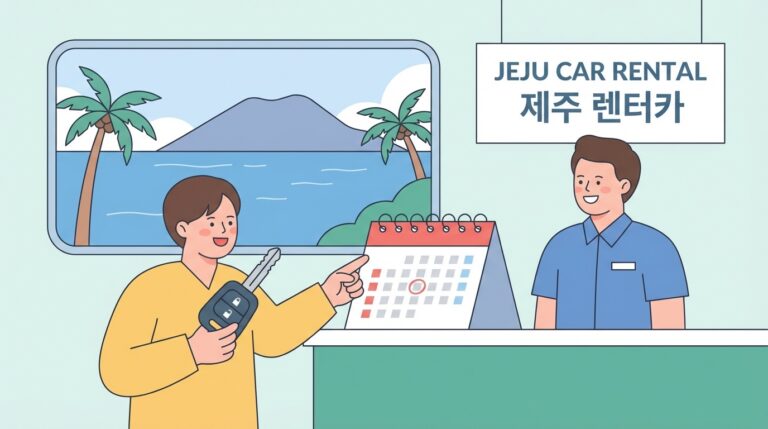
Editor’s Tip: Don’t be shy to point at a calendar on the desk while saying “Yeogi-buteo, yeogi-kkaji” (From here to here). It’s great communication strategy!
4-2. K-Travel: The Jeju Island Rule
Jeju Island is the capital of rental cars in Korea. Unlike Seoul, where the subway is king, you need a car in Jeju.
* The 24-Hour Clock: Rental reservations almost always use the 24-hour clock (14:00 instead of 2 PM) to avoid confusion.
* Strict Returns: Korean rentals are very strict about return times. Being 10 minutes late can charge you for an extra hour.
Phase 5: Immersive Roleplay Scenario
Setting: Jeju International Airport, Rental Car Desk. It’s busy, loud, and full of excited tourists. You finally reach the front of the line.
Characters:
* YOU: A tourist ready to explore Hallasan Mountain.
* Clerk (Minji): Efficient, typing fast on a keyboard, wearing a uniform.
The Dialogue:
Minji: 예약하셨나요? (Did you make a reservation?)
(Ye-yak ha-syeot-na-yo?)
YOU: 네, 제니퍼로 예약했어요. (Yes, I booked under Jennifer.)
(Ne, Jennifer-ro ye-yak-haess-eo-yo.)
Minji: 아, 네. 언제부터 언제까지 쓰시나요? (Ah, yes. From when to when will you use it?)
(A, ne. Eonje-buteo eonje-kkaji sseusi-nayo?)
YOU: 오늘 2시부터 목요일 2시까지요. (From 2 o’clock today to 2 o’clock Thursday.)
(Oneul du-si-buteo mogyo-il du-si-kkaji-yo.)
Minji: 네, 총 3일이네요. 반납은 공항 지점에서 하세요? (Okay, total 3 days. Will you return it at the airport branch?)
(Ne, chong sam-il-i-ne-yo. Bannap-eun gonghang jijom-eseo ha-se-yo?)
🔀 Decision Point: Where do you want to return it?
- Option A: “네, 여기서 할게요.” (Yes, I’ll do it here.)
- Option B: “아니요, 서귀포에서 반납 가능해요?” (No, is return possible in Seogwipo?)
✅ Best Choice: Option A. Most rentals in Jeju work best as round trips from the airport (shuttle buses are frequent). One-way rentals (Option B) are rare or expensive in Korea compared to other countries.
Phase 6: 10-Second Shadowing Drill
Let’s practice the flow. Focus on the pauses!
Sentiment: Clear & Confident (You want that car!) 🚙
오늘부터 / 3일 동안 / 빌릴게요.
(Oneul-buteo / sam-il dong-an / billil-geyo)
I will rent it / for 3 days / starting today.
Phase 7: K-Culture Mini Glossary
| Korean | Romanization | Meaning | Context |
|---|---|---|---|
| 렌터카 | Renteokka | Rental Car | Konglish! It’s exactly the same word. Easy, right? |
| 풀옵션 | Pul-opsyeon | Full Option | A car with all the features (sunroof, heated seats, etc.). |
| 자차 보험 | Jacha boheom | Collision Insurance | Crucial vocabulary. Always get “Full coverage” (Wanjeon jacha). |
| 내비 | Naebi | Navigation | Short for “Navigation.” Essential in Korea. |
Phase 8: Traveler’s Survival Kit (Driving Edition)
🆘 Survival Expression #1
* 🇰🇷 “내비게이션 영어로 돼요?” (Naebigeisyeon yeong-eo-ro dwaeyo?)
* 🗣️ Meaning: Does the GPS work in English?
* 📍 Where: At the rental desk, before you drive off.
* 💡 Pro Tip: Most Korean rental cars have built-in GPS. Ensure it’s set to English before the staff leaves!📌 Editor’s Travel Note: The Map App War
DO NOT rely on Google Maps for driving in Korea. It does not provide turn-by-turn navigation due to local laws.
* Download: Naver Map or KakaoMap. Both have English interfaces now.
Phase 9: Think Deeper — “Nights & Days”
Topic: The Philosophy of Time Counting
Why does Korea use 2박 3일 (2 nights, 3 days) instead of just saying “3 days”?
This reflects a culture that values the process of staying, not just the daylight hours. In the past, traveling was arduous, and where you laid your head (the “bak” or lodging) was just as important as the journey during the day. It also avoids ambiguity—does “3 days” mean you leave on the 3rd night or the 4th morning? The “Night/Day” system makes the checkout time crystal clear.
💬 Your Turn: How do you book trips in your country? By nights (hotel style) or by days?
Phase 10: FAQ & Troubleshooting
- Q: Can I just say dates using English numbers? (e.g., “June Two”)
- Editor: It’s risky. Older staff might not catch it. Use the format: [Number] + Wol (Month), [Number] + Il (Day).
- Example: 6월 2일 = Yu-wol, I-il.
- Q: I’m running late for return! What do I do?
- Strict Warning: Call the rental company immediately. If you don’t call, the penalty fees are much higher. Say: “조금 늦을 것 같아요” (Jo-geum neujeul geot gat-ayo / I think I’ll be a little late).
- ❌ Common Mistake: Confusing Native Numbers (Hana, Dul, Set) with Sino-Korean Numbers (Il, I, Sam).
- Rule of Thumb:
- Dates & Minutes: Sino-Korean (Il, I, Sam…)
- Hours: Native Korean (Han, Du, Se…)
- If this is too hard, showing your fingers or typing on a phone is 100% acceptable for A2 learners!
- Rule of Thumb:
Phase 11: Wrap-up & Action Mission
One-Liner: To rent a car, remember the magic combo: “[Start Time] Buteo, [End Time] Kkaji.”
Action Missions:
* 🥉 Bronze: Look at your calendar. Point to today and next Friday, saying “Oneul-buteo, Geumyoil-kkaji.”
* 🥈 Silver: Open a Korean map app (Naver Map). Pretend to search for a route from “Seoul Station” to “Incheon Airport.”
* 🥇 Gold: Next time you borrow something (even a pen) from a friend, jokingly ask, “Eonje bannap-haeyo?” (When do I return it?)
K-Culture Mission:
Watch a scene from the variety show “Earth Arcade” (ppong-ppong jigu-orak-sil). Watch how the cast negotiates time and games with the producers. Listen for “Myeot-si kkaji?” (Until what time?).
Phase 12: Quiz — Interactive Challenge
- Situational Judgment: You want to rent a car from Monday to Wednesday. Which phrase is correct?
- A) Woryoil-buteo Suyoil-kkaji. (Mon to Wed)
- B) Woryoil-eseo Suyoil-ro. (Mon at Wed)
- Answer: A. (~Buteo ~Kkaji is the standard “From-To” structure.)
- K-Culture True or False:
- “In Korea, you can usually drop off a rental car in any city, regardless of where you picked it up, for free.”
- Answer: False. Most Korean rental agencies require return to the same location, or charge a significant fee for one-way rentals.
See you on the road! Drive safely! 🚗💨
Frequently Asked Questions (FAQ)
Q: What does "~부터 ~까지 (…buteo …kkaji)" mean in Korean and how do you pronounce it?
A: In Korean, "~부터 ~까지 (…buteo …kkaji)" is pronounced [bu-teo] and means: From [Time A] to [Time B]
Q: What does "2박 3일 (I-bak Sam-il)" mean in Korean and how do you pronounce it?
A: In Korean, "2박 3일 (I-bak Sam-il)" is pronounced [ee-bak] and means: 2 nights, 3 days
Q: What does "언제 반납하세요? (Eonje bannap-haseyo?)" mean in Korean and how do you pronounce it?
A: In Korean, "언제 반납하세요? (Eonje bannap-haseyo?)" is pronounced [on-jeh] and means: When will you return it?







