

Don’t Blow It! (Literally): The Art of Burning Incense in Korea
Phase 1: The Immersive Hook
Hello! This is your Senior Editor at Daily Hangul.
Picture this: You are watching a heavy scene in a K-Drama like My Mister or Move to Heaven. The main character walks into a hospital basement (yes, funerals are usually held there), dressed in black. The air is heavy. They approach a white altar covered in flowers. They pick up a stick of incense, light it… and then—wait!
Did they just wave it to put out the flame? Why didn’t they blow on it?
If you were about to blow it out like a birthday candle, stop right there! 🛑 In Korea, blowing out incense with your mouth is considered incredibly disrespectful to the deceased. It’s a tiny gesture, but getting it wrong can make you feel like the music in the drama just stopped and everyone is staring at you.
Don’t worry. Today, I’ll guide you through this solemn but beautiful ritual so you can pay your respects like a true local.
Phase 2: Deep Dive into Key Expressions
Since this is a funeral, actions often speak louder than words. However, knowing what these words mean will help you understand the atmosphere.
1. 분향하다 (Bun-hyang-ha-da)
- Pronunciation: [Bun-hyang-ha-da] -> Sounds like “Bun” (burger bun) + “Hyang” (like ‘young’ with an H) + “Ha-da”.
- Meaning: To burn incense (Formal)
- K-Culture Moment: You won’t hear people say this out loud during the act, but you will see signs saying “분향소” (Bun-hyang-so) which means “Incense Burning Place/Memorial Altar.”
- Editor’s Insight: This is the core ritual. It symbolizes connecting the living with the spirit of the deceased through smoke.
- Situation Spectrum:
[🚫 Casual] ———— [⚠️ Semi-formal] ———— [✅ Formal]
(Strictly used in funeral contexts)- 🤔 Think About It: Why is scent/smell chosen as the medium to connect with spirits? In many cultures, smoke rising is seen as a bridge to heaven. Is it the same in your culture?
2. 삼가 고인의 명복을 빕니다 (Sam-ga go-in-ui myeong-bok-eul bim-ni-da)
- Pronunciation: [Sam-ga] + [Go-in-ui] + [Myeong-bok-eul] + [Bim-ni-da]
Tip: “Sam-ga” sounds like “Samba” but with a G.- Meaning: “I respectfully pray for the repose of the deceased.”
- K-Culture Moment: This is the standard phrase written on the ribbon of funeral wreaths you see lined up outside the room.
- Editor’s Insight: 🚨 Warning for A1 Learners: This phrase is extremely difficult and formal. If you try to say it and stutter, it might be awkward. It is perfectly okay (and often better) to just bow silently. Silence is a language of respect in Korea.
- Situation Spectrum:
[🚫 Casual] ———— [⚠️ Friends] ———— [✅ Formal]
(Used with the Chief Mourner)- 🤔 Think About It: Notice the word “Sam-ga” (respectfully/cautiously). Korean funeral language is all about lowering yourself and being cautious not to disturb the grief.
3. 절 (Jeol)
- Pronunciation: [Jeol] -> rhymes with “Hull” (as in a ship’s hull) but with a ‘J’.
- Meaning: The Big Bow (Full body bow)
- K-Culture Moment: In historical dramas, subjects bow to the King. At a funeral, you bow twice to the deceased, but only once to the living family members.
- Editor’s Insight: Why twice? One is for the separation of heaven and earth, the other is for the separation of the body and spirit. (Yin and Yang).
Phase 3: Textbook vs. Real Life
At a funeral, being “correct” is less important than being “sincere.”
| Situation | 📖 Textbook Korean | 🗣️ Real Life (Vibe) | 💡 Why different? |
|---|---|---|---|
| Meeting the Chief Mourner (Sangju) | “삼가 고인의 명복을 빕니다” (Full formal phrase) | Silence + Deep Bow + Minimal Eye Contact | Grief is often too heavy for words. Silence conveys “I have no words to express my sorrow.” |
| Comforting a friend | “상심이 크시겠습니다” (Your sorrow must be great) | “밥은 먹었어?” (Did you eat?) or “힘내” (Stay strong) | Koreans show care by checking physical well-being (food) rather than discussing abstract emotions. |
| Leaving the altar | “안녕히 계십시오” (Goodbye) | Just a slight nod and backing away quietly. | You don’t say “Goodbye” at a funeral; it implies you want to leave quickly or see them again at another funeral. |
Phase 4: Cultural Deep Dive — K-Culture Connection
4-1. The “No Blowing” Rule (Non-verbal)
In K-Dramas, have you noticed how characters extinguish the incense? They shake it gently or wave it with their hand. 🌬️❌
* The Logic: Human breath is considered “living” and “earthly.” Blowing on the incense (which is for the spirit) with your earthly breath is seen as pushing the spirit away or being disrespectful. Use the wind of your hand!
4-2. The “Incense” Trope in K-Media
In the fantasy drama Hotel Del Luna or Goblin, smoke often signifies the summoning of a being or the transition to the afterlife. The incense stick is a timer. In real Korean funerals, ensuring the incense never goes out (for 3 days) used to be the family’s duty, symbolizing that the memory of the deceased will not fade.
Phase 5: Immersive Roleplay
Setting: A hospital funeral home. The air smells of chrysanthemum and incense. You are visiting the funeral of a co-worker’s father. You are standing in front of the altar.
Characters:
* YOU: A respectful foreign colleague.
* Sang-ju (Chief Mourner): Your co-worker, looking tired and sad.
— Start —
(Stage Direction: You take off your shoes and step onto the raised floor. You walk to the altar.)
YOU: (Pick up one stick of incense with your right hand, supporting your right wrist with your left hand.)
YOU: (Light it with the candle. The flame burns.)
🔀 Decision Point! How do you put out the flame?
A) Blow it out quickly with your mouth. 🌬️
B) Shake the stick gently side to side. 👋
C) Pinch it with your fingers. 🤏✅ Best Choice: B) Shake it gently! This is the standard respectful way.
❌ Choice A Analysis: Big mistake! Never blow with your mouth.
⚠️ Choice C Analysis: You’ll burn your fingers! Ouch.
(Stage Direction: You place the incense in the burner. Now, you must bow.)
YOU: (Perform two full bows to the photo of the deceased.)
(Stage Direction: You turn to face the Sang-ju/Family.)
Sang-ju: (Bows to you on the floor)
YOU: (You bow back—only once—to the living person.)
Sang-ju: 와 주셔서 감사합니다. (Wa ju-syeo-seo gam-sa-ham-ni-da.)
(Translation: Thank you for coming.)
YOU: … (Nod silently and look sympathetic).
Phase 6: 10-Second Shadowing Drill
Since words are scarce, let’s practice the “Internal Monologue” or the short phrase to a friend.
- Emotion: 😢 Sad, warm, supportive.
- Action: Placing a hand on a friend’s shoulder.
😢 힘내세요. (Him / nae / se / yo)
(Please stay strong.)
🙏 좋은 곳으로 / 가셨을 거예요. (Jo-eun / go-seu-ro / ga-syeos-seul / ggeo-ye-yo)
(They probably went to a better place.)
Phase 7: K-Culture Mini Glossary
| Korean | Romanization | Meaning | Context |
|---|---|---|---|
| 국화 | Gukhwa | White Chrysanthemum | The standard funeral flower in Korea. You might offer this instead of incense. |
| 조의금 | Jo-ui-geum | Condolence Money | Money given in an envelope to help the family with funeral costs. |
| 육개장 | Yukgaejang | Spicy Beef Soup | The food served at almost every Korean funeral. It represents the “red” energy to chase away bad spirits. |
| 향 | Hyang | Incense | The stick you burn. Usually sandalwood scent. |
Phase 8: Traveler’s Survival Kit (Funeral Edition)
Even if you are just traveling, you might be invited to a funeral if you make close friends. Here is your survival gear.
🆘 Survival Essentials
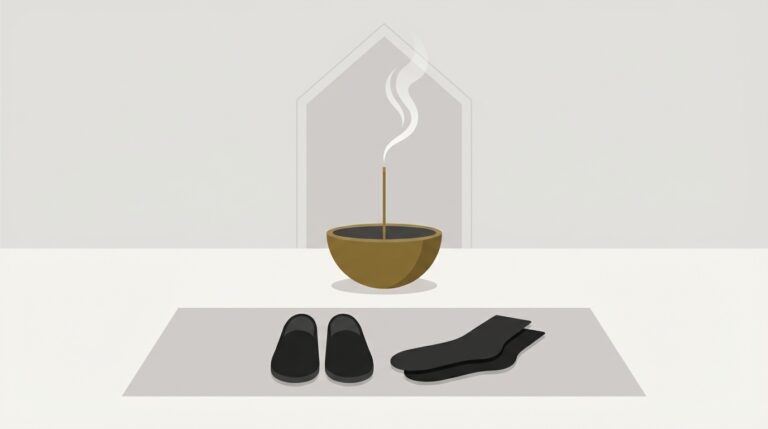
– ⚫ Black Socks: This is crucial. You have to take off your shoes. If you wear bright neon socks or have a hole in your toe, it will be very embarrassing. Always wear black socks to a funeral.
– ✉️ Envelope: Don’t worry about buying one. They are usually provided for free at the entrance of the funeral hall.
– 👔 Dress Code: Black suit is best. If not, dark colors (Navy, Dark Grey). No shorts, no slippers, no hats.📌 Editor’s Pro Tip
If you are Christian or uncomfortable with bowing to a photo (idol worship concerns), it is perfectly acceptable in Korea to stand and pray silently for a moment instead of doing the full bow. Koreans respect religious differences.
Phase 9: Think Deeper — “Why Odd Numbers?”
🧠 Think Deeper:
When you place the incense into the burner, you might see people putting in one or three sticks. Never two or four. Why?
In East Asian philosophy (Yin and Yang), odd numbers (1, 3, 5, 7, 9) represent Yang (brightness, growth, heaven). Even numbers represent Yin (darkness, earth). Even though a funeral is a sad event (Yin), we use odd numbers (Yang) to wish for the deceased’s positive journey to the afterlife and to balance the heavy energy. It’s a fascinating blend of philosophy and ritual.
💬 Your Turn: Does your culture have lucky or unlucky numbers associated with death?
Phase 10: FAQ & Troubleshooting
- Q: Can I smile at the family?
- A: No. Keep a solemn face. A faint, sad smile of comfort is okay for a close friend, but generally, a serious expression is best.
- Q: Do I really have to eat the food?
- A: It’s polite to sit and eat a little bit. It shows you are sharing the burden and keeping the family company. The food is free (paid for by the chief mourner).
- Q: How much money should I give?
- A: For acquaintances, 30,000 KRW or 50,000 KRW is standard. Note: We usually give odd numbers (3, 5) or round numbers like 10 (which is 3+7). 50,000 KRW is the safest bet for a friend/colleague.
Phase 11: Wrap-up
One-Liner Summary: Don’t blow the incense with your mouth, wear black socks, and remember that silence is often the best language of comfort.
🏆 Action Mission:
* 🥉 Bronze: Look at your sock drawer. Do you have a clean pair of black socks? If not, buy one pair today. (Just in case!)
* 🥈 Silver: Watch a scene from My Mister (Episode 1 or general clips) and observe the funeral etiquette deeply.
* 🥇 Gold: Practice the “two bows” motion on your yoga mat. Kneel, hands down, head down. Up. Repeat.
K-Culture Mission: Next time you visit a Korean temple (like Jogyesa in Seoul), try burning incense using the “shake” method you learned today!
Phase 12: Quiz — Interactive Challenge
- True or False? It is polite to blow out the incense flame to make sure it doesn’t cause a fire.
- [ ] True
- [ ] False
- Situation: You are at a funeral and you forgot your black socks. You are wearing bright pink socks with cartoon characters. What should you do?
- a) Just go in confidently. K-Pop style!
- b) Try to buy black socks at a nearby convenience store before entering.
- c) Keep your shoes on.
- Culture Check: How many times do you bow to the living family members (Sang-ju)?
- a) Two times
- b) One time
- c) Zero times (just a handshake)
🔑 Answer Key:
1. False. Never blow it out with your mouth! Shake it.
2. b) Definitely buy socks. Convenience stores in Korea sell black socks for this exact reason!
3. b) One time to the living, two times to the deceased.
Frequently Asked Questions (FAQ)
Q: What does "분향하다 (Bun-hyang-ha-da)" mean in Korean and how do you pronounce it?
A: In Korean, "분향하다 (Bun-hyang-ha-da)" is pronounced [Bun-hyang-ha-da] and means: To burn incense (Formal)
Q: What does "삼가 고인의 명복을 빕니다 (Sam-ga go-in-ui myeong-bok-eul bim-ni-da)" mean in Korean and how do you pronounce it?
A: In Korean, "삼가 고인의 명복을 빕니다 (Sam-ga go-in-ui myeong-bok-eul bim-ni-da)" is pronounced [Sam-ga] and means: "I respectfully pray for the repose of the deceased."
Q: What does "절 (Jeol)" mean in Korean and how do you pronounce it?
A: In Korean, "절 (Jeol)" is pronounced [Jeol] and means: The Big Bow (Full body bow)






