

Turn Your Dust-Gathering Books into Cash: The Korean Second-Hand Bookstore Guide 📚💸
Phase 1: Immersive Hook
Greeting: 안녕하세요! Welcome back to Daily Hangul. It’s your editor here—the one who spends way too much time sniffing old books in Jongno.
The Scene: You’ve seen it in K-Dramas. The protagonist is broke (usually before meeting the Chaebol heir), so they gather their cherished books and head to a brightly lit store with yellow and orange branding (looking at you, Aladin or Yes24). They dump a heavy bag on the counter, looking hopeful.
But wait! The staff starts inspecting the books like a forensic scientist at a crime scene. They flip pages rapidly, check for water damage, and scan barcodes. Suddenly, the staff member says something, and our protagonist looks crushed.
What did they say? Why was the book rejected? If you’re living in Korea or planning a long stay, selling used books is a great way to declutter and earn some coffee money. But to survive the “Strict Inspection,” you need more than just a smile.
Today, we are mastering the art of selling books at a Korean second-hand bookstore. Let’s get that cash!
Phase 2: Deep Dive into Core Phrases
Here are the top 3 expressions you need to survive the counter.
1. 이 책 팔 수 있나요?
- Pronunciation: [I chaek pal su innayo?] + (Sounds like: E-check pal-sue-in-nah-yo?)
- Meaning: Can I sell this book? (Literal: Is it possible to sell this book?)
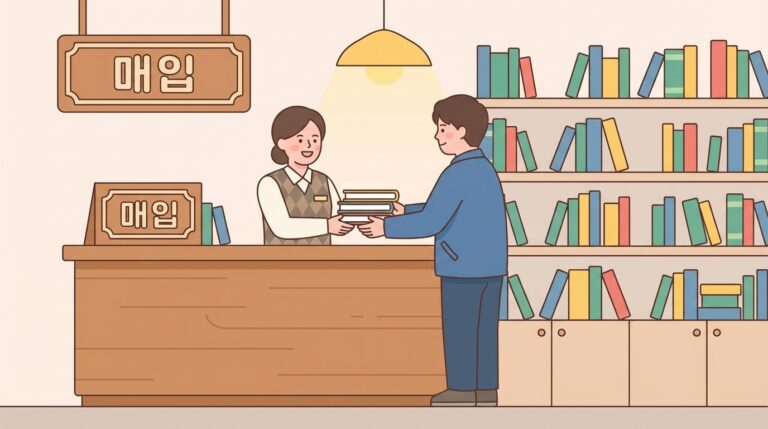
- K-Culture Moment: You walk up to the counter labeled ‘매입 (Buying)’, not ‘판매 (Selling)’. You place your books down. This is your opening line.
- Editor’s Insight: The verb 팔다 (to sell) combines with ~할 수 있나요? (Can I…?). It’s polite and direct. Note that in big franchise stores, you often take a number ticket first!
- Situation Spectrum:
[🚫 Boss] ———— [✅ Clerk/Stranger] ———— [✅ Friend]- 🤔 Think About It: In English, we might say “I’d like to sell this.” In Korean, we often ask “Is it possible to sell this?” Why do you think Korean favors asking about possibility rather than stating desire?
2. 매입 불가예요?
- Pronunciation: [Mae-ip bul-ga-yeyo?] + (Sounds like: May-ip bull-gah-yay-yo?)
- Meaning: Is it un-purchasable? / You can’t buy this?
- K-Culture Moment: The staff scans a book, the machine beeps an angry sound 🚨, and they push the book back to you. This is the phrase to use when you want to confirm the rejection.
- Editor’s Insight: This is B1 level gold! Instead of just saying “No?”, use the specific noun 매입 (Purchase by store) and 불가 (Impossibility). It makes you sound like a pro who understands the system.
- Situation Spectrum:
[🚫 Formal Presentation] ———— [✅ Store/Service] ———— [⚠️ Friend (Too stiff)]- 🤔 Think About It: 매입 (Store buying from you) vs. 구매 (You buying from store). Korean has specific words for the direction of the transaction. Are there similar distinctions in your language?
3. 적립금으로 받을게요.
- Pronunciation: [Jeong-nip-geum-euro badeul-kkeyo.] + (Sounds like: Jung-nip-gum-euro bah-dul-kay-yo.)
- Meaning: I’ll take it as loyalty points.
- K-Culture Moment: The “Cha-ching!” moment. The staff asks: “Cash or Points?” In Korea, points (Pointu/Jeokripgeum) often give you a slightly higher rate or can be used instantly for that K-Pop album you wanted.
- Editor’s Insight: 적립금 literally means “accumulated money.” This is essential survival vocabulary for any shopping in Korea, from Olive Young to bookstores.
- Situation Spectrum:
[🚫 Elders] ———— [✅ Store Clerks] ———— [🚫 Friends]
Phase 3: Textbook vs. Real Life
| Situation | 📖 Textbook Korean | 🗣️ Real Korean | 💡 Why the difference? |
|---|---|---|---|
| Opening | 책을 판매하고 싶습니다. (I want to sell books.) | 이거 매입돼요? (Does this ‘buy-in’? / Can you take this?) | “Selling” sounds active. “Buy-in” focuses on the store’s acceptance policy. |
| Reason for rejection | 책에 낙서가 있어서 안 됩니다. (It is not allowed because of scribbles.) | 밑줄이 많아서 ‘매입 불가’ 떠요. (It pops up as ‘unbuyable’ because of too many underlines.) | Staff often blame the system or the computer screen (it pops up) rather than saying they are rejecting it. |
| Getting Paid | 돈으로 주십시오. (Please give me money.) | 현금으로 주세요. (Please give it in cash.) | Specificity! “Money” is vague; “Cash” implies physical bills right now. |
Phase 4: Cultural Deep Dive — The “Clean Book” Obsession 🧐
4-1. The “Cho-S Sangeup” (Ultra S-Grade) Standard
Unlike some Western countries where a used book is loved because of its dog-ears and coffee stains, Korean second-hand bookstores (especially franchises like Aladin or Yes24) have extremely strict standards.
– Wet spots? Rejected.
– Name written on the side? Rejected.
– More than 5 pages with underlines? Rejected.
This reflects the Korean consumer psychology of “New-like Used Goods.” People want the discount, but they want the product to feel brand new. If you try to sell a book with a coffee ring on it, the staff won’t just say no; they might look at you with a “How could you?” expression. It’s not personal; it’s the K-Standard.
4-2. K-Drama Connection: The “Bookstore Romance”
In dramas like “Romance is a Bonus Book”, books are treated as sacred objects with souls. Selling a book is often portrayed as “sending it to a new owner” rather than just a transaction. So, when you hand over your books, do it with two hands! It shows respect for the object and the person handling it.
Phase 5: Immersive Roleplay 🎭
Setting: It’s a Saturday afternoon at a large used bookstore in Gangnam. It smells like paper and coffee. You have a number ticket (대기표) in your hand. Your number, 104, dings.
Characters:
– YOU: A student trying to sell old textbooks before moving.
– Staff (Jimin): Efficient, fast, wears a uniform vest.
(Dialogue Start)
Staff (Jimin): 104번 고객님, 오세요. 책 이쪽에 놔주세요.
(104-beon gogaengnim, oseyo.)
(Customer 104, come here. Please put the books here.)
YOU: 안녕하세요. 이 책들 팔 수 있나요?
(Annyeonghaseyo. I chaekdeul pal su innayo?)
(Hello. Can I sell these books?)
Staff (Jimin): (Typing rapidly) 잠시만요… 아, 이 소설책은 재고가 너무 많아서 매입이 안 돼요.
(… I soseolchaegeun jaegoga neomu manaseo mae-ibi an dwaeyo.)
(One moment… Ah, this novel has too much stock, so we can’t buy it.)
🔀 Decision Point! How do you react?
– A) “아, 정말요? 알겠습니다. 버려주세요.” (Oh really? Okay. Please throw it away.)
– B) “그럼 이건 제가 다시 가져갈게요.” (Then I will take this one back.)
– C) “왜요? 이거 새건데?” (Why? It’s new!)✅ Best Choice: B. Most polite and common. You take it back.
⚠️ Choice A: Most stores won’t throw it away for you; you usually have to take rejected items with you.
🚫 Choice C: Arguing won’t help. The computer system decides based on stock levels!
Staff (Jimin): 나머지 두 권은 ‘최상’ 등급이라 8,000원입니다. 정산 어떻게 해드릴까요?
(The other two are ‘Top Grade’, so 8,000 won. How should I settle this?)
YOU: [ Insert Phrase #3 ] 주세요.
(Give it to me as [points/cash].)
(Dialogue End)
Phase 6: 10-Second Shadowing Drill 🗣️
Listen to the rhythm! Don’t be robotic.
- (Curious & Polite) 😊
이 책 / 혹시 / 매입 되나요?
(I chaek / hoksi / mae-ip doenayo?)
(By any chance, is this book buyable?) -
(Accepting the situation) 😌
아, 그럼 / 그건 / 다시 가져갈게요.
(Ah, geureom / geugeon / dasi gajyeogalkkeyo.)
(Ah, then / that one / I’ll take it back.)
Phase 7: K-Culture Mini Glossary 📖
| Korean | Romanization | English | Context |
|---|---|---|---|
| 순번 대기표 | Sunbeon Daegipyo | Number Ticket | You MUST pull this ticket from the machine when you enter. Don’t just walk to the counter! |
| 낙서 | Nakseo | Scribble/Doodle | Any writing in the book. A major reason for rejection. |
| 변색 | Byeonsaek | Discoloration | Yellowing of pages due to sunlight/age. Lowers the grade. |
| 최상 / 상 / 중 | Choesang / Sang / Jung | Best / Good / Fair | The grading system for book condition. |
Phase 8: Traveler’s Survival Kit 🧳
Even if you aren’t selling books, visiting a Korean used bookstore is a must-do!
🆘 Survival Phrases
– 🇰🇷 “회원 아이디 있으세요?” (Do you have a member ID?)
– You will hear this 100%. If you don’t have one, say: “아니요, 없어요.” (No, I don’t.)
– 🇰🇷 “봉투 필요하세요?” (Do you need a bag?)
– Bags cost 100 won. Say: “네, 주세요.” (Yes, please.) or “아니요, 괜찮아요.” (No, it’s okay.)📌 Editor’s Pro Tip:
Most major used bookstores (Aladin, Yes24) have an App. You can scan the barcode of your book at home with the app before going to the store. It will tell you instantly if they are buying it and the estimated price! Save yourself the heavy lifting.
Phase 9: Think Deeper — “The Quick-Cycle Culture” 🧠
Why are Korean bookstores so strict about condition?
This reflects the “Pali-Pali” (Fast-Fast) and trend-sensitive culture. Books in Korea go out of print or fashion quickly. The second-hand market is efficient and resembles a stock market—if there are too many copies of a bestseller, the “Buy-in Price” drops to zero instantly. It’s not just about the book; it’s about supply, demand, and the Korean desire for “perfect” condition goods.
💬 Your Turn: In your country, do used bookstores care if a book has a coffee stain or a name written inside? Or does that add “character”? Tell me in the comments!
Phase 10: FAQ & Troubleshooting 🛠️
- Q: Can I sell English books in Korea?
- A: Yes! But usually only at larger branches in major areas (Gangnam, Jongno, Hongdae). They are very strict about the condition of foreign books too.
- Q: Do I need my ID card? (Make-or-Break Question!)
- A: YES. You absolutely cannot sell books without a form of identification (Alien Registration Card or Passport) and a Korean phone number in many cases. This is to prevent selling stolen goods.
- Q: Can I negotiate the price?
- A: No. The price is determined by an algorithm based on stock and condition. Don’t try to haggle; the part-time staff has no power to change it.
Phase 11: Wrap-up & Action Mission 🚀
One-Liner: Selling books in Korea is all about the barcode scan and the condition check—don’t take rejections personally!
Your Mission:
– 🥉 Bronze: Practice saying “매입 불가예요?” out loud three times. (Try to sound disappointed but polite!)
– 🥈 Silver: Download the ‘Aladin’ or ‘Yes24’ app and scan a Korean book (or English book) you own to see its value.
– 🥇 Gold: Visit a used bookstore, find the “Buying Counter” (매입 창구), and observe the process for 5 minutes. (Bonus points if you actually sell a book!)
Phase 12: Quiz — The “Sell or Fail” Challenge 📝
- Situation: The staff says “재고 과다로 매입이 안 됩니다.” What does this mean?
- A) The book is too dirty.
- B) They already have too many copies of this book.
- C) The system is down.
- Culture: Which item is commonly needed to finalize the sale?
- A) A recommendation letter.
- B) Your ID card (Passport/ARC).
- C) A receipt from when you bought it.
- True or False: You should write your name on the first page of your book so the bookstore knows it was yours.
- (T/F)
Answer Key:
1. B (재고 과다 = Overstock)
2. B (ID is mandatory!)
3. False (Writing your name counts as ‘Nakseo’ and might make the book un-sellable!)
Frequently Asked Questions (FAQ)
Q: What does "이 책 팔 수 있나요?" mean in Korean and how do you pronounce it?
A: In Korean, "이 책 팔 수 있나요?" is pronounced [I chaek pal su innayo?] and means: Can I sell this book? (Literal: Is it possible to sell this book?)
Q: What does "매입 불가예요?" mean in Korean and how do you pronounce it?
A: In Korean, "매입 불가예요?" is pronounced [Mae-ip bul-ga-yeyo?] and means: Is it un-purchasable? / You can't buy this?
Q: What does "적립금으로 받을게요." mean in Korean and how do you pronounce it?
A: In Korean, "적립금으로 받을게요." is pronounced [Jeong-nip-geum-euro badeul-kkeyo.] and means: I’ll take it as loyalty points.







