

Help! I’m Lost in Seoul! 🚇 How to Ask “Which Subway Line?” Like a Local
Phase 1: The “Seoul Maze” Reality Check
안녕하세요! Hello! This is your Daily Hangul Editor.
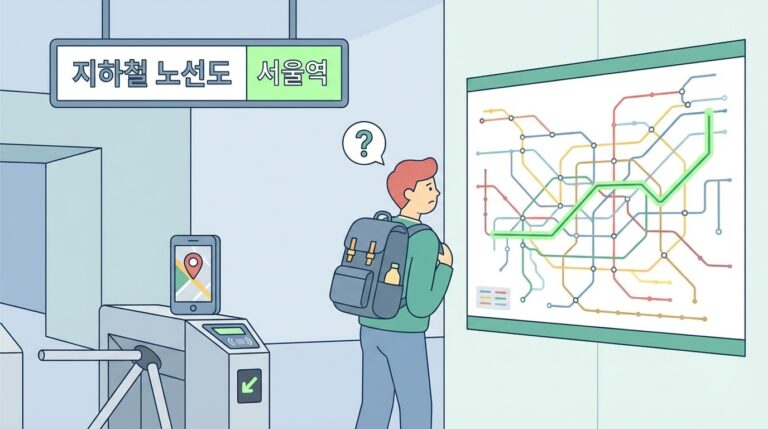
Picture this: You are in Seoul. You just finished a delicious bibimbap in Gangnam and now you need to get to Myeongdong for some shopping. You walk into the subway station and… Boom. 🤯
It looks like a spaceship. There are lines everywhere—Green, Blue, Orange, Purple. People are walking fast, like they are in a mission in a K-Drama action scene. You stare at the map, and your brain freezes.
In K-Dramas, the main characters always seem to find each other romantically on the subway. But in reality? If you take the wrong line, you might end up in a different city entirely!
Today, we are going to learn the ultimate survival phrase to save you from getting lost in the beautiful spiderweb that is the Seoul Metro. Let’s make you look like a pro commuter!
Phase 2: Deep Dive into Key Expressions
Here are the 3 phrases that will save your life (and your legs).
1. 몇 호선 타야 해요? (Myeot hoseon taya haeyo?)
- Pronunciation: [Myeot ho-seon ta-ya hae-yo?]
- Myeot sounds like “Myuh-t” (sharp ending).
- Ho-seon sounds like “Ho-sun”.
- Meaning:
- Literal: Which number line must I ride?
- Real Nuance: Which line should I take?
- K-Culture Moment: Think of a variety show like Running Man. The members are racing against time, breathing heavily, asking a random citizen, “Which line do I take to get to City Hall?!” That urgency is key.
- Editor’s Insight: Seoul subway lines are known by numbers (Line 1, Line 2) and colors. Asking for the “Line Number” (Ho-seon) is the most accurate way to navigate.
- Situation Spectrum:
[🚫 To the President] ———— [⚠️ Boss] ———— [✅ Strangers/Friends]- It is polite enough for strangers (using ‘yo’ at the end makes it safe).
- 🤔 Think About It: Why does Korean use specific counters like “Ho-seon” (Line number) instead of just “Which train?” It reflects the precise, systematic nature of Korean public infrastructure.
2. 어디서 갈아타요? (Eodiseo garatayo?)
- Pronunciation: [Eo-di-seo ga-ra-ta-yo?]
- Gara sounds like “Gotta” in “I gotta go”.
- Meaning: Where do I transfer?
- Editor’s Insight: “Gal-a-ta-da” literally means “to change and ride.” You will do this a lot in Seoul.
3. 이쪽이에요? (Ijjogieyo?)
- Pronunciation: [E-jo-gi-e-yo?]
- Ij sounds like “Eat” without the ‘t’.
- Meaning: Is it this way?
- Editor’s Insight: Use this when pointing a direction. It is the best way to confirm before you walk down 100 stairs!
Phase 3: Textbook vs. Real Life
| Situation | 📖 Textbook Korean | 🗣️ Real Life Korean | 💡 Why is it different? |
|---|---|---|---|
| Asking for a route | 몇 호선을 타야 합니까? (Myeot hoseoneul taya hamnikka?) | 몇 호선 타요? (Myeot hoseon tayo?) | “Hamnikka” is too military/formal. “Tayo” is quicker and softer. |
| Finding the station | 지하철역이 어디입니까? (Jihacheol-yeogi eodi-imnikka?) | 역 어디예요? (Yeok eodiyeyo?) | In busy streets, we drop “subway” (Jihacheol) and just say “Station” (Yeok). |
| Confirming direction | 이쪽으로 가는 것이 맞습니까? (Ijjogeuro ganeun geosi matseumnikka?) | 이쪽 맞아요? (Ijjok majayo?) | Efficiency! We prefer short questions to get quick answers. |
Bottom Note: For A1 beginners, “Myeot hoseon?” (Which line?) combined with pointing at your map app is the magic combo.
Phase 4: Cultural Deep Dive
4-1. Non-verbal: The Art of Pointing
In Western cultures, pointing with an index finger is normal. In Korea, when asking for directions, try to use an open hand to gesture toward a direction. It looks much more polite and inviting. Also, don’t block the ticket gate (turnstile) while asking! Koreans value ppalli-ppalli (hurry-hurry) culture during commute hours.
4-2. K-Culture Connection: The “Circle of Death” (Line 2)
- The Scenario: In many K-Dramas depicting office life (like Misaeng), you see protagonists crushed against the subway doors.
- The Context: That is usually Line 2 (Green Line). It is a loop line that connects major spots like Gangnam, Hongdae, and City Hall. It is notoriously crowded.
- Critical Perspective: Why is the subway so quiet even when packed? Koreans consider it rude to talk loudly on the phone or with friends in public transit. It is a collective effort to maintain peace in a crowded space.
Phase 5: Immersive Roleplay 🎬
Setting: It is Friday, 6 PM. You are at Sindorim Station (famous for being super crowded). You need to go to Hongdae to meet friends, but the signs are confusing. You stop a student passing by.
Characters:
* YOU: A tourist holding a phone with a map app.
* Student: A busy university student carrying a backpack.
Start Dialogue:
YOU: 저기요! 죄송합니다.
(Jeogiyo! Joesong-hamnida.)
(English: Excuse me! I am sorry.)
Student: (Stops and takes out one earbud) 네?
(Ne?)
(English: Yes?)
YOU: 홍대 가고 싶어요. [ 1. Which line should I take? ]
(Hongdae gago sipeoyo…)
(English: I want to go to Hongdae…)
🔀 Decision Point: How do you complete the sentence?
* Option A: 몇 호선 타야 해요? (Myeot hoseon taya haeyo?)
* Option B: 몇 호선이야? (Myeot hoseoniya?)
* Option C: 이거 타요? (Igeo tayo? – Pointing at a random train)✅ Best Choice: Option A. It is polite and clear.
⚠️ Analysis of B: This is Banmal (casual language). Unless the student is a child (and you are an adult), this is rude to a stranger!
Student: 아, 홍대요? 2호선 타세요. 초록색이에요.
(Ah, Hongdae-yo? I-ho-seon taseyo. Chorok-saek-ieyo.)
(English: Ah, Hongdae? Take Line 2. It’s the green color.)
YOU: 감사합니다! [ 2. Is it this way? ]
Student: 네, 맞아요. 오른쪽으로 가세요.
(Ne, majayo. Oreunjjogeuro gaseyo.)
(English: Yes, correct. Go to the right.)
Phase 6: 10-Second Shadowing Drill 🗣️
Listen to the rhythm and repeat. Pay attention to the rising intonation at the end!
- 😰 (Confused/Urgent): 홍대… / 몇 호선 / 타야 해요?
- (Hongdae… / myeot hoseon / taya haeyo?)
- 🤔 (Checking): 이거 / 2호선 / 맞아요?
- (Igeo / i-ho-seon / majayo?)
- 😊 (Relieved): 아! / 감사합니다!
- (Ah! / Kamsa-hamnida!)
Phase 7: K-Culture Mini Glossary
| Korean | Romanization | English | Context |
|---|---|---|---|
| 지옥철 | Ji-ok-cheol | Hell Train | Slang for extremely crowded subways during rush hour. (Jiok = Hell + Jihacheol = Subway). |
| 막차 | Mak-cha | Last Train | Very important word! “When is the makcha?” Cab fees are expensive, so catch the makcha! |
| 환승 | Hwan-seung | Transfer | You will hear this announcement constantly: “Hwan-seung imnida.” |
Phase 8: Traveler’s Survival Kit 🧳
The “I’m Lost” Emergency Card
🆘 Survival Expression #1
* 🇰🇷 “여기 어디예요?” (Yeogi eodiyeyo?)
* 🗣️ Pronunciation: [Yuh-gi uh-di-yeh-yo?]
* 📍 Meaning: Where is this place? (Use when you wake up from a nap and don’t know the station!)📌 Editor’s Travel Note
* Apps are King: Don’t rely on paper maps. Download Naver Map or KakaoMetro. They tell you exactly which car door (e.g., 5-3) is closest to the escalator!
* T-Money Card: You need this reloadable card. You can buy it at any convenience store (CU, GS25, 7-Eleven).
Phase 9: Think Deeper — “Silence is Golden?”
Topic: Media vs. Reality
In K-Dramas, you often see characters having deep, emotional conversations or even arguments on the subway. In reality, the Seoul subway is surprisingly quiet. People are glued to their smartphones, watching YouTube or webtoons.
🧠 Think Deeper:
Why is public silence so valued in Korea? It is related to the concept of “Nam-ege pihae-reul juji malja” (Let’s not cause harm/inconvenience to others). Being loud is considered selfish.
💬 Your Turn: Is it okay to talk on the phone in public transport in your country? Let me know in the comments!
Phase 10: FAQ & Troubleshooting
Q: Can I ask an older person for directions?
A: Yes! But be very polite. Bow slightly and use “Sil-lye-ham-nida” (Excuse me) first. Older Koreans are often very helpful to foreigners.
Q: What if I don’t know the station name in Korean?
A: Just show your phone screen! Point to the station on the map and say “Yeogi” (Here) + “Gago sipeoyo” (I want to go).
❌ Common Mistake #1: Sitting in the seats at the very ends of the carriage.
✅ Fix: Those are Priority Seats (No-yak-ja-seok) for the elderly, disabled, and pregnant. Even if the train is full, young people usually leave them empty out of respect.
Phase 11: Wrap-up & Action Mission
Summary: Today we learned how to ask “Myeot hoseon taya haeyo?” (Which line?) and “Ijjok majayo?” (Is this right?).
🚀 Action Missions:
* 🥉 Bronze: Say “Myeot hoseon taya haeyo?” 3 times while looking at a subway map.
* 🥈 Silver: Download a Korean subway app and plan a route from “Gangnam” to “Gyeongbokgung”. Check the line number!
* 🥇 Gold: Next time you watch a K-Drama scene in a subway, try to spot if it is the Green Line (Line 2)!
Phase 12: Quiz — Interactive Challenge
1. Situation Judgment:
You are rushing to catch the train. A stranger blocks your way. What is the best thing to say/do?
* A) Yell “Move!” in English.
* B) Gently say “Jamsimanyo” (Just a moment/Excuse me) and pass.
* C) Push them silently.
2. True or False?
It is okay to sit in the Pink Seats if you are a healthy young man.
* (True / False)
Answers:
1. B. “Jamsimanyo” is the magic word for passing through crowds.
2. False. Pink seats are specifically for pregnant women. Even if empty, it’s culturally better to stand.
Frequently Asked Questions (FAQ)
Q: What does "몇 호선 타야 해요? (Myeot hoseon taya haeyo?)" mean in Korean and how do you pronounce it?
A: In Korean, "몇 호선 타야 해요? (Myeot hoseon taya haeyo?)" is pronounced [Myeot ho-seon ta-ya hae-yo?] and means: a key conversational Korean expression covered in this lesson.
Q: What does "어디서 갈아타요? (Eodiseo garatayo?)" mean in Korean and how do you pronounce it?
A: In Korean, "어디서 갈아타요? (Eodiseo garatayo?)" is pronounced [Eo-di-seo ga-ra-ta-yo?] and means: a key conversational Korean expression covered in this lesson.
Q: What does "이쪽이에요? (Ijjogieyo?)" mean in Korean and how do you pronounce it?
A: In Korean, "이쪽이에요? (Ijjogieyo?)" is pronounced [E-jo-gi-e-yo?] and means: a key conversational Korean expression covered in this lesson.







