

Phase 1: The Ringtone Panic — Are You Ready? 📞
Hello! It’s your Daily Hangul Editor.
Picture this: You are in a crowded Seoul subway. Suddenly, your phone rings. It’s not your mom, it’s not a spam call… it’s your Korean language tutor (or maybe that Korean friend you promised to do a language exchange with).
In K-Dramas, the protagonist often stares at the vibrating phone, takes a deep breath, and answers with a trembling voice. Why? Because talking on the phone removes all visual cues. You can’t see their gestures, you can’t read their lips, and the connection might be static-filled.
In Korea, “Phone English” (전화 영어) is a massive industry where busy office workers spend 10 minutes every morning battling with a tutor to improve their specs. Today, we flip the script. You are the student, and we are going to master the Art of the Korean Phone Call. No more panic buttons. Let’s pick up that phone with confidence.
Phase 2: Deep Dive — 3 Key Expressions 🎯
1. 여보세요? vs. 네, [Name]입니다.
- Pronunciation: [Yeoboseyo?] vs. [Ne, [Name]-imnida]
- Sound Guide: Yeo-bo-say-yo (Like saying “Yo, boy!” but softer) / Ne (Short ‘e’ like ‘net’)
- Meaning: Hello? (Standard) vs. Yes, this is [Name]. (Formal/Polite)
- K-Culture Moment: In thrillers like Signal, the detective picks up the walkie-talkie and yells “Yeoboseyo?!” urgently. But in office dramas like Misaeng, employees answer desk phones with “Ne, Marketing Team, Jang Geu-rae imnida.”
- Editor’s Insight: “Yeoboseyo” is fine if you don’t know who is calling. But if you have a scheduled lesson or a call from a superior, answering with “Ne, [Your Name] imnida” sounds much more professional and prepared.
- Situation Spectrum:
[🚫 Formal Biz] ———— [⚠️ Unknown Number] ———— [✅ Friends/Casual]
(Use ‘Yeoboseyo’ for unknown numbers/friends. Use ‘Ne, ~imnida’ for appointments.)- 🤔 Think About It: Why does identifying yourself immediately imply politeness in Korea, whereas “Hello” is neutral in English? It saves the caller the time of asking “Is this…?”
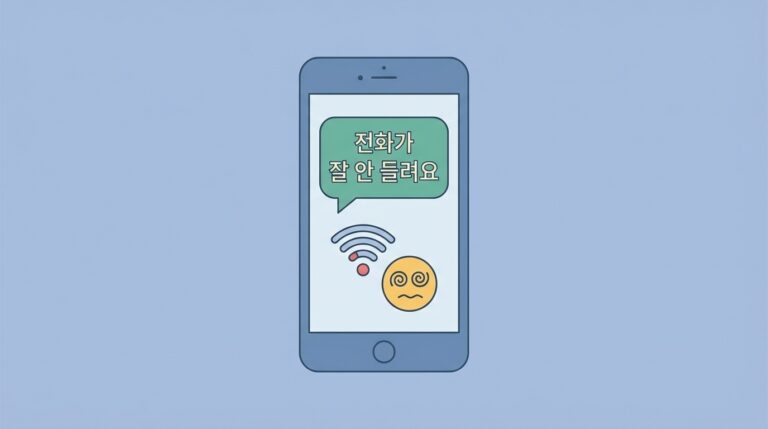
2. 잘 안 들려요.
- Pronunciation: [Jal an deullyeoyo]
- Sound Guide: Jal (rhymes with Hal) an (like ‘un’ in undo) dul-lyuh-yo
- Meaning: I can’t hear you well.
- K-Culture Moment: You’re on a video call with your favorite idol during a virtual fan sign event, and the Wi-Fi lags! You frantically wave your hand and say this.
- Editor’s Insight: Don’t just say “What?” (mwo?). That’s rude. This phrase puts the blame on the connection, not the speaker. It preserves the other person’s face (Chaemyeon).
- Situation Spectrum:
[🚫 Never] ———— [⚠️ Care] ———— [✅ Universal]
(Safe to use with almost anyone when tech fails.)- 🤔 Think About It: By saying “It isn’t heard well” (passive) rather than “I can’t hear you,” you are being indirect. How does this reflect Korean indirect communication styles?
3. 지금 통화 괜찮으세요?
- Pronunciation: [Jigeum tonghwa gwaenchaneuseyo?]
- Sound Guide: Ji-geum (like G-gum) tong-hwa (Tongue-hwa) gwen-cha-neu-say-yo
- Meaning: Is it okay to talk right now?
- K-Culture Moment: The male lead calls the female lead late at night. Before confessing his love, he politely asks this. (Unless he’s drunk, then he just rambles!)
- Editor’s Insight: This is the peak of Phone Etiquette. Even if you have a scheduled call, asking this shows you respect their time and current situation (Are they on the bus? In a meeting?).
- Situation Spectrum:
[🚫 Close Friends] ———— [⚠️ Seniors] ———— [✅ Everyone]
(Always good to ask, except maybe with your bestie who you call 10 times a day.)- 🤔 Think About It: Korean culture values “Nunchi” (reading the room). Why is asking for permission to speak essential in a high-context society?
Phase 3: Textbook vs. Real Life 🥊
| Situation | 📖 Textbook Korean | 🗣️ Real Korean | 💡 Why the difference? |
|---|---|---|---|
| Answering | 전화를 받습니다. (I receive the phone.) | “어, 왜?” (Oh, why/what’s up?) | Efficiency between friends. “Why did you call?” cuts to the chase. |
| Hanging up | 끊겠습니다. (I will hang up.) | “들어가세요~” (Please go in/back.) | “Go back to what you were doing.” It’s a caring way to end a call. |
| Bad connection | 다시 말씀해 주세요. (Please say it again.) | “여보세요? 여보세요??” (Hello? Hello??) | In panic, grammar disappears. Repetition signals the connection is lost. |
Bottom Note: If you are speaking to your tutor, stick to the Textbook or polite versions. Use “어, 왜?” only if you want to shock your close Korean friends!
Phase 4: Cultural Deep Dive — The “Bali Bali” Connection 🇰🇷
4-1. Non-verbal: The Subway Whisper
In Korea, talking loudly on the phone in public transport (subway/bus) is a major social faux pas. You will get the “laser eyes” from Ajummas.
* The Move: If you get a call on the subway, cover your mouth with your hand, whisper “지금 지하철이라서요” (I’m on the subway right now), and hang up quickly. Text them instead.
4-2. Why “Phone English”?
Why is the unit topic “Phone English”? Korea has a “Bali Bali” (Hurry Hurry) culture. Office workers want to learn English but have no time. So, 10-minute phone lessons at 6:00 AM or during lunch breaks became a cultural phenomenon.
* Connection: Just like they squeeze in English learning, you can squeeze in Korean practice. But remember, because time is money, clarity and politeness on the phone are highly valued.
Phase 5: Immersive Roleplay — The Surprise Call 🎬
Setting: It’s Tuesday, 12:30 PM. You are at a noisy cafe in Hongdae having a latte. Your phone rings. It’s Minji, your language exchange partner who usually texts, but today she is calling.
Characters:
* YOU: A dedicated Korean learner, slightly nervous about phone calls.
* Minji: Enthusiastic, talks a bit fast.
(Phone Vibrate Sound: Zzzzt! Zzzzt!)
Minji: (Over the phone) 여보세요? [Your Name] 씨! 점심 드셨어요?
(Yeoboseyo? [Name]-ssi! Jeomsim deusyeosseoyo?)
(Hello? Did you eat lunch?)
YOU: 네, 먹었어요. 민지 씨는요?
(Ne, meogeosseoyo. Minji-ssi neun-yo?)
(Yes, I ate. How about you, Minji?)
Minji: 저도요! 아, 다름이 아니라, 우리 이번 주 약속 시간 좀 바꿀 수 있을까요? 제가 갑자기 야근을 해야 해서요.
(Jeo-do-yo! Ah, dareumi anira, uri ibeon ju yaksok sigan jom bakkul su isseulkkayo? Jaega gapjagi yageun-eul haeya haeseoyo.)
(Me too! Ah, the reason I’m calling is, can we change our meeting time this week? I suddenly have to do overtime work.)
🎭 Stage Direction: The cafe blender starts making a loud noise. WHIRRRRR!
🔀 Decision Point: You couldn’t hear the last part.
A) “네? 싫어요.” (What? No.)
B) “죄송한데, 잘 안 들려요. 다시 말씀해 주시겠어요?” (Sorry, I can’t hear well. Can you say it again?)
C) Just pretend to understand: “네, 알겠습니다!” (Yes, okay!)
✅ Best Choice: B. In a phone call, honesty is key. If you choose C, you might agree to meet at 3 AM! Option A is grammatically correct but culturally too blunt for a B1 level polite interaction.
Phase 6: 10-Second Shadowing Drill 🗣️
Mimic the emotion. Don’t be a robot!
- 😟 Apologetic & Polite:
지금은 / 통화가 / 좀 어려워요.
(Jigeum-eun / tonghwa-ga / jom eoryeowoyo.)
(It’s a bit difficult to talk right now.) -
📶 Frustrated (Bad Signal):
여보세요? / 제 목소리 / 들리세요?
(Yeoboseyo? / Je moksori / deulliseyo?)
(Hello? Can you hear my voice?)
Phase 7: K-Culture Mini Glossary 📒
| Korean | Romanization | Meaning | Context |
|---|---|---|---|
| 보이스톡 | Voice Talk | KakaoTalk Call | Most Koreans use KakaoTalk’s “Voice Talk” instead of regular calls to save data/minutes. |
| 데이터 | De-i-teo | Mobile Data | “데이터가 없어서…” (I have no data…) is a common excuse to hang up. |
| 끊다 | Kkeun-ta | To hang up | Literally means “to cut.” Used for ending calls. |
| 부재중 | Bujaejung | Missed Call | You will see this on your screen: “부재중 전화 1통”. |
Phase 8: Traveler’s Survival Kit — Connectivity 🛜
Even if you aren’t taking a class, you need your phone to survive in Korea.
🆘 Survival Phrase #1: Wi-Fi
– 🇰🇷 “여기 와이파이 비밀번호 뭐예요?” (Yeogi wa-i-pa-i bimil-beonho mwo-yeyo?)
– 📍 Where: Cafes, Restaurants, Hotels.
– 💡 Pro Tip: Look for the receipt! The Wi-Fi password is almost always printed at the bottom of the receipt in Korean cafes.📌 Editor’s Tech Note
– SIM Cards: Pick up a prepaid SIM (usim) at Incheon Airport. You need a Korean number to use delivery apps or reserve some smart queues!
– KakaoTalk: You cannot survive without this app. It’s not just for chatting; it’s for maps, payments, and gifts.
Phase 9: Think Deeper — The “Spec” Society 🧠
Language & Social Pressure:
Why is the “Phone English” market so huge in Korea? It reflects the intense pressure of “Spec” (Specifications) culture. Koreans feel the need to constantly upgrade their skills (English, certifications) to remain competitive in the job market or social hierarchy. When you learn Korean, are you doing it for “Spec” or for “Connection”?
💬 Your Turn: In your country, do adults take phone lessons before work? Or is language learning considered a hobby rather than a survival skill?
Phase 10: FAQ & Troubleshooting 🛠️
Q: Can I video call (FaceTime) my Korean teacher/friend first?
A: ⚠️ Be Careful. Video calls (영상 통화) are considered very intimate in Korea. Unless you are very close family or dating, stick to voice calls or text first. A sudden video call can be burdensome (부담스러워요).
Q: How do I end a call with a superior/teacher?
A: Don’t just say “Bye.” Say “들어가세요” (Please go in) or “수고하셨습니다” (You worked hard / Thank you for your effort). Wait for them to hang up first!
❌ Common Mistake: Saying “Hello” (Annyeonghaseyo) when answering the phone.
✅ Fix: “Annyeonghaseyo” is okay, but “Yeoboseyo” is the standard phone greeting. “Annyeonghaseyo” sounds like you just walked into a room.
Phase 11: Wrap-up & Action Mission 🚀
Summary: Today we learned that phone etiquette in Korea is about identifying yourself, respecting timing, and handling tech fails gracefully.
🔥 Action Mission:
* 🥉 Bronze: Practice saying “여보세요? 잘 안 들려요” while holding your phone to your ear in front of a mirror.
* 🥈 Silver: Change your phone’s language setting to Korean for 1 hour. Try to find the “Call” (통화) button.
* 🥇 Gold: Call a Korean restaurant and ask: “오늘 영업 하세요?” (Are you open today?) — even if you don’t go!
K-Culture Mission: Watch a scene from the drama Misaeng (Incomplete Life). Observe how the new interns answer the phones versus how the managers do it. Spot the difference!
Phase 12: Quiz — Do You Have “Nunchi”? 🧩
1. Situation: You are on a quiet bus. Your phone rings loudly. What do you do?
* A) Answer loudly: “YEOBOSEYO?!”
* B) Ignore it until it stops.
* C) Answer quickly, whisper “I’m on the bus,” and hang up.
2. True or False:
* Koreans prefer video calls over voice calls for business meetings. (T/F)
3. Fill in the blank:
* “Wait, the connection is bad.
________ 안 들려요.”
(Answers: 1. C, 2. False (Voice or Text is preferred), 3. 잘 (Jal))
Frequently Asked Questions (FAQ)
Q: What does "여보세요? vs. 네, [Name]입니다." mean in Korean and how do you pronounce it?
A: In Korean, "여보세요? vs. 네, [Name]입니다." is pronounced [Yeoboseyo?] and means: Hello? (Standard) vs. Yes, this is [Name]. (Formal/Polite)
Q: What does "잘 안 들려요." mean in Korean and how do you pronounce it?
A: In Korean, "잘 안 들려요." is pronounced [Jal an deullyeoyo] and means: I can't hear you well.
Q: What does "지금 통화 괜찮으세요?" mean in Korean and how do you pronounce it?
A: In Korean, "지금 통화 괜찮으세요?" is pronounced [Jigeum tonghwa gwaenchaneuseyo?] and means: Is it okay to talk right now?







