

Unit: Operating Cooling Centers for Vulnerable Groups (C2 Advanced Level)
Phase 1: The Immersive Hook
안녕하세요! Daily Hangul’s Senior Editor here.
Imagine this: It’s mid-August in Seoul. The humidity is at 90%, and the asphalt seems to be melting under your feet. The sound of cicadas is deafening—a relentless mem-mem-mem that amplifies the heat. Suddenly, every smartphone in the subway car starts screeching in unison with a piercing alarm tone.
Beeeeeep! Beeeeeep! 🚨
Is it an air raid? No. It’s a Safety Guidance Text (재난 안전 문자) warning you of a heatwave advisory.
In K-Dramas, you might see the protagonist fainting dramatically in the heat, only to be caught by a handsome lead. But in reality, for the elderly collecting cardboard boxes or living in semi-basement banjiha (like in the movie Parasite) or rooftop oktapbang apartments, this heat is a life-threatening disaster.
Today, we aren’t just learning to say “It’s hot.” We are diving into the sophisticated vocabulary of social welfare and disaster management. We will explore how Korean society mobilizes ‘Jeong’ (affection/bond) through administrative systems to protect its most vulnerable during the sweltering summer. This is advanced Korean for those who want to understand the society, not just the language.
Phase 2: Deep Dive into Core Expressions
1. 무더위 쉼터 (Mudeowi Shimteo)
- Pronunciation: [Mudeowi Shimteo] Sounds like ‘Moo-doh-wee Shim-tuh’
- Meaning:
- Literal: Steaming Heat Shelter
- Real Nuance: Designated Cooling Center. Unlike a generic “shelter,” this specifically refers to public spaces (community centers, banks, senior halls) officially designated by the government for people to escape the heat.
- K-Culture Moment: You know those scenes in dramas where neighborhood elders gather in a community hall with fans whirring, eating watermelon? That is effectively a Mudeowi Shimteo in action.
- Editor’s Insight: The word 무더위 differs from simple 더위. The prefix 무- (related to 물/water or meaning ‘steaming’) implies a wet, oppressive, sauna-like heat. Using this word shows you understand the texture of Korean summer.
- Situation Spectrum:
[🚫 Casual Slang] ———— [✅ News/Formal] ———— [✅ Community Info] - 🤔 Think About It: Why does the Korean government designate banks as shelters? What does this imply about the relationship between private corporations and public social responsibility in Korea?
2. 폭염 취약 계층 (Pogyeom Chwiyak Gyecheung)
- Pronunciation: [Pogyeom Chwiyak Gyecheung]
- Meaning:
- Literal: Heatwave Vulnerable Class/Stratum
- Real Nuance: Vulnerable social groups during heatwaves (e.g., the elderly living alone, outdoor laborers, the homeless).
- K-Culture Moment: News reports often feature social workers delivering blocks of ice or electric fans to small rooms in Jjokbangchon (shanty towns) while using this term.
- Editor’s Insight: This is a high-level academic and administrative term. 폭염 (Explosive Heat) is the formal term for heatwave. 취약 (Fragile/Weak) and 계층 (Social Stratum) are essential vocabulary for discussing social issues or reading news articles.
- Situation Spectrum:
[🚫 Friends] ———— [⚠️ Colleagues] ———— [✅ Reports/News]
3. 안부 확인 (Anbu Hwagin)
- Pronunciation: [Anbu Hwagin]
- Meaning:
- Literal: Confirming peace/safety
- Real Nuance: Checking in on someone’s well-being. In a disaster context, it means monitoring the safety of isolated individuals.
- K-Culture Moment: In the drama Reply 1988, neighbors constantly share food and check on each other. That is the essence of Anbu. In modern administrative terms, it’s when public officers visit the elderly during a heatwave.
- Editor’s Insight: Anbu is the heart of Korean etiquette. You don’t just ask “How are you?”; you ask about their Anbu. It implies a deeper concern for their survival and state of being.
Phase 3: Textbook vs. Real Life
| Situation | 📖 Textbook Korean | 🗣️ Real Korean (Advanced) | 💡 Why the difference? |
|---|---|---|---|
| Describing the heat | 날씨가 너무 더워요. (The weather is too hot.) |
가마솥더위가 기승을 부리네요. (The cauldron-like heat is raging.) |
Koreans use metaphors involving cooking (steaming, boiling) to express the intensity of the humidity. |
| Suggesting a break | 시원한 곳에서 쉬세요. (Rest in a cool place.) |
온열 질환 조심하시고 수분 섭취하세요. (Beware of heat illness and hydrate.) |
In a safety context, medical precision (‘heat illness’ vs ‘sick’) shows professionalism and urgency. |
| Checking on elders | 할머니, 괜찮으세요? (Grandma, are you okay?) |
어르신, 건강 우려되어 방문했습니다. (Elder, I visited out of concern for your health.) |
Using honorific nouns like ‘어르신’ (Elder) and ‘우려’ (Concern) establishes respect and official purpose. |
💡 Bottom Note: At the C2 level, simply communicating facts isn’t enough. You must communicate status and intent. Using Sino-Korean words (Hanja) like 수분 섭취 (hydration intake) instead of 물 마시기 (drinking water) elevates the tone to a professional advisory level.
Phase 4: Cultural Deep Dive — The “Nanny State” of Care?
4-1. Non-verbal: The Art of the “Cooling Fog”
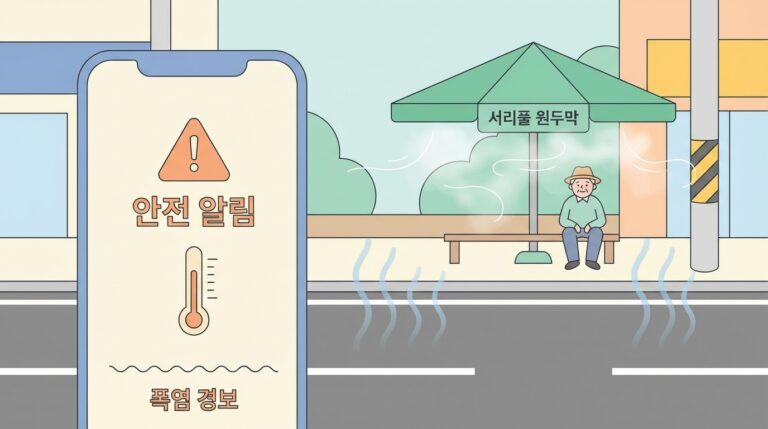
In major tourist areas or waiting lines (like at bus stops), you will see mist spraying from the ceiling or large parasols titled ‘Seo-ri-pul’ shelters (green giant umbrellas).
* The Vibe: It is perfectly acceptable to stand under these umbrellas with strangers. No personal space invasion is felt here; it is a shared survival zone. Do not feel awkward crowding under the shade.
4-2. K-Culture Connection: The “Yakult Lady” Network
K-Drama Context: You’ve seen the ladies in beige uniforms riding electric carts selling yogurt? They are often the unsung heroes of the Anbu system.
* Reality: Many local districts officially partner with these delivery workers. Since they visit neighborhoods daily, they are the first to notice if an elderly person hasn’t picked up their milk or yogurt—a sign they might have collapsed from the heat. This blends commerce with community safety net.
* Critical View: This reliance on informal networks highlights both the strength of Korean community bonds and the gaps in the formal welfare system.
Phase 5: Immersive Roleplay Scenario
Setting: A scorching Tuesday afternoon (2:00 PM). You are volunteering with a local community center in a neighborhood with many elderly residents. You are visiting an elderly gentleman (Kim Cheol-su, 78) living in a rooftop room without AC.
Characters:
* YOU: A foreign volunteer assisting social workers.
* Mr. Kim: A stubborn but kind elderly resident who insists he is “fine.”
Dialogue:
YOU: (Knocking gently but firmly)
어르신, 계십니까? 주민센터에서 나왔습니다.
(Eoreusin, gyesimnikka? Jumin-senteo-eseo nawasseumnida.)
“Sir, are you there? We are from the community center.”
Mr. Kim: (Opening the door, sweating profusely)
아이고, 이 더운 데 뭐 하러 왔어. 난 괜찮아.
(Aigo, i deoun de mwo ha-reo wasseo. Nan gwaenchana.)
“Oh my, why did you come in this heat? I’m fine.”
🔀 Decision Point: He is clearly not fine. How do you persuade him to go to the Cooling Center?
Option A: “여기 너무 더워요. 가셔야 해요.” (It’s too hot here. You must go.)
Option B: “센터에 시원한 수박 화채 준비해 뒀어요. 잠시 마실 나오세요.” (We prepared cold watermelon punch at the center. Please come out for a casual outing.)
Option C: “정부 지침이라서 가셔야 합니다.” (It is government policy, so you must go.)✅ Best Choice: Option B.
Why? In high-context Korean culture, saving face (Chemyon) is crucial. Telling him his house is “too hot” (Option A) might shame him for his poverty. Citing “policy” (Option C) feels cold. Inviting him for food/refreshment (Option B) allows him to leave his hot room under the guise of a social visit, preserving his dignity while ensuring his safety.
YOU: (Smiling warmly)
어르신, 센터에 에어컨도 빵빵하고 시원한 수박 썰어놨거든요. 저랑 같이 가서 땀 좀 식히시죠.
(Eoreusin, senteo-e e-eo-keon-do ppang-ppang-hago siwonhan subak sseoreonat-geodeunyo. Jeorang gachi gaseo ttam jom sikhisijyo.)
“Sir, the AC is blasting at the center and we sliced some cold watermelon. Let’s go cool off together.”
Mr. Kim: (Smiling)
그래? 수박이 있다면야… 못 이기는 척 가볼까?
(Geurae? Subagi itdamyeon-ya… mot igineun cheok gabolkka?)
“Really? Well, if there’s watermelon… maybe I’ll pretend to lose to your persuasion and go?”
Phase 6: 10-Second Shadowing Drill
Let’s practice a phrase commonly heard in safety announcements. Focus on the authoritative yet caring tone.
폭염 특보 발효 시, / 야외 활동을 자제하고 / 무더위 쉼터를 이용해 주세요.
(Pogyeom teukbo balhyo si, / ya-oe hwal-dong-eul jajehago / mudeowi shimteo-reul iyong-hae juseyo.)Meaning: When a heatwave warning is in effect, please refrain from outdoor activities and use cooling centers.
Emotion: 📢 Professional & Urgent (Clear enunciation)
Guide: Pause after ‘si’ and ‘jajehago’. Stress ‘Pogyeom’ (Heatwave) and ‘Jaje’ (Refrain).
Phase 7: K-Culture Mini Glossary
| Korean | Romanization | Meaning | Context |
|---|---|---|---|
| 쪽방촌 | Jjokbangchon | Slice-room Village | Neighborhoods with extremely small, partitioned rooms. High priority for heatwave support. |
| 독거노인 | Dokgeonoin | Elderly living alone | The primary demographic for Anbu checks. |
| 이열치열 | Iyeolchiyeol | Fight heat with heat | The cultural belief of eating hot food (like Samgyetang) during summer to sweat and cool down. |
| 손선풍기 | Son-seonpunggi | Hand-held fan | Essential survival item (often called ‘Son-punggi’). |
| 쿨토시 | Kul-tosi | Cooling arm sleeves | Essential fashion for hikers and outdoor workers to prevent sunburn and heat. |
Phase 8: Traveler’s Survival Kit (Disaster Edition)
Even if you aren’t a “vulnerable group,” knowing how to find shelter is key when touring Seoul in August.
🆘 Survival Expression #1
– 🇰🇷 “근처에 무더위 쉼터가 어디 있나요?” (Geuncheo-e mudeowi shimteo-ga eodi innayo?)
– Meaning: Where is the nearest cooling center?
– 📍 Use here: Walking on the street, asking a police officer or shop owner.
– 💡 Pro Tip: If they look confused, just ask for a “Bank” (Eun-haeng) or “Department Store.” They are unofficial cooling centers.📌 Editor’s Tech Note
– Apps: In Naver Map or Kakao Map, search for무더위쉼터. The map will show nearby community centers or banks designated as shelters.
– Alerts: Don’t be scared by the loud emergency alerts on your phone. If you see ‘폭염’ (Heatwave), just drink water and stay inside.
Phase 9: Think Deeper — “Alert Fatigue”
The Paradox of Safety:
Korea is often called a hyper-connected society. During summer, residents receive near-daily emergency text alerts regarding the heat.
Think About It:
While this system (Cell Broadcast Service) saves lives by constantly reminding citizens of danger, it also creates “Alert Fatigue.” Many Koreans now instinctively ignore the loud sirens from their phones.
* How does your country handle disaster alerts?
* Is it better to be over-warned and annoyed, or under-warned and independent?
* Does the state have the right to interrupt your day to tell you to drink water?
💬 Your Turn: In your culture, would people appreciate these daily safety texts, or consider it an invasion of privacy?
Phase 10: FAQ & Troubleshooting
Q: Can a tourist actually enter a ‘Community Center’ (Jumin Center) to rest?
A: Yes! If it is designated as a Mudeowi Shimteo, it is open to the public. However, remember Nunchi. Don’t lie down on the floor or make loud noises. Just sit, drink water, and cool down.
Q: Is it rude to wear sunglasses/masks when talking to elders?
A: In a heatwave, safety comes first. However, if you are strictly following etiquette (like in our roleplay), briefly taking off your sunglasses when greeting an elder shows respect. It says, “I am engaging with you fully.”
❌ Common Mistake #1: Assuming everyone has AC.
Reality: Electricity bills are expensive in Korea (progressive tax system). Many elderly people have AC but don’t turn it on to save money. Suggesting “Just turn on the AC” can be insensitive.
Phase 11: Wrap-up & Action Mission
One-Liner:
Korean disaster safety is built on a mix of high-tech alerts and the old-school human touch of Jeong.
🚀 Action Missions:
– 🥉 Bronze: Open Naver Map and type 무더위쉼터. See how many are around your (virtual or real) location.
– 🥈 Silver: Watch a Korean news clip on YouTube searching for “폭염 취약 계층” and try to catch the words Anbu or Jjokbangchon.
– 🥇 Gold: If you are in Korea, visit a bank during the hottest part of the day (2 PM) just to cool down. Observe if others are doing the same. That’s the Shimteo culture!
K-Culture Mission:
In the movie Parasite, look closely at the semi-basement apartment scenes. Imagine that space during a heatwave. How would the vocabulary we learned today (Jjokbangchon, Pogyeom) apply to the Kim family?
Phase 12: Interactive Quiz
1. Situational Judgment:
You receive a text: [행정안전부] 폭염경보 발효. 야외활동 자제. What should you do?
– A) Go hiking to fight fire with fire (Iyeolchiyeol).
– B) Cancel your picnic and find an indoor café or shelter.
– C) Ignore it, it’s just spam.
2. Nuance Check:
Which phrase is most appropriate for a news anchor reporting on the heatwave affecting the elderly?
– A) 날씨가 쪄 죽겠네요. (The weather is hot enough to kill.)
– B) 폭염 취약 계층의 건강이 우려됩니다. (There is concern for the health of the heat-vulnerable class.)
– C) 할머니들 시원한 데 가세요. (Grandmas, go somewhere cool.)
Answers:
1. (B) ‘Jaje’ means to refrain/hold back. ‘Gyeongbo’ is a serious warning.
2. (B) News requires formal, objective, and respectful terminology like ‘Uryeo’ (concern) and ‘Gyecheung’ (class).
Frequently Asked Questions (FAQ)
Q: What does "무더위 쉼터 (Mudeowi Shimteo)" mean in Korean and how do you pronounce it?
A: In Korean, "무더위 쉼터 (Mudeowi Shimteo)" is pronounced [Mudeowi Shimteo] and means: Literal: Steaming Heat Shelter
Q: What does "폭염 취약 계층 (Pogyeom Chwiyak Gyecheung)" mean in Korean and how do you pronounce it?
A: In Korean, "폭염 취약 계층 (Pogyeom Chwiyak Gyecheung)" is pronounced [Pogyeom Chwiyak Gyecheung] and means: Literal: Heatwave Vulnerable Class/Stratum
Q: What does "안부 확인 (Anbu Hwagin)" mean in Korean and how do you pronounce it?
A: In Korean, "안부 확인 (Anbu Hwagin)" is pronounced [Anbu Hwagin] and means: Literal: Confirming peace/safety







