

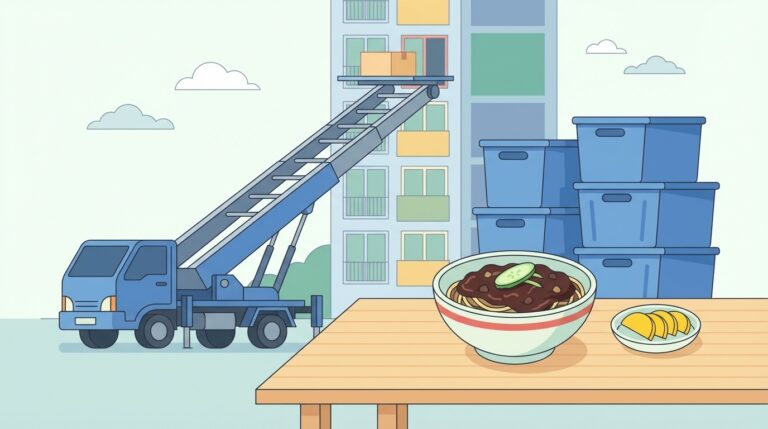
Phase 1: The Immersive Hook 📦
“Please tell me you ordered the Jjajangmyeon!”
Hello, Daily Hangul family! It’s your editor here.
Imagine this scene: You’ve just signed your housing contract (congrats!). Now, you’re standing in your new, empty apartment in Seoul. In every K-Drama involving a move, there is always one specific scene. The protagonist is sitting on the floor, surrounded by boxes, mixing a bowl of black bean noodles (Jjajangmyeon).
But before you get to that delicious noodle moment, you have a hurdle to jump: The Moving Center (이삿짐 센터 – Isajim Center).
Korean moving services are legendary for their speed—sometimes called the “Pali-pali” (Hurry-hurry) culture at its finest. If you don’t know how to ask for the right service, you might end up packing 50 boxes by yourself while the movers watch! 😱
Don’t worry. As a tutor who has helped many students move from Gangnam studios to Hongdae lofts, I’ve got the script you need. Let’s get you moved in so you can eat those noodles!
Phase 2: Deep Dive into Key Expressions 🗣️
Here are the 3 essential phrases to survive a phone call with a Korean mover.
1. 견적 받고 싶어요 (Gyeon-jeok bat-go si-peo-yo)
- Pronunciation: Gyeon-jeok (sounds like ‘Yawn’ with a G + ‘Jock’) bat-go she-po-yo
- Meaning: “I want to get a quote/estimate.”
- K-Culture Moment: You know those makeover shows where they calculate the cost? That calculation is the Gyeon-jeok. In Korea, moving prices vary wildly based on the floor level and amount of stuff.
- Editor’s Insight: Don’t just say “I want to move.” Asking for a “Gyeon-jeok” makes you sound like a savvy local who cares about the price. It signals, “I know how business works here.”
- Situation Spectrum:
[🚫 To Boss] ———— [✅ To Service Staff] ———— [✅ To Friend] - 🤔 Think About It: Why is “getting an estimate” (visiting your house to look at your stuff) almost always free in Korea? It reflects the high competition and “service-first” mindset.
2. 포장 이사예요? (Po-jang i-sa-ye-yo?)
- Pronunciation: Po-jang (sounds like ‘Po’ in police + ‘Jang’) i-sa-ye-yo?
- Meaning: “Is it ‘packaging moving’?” (Full-service moving)
- K-Culture Moment: This is the magic of Korea. If you watch reality shows like I Live Alone (나 혼자 산다), you’ll see a team of people swarm a house, wrap everything in blue plastic, and magically recreate the exact same room setup in the new house. That is Pojang Isa.
- Editor’s Insight: If you are A2 level, do not choose “General Moving” (Ilban Isa) to save money. You will regret it. Confirm it is Pojang Isa.
3. 사다리차 가능해요? (Sa-da-ri-cha ga-neung-hae-yo?)
- Pronunciation: Sa-da-ri (Ladder) cha (Car) ga-neung-hae-yo?
- Meaning: “Is a ladder truck possible/available?”
- K-Culture Moment: Walking through Korean cities, you’ve definitely seen a truck extending a huge ladder to a 15th-floor window. Elevators are often too small or protected, so the Ladder Truck is the MVP of Korean moving.
- Editor’s Insight: If you live on the 2nd floor or higher, this question is mandatory!
Phase 3: Textbook vs. Real Life 🥊
| Situation | 📖 Textbook Korean | 🗣️ Real Street Korean | 💡 Why is it different? |
|---|---|---|---|
| Asking for cost | 이사 비용이 얼마입니까? (How much is the moving cost?) | 견적 얼마나 나와요? (How much does the estimate come out to?) | “Cost” sounds fixed. “Estimate” allows for negotiation! |
| Checking date | 3월 1일에 예약할 수 있습니까? (Can I reserve on March 1st?) | 3월 1일(에) 돼요? (Does March 1st work?) | Koreans love efficiency. Shorter is better in service calls. |
| Asking about help | 제가 무엇을 도와드릴까요? (What shall I help you with?) | 제가 할 거 있어요? (Is there anything for me to do?) | Real nuance: “Do I need to lift boxes, or can I just watch?” |
Bottom Note: For A2 learners, simply adding “…돼요?” (Does it work?) after a date or time is a magic hack!
Phase 4: Cultural Deep Dive — The “Jjajangmyeon” Rule 🍜
Why do Koreans eat Black Bean Noodles on moving day?
- Fast & Cheap: Moving is expensive and chaotic. You don’t have pots or pans unpacked. Jjajangmyeon is the classic “delivery food” that arrives in minutes.
- K-Drama Effect: It’s a trope! Eating greasy noodles on a newspaper-covered floor signals “The hard work is over; this is my new home.”
- The “Ladder Truck” Ballet: Watch the movers. They don’t just lift; they coordinate like a K-Pop group dancing. It relies on Nunchi (sensing the timing). If you try to help physically during Pojang Isa, you might actually get in their way. The best help? Buy them cool coffee cans!
Phase 5: Roleplay — Booking the Movers 📞
Setting: It’s Tuesday afternoon. You are calling “Speedy Moving Center” to book a date. You are nervous.
Characters:
* YOU: An expat moving from a one-room (studio) to a bigger officetel.
* Manager Kim: Fast-talking, energetic moving center boss.
(Phone rings: Tturururu…)
Manager Kim: 네, 번개 이사입니다! 언제 이사하세요? ⚡
(Ne, Beongae Isa-imnida! Eonje isa-haseyo?)
(Yes, Lightning Moving! When are you moving?)
YOU: 안녕하세요. [ 1 ].
(Annyeonghaseyo. [ 1 ].)
(Hello. I want to get a quote.)
🔀 Decision Point: How do you say “I want a quote”?
* A) 견적 받고 싶어요. (Gyeon-jeok bat-go si-peo-yo.)
* B) 돈을 주고 싶어요. (I want to give you money.)✅ Best Choice: A. Option B sounds like you are offering a bribe! 😅
Manager Kim: 아, 네! 짐이 많아요? 몇 층이에요?
(Ah, yes! Do you have a lot of stuff? What floor is it?)
YOU: 3층이에요. [ 2 ]?
(Sam-cheung-ieyo. [ 2 ]?)
(It’s the 3rd floor. Is a ladder truck possible?)
🔀 Decision Point: Ladder Truck?
* A) 사다리차 가능해요? (Sa-da-ri-cha ga-neung-hae-yo?)
* B) 엘리베이터 좋아요. (Elevator is good.)✅ Best Choice: A. Even if the elevator is good, movers often prefer the ladder truck because it’s faster. Ask first!
Manager Kim: 네, 가능합니다. 포장 이사로 해드릴까요?
(Yes, possible. Shall we do Full Packaging Moving?)
YOU: 네! [ 3 ].
(Ne! [ 3 ].)
(Yes! Please do it well/Please take care of it.)
🔀 Decision Point: The Magic Closing Phrase
* A) 잘 부탁드립니다. (Jal bu-tak-deu-rim-nida.)
* B) 수고하세요. (Work hard.)✅ Best Choice: A. “Jal butak deurimnida” is the politest way to say “I’m relying on you.” “Sugo haseyo” is for after the work is done or when hanging up, but A is better for closing a deal.
Phase 6: 10-Second Shadowing Drill 🎤
Read this out loud with the emotion tags! Listen to the rhythm. / indicates a pause.
- [😊 Polite Inquiry] 견적을 / 받고 싶은데요. (Gyeon-jeogeul / bat-go si-peun-de-yo.)
- [😯 Concerned] 사다리차가 / 필요할까요? (Sa-da-ri-cha-ga / pi-ryo-hal-kka-yo?)
- [😋 Excited] 이사 끝나고 / 짜장면 먹자! (I-sa kkeut-na-go / Jjajangmyeon meok-ja!)
Phase 7: K-Culture Mini Glossary 📘
| Korean | Romanization | Meaning | Context |
|---|---|---|---|
| 손 없는 날 | Son-eomneun-nal | Day without evil spirits | A traditional belief. Moving prices are more expensive on these lucky calendar days! |
| 부동산 | Budongsan | Real Estate Agency | Where your journey starts. Usually has a map in the window. |
| 관리비 | Gwanlibi | Maintenance Fee | Always check this! It’s separate from rent. |
| 옵션 | Option | Furnishings | “Full Option” means the house has a fridge, washer, and AC. |
Phase 8: Traveler’s Survival Kit (Moving Edition) 🧳
Even if you aren’t moving furniture, you might need to move luggage or send boxes home.
🆘 Survival Expression #1: Delivery Service
* 🇰🇷 “이거 택배로 보낼 수 있어요?” (I-geo taek-bae-ro bo-nael su i-sseo-yo?)
* 🗣️ Meaning: “Can I send this via package delivery?”
* 📍 Where: Convenience stores (GS25, CU) or Post Office.
* 💡 Pro Tip: Korean convenience store delivery is incredibly cheap and fast!📌 Editor’s Note:
If you are just moving suitcases between hotels, search for “Luggage Delivery” (짐 배송) services at Incheon Airport or major stations. You don’t need a moving truck for that!
Phase 9: Think Deeper — “The Speed of Trust” 🧠
Why is Korean moving so fast?
In many Western countries, moving takes days of self-packing. In Korea, Pojang Isa teams can pack, move, and unpack a whole family apartment in half a day. This reflects the Korean value of “Pali-pali” (Hurry Hurry) combined with a high-trust society. You hand over your door code, leave for lunch, and come back to a finished home.
Think About It: In your culture, would you feel comfortable letting strangers pack your underwear and setup your bedroom while you eat lunch? What does this say about the concept of privacy vs. efficiency in Korea?
Phase 10: FAQ & Troubleshooting ⚠️
- Q: Can I help the movers carry boxes?
- A: Honestly? No. Unless it’s your personal valuables (jewelry, passport), stay out of their way. They have a system. Helping often slows them down. Just buy them iced coffee or energy drinks!
- Q: Do I need to tip?
- A: Officially, no. But for a big move (Pojang Isa), it is common to provide lunch money (about 10,000-20,000 KRW per person) or buy lunch/snacks. It’s not mandatory, but it’s good Jeong (affection/connection).
- ❌ Common Mistake: Booking a move on a rainy day without checking if the truck has a cover (Top-cha/탑차). Always ask if rain is forecast!
Phase 11: Wrap-up & Mission 🚀
Summary: To move in Korea, ask for a Gyeon-jeok (quote), check for a Ladder Truck, and choose Pojang Isa (Full service). And don’t forget the noodles!
Your Mission:
* 🥉 Bronze: Say “Pojang Isa” out loud 3 times to perfect the pronunciation.
* 🥈 Silver: Go to a Korean convenience store and find the section where they sell boxes or tape. (Just to look!)
* 🥇 Gold: Order Jjajangmyeon delivery (or visit a restaurant) and post a photo with the caption: “Practicing for my Korean moving day!”
Phase 12: Interactive Quiz 🧩
1. You want to ask the mover if March 5th is okay. Which is the most natural A2 phrase?
* A) 3월 5일 돼요? (Sam-wol o-il dwae-yo?)
* B) 3월 5일이 존재합니까? (Does March 5th exist?)
* C) 3월 5일 주세요. (Give me March 5th.)
2. True or False: “Son-eomneun-nal” (Handless Day) is the cheapest day to move.
* (True / False)
Answers:
1. A. Simple and effective.
2. False. It is the most expensive day because traditional superstition says evil spirits won’t follow you on this day, so everyone wants to move then!
Frequently Asked Questions (FAQ)
Q: What does "견적 받고 싶어요 (Gyeon-jeok bat-go si-peo-yo)" mean in Korean and how do you pronounce it?
A: In Korean, "견적 받고 싶어요 (Gyeon-jeok bat-go si-peo-yo)" is pronounced [Gyeon-jeok (sounds like 'Yawn' with a G + 'Jock'] and means: "I want to get a quote/estimate."
Q: What does "포장 이사예요? (Po-jang i-sa-ye-yo?)" mean in Korean and how do you pronounce it?
A: In Korean, "포장 이사예요? (Po-jang i-sa-ye-yo?)" is pronounced [Po-jang (sounds like 'Po' in police + 'Jang'] and means: "Is it 'packaging moving'?" (Full-service moving)
Q: What does "사다리차 가능해요? (Sa-da-ri-cha ga-neung-hae-yo?)" mean in Korean and how do you pronounce it?
A: In Korean, "사다리차 가능해요? (Sa-da-ri-cha ga-neung-hae-yo?)" is pronounced [Sa-da-ri (Ladder] and means: "Is a ladder truck possible/available?"






