

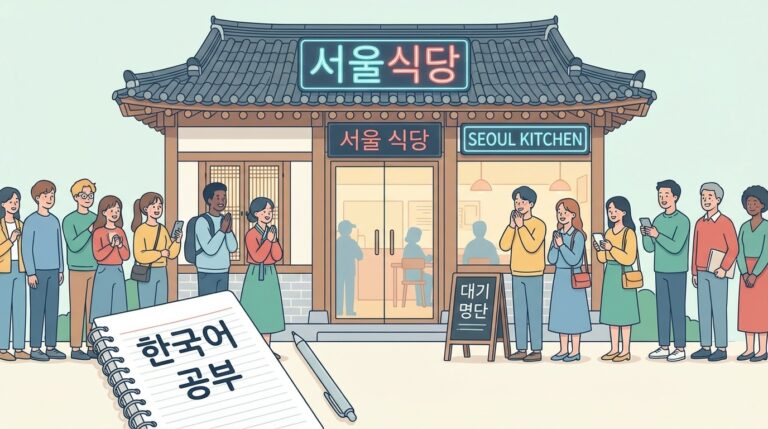
Is That Line for Food?! 😱 How to Predict Wait Times in Korean Like a Local
Phase 1: The “Matjib” Reality Check
Annyeonghaseyo! (안녕하세요!) This is your Daily Hangul Editor.
Imagine this: You are in the trendy streets of Seongsu-dong or Hongdae. You’re starving. You see a small sign with a cute pig logo, and in front of it… a line of 20 people winding down the street.
In a K-Drama, the lead characters might magically walk into a crowded restaurant and get the best seat. But in reality? That line is the battlefield of Korean dining culture.
Your Korean friend looks at the queue, sighs, and says something soft and indirect. They don’t say, “The line is long.” They say, “It seems like the line will be long.”
Why the uncertainty when the line is right there? Today, we are mastering the art of Assumption and Prediction in Korean. This isn’t just grammar; it’s about the Korean mindset of softening facts to be polite and the national obsession with “Matjib” (Famous Restaurants).
Let’s learn how to predict the future (or at least, the lunch wait time)!
Phase 2: Deep Dive into Key Expressions
Here are the tools you need to survive the lunch rush.
1. ~(으)ㄹ 것 같아요 (-(eu)l geot gatayo)
- Pronunciation: [eul-got-ga-ta-yo] Sounds like “eul-got-got-ta-yo”
- Meaning: “It seems like…” / “I think it will…” / “It looks like…”
- Grammar Note: This is the King of Korean Guessing. You attach it to a verb or adjective to express a prediction or an opinion based on what you see.
- K-Culture Moment: In K-Pop survival shows, trainees often say, “떨어질 것 같아요” (I think I will be eliminated) before the results are announced. It lowers expectations and softens the blow.
- Editor’s Insight: Koreans love this phrase. Even when something is 99% certain, we say “It seems like it.” Why? Because stating a fact too strongly can sometimes sound arrogant or confrontational. It leaves room for error.
- Situation Spectrum:
[🚫 Boss (Too casual)] ———— [⚠️ Colleagues] ———— [✅ Friends/Strangers]
(Note: This is polite ending (-yo), so it’s safe for most daily interactions, but formal settings might require ~습니다.)- 🤔 Think About It: In English, you might say “The line is long.” In Korean, we prefer “The line seems to be long.” Does your language prefer direct facts or softer guesses?
2. 맛집 (Matjib)
- Pronunciation: [mat-jip] The ‘t’ stops abruptly.
- Meaning: Literal translation is “Taste House.” Real meaning: A trendy, must-visit restaurant known for delicious food.
- K-Culture Moment: If you search Instagram for
#Seoul, half the results are#맛집. It is the ultimate goal of any outing.- Editor’s Insight: A Matjib isn’t just about food; it’s about the hype. If there is no line, Koreans might suspiciously ask, “Is this really a Matjib?”
- Situation Spectrum:
[🚫 Formal Documents] ———— [⚠️ Semi-formal] ———— [✅ Everyone!]3. 웨이팅 (Weiting)
- Pronunciation: [we-i-ting]
- Meaning: Waiting (Konglish).
- Editor’s Insight: Yes, it’s English, but it’s used specifically as a noun for “the act of waiting in line at a restaurant.” We don’t usually say “waiting” for a bus. We say “waiting” for pasta.
- Example: “There is a waiting.” (웨이팅 있어요 / Weiting isseoyo)
Phase 3: Textbook vs. Real Life
Let’s see how a language book speaks versus how a hungry Seoulite speaks.
| Situation | 📖 Textbook Korean | 🗣️ Real Korean (In the Street) | 💡 Why the difference? |
|---|---|---|---|
| Predicting a long wait | 사람들이 많아서 줄이 길겠습니다. (People are many, so the line will be long.) |
맛집이라 (웨이팅) 쩔 것 같은데? (It’s a Matjib, so the waiting seems intense/dope?) |
“쩔다” (Jjeol-da) is common slang for “intense” or “great.” Textbook Korean is too stiff for casual dining. |
| Suggesting to go elsewhere | 다른 식당으로 갑시다. (Let’s go to another restaurant.) |
딴 데 갈까? (Shall we go somewhere else?) |
“딴 데” is a faster, spoken way of saying “다른 데” (another place). |
💡 Editor’s Note: As a B1 learner, stick to “사람이 많을 것 같아요” (It seems there will be many people). It’s natural but polite. Use “쩔다” only with close friends!
Phase 4: Cultural Deep Dive — The Art of the Queue
4-1. Nunchi (눈치) at the Door
When you approach a restaurant, you need Nunchi (the art of sensing the atmosphere).
1. Scan the Door: Is there a clipboard? A tablet machine? Or just a physical line?
2. The Eye Contact: If you walk straight in while people are waiting, you will feel the burning gaze of 20 hungry people. Don’t do it.
3. The Prediction: Use your Nunchi. If you see couples taking selfies in line, the wait is long. If you see office workers looking at their watches, the table turnover is fast.
4-2. K-Food Connection: The “Waiting” Culture
In many Western cultures, a 2-hour wait for a sandwich is insane. In Korea, it validates the restaurant.
– Apps you need: Catch Table (캐치테이블) or Tabling (테이블링). These are apps where you register your phone number and wait at a nearby café. If a restaurant uses these, you won’t see a long physical line, but the virtual line might be 50 teams deep!
Phase 5: Immersive Roleplay
Scenario: It is Friday night, 7:00 PM in Gangnam. You and your Korean friend, Min-su, arrive at a famous Samgyeopsal (Pork Belly) place. The smell of grilled meat is taunting you.
Min-su: 와… 저기 봐. 사람 진짜 많다.
(Wa… jeogi bwa. Saram jinjja manta.)
(Wow… look over there. There are so many people.)
YOU: ____________________.
(Try to say: “It seems like we have to wait 30 minutes.”)
Min-su: (Looking at the tablet) 30분? 아니야. 내 생각엔 1시간은 걸릴 것 같아.
(30 minutes? No way. In my opinion, it seems it will take 1 hour.)
YOU: 배고픈데… 어떡하지?
(I’m hungry… what should we do?)
🔀 Decision Point! Min-su asks: “기다릴까? 아니면 딴 데 갈까?” (Should we wait? Or go elsewhere?)
- Option A: “맛집이니까 기다리자!” (It’s a Matjib, so let’s wait!)
- Option B: “줄이 너무 길 것 같아. 딴 데 가자.” (It seems the line is too long. Let’s go elsewhere.)
✅ Analysis:
– Option A: Shows you understand Korean “Matjib” patience. Min-su will respect your dedication to food.
– Option B: Shows practical “Pali-pali” (Hurry-hurry) spirit. Also a very Korean response!
Phase 6: 10-Second Shadowing Drill
Practice this sentence to sound like a local speculating on the situation.
“It’s a famous place, so it seems like there will be a waiting list.”
😟 Emotion: Worried but accepting
여기가 / 맛집이라서 / 웨이팅이 / 있을 것 같아요.
(Yeogi-ga / matjib-iraseo / weiting-i / isseul geot gatayo.)
Key Point: Slightly drag the “ra~” in matjib-iraseo to show you are thinking/reasoning.
Phase 7: K-Culture Mini Glossary
| Korean | Romanization | Meaning | Context |
|---|---|---|---|
| 오픈런 | Open Run | Waiting before opening | Arriving 30 mins before the store opens to run in first. Common for bagels and luxury goods. |
| 브레이크 타임 | Break Time | Break Time | 3 PM to 5 PM is usually break time. Don’t go then! |
| 라스트 오더 | Last Order | Last Order | The final time you can order food (usually 1 hour before closing). |
| 회전율 | Hoejeonyul | Turnover rate | “Is the line moving fast?” = “Turnover rate is good.” |
Phase 8: Traveler’s Survival Kit (Restaurant Edition)
Heading to a popular spot? Keep these handy.
🆘 Survival Phrases
1. “대기 시간 얼마나 걸릴 것 같아요?” (Daegi sigan eolmana geollil geot gatayo?)
– Translation: How long do you think the wait will be?
– Tip: Use this with the staff or the person managing the line.
- “대기 명단 있어요?” (Daegi myeongdan isseoyo?)
- Translation: Is there a waiting list?
- Tip: Look for a paper list or a tablet at the entrance.
- “포장은 바로 돼요?” (Pojang-eun baro dwaeyo?)
- Translation: Is takeout available immediately?
- Tip: Sometimes the takeout line is separate and much faster!
📌 Editor’s Travel Note:
If you see a tablet (Tabling/Catch Table), it might require a Korean phone number. If you don’t have one, go inside and ask the staff directly. They will often write your name down manually or give you a number ticket!
Phase 9: Think Deeper — The Psychology of the Line
Topic: The Bandwagon Effect (편승 효과)
Why do Koreans wait 2 hours for a donut? In Korea, a long line is the ultimate “Trust Signal.” It proves the place is current, trendy, and safe from failure. In a collective society, eating where everyone else is eating means you are part of the cultural conversation. Eating at an empty restaurant next door feels like missing out (FOMO).
🧠 Critical Thinking:
In your country, if you see a long line, do you think “Must be good!” or “Must be inefficient!”? How does this reflect your culture’s value on time vs. trend?
Phase 10: FAQ & Troubleshooting
Q: Can I save a spot for my friends in line?
A: ⚠️ Risky. In Korea, “cutting in line” (새치기) is heavily frowned upon. If one person waits and 5 friends show up right at the door, people behind you might complain. It’s best if at least half the group is there, or ask the staff first.
Q: Can I wait inside the restaurant if it’s cold?
A: NO. Unless there is a designated waiting area, standing near eating customers is considered rude and pressures them to eat faster. Wait outside!
❌ Common Mistake: Saying “I think…” as “Think 해요” (Think-haeyo).
✅ Correction: Always use the grammar “~(으)ㄹ 것 같아요.” It’s the natural way to express opinion or prediction.
Phase 11: Wrap-up & Action Mission
Summary: Today we learned to soften our predictions using “~(으)ㄹ 것 같아요” and navigated the intense world of Korean “Matjib” lines.
🚀 Action Missions:
– 🥉 Bronze: Look at the weather forecast and say out loud: “Tomorrow it seems it will rain.” (내일 비가 올 것 같아요.)
– 🥈 Silver: Search for a famous Korean restaurant on Google Maps/Instagram. Look at the photos of the crowd and comment: “Here, the waiting seems long.” (여기 웨이팅 길 것 같아요.)
– 🥇 Gold: Go to a restaurant in your town. Ask the staff, “How long do you think the food will take?” (Wait, do this in Korean if it’s a Korean restaurant! otherwise, just practice the sentence in your head!)
💬 K-Culture Mission: Watch a scene from the drama “Let’s Eat” (식샤를 합시다) or search for “Korean street food line” on YouTube. Observe the body language of the people waiting. Are they impatient or excited?
Tell me in the comments: What is the longest you have ever waited for food?
Phase 12: Interactive Quiz
1. Which sentence is the most natural way to say “It seems delicious” looking at a picture?
a) 맛있어요. (It is delicious – fact)
b) 맛이 존재합니다. (Taste exists – robotic)
c) 맛있을 것 같아요. (It seems like it will be delicious)
2. True or False?
“In Korea, if a restaurant is empty during lunch hour, it is usually considered a hidden gem that you are lucky to find.”
3. Situation: You see a tablet at the entrance.
You ask: “________?”
a) 이거 얼마예요? (How much is this?)
b) 대기 명단 작성해야 해요? (Do I have to write on the waiting list?)
💡 Answers:
1. (c) We are guessing based on the visual.
2. False. Koreans usually think “If it’s empty, there’s a reason (it’s bad).” Empty places make people suspicious!
3. (b) Perfect survival phrase for modern Korean restaurants.
Frequently Asked Questions (FAQ)
Q: What does "~(으)ㄹ 것 같아요 (-(eu)l geot gatayo)" mean in Korean and how do you pronounce it?
A: In Korean, "~(으)ㄹ 것 같아요 (-(eu)l geot gatayo)" is pronounced [eul-got-ga-ta-yo] and means: "It seems like..." / "I think it will..." / "It looks like..."
Q: What does "맛집 (Matjib)" mean in Korean and how do you pronounce it?
A: In Korean, "맛집 (Matjib)" is pronounced [mat-jip] and means: Literal translation is "Taste House." Real meaning: A trendy, must-visit restaurant known for delicious food.
Q: What does "웨이팅 (Weiting)" mean in Korean and how do you pronounce it?
A: In Korean, "웨이팅 (Weiting)" is pronounced [we-i-ting] and means: Waiting (Konglish).







