

Phase 1: The Immersive Hook
Annyeonghaseyo! This is your Daily Hangul Editor. 👋
Picture this: You’re watching a K-Drama. The main character faints from stress (or a tragic secret), and in the next scene, they wake up in a pristine, white VIP hospital room with an IV drip, looking surprisingly beautiful. ✨
But here in the real world—whether you have a sudden stomach ache from eating too much buldak-bokkeummyeon (spicy fire noodles) or just need a check-up—you can’t just faint and hope for the best. You need to make an appointment!
Walking into a Korean hospital can feel like entering a spaceship. Everything is fast, digital, and efficient. If you don’t know what to say, you might end up staring at the receptionist while the ‘ding-dong’ of the waiting number machine makes you more nervous.
Don’t worry. I’ve taught this to hundreds of students who were terrified of Korean hospitals. By the end of this guide, you’ll know exactly how to secure your slot like a local.
Phase 2: Deep Dive into Key Phrases
1. 예약하고 싶어요 (I want to make an appointment)
- Pronunciation:
Ye-yak-ha-go si-peo-yo- Sound Analogy: Ye (like ‘Yeah’) + yak (like a ‘yak’ animal) + ha-go (haggling) + si-peo-yo (see-po-yo).
- Meaning:
- Literal: “I want to do a reservation.”
- Real Nuance: “I’d like to book a slot.”
- K-Culture Moment: In medical dramas like Hospital Playlist, you rarely see this because it’s too mundane. But in reality, this is the magic phrase that opens the door. Without it, you might hear the dreaded “Oneul an doeyo” (Not possible today).
- Editor’s Insight: This isn’t just for doctors! Use it for hair salons, nail bars, and popular restaurants too. It’s the “I am serious about coming” phrase.
- Situation Spectrum:
[🚫 To a best friend] ———— [✅ Receptionist] ———— [✅ Professor] - 🤔 Think About It: In English, we “make” an appointment. In Korean, we “do” (hada) a reservation. Why do you think Korean treats an appointment as an action you perform rather than an object you make?
2. 언제 가능해요? (When is it possible?)
- Pronunciation:
Eon-je ga-neung-hae-yo?- Sound Analogy: Eon (like ‘Un’ in Onion) + je (jay) + ga-neung (gah-neung) + hae-yo (hey-yo).
- Meaning:
- Literal: “When is possible?”
- Real Nuance: “When is the earliest slot?” or “When are you free?”
- K-Culture Moment: Imagine a K-Pop fan meeting ticket war. Fans frantically ask, “When is it possible to buy?” It implies urgency and availability.
- Editor’s Insight: This is a soft, polite way to ask for availability without demanding a specific time. It puts the ball in their court.
- Situation Spectrum:
[⚠️ Close Friend] ———— [✅ Stranger] ———— [✅ Formal]
3. 어디가 아프세요? (Where does it hurt?)
- Pronunciation:
Eo-di-ga a-peu-se-yo?- Sound Analogy: Eo-di (Auddy) + ga + a-peu (ah-poo) + se-yo (say-yo).
- Meaning:
- Literal: “Where are you sick/hurt?”
- Real Nuance: “What brings you here today?”
- K-Culture Moment: You hear the word “Appa” (Hurts/Sick) in countless K-Pop ballads when they sing about heartbreaks (maeumi apa – my heart hurts). In the clinic, they are asking about your physical body, not your ex!
- Editor’s Insight: You will hear this from the receptionist. You don’t say it, but you must recognize it to reply.
Phase 3: Textbook vs. Real Life
| Situation | 📖 Textbook Korean | 🗣️ Real Korean (Street/Clinic) | 💡 Why the difference? |
|---|---|---|---|
| Starting the call | “안녕하십니까, 병원입니다.” (Hello, this is the hospital.) | “네~ OO의원입니다.” (Yes~ OO Clinic.) | Real receptionists answer calls all day; they often skip the formal greeting for speed. |
| Asking to book | “진료 예약을 하고 싶습니다.” (I wish to make a medical reservation.) | “예약 좀 하려고요.” (I’m trying to book…) | “~Jom” (a little) softens the request, making you sound less like a robot and more polite. |
| Checking time | “몇 시에 갈 수 있습니까?” (At what time can I go?) | “가장 빠른 시간 언제예요?” (When is the fastest time?) | Koreans love speed (Palli-Palli culture). We want the soonest slot, not just any slot. |
Note: As an A1 learner, stick to the polite “-yo” ending. It works everywhere!
Phase 4: Cultural Context — The K-Clinic Vibe
4-1. Non-verbal: The Art of Waiting
In Korean clinics, especially dermatology or eye clinics, there is often a small machine near the door. It prints a waiting number. Don’t just stand at the desk! Look for the machine. Taking a ticket without asking shows you have Nunchi (quick situational awareness).
4-2. K-Culture Connection: K-Beauty & Dermatology
Booking an appointment isn’t just for when you are sick. In Korea, visiting a Pibu-gwa (Dermatology Clinic) is as common as going to a gym.
* Drama Trope: The rich CEO getting an IV drip for fatigue.
* Real Life: You might see young people with small patches on their faces walking around Gangnam. They just had a quick procedure during their lunch break! The phrase “예약하고 싶어요” is your ticket to that K-Beauty glow.
Phase 5: Immersive Roleplay
Setting: It’s Tuesday morning. You woke up with a sore throat. You are calling a local internal medicine clinic (Naegwa) near your Airbnb.
Characters:
* YOU: A foreigner who speaks basic Korean.
* Receptionist: Efficient, fast-talking hospital staff.
Start Dialogue:
Receptionist: 네, 서울 내과입니다. (Ne, Seoul Naegwa-imnida.)
(Translation: Yes, Seoul Internal Medicine.)
YOU: 안녕하세요. [ 1. 예약하고 싶어요 ].
(Translation: Hello. I want to make an appointment.)
Receptionist: 네, 언제 방문하시겠어요? (Ne, eonje bangmun-hasigesseoyo?)
(Translation: Yes, when would you like to visit?)
YOU: 오늘 [ 2. 언제 가능해요? ]
(Translation: When is possible today?)
Receptionist: 2시는 꽉 찼고요, 4시 가능해요. (2-si-neun kkwak chatgoyo, 4-si ganeunghaeyo.)
(Translation: 2 PM is full, 4 PM is possible.)
🔀 Decision Point: The 4 PM slot works for you. How do you confirm?
- Option A: “네, 4시요.” (Yes, 4 PM.)
- Option B: “아니요, 싫어요.” (No, I hate it.)
- Option C: “네, 4시로 해주세요.” (Yes, please do it for 4 PM.)
✅ Best Choice: Option C. It is polite and clear. Option A is okay but a bit short. Option B is rude!
Receptionist: 성함이 어떻게 되세요? (Seonghami eotteoke doeseyo?)
(Translation: What is your name?)
YOU: 제 이름은 [Your Name]입니다.
Receptionist: 네, 4시에 뵙겠습니다.
Phase 6: 10-Second Shadowing Drill
Read this aloud. Focus on the intonation!
Sentences:
1. 😊 저 / 예약하고 / 싶어요!
* (Jeo / ye-yak-ha-go / si-peo-yo!)
* Emotion: Polite and clear.
2. 🤔 오늘 / 언제 / 가능해요?
* (O-neul / eon-je / ga-neung-hae-yo?)
* Emotion: Curious and slightly urgent.
Phase 7: K-Culture Mini Glossary
| Korean | Romanization | Meaning | Context |
|---|---|---|---|
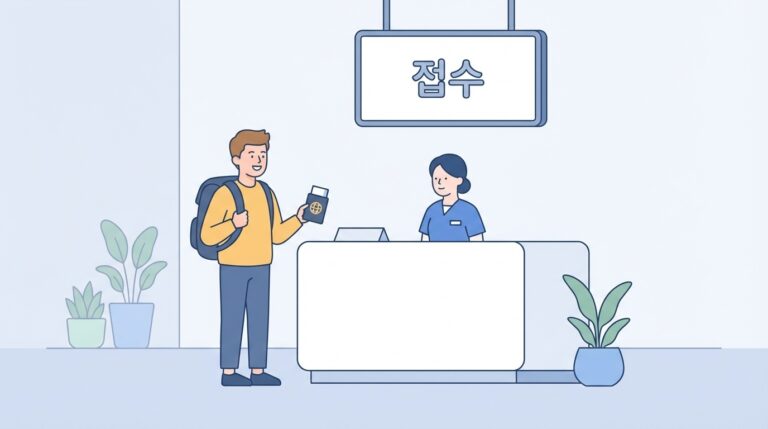
| 접수 | Jeopsu | Registration | The first thing you do at the counter. “Jeopsu haesseoyo?” (Did you register?) |
| 원장님 | Wonjangnim | Head Doctor | In clinics, we call the main doctor Wonjangnim, not just Uisa (doctor). It sounds more respectful. |
| 건강보험 | Geongang-boheom | Health Insurance | Korea’s national treasure. It makes bills very cheap, but check if your travel insurance covers you! |
| 초진 | Chojin | First Visit | They will ask if it’s your “Chojin” (first time) or “Jaejin” (return visit). |
Phase 8: Traveler’s Survival Kit
🆘 Survival Phrases for the Hospital
* 🇰🇷 “여기 아파요.” (Yeogi apayo) — “It hurts here.” (Point to the body part!)
* 🇰🇷 “영어 가능한가요?” (Yeong-eo ganeung-hangayo?) — “Is English possible?”
* 🇰🇷 “약국 어디예요?” (Yak-guk eodiyeyo?) — “Where is the pharmacy?” (In Korea, you buy meds at a separate pharmacy, not in the clinic.)📌 Editor’s Travel Note
* ID is Mandatory: You MUST bring your Passport or Alien Registration Card (ARC). They cannot register you without it.
* Lunch Break: Most Korean clinics have a strict lunch break (usually 1:00 PM – 2:00 PM). The lights go off, and doors might lock. Don’t visit then!
Phase 9: Think Deeper — “Why so fast?”
Subject: The ‘Palli-Palli’ (Hurry-Hurry) Medical System
In many Western countries, seeing a specialist can take weeks. In Korea, you can often see a specialist (dermatologist, ENT, internal medicine) on the same day within 30 minutes. Why?
This reflects Korea’s intense focus on efficiency and accessibility. The medical system is designed to process patients quickly. Some foreigners feel the consultation is “too short” (sometimes just 3 minutes!), but it’s not because the doctor doesn’t care. It’s a cultural difference in valuing speed of solution over length of conversation.
💬 Your Turn: Do you prefer a long chat with your doctor, or a quick solution so you can get back to your day? Let me know in the comments!
Phase 10: FAQ & Troubleshooting
- Q: Can I just walk in without a reservation?
- A: Yes! For small local clinics (internal medicine, ENT), walk-ins are very common. You just have to wait a bit longer. But for university hospitals or popular dermatology clinics, reservations are a must.
- Q: Do I need to tip the doctor or nurse?
- A: NO! 🚫 Never tip in a Korean hospital. It can be seen as a bribe or just very awkward. A heartfelt “Gamsahamnida” (Thank you) is enough.
- Q: They asked for my “Jumin-beonho”. What is that?
- A: That’s the Resident Registration Number. If you are a tourist, just say “Traveler” and show your passport.
❌ Common Mistake:
Don’t say “Teacher” (Seonsaengnim) to the receptionist. While not rude, it’s more natural to just say “Jeogiyo” (Excuse me) or just start your sentence politely.
Phase 11: Wrap-up & Action Mission
One-Liner Summary: To book a doctor, say “Ye-yak-ha-go si-peo-yo” and bring your passport!
🚀 Action Mission:
* 🥉 Bronze: Look in the mirror and practice saying “Eodiga apuseyo?” while pointing to your head/stomach.
* 🥈 Silver: Watch a scene from Hospital Playlist or Doctor Cha and try to catch the word “Ye-yak” or “Wonjangnim”.
* 🥇 Gold: If you are in Korea, walk past a clinic and find the sign that says [접수] (Registration). Take a photo (outside only)!
Phase 12: Interactive Quiz
- Situation: You want to ask if 3 PM is available. What do you say?
- A) 3시 싫어요. (I hate 3 PM.)
- B) 3시 가능해요? (Is 3 PM possible?)
- C) 3시 아파요. (3 PM hurts.)
- True or False (K-Culture): You should give a 10% tip to the nurse after your injection.
- (True / False)
- Fill in the Blank:
To start a reservation, you say: “_________ hago sipeoyo.”
(Scroll down for answers)
…
Answers: 1. (B), 2. (False – No tipping!), 3. (Yeyak)
Frequently Asked Questions (FAQ)
Q: What does "예약하고 싶어요 (I want to make an appointment)" mean in Korean and how do you pronounce it?
A: In Korean, "예약하고 싶어요 (I want to make an appointment)" is pronounced [Ye-yak-ha-go si-peo-yo] and means: a key conversational Korean expression covered in this lesson.
Q: What does "언제 가능해요? (When is it possible?)" mean in Korean and how do you pronounce it?
A: In Korean, "언제 가능해요? (When is it possible?)" is pronounced [Eon-je ga-neung-hae-yo?] and means: a key conversational Korean expression covered in this lesson.
Q: What does "어디가 아프세요? (Where does it hurt?)" mean in Korean and how do you pronounce it?
A: In Korean, "어디가 아프세요? (Where does it hurt?)" is pronounced [Eo-di-ga a-peu-se-yo?] and means: a key conversational Korean expression covered in this lesson.






