

Phase 1: The Immersive Hook
Greeting: 안녕하세요! This is your Daily Hangul Chief Editor, back with the advanced toolkit you didn’t know you needed.
The Scene: Picture this. You are in a sleek conference room in Gangnam, overlooking the Han River. It’s a scene straight out of Start-Up or Itaewon Class. The air is thick with tension. Your business partner—or perhaps a stubborn landlord—just rejected your initial proposal with a heavy sigh. The background music cuts out. Zoom in on your face.
Do you panic? Do you translate “Let’s meet in the middle” literally? No.
You take a sip of water, adjust your glasses, and drop a line so sophisticated, so culturally tuned, that the air in the room changes from ‘Hostile’ to ‘Collaborative’.
The ‘Why’: At the C2 level, fluency isn’t about grammar; it’s about emotional intelligence (EQ) wrapped in vocabulary. In Korea, a flat “No” is an insult. A blunt “I want this” is aggressive. To win, you must offer an alternative that saves the other person’s Chemyon (face) while securing your interests. Today, we master the art of the “Win-Win” (윈윈) strategy.
Transparency: This guide is built on high-stakes business meetings and delicate social navigations I’ve personally witnessed (and survived) in Seoul over the last decade.
Phase 2: Deep Dive — The Art of Soft Power
Here are three high-level expressions to pivot a conversation without breaking the harmony.
1. 현실적인 절충안을 찾아보는 건 어떨까요?
(Hyeonsiljeogin jeolchungan-eul chajaboneun geon eotteolkkayo?)
- Pronunciation: [Hyeon-sil-jeok-in] + [Jeol-chung-an] (sounds like jolts + chew + ng + ahn) + [eul chaja-bo-neun geon…]
- Meaning: “How about we look for a realistic compromise?”
- K-Culture Moment: This is the “Turning Point” line in office dramas. The protagonist stops fighting the antagonist and suggests a deal that benefits both companies. It signals maturity.
- Editor’s Insight: The word 절충안 (Compromise/Eclectic plan) is the star here. It sounds much more professional than simply saying “중간 지점” (middle point). It implies intellectual effort has been made.
- Situation Spectrum:
[🚫 Casual/Friends] ———— [✅ Colleagues] ———— [✅ Formal/Biz]- 🤔 Think About It: Why does adding the word “realistic” (현실적인) make this phrase more persuasive in Korean culture? (Hint: It frames the opposition as ‘idealistic’ but impractical without attacking them directly.)
2. 차선책으로 ~하는 방향은 어떠신가요?
(Chaseonchaeg-euro ~haneun banghyang-eun eotteosingayo?)
- Pronunciation: [Cha-seon-chaek] (Think of Cha + Sun + Check) + [euro…]
- Meaning: “As a second-best plan (Plan B), how about heading in the direction of…?”
- K-Culture Moment: Imagine a K-Pop agency meeting where the debut date is delayed. The manager doesn’t just say “We are delayed.” They say, “As a chaseonchaek, we will release a teaser video first.”
- Editor’s Insight: Koreans love the word 방향 (Direction). Instead of suggesting a specific rigid action, suggesting a “direction” feels less binding and more open to discussion. It lowers the barrier for agreement.
- Situation Spectrum:
[🚫 Dating] ———— [⚠️ Semi-formal] ———— [✅ Formal/High Stakes]- 🤔 Think About It: By labeling your own idea as the “Second Best” (Cha-seon), you are humbling yourself. How does this humility actually strengthen your negotiation position in a Confucian society?
3. 서로 한 발씩 양보해서 접점을 찾으시죠.
(Seoro han bal-ssik yangbohaeseo jeopjeomeul chajeusijyo.)
- Pronunciation: [Yang-bo] (sounds like Young + Boy without the ‘y’) + [Jeop-jeom]
- Meaning: “Let’s each yield one step and find a contact point (common ground).”
- K-Culture Moment: This is often heard in diplomatic news or when a senior mediator steps in to stop a fight between two subordinates.
- Editor’s Insight: 양보 (Yielding) is a virtue in Korea. Framing the deal not as “winning” but as “yielding together” makes the other person feel virtuous for agreeing with you.
- Situation Spectrum:
[⚠️ Close Friends (Serious)] ———— [✅ Business] ———— [✅ Conflict Resolution]
Phase 3: Textbook vs. Real Life (C2 Edition)
| Context | 📖 Textbook Korean | 🗣️ Real Life (High-Level) | 💡 Why the difference? |
|---|---|---|---|
| Disagreeing | 그 의견에는 동의하지 않습니다. (I do not agree with that opinion.) | 그 말씀도 일리가 있습니다만, 현실적으로는… (That makes sense, but realistically…) | Direct disagreement is considered rude. Validating the other person first (Il-li-ga-it-da) is crucial for Nunchi. |
| Proposing New Idea | 다른 방법을 제안합니다. (I suggest another method.) | 혹시 이런 대안은 어떨지 조심스럽게 여쭤봅니다. (I cautiously ask how this alternative might be.) | The adverb “cautiously” (조심스럽게) acts as a linguistic cushion to soften the impact of change. |
| Pushing for Deal | 이렇게 하시죠. (Let’s do this.) | 긍정적으로 검토해 주시면 감사하겠습니다. (I would appreciate a positive review.) | Passive-aggressive politeness. You aren’t forcing them; you are asking for a “positive review” (a standard business euphemism). |
Phase 4: Cultural Deep Dive — The Strategy of “Jeong” (정)
4-1. Non-verbal: The Strategic Silence
In the West, silence in a negotiation is awkward. In Korea, silence is a tool. After proposing a Jeolchungan (Compromise), do not speak. Maintain soft eye contact. Give them time to calculate their Chemyon. If you rush to fill the silence, you look desperate.
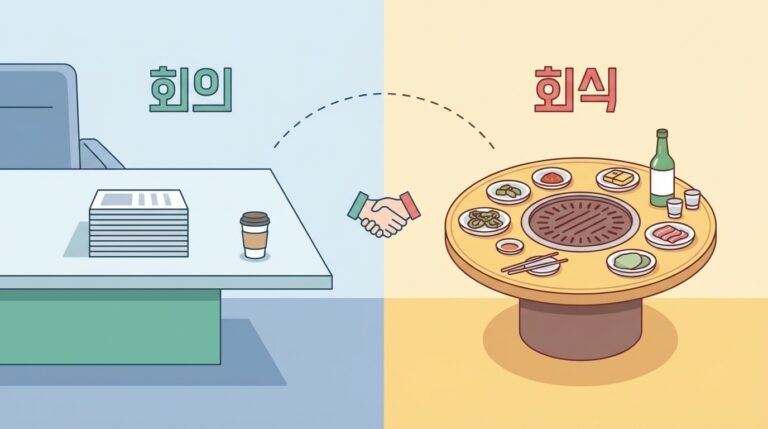
4-2. The “Hoesik” (Dining) Context
Many “Win-Win” scenarios actually happen after the meeting, over Soju and Pork Belly.
– The K-Drama Trope: The strict CEO rejects the proposal in the boardroom but accepts the compromise at the dinner table when the subordinate pours them a drink.
– Critical Insight: Why? Because the boardroom is for official rank. The dinner table is for human connection (Jeong). If you are stuck in a negotiation, suggest moving the discussion to a meal. “식사 하면서 좀 더 편하게 이야기 나누시죠.” (Let’s talk more comfortably over a meal.)
Phase 5: Immersive Roleplay — The Contract Renewal
Setting: A quiet, upscale cafe in Yeouido (Korea’s Wall Street). You are negotiating a contract renewal with a long-term client who wants to cut the budget.
Characters:
– YOU: A seasoned Project Manager.
– Director Kim (50s): Conservative, values loyalty but is under pressure to cut costs.
The Dialogue:
Director Kim: (Sighs) 이번에는 예산을 10% 삭감해야 할 것 같아요. 회사 사정이 좀 어렵습니다.
(I think we need to cut the budget by 10% this time. The company situation is difficult.)YOU: 아, 이사님 입장이 충분히 이해가 갑니다. 위에서 압박이 많으시죠?
(Ah, I fully understand your position, Director. You must have a lot of pressure from above.)
(🎭 Stage Direction: Nod slowly, showing empathy, not annoyance.)Director Kim: 네, 맞아요. 그래서 말인데, 단가는 좀 낮춰줄 수 없나?
(Yes, exactly. So about that, can’t you lower the unit price?)
🔀 Decision Point: How do you propose a Win-Win?
Option A: “10%는 힘들고, 5%만 깎아 드릴게요.” (Direct haggling)
Option B: “단가는 유지하되, 서비스 기간을 1개월 더 늘려드리는 차선책은 어떠세요?” (Offering added value instead of price cut)
Option C: “안 됩니다. 저희도 남는 게 없어요.” (Direct refusal)✅ Best Choice: Option B
Why? At C2 level, you avoid a zero-sum game. Option B preserves your price integrity (Face) while giving Director Kim something to show his boss (A “Bonus” month). It uses the logic of “덤” (Deom – Free extra) culture applied to business.
⚠️ Choice A Analysis: It turns the relationship into a transactional vendor interaction, lowering your brand value.
Phase 6: 10-Second Shadowing Drill
Practice this sentence to sound like a K-Drama CEO resolving a conflict.
😤 (Confident but Soft):
서로 / 얼굴 붉히지 말고 / 합리적인 / 접점을 / 찾으시죠.
(Seo-ro / eol-gul bul-hi-ji mal-go / ham-ni-jeok-in / jeop-jeom-eul / cha-jeu-si-jyo.)Translation: Let’s not blush (get angry/embarrassed) at each other, and instead find a rational contact point.
💡 Tip: Pronounce 합리적인 as [Ham-ni-jeok-in] due to nasal assimilation rules!
Phase 7: K-Culture Mini Glossary
| Korean | Romanization | Meaning | Context |
|---|---|---|---|
| 명분 | Myeongbun | Justification / Moral Cause | Vital in negotiation. You don’t just need a deal; you need a “Myeongbun” to explain to others why you agreed. |
| 체면 | Chemyon | Face / Reputation | Saving the other person’s Chemyon is often more important than the actual money involved. |
| 눈치 | Nunchi | Social Sensing | Sensing when to push and when to yield without being told. |
Phase 8: Traveler’s Survival Kit (The “Upgrade” Edition)
Even as a traveler, you can use Win-Win strategies. Imagine you are checking into a hotel or dealing with an Airbnb host.
🆘 Survival Phrase: The “Service” Ask
– 🇰🇷 “혹시 룸 업그레이드가 어렵다면, 조식이라도 서비스로 가능할까요?”
– (Hoksi rum eop-geu-re-i-deu-ga eo-ryeop-da-myeon, jo-sik-i-ra-do seo-bi-seu-ro ga-neung-hal-kka-yo?)
– Meaning: “If a room upgrade is difficult, would complimentary breakfast be possible instead?”
– 💡 Pro Tip: The construction “~가 어렵다면, ~라도” (If A is difficult, then at least B…) is the golden grammatical structure for compromise.📌 Editor’s Note:
Koreans love cool-headed negotiation. If you smile and offer a logical alternative (“I’m staying for 5 nights, so…”), it works better than complaining.
Phase 9: Think Deeper — Language & Power
Topic: The Hierarchy of Indirectness
Notice how the higher the stakes, the more indirect the Korean language becomes? In English, “clarity” is king. In high-level Korean business culture, “ambiguity” is a buffer. By saying “I cautiously suggest a direction” rather than “I want this,” you create a safety zone. If the other person rejects the “direction,” you haven’t technically failed—you just need to adjust the compass.
🧠 Think Deeper: In your culture, is being direct seen as honest/efficient, or rude/aggressive? Does your language have a “formal ambiguity” similar to Korean?
Phase 10: FAQ & Troubleshooting
Q: Can I use “절충안” (Compromise) with my Korean boyfriend/girlfriend?
A: Maybe. If you are having a serious discussion about marriage or finances, yes. If you are deciding what to eat for dinner, it sounds too stiff. Use “중간” (middle) or “타협” (settle) instead, or just do Rock-Paper-Scissors (Gawi-Bawi-Bo)!
Q: Is it rude to reject a proposal directly?
A: Yes. Never say “No” (아니요/싫어요) to a superior or client’s idea immediately. Always start with “It’s a great idea, but…” (좋은 말씀입니다만…) or “I will consider it positively…” (긍정적으로 검토해보겠습니다…) and then let it fade away. This is the “Soft Kill” technique.
Phase 11: Wrap-up & Action Mission
One-Liner: Negotiation in Korean is not about conquering the enemy, but dancing until you both land on the same beat.
Action Mission:
– 🥉 Bronze: Stand in front of a mirror and practice the “Ssseup…” (sucking in air) sound while thinking, followed by “현실적으로는…” (Realistically…).
– 🥈 Silver: Watch a clip of the drama Misaeng (Incomplete Life) or Agency and identify one moment where a character uses indirect speech to solve a problem.
– 🥇 Gold: Next time you are in a store (even outside Korea), try the mental exercise: “If I had to ask for a discount here using Korean logic, what Myeongbun (Justification) would I use?”
💬 Your Turn: Have you ever experienced a “Nunchi” failure where you were too direct? Tell me in the comments!
Phase 12: Interactive Quiz
Scenario: Your Korean boss suggests a project timeline that is impossible. What is the WORST response?
- “긍정적으로 검토해보겠지만, 현실적으로 시간이 더 필요할 것 같습니다.” (I’ll review positively, but realistically we need more time.)
- “이사님, 그건 불가능합니다. 날짜를 바꾸셔야 해요.” (Director, that’s impossible. You must change the date.)
- “인력을 더 충원해주신다면 맞춰보도록 하겠습니다.” (If you add more manpower, we will try to match it.)
Answer: #2.
Why? Using “Impossible” (불가능) and imperative form “Must change” (바꾸셔야 해요) causes the boss to lose face completely. #1 is the standard safe delay. #3 is a good Win-Win negotiation.
Frequently Asked Questions (FAQ)
Q: What does "절충안" mean in Korean and how do you pronounce it?
A: In Korean, "절충안" is pronounced [Compromise/Eclectic plan] and means: is the star here. It sounds much more professional than simply saying "중간 지점" (middle point). It implies intellectual effort has been made.
Q: What does "방향" mean in Korean and how do you pronounce it?
A: In Korean, "방향" is pronounced [Direction] and means: . Instead of suggesting a specific rigid action, suggesting a "direction" feels less binding and more open to discussion. It lowers the barrier for agreement.
Q: What does "양보" mean in Korean and how do you pronounce it?
A: In Korean, "양보" is pronounced [Yielding] and means: is a virtue in Korea. Framing the deal not as "winning" but as "yielding together" makes the other person feel virtuous for agreeing with you.
Q: What does ""덤"" mean in Korean and how do you pronounce it?
A: In Korean, ""덤"" is pronounced [Deom - Free extra] and means: culture applied to business.







