

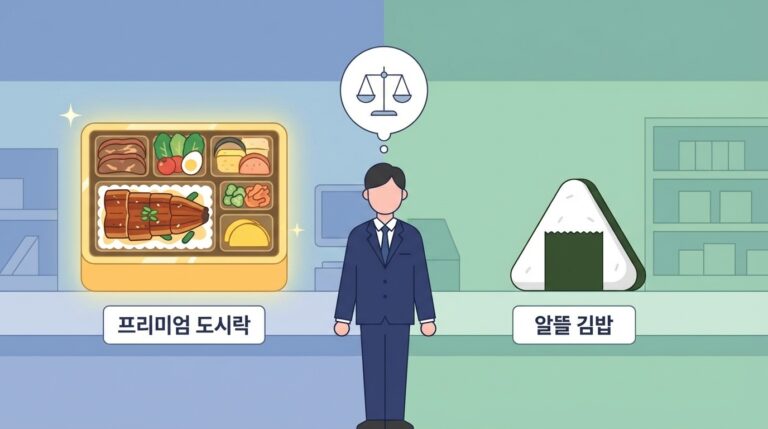
Phase 1: Immersive Hook — The “Lunchflation” Era
Greeting: 안녕하세요! This is your Daily Hangul Senior Editor.
Picture this: It’s 12:00 PM in Gangnam. A sea of office workers floods the streets. But instead of heading to the usual galbi-tang joint where prices have skyrocketed to 15,000 KRW, many are quietly slipping into a brightly lit sanctuary: The Convenience Store (Pyun-ui-jeom).
Have you seen that scene in K-Dramas like Drinking Solo (혼술남녀) or Misaeng (미생)? The protagonist sits alone on a plastic chair, staring at a microwave spinning their lunch. It looks lonely, but in 2024 Korea, this is a battlefield of sophisticated tastes and economic strategy.
We are witnessing the era of “Lunchflation” (Lunch + Inflation). But here’s the twist: Korean convenience store lunchboxes (Dosirak) aren’t just “cheap food” anymore. They are caught in a fierce war between Premiumization (고급화) and Ultimate Value (가성비).
Today, we aren’t just learning how to buy food. We are decoding the sociology of the Korean lunch hour at a C2 Master level. Ready to become a true insider?
Phase 2: Deep Dive — The Language of Value
At the C2 level, you don’t just say “It’s cheap.” You evaluate the socio-economic worth of your meal. Here are the three pillars of modern Korean consumption slang.
1. 혜자롭다 (Hyejaropda)
- Pronunciation: [Hye-ja-rop-da] + Sounds like “Hye-ja-rope-da”
- Meaning: Literal: To be like Kim Hye-ja / Real Nuance: Extremely generous portions, high quality, and amazing value for money.
- K-Culture Moment: This term originated from the “Kim Hye-ja Lunchbox” series at GS25, which was famous for being overflowing with side dishes compared to its price. It is now a proper adjective used even outside of food contexts.
- Editor’s Insight: If you find a lunchbox with eel, pork belly, and 5 side dishes for 5,500 KRW, you exclaim this. It is the highest compliment for a product.
- Situation Spectrum:
[🚫 Formal Biz Reports] ———— [⚠️ Semi-Formal Chat] ———— [✅ Social Media/Friends]- 🤔 Think About It: Why did a celebrity’s name become an adjective for “generosity”? How does this reflect the Korean consumer’s desire for “warmth” and “motherly care” in a cold, industrial convenience store setting?
2. 창렬하다 (Changryeolhada)
- Pronunciation: [Chang-nyeol-ha-da] + Sounds like “Chang-nyul-ha-da” (Liquidization rule)
- Meaning: Literal: To be like Kim Chang-yeol / Real Nuance: A rip-off; flashy packaging but empty content.
- K-Culture Moment: The antagonist to Hyejaropda. Originating from a snack endorsed by singer Kim Chang-yeol that was mostly nitrogen gas and little food.
- Editor’s Insight: Warning! This is very negative. While widely used online and among friends to criticize bad products (“This app subscription is so changryeol“), using it in front of older conservatives or formal settings is risky due to its controversial origin.
- Situation Spectrum:
[🚫 Formal/Polite] ———— [⚠️ Close Colleagues] ———— [✅ Close Friends/Online]- 🤔 Think About It: This term led to a lawsuit! It shows how sensitive Korean consumers are to the “packaging vs. reality” deception. Do you have a slang for “rip-off” that comes from a specific person in your culture?
3. 가심비 (Gasimbi)
- Pronunciation: [Ga-sim-bi]
- Meaning: Literal: Price-Heart Ratio / Real Nuance: Psychological satisfaction relative to price.
- K-Culture Moment: When a K-Pop fan buys a 30,000 KRW idol-branded lunchbox not because it’s tasty, but because it makes them happy. Or buying the “Premium Hotel Collaboration Bento” for 10,000 KRW as a small luxury (Small indulgence: sohwakhaeng).
- Editor’s Insight: Gaseongbi (Cost-effectiveness) is about saving money. Gasimbi is about saving your soul. Use this when justifying a slightly expensive purchase.
- Situation Spectrum:
[🚫 None] ———— [⚠️ Formal Writing] ———— [✅ Everyday Speech]
Phase 3: Textbook vs. Real Life — The Critic’s Eye
| Situation | 📖 Textbook Korean | 🗣️ Real Korean (Insa Style) | 💡 Why different? |
|---|---|---|---|
| Praising value | 가격 대비 성능이 좋습니다. (The price-performance ratio is good.) | 와, 이거 완전 혜자네! / 갓성비 미쳤다. (Wow, this is total Hyeja! / God-tier value.) | Young Koreans love combining words (God + Gaseongbi) to exaggerate for emphasis. |
| Criticizing bad value | 내용물이 너무 적습니다. (The contents are too few.) | 포장만 그럴듯하고 완전 창렬이야. (Packaging looks okay, but it’s total Changryeol.) | Direct criticism is harsh, so using the meme-term softens the blow while maintaining the humor. |
| Justifying a splurge | 비싸지만 마음에 들어서 샀어요. (I bought it because I liked it, though expensive.) | 오늘 하루 고생한 나를 위한 가심비 투자지. (It’s a ‘Gasimbi’ investment for myself who suffered today.) | Koreans often frame consumption as a “reward” or “compensation” for hard work. |
💡 Bottom Note: In a C2 context, don’t just use slang. Mix it with high-level grammar like “~느니 차라리” (I’d rather… than…).
Ex: “이 돈 주고 저걸 먹느니 차라리 편의점 도시락 두 개를 먹겠다.” (I’d rather eat two convenience store lunchboxes than pay this much for that.)
Phase 4: Cultural Deep Dive — The ‘Honbap’ Sanctuary
4-1. Nunchi & The Microwave Queue
In a convenience store, the microwave zone is a silent zone of high-level Nunchi.
– The Rule: If there is a line, you do not run the microwave for 3 minutes straight. You might see people heating for 1 min 30 sec, checking, and stepping back.
– The Cleaning: Leaving sauce splatters inside is a cardinal sin. C2 level manners involve quickly wiping it with a napkin before you leave.
4-2. The Rise of ‘App-tech’ (App + Technology)
The true “Premium Lunchbox” war happens on smartphones. Apps like “Pocket CU” or “Woori Dongne GS” allow you to:
1. Reserve popular premium bentos (stock check) so you don’t face an empty shelf.
2. QR Code Pickup: Walking in, scanning, and walking out without saying a word.
– K-Drama Trope: The poor protagonist running to the store only to find the shelves empty. In reality, the smart protagonist reserved it on the app 2 hours ago.
Phase 5: Immersive Roleplay — The Lunch Choice
Setting: 12:10 PM. A GS25 near a major office building in Yeouido. The shelves are half-empty. You are with Min-ji (30, Assistant Manager, known for being a foodie but frugal).
YOU: A foreign team leader who wants to try the famous “11-side-dish” bento.
(Dialogue Start)
Min-ji: (Sighing while looking at a 12,000 KRW restaurant queue across the street)
아후, 저기 줄 선 거 보세요. 오늘 점심은 그냥 여기서 해결하죠? 과장님, ‘혜자 도시락’ 아직 남아 있으려나?
(Ahu, look at that line. Let’s just resolve lunch here today? Chief, I wonder if there are any ‘Hyeja lunchboxes’ left?)
YOU: (Scanning the shelf)
[Option A] 여기 하나 남았어요! 근데 5,000원짜리랑 10,000원짜리 프리미엄 장어 덮밥이 있네요.
(Here’s one left! But there is a 5,000 won one and a 10,000 won premium eel rice bowl.)
Min-ji: 오, 장어라니! 편의점 퀄리티가 날이 갈수록 좋아지네요. 근데 편의점에서 만 원 쓰기는 좀… 고민되는데요?
(Oh, eel! Convenience store quality gets better by the day. But spending 10,000 won at a convenience store is a bit… I’m hesitating.)
🔀 Decision Point: How do you persuade her?
- A) “돈 아껴야죠. 그냥 5,000원짜리 드세요.” (Practical but boring)
- B) “민지 대리님, 어제 야근하셨잖아요. 오늘은 가심비 챙기셔야죠! 제가 쏠게요.” (Demonstrating C2 vocabulary & Empathy)
- C) “이게 혜자예요? 저는 잘 모르겠는데.” (Feigning ignorance)
✅ Best Choice: B
Analysis: You correctly used “가심비” (psychological satisfaction) and acknowledged her hard work (야근 – overtime). Offering to treat (쏘다) for a relatively small amount creates a huge bonding moment.
Min-ji: (Eyes widening) 세상에, 과장님 완전 센스쟁이! 그럼 저는 사양 않고 장어로 가겠습니다. 대신 커피는 제가 살게요!
(Omg, Chief, you have such good sense! Then I won’t refuse and go for the eel. Instead, I’ll buy the coffee!)
Phase 6: 10-Second Shadowing Drill
Let’s practice justifying a “Premium” purchase with emotion.
Context: Your friend asks why you bought an expensive lunchbox instead of a cheap gimbap.
😠 (Defensive but proud):
매일 / 야근하느라 / 힘들었는데, / 점심이라도 / 제대로 / 먹어야지!
(Maeil / yageun-haneura / himdeureonneunde, / jeomsimirado / jedaero / meogeoyaji!)
“I’ve been suffering from overtime every day, I should at least eat a proper lunch!”
💡 Tips:
– Stress “점심이라도” (At least lunch) to emphasize that everything else in life is hard, so this small thing matters.
– “제대로” (Properly) is a key keyword in food culture. Koreans hate eating “roughly” (대충).
Phase 7: K-Culture Mini Glossary
| Korean | Romanization | Meaning | Context |
|---|---|---|---|
| 편도족 | Pyeondojok | Convenience Store Lunchbox Tribe | People who mainly eat convenience store lunchboxes. |
| 런치플레이션 | Lunchflation | Lunch + Inflation | The phenomenon of rising lunch prices forcing workers to cheaper options. |
| 1+1 (원플원) | Won-peul-won | Buy one get one free | The holy grail of convenience store shopping. “2+1” is also common. |
| 맵부심 | Maepbusim | Spicy Pride | Often challenged by “spicy” versions of lunchboxes (e.g., Fire Chicken flavor). |
Phase 8: Traveler’s Survival Kit (The Premium Edition)
Even as a traveler, you might want to try these high-end bentos. Here is how not to look like a confused tourist.
🆘 Survival Expressions #1: The Microwave Etiquette
– 🇰🇷 “이거 뚜껑 덮고 데워야 해요?” (Igeo ttukkeong deopgo dewoya haeyo?)
– 🗣️ Meaning: “Should I heat this with the lid on?”
– 💡 Pro Tip: Premium lunchboxes often have specific instructions. Some lids must be removed (plastic deformation risk), while others stay on to steam the food. When in doubt, ask!📌 Editor’s Travel Note: The “Time Sale”
– What: Many convenience store apps or shelves have stickers for expiring items (still safe, just close to the hour).
– When: Usually check around 8 PM or early morning.
– Why: You can get premium bentos for 30-50% off. It’s not being cheap; it’s being smart (알뜰하다).
Phase 9: Think Deeper — “The Sorrow of the Square Box”
Topic: Food and Solitude in a Collective Society
Korea is historically a “Jeong (정)” society where eating together (Dunsik) is crucial for bonding. The phrase “Have you eaten?” is a greeting. However, the explosive growth of the premium lunchbox market signifies a shift. It reflects the rise of single-person households (1 in 3 households) and the intense pressure of modern work life where lunch is the only “me-time.”
While the lunchboxes are getting luxurious (Eel, Wagyu beef), the act of eating them often remains a solitary, quick affair. Is the “Premium Lunchbox” a genuine culinary evolution, or is it a “Small Luxury” (소확행) to comfort a lonely, busy generation?
💬 Your Turn: In your country, is eating alone at a convenience store considered normal, sad, or convenient? How does your culture view “Gasimbi” (paying for satisfaction)?
Phase 10: FAQ & Troubleshooting
Q: Can I drink alcohol (So-maek) with my lunchbox at the table outside the convenience store?
A: Maybe. In general, yes (called No-sang). However, by law, convenience stores are not pubs. If you get too loud or drunk, the police can be called. Also, some tables are strictly non-smoking zones. C2 level advice: Look around. If others are doing it quietly, it’s okay. If it’s a residential area late at night, skip it.
Q: Is it rude to leave the trash on the table?
A: YES (Absolute Taboo). Korea has a strict recycling system. You must separate food waste (leftovers), plastic, and general trash at the designated bins inside or outside the store. Leaving a mess is the quickest way to be labeled a “bad foreigner.”
❌ Common Mistake #1: Thinking “Kim Hye-ja” is the store owner.
✅ Correction: She is a famous veteran actress known for “mother” roles. The lunchbox is a branding collaboration implying “Mother’s love.”
Phase 11: Wrap-up & Action Mission
One-Liner Summary: Today we learned that buying a lunchbox isn’t just buying food—it’s navigating Lunchflation with Hyejaropda (value) and Gasimbi (satisfaction).
🚀 Action Mission:
– 🥉 Bronze: Go to a Korean convenience store (or Asian market) and identify a “1+1” item.
– 🥈 Silver: Post a photo of your lunch on social media and use the hashtag #가심비 or #갓성비 with a short Korean caption explaining why.
– 🥇 Gold: If you are in Korea, buy a premium lunchbox, heat it up properly (check the lid!), and eat it at the store counter while observing the “Microwave Nunchi.”
K-Culture Mission: Watch a clip of the drama “Convenience Store Saet-byul” (Backstreet Rookie). Can you spot the difference between how the characters talk to customers vs. their friends?
Phase 12: Quiz — The Value Master
1. Which sentence uses the slang most naturally?
– A) 사장님, 이 도시락은 정말 창렬하시네요. (To the owner: This lunchbox is very rip-off.)
– B) 와, 이 구성에 5천 원이라니 완전 혜자다! (Wow, 5,000 won for this set? Total Hyeja!)
– C) 저는 오늘 창렬한 기분이에요. (I feel like a rip-off today.)
2. True or False?
– “Gasimbi” means finding the cheapest product possible regardless of quality. (T/F)
Answers:
1. B (A is rude to say to a seller. C is grammatically weird; it describes products/prices, not feelings.)
2. False (That is Gaseongbi. Gasimbi prioritizes psychological satisfaction, even if it costs more.)
Frequently Asked Questions (FAQ)
Q: What does "혜자롭다 (Hyejaropda)" mean in Korean and how do you pronounce it?
A: In Korean, "혜자롭다 (Hyejaropda)" is pronounced [Hye-ja-rop-da] and means: Literal: To be like Kim Hye-ja / Real Nuance: Extremely generous portions, high quality, and amazing value for money.
Q: What does "창렬하다 (Changryeolhada)" mean in Korean and how do you pronounce it?
A: In Korean, "창렬하다 (Changryeolhada)" is pronounced [Chang-nyeol-ha-da] and means: Literal: To be like Kim Chang-yeol / Real Nuance: A rip-off; flashy packaging but empty content.
Q: What does "가심비 (Gasimbi)" mean in Korean and how do you pronounce it?
A: In Korean, "가심비 (Gasimbi)" is pronounced [Ga-sim-bi] and means: Literal: Price-Heart Ratio / Real Nuance: Psychological satisfaction relative to price.







