

Don’t Freeze! How to Handle “Curveball Questions” in Korean Presentations Like a Pro
Phase 1: The Immersive Hook
Hello! This is your Daily Hangul Editor.
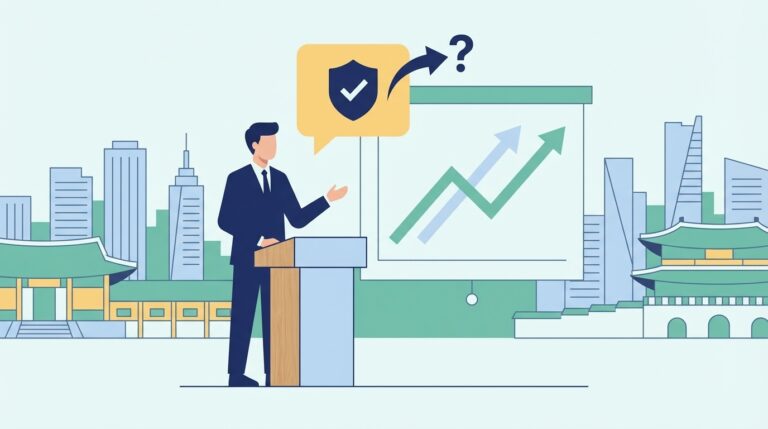
Imagine this: You are the protagonist in a high-stakes K-Drama office scene. You’ve just finished presenting your marketing strategy. The room is silent. Suddenly, the stern-faced Director (who looks suspiciously like the villain in Itaewon Class) leans forward, taps his pen on the desk, and asks a question you never prepared for regarding the Q3 budget variance.
Your heart races. In English, you might say, “That’s a good point, let me get back to you.” But in Korean? If you just stare blankly or stutter “Uh… molla (I don’t know),” the tension in the room will snap.
Today, we are mastering Im-gi-eung-byeon (임기응변 – Improvisation/Adaptability). We aren’t just learning how to answer; we’re learning how to buy time, show respect, and maintain your authority without losing face. Because in Korea, how you handle a difficult question is often more important than the answer itself.
This guide is built on real feedback from C1-level learners who aced their presentations but froze during the Q&A session. Let’s fix that today.
Phase 2: Deep Dive into Core Expressions
Here are the three most sophisticated ways to handle the heat.
1. The “Ego-Soother” (Buying Time)
“지적해 주신 부분은 미처 생각하지 못했습니다. 정말 예리한 질문이십니다.”
- Pronunciation: [Jijeok-hae jusin bubeun-eun micheo saeng-gak-haji mot-haetseumnida. Jeongmal yeri-han jilmun-isimnida.]
- Sound Analogy: Think of micheo (not yet) as saying “me” + “cho” (like cho-colate). Yeri (sharp) sounds like “Yeti” but with an ‘r’.
- Meaning:
- Literal: I couldn’t think of the part you pointed out. It is a truly sharp question.
- Real Nuance: “Wow, you are so smart to notice that. I admit I missed it, but I’m framing it as your insight rather than my failure.”
- K-Culture Moment: Watch any press conference with a CEO or politician. When a reporter asks a tough question, they almost always start by praising the quality of the question to diffuse tension.
- Editor’s Insight: This is perfect for when you are totally stumped. It shifts the focus from your lack of preparation to the asker’s intelligence. Flattery gets you everywhere in a Korean hierarchy.
- Situation Spectrum:
[🚫 Friends] ———— [⚠️ Colleagues] ———— [✅ Boss/Formal] - 🤔 Think About It: Why does Korean business culture value acknowledging the asker’s “sharpness” before answering? Does this relate to Chemyon (saving face)?
2. The “Professional Deferral” (Avoiding ‘I Don’t Know’)
“정확한 답변을 위해 확인 후, 이메일로 바로 송부해 드려도 되겠습니까?”
- Pronunciation: [Jeong-hwak-han dap-byeon-eul wihae hwangin hu, imeil-lo baro songbu-hae deuryeodo doe-get-seumnida?]
- Meaning:
- Literal: For an accurate answer, after checking, may I send it to you right away via email?
- Real Nuance: “I don’t know right now, but I refuse to guess and give you wrong information because I am a professional.”
- Editor’s Insight: Never say “모르겠습니다” (I don’t know) in a formal presentation. It sounds irresponsible. “Checking for accuracy” sounds diligent.
- Situation Spectrum:
[🚫 Friends] ———— [⚠️ Colleagues] ———— [✅ Boss/Formal]
3. The “Clarifier” (When You Didn’t Understand)
“말씀하신 내용이 ~에 관한 것이 맞는지요?”
- Pronunciation: [Malsseum-hasin naeyong-i ~e gwanhan geosi manneunjiyo?]
- Meaning:
- Literal: Is the content you spoke of regarding ~ correct?
- Real Nuance: “I want to make sure I’m answering the right question (and also I need 5 seconds to think).”
- K-Culture Moment: This is the “Variety Show MC” technique. MCs like Yoo Jae-suk use this to clarify a guest’s rambling story before summarizing it for the audience.
Phase 3: Textbook vs. Real Life
| Situation | 📖 Textbook Korean | 🗣️ Real Business Korean | 💡 Why the difference? |
|---|---|---|---|
| Stalling for time | 잠시만 기다려 주세요. (Please wait a moment.) | 잠시 생각할 시간을 주시겠습니까? (Could you give me a moment to think?) | The textbook phrase sounds like you are putting them on hold like a call center. The Real Korean phrase asks for permission, showing deference. |
| Checking facts | 잘 모르겠습니다. (I don’t know.) | 구체적인 수치는 다시 한번 더블 체크해 보겠습니다. (I will double-check the specific figures.) | “Don’t know” implies incompetence. “Double-check” implies thoroughness. Use English loan words like “Double-check” (더블 체크) to sound modern/corporate. |
| Answering vaguely | 아마 그럴 거예요. (Maybe it is so.) | 현재 추세로 보아 그럴 가능성이 높습니다. (Judging by current trends, the probability is high.) | C1 learners must avoid “Maybe” (아마). Use data-driven language to sound authoritative. |
Bottom Note: In a corporate setting, ending sentences with ~입니다/습니까? (H하십시오-che) is safer than ~에요 (Haeyo-che), especially during the Q&A session where tension is higher.
Phase 4: Cultural Deep Dive
4-1. Non-verbal Communication: The Art of “Listening Posture”
When a senior person asks a “gotcha” question:
1. Do not cross your arms. It looks defensive.
2. Nod slowly (Reaction). Show that you are processing their “wisdom,” even if they are criticizing you.
3. Eye Contact: Do not stare intensely into their eyes (challenge), but do not look at the floor (guilt). Look at their nose or mouth area, occasionally meeting eyes.
4-2. K-Culture Connection: The “Idol Press Conference”
Have you ever seen a K-Pop idol handle a rude question about dating rumors or scandals? They never get angry. They use the “Kushion” (Cushion) Language strategy.
– Example: “Thank you for your interest in my private life (Cushion), but today I would like to focus on our album activity (Deflection).”
– In your presentation, use this! “Thank you for that interesting perspective on the design (Cushion), but regarding the budget implications (Focus)…”
Phase 5: Immersive Roleplay
Setting: Monday morning executive meeting at a cosmetic company in Gangnam. You are presenting the launch plan for a new skincare line.
Characters:
– YOU: Global Marketing Manager.
– Director Choi (NPC): The intimidating Head of Sales. Impatient and numbers-focused.
Dialogue:
Director Choi: (Flipping through your handout aggressively) 팀장님, 이 마케팅 예산 말이죠. ROI가 너무 낙관적인 거 아닙니까? 근거가 뭐예요?
(Timjang-nim, i maketing yesan marijyo. ROI-ga neomu nak-gwan-jeog-in geo animnikka? Geungeo-ga mwoyeyo?)
(Team Leader, about this marketing budget. Isn’t the ROI too optimistic? What is the basis for this?)
🔀 YOUR TURN! How do you handle this pressure?
- A) “아, 그게요… 지난번 캠페인이랑 비슷하게 잡았습니다.” (Um, well… I set it similar to the last campaign.)
- B) “지적해 주신 대로 목표가 다소 높게 보일 수 있습니다. 하지만 최근 경쟁사 데이터를 기반으로 산출했습니다.” (As you pointed out, the goal may look slightly high. However, it was calculated based on recent competitor data.)
- C) “제 생각이 틀렸나요? 다시 계산하겠습니다.” (Was I wrong? I will recalculate.)
✅ Best Choice: B
– Why: You acknowledged his skepticism (







