

Phase 1: The “Awkward Silence” at the Counter (Immersive Hook)
Greeting: 안녕하세요! Welcome back to Daily Hangul. I’m your editor, ready to guide you through the neon-lit streets of Seoul.
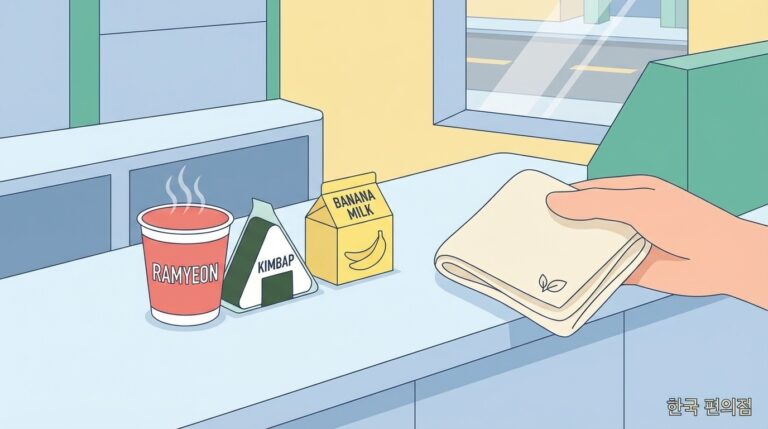
Picture this: It’s 11 PM. You’ve just finished watching a K-Drama and suddenly craved Ramyeon. You run to the nearest GS25 or CU (convenience stores). You grab a cup noodle, a triangle kimbap (Samgak-gimbap), and a banana milk.
You put everything on the counter. The clerk scans them—beep, beep, beep—and then asks you a question very quickly. You freeze. The line behind you is growing.
He’s asking if you need a bag. In Korea, plastic bags aren’t free! If you don’t know how to answer, you might end up juggling hot noodles and milk all the way back to your hotel. Let’s fix that today.
Phase 2: Core Expressions (Deep Dive)
Here are the absolute essentials to survive the checkout counter.
1. 봉투 필요하세요? (Bongtu piryohaseyo?)
- Pronunciation: [Bong-tu pi-ryo-ha-se-yo?]
- Sound Analogy: “Bong” sounds like a bongo drum + “Two” like the number 2.
- Meaning: “Do you need a bag?”
- K-Culture Moment: You will hear this in every convenience store scene in K-Dramas right before the lead characters sit outside at the plastic tables to drink soju.
- Editor’s Insight: The clerk might say this very fast, or mumble it. Listen for the keyword “Bongtu” (Bag).
- Situation Spectrum:
[🚫 Formal] ———— [⚠️ Semi-formal] ———— [✅ Standard]
- This is the standard polite phrase used by staff.
- 🤔 Think About It: Why do you think Korean clerks ask this every single time instead of just giving you one? (Hint: It’s about the law, not stinginess!)
2. 네, 담아 주세요. (Ne, dama juseyo.)
- Pronunciation: [Ne, da-ma ju-se-yo]
- Sound Analogy: “Dam-a” sounds like “Dama” in “Damage”.
- Meaning: “Yes, please put (them) in.”
- Literal: “Yes, contain (it) please.”
- Editor’s Insight: Just saying “Ne” (Yes) works, but adding “Dama juseyo” is much clearer. It means you want the clerk to pack the items for you.
- Situation Spectrum:
[🚫 Friends] ———— [⚠️ Co-workers] ———— [✅ Strangers/Staff]
- Use this with store clerks, taxi drivers (for luggage), or market vendors.
3. 봉투 값 있어요. (Bongtu-gap isseoyo.)
- Pronunciation: [Bong-tu-gap i-sseo-yo]
- Meaning: “There is a charge for the bag.”
- Context: The clerk is warning you that it will cost extra (usually 20 to 100 won).
- 🤔 Think About It: In many countries, bags are free. Korea has strict environmental laws banning free disposable bags in large stores. How does your country handle plastic waste?
Phase 3: Textbook vs. Real Life
| Situation | 📖 Textbook Korean | 🗣️ Real Street Korean | 💡 Why the difference? |
|---|---|---|---|
| Asking for a bag | 봉투를 주시겠습니까? (Could you give me a bag?) | 봉투 하나 주세요. (Give me one bag, please.) | The textbook version is too formal for buying a snack. |
| Answering “Yes” | 네, 봉투가 필요합니다. (Yes, I need a bag.) | 네, 주세요. (Yes, give please.) | Koreans love efficiency (Speed/Ppalli-ppalli culture). |
| Paying for the bag | 봉투 가격은 얼마입니까? (What is the price of the bag?) | (Just nod and pay) | Everyone knows it costs 20-50 won. Asking the price slows things down. |
💡 Editor’s Note: For A2 learners, “봉투 주세요” (Bongtu juseyo) is the magic phrase. It’s polite enough and easy to remember.
Phase 4: Cultural Context — K-Culture Deep Dive
4-1. The Art of “Nunchi” (Eye Measure)
When the clerk points at the sign “20원” (20 won), don’t get angry or confused. Use your Nunchi. They aren’t trying to scam you for pennies; they are legally required to charge you. Just nod and say “Ne” (Yes).
4-2. K-Drama Connection: The “Pyeonuijeom” (Convenience Store) Vibe
In dramas like Convenience Store Saet-byul (Backstreet Rookie), the store is a community hub.
* The Trope: Characters often sit at the outdoor tables (called “Yajang”) drinking beer or eating cup noodles.
* Real Life: If you plan to eat at the store, you don’t need a bag! Just say “여기서 먹고 갈게요” (I’ll eat here and go). If you ask for a bag and then sit down to eat, you look like a rookie!
Phase 5: Immersive Roleplay Scenario
Setting: It is a rainy Tuesday evening at a CU convenience store in Hongdae. You are buying an umbrella and a bottle of water.
Characters:
* YOU: A thirsty traveler caught in the rain.
* Clerk: A part-time student, looking a bit tired but polite.
(The Dialogue)
Clerk: (Scans items) 삑. 봉투 필요하세요? 🛍️
(Bongtu piryohaseyo?)
(Do you need a bag?)
YOU:
🔀 Your Turn! Choose your response:
– A) “No.” (English)
– B) “네, 담아 주세요.” (Ne, dama juseyo.)
– C) “봉투 얼마예요?” (Bongtu eolmayeyo?)
If you chose B (Best Choice):
YOU: 네, 담아 주세요.
(Yes, please put it in.)
Clerk: 20원 추가됩니다.
(20-won chugadoemnida)
(20 won will be added.)
YOU: 네, 괜찮아요.
(Ne, gwaenchanayo)
(Yes, that’s fine.)
⚠️ Analysis of Choice A: Saying “No” in English might work, but the clerk might panic if they don’t speak English. A simple Korean hand gesture (shaking hand) is better.
⚠️ Analysis of Choice C: Asking “How much is it?” is okay, but for 20 won (approx $0.02), it’s rarely asked by locals.
Phase 6: 10-Second Shadowing Drill
Practice this before you enter the store!
- Requesting a bag:
- 😊 (Polite & Clear) 봉투 / 하나 / 주세요.
- (Bong-tu / ha-na / ju-se-yo)
- “Bag / one / give please.”
- Declining a bag (I have my hands!):
- 😤 (Confident) 봉투 / 괜찮아요.
- (Bong-tu / gwaen-cha-na-yo)
- “Bag / (is) fine (I don’t need it).”
Phase 7: K-Culture Mini Glossary
| Korean | Romanization | Meaning | Context |
|---|---|---|---|
| 편의점 | Pyeonuijeom | Convenience Store | The lifeline of modern Korea. Open 24/7. |
| 봉투 | Bongtu | Bag (Plastic/Paper) | Usually implies a plastic carrier bag here. |
| 영수증 | Youngsujeung | Receipt | You will be asked: “Youngsujeung piryohaseyo?” |
| 원 플러스 원 | One-plus-one | Buy 1 Get 1 Free | The holy grail of convenience store shopping. |
Phase 8: Traveler’s Survival Kit
🆘 Survival Phrases: Convenience Store Edition
- 🇰🇷 “봉투 주세요.” (Bongtu juseyo)
- 🗣️ Bong-tu Ju-se-yo
- 📍 Use when: You bought too many snacks to carry.
- 🇰🇷 “데워 주세요?” (Dewo juseyo?)
- 🗣️ De-wo Ju-se-yo
- 📍 Use when: You buy a lunch box (Dosirak) and want them to microwave it. (Or they might point to the microwave for you to do it).
- 🇰🇷 “T-money 충전해 주세요.” (T-money chungjeon-hae juseyo)
- 🗣️ T-money Chung-jeon-hae Ju-se-yo
- 📍 Use when: You need to top up your subway/bus card.
📌 Editor’s Travel Note:
Plastic vs. Paper: Some stores only have paper bags now due to eco-regulations. Don’t be surprised if your “Bongtu” is brown paper!
Phase 9: Think Deeper — “Why pay for a bag?”
Topic: Media vs. Reality (Eco-Awareness)
In old K-Dramas, you might see characters walking out of stores with black plastic bags effortlessly. However, modern Korea is fighting a war on plastic waste. The government enforces strict rules on disposable items.
🧠 Think Deeper:
Even in a “Palli-palli” (Hurry, hurry) culture where convenience is king, Koreans pause to pay for a bag or carry reusable ones. This shows a collective effort to follow social rules for the greater good.💬 Your Turn: Does your country charge for plastic bags? Do people complain or accept it? Tell me in the comments!
Phase 10: FAQ & Troubleshooting
- Q: Can I use “Bongtu” for a fancy shopping bag at a department store?
- A: Yes! “Showpping-bag” (Shopping bag) is also used, but “Bongtu” is the generic word for any bag that holds things.
- Q: The clerk mumbled something ending in “-yo” and I didn’t understand.
- A: It was likely “Bongtu piryohaseyo?” (Need a bag?) or “Youngsujeung deurilkkayo?” (Receipt?). If you just want to leave, a polite “Gwaenchanayo” (It’s okay/No thanks) covers both!
- ❌ Common Mistake: Trying to give the 20 won in cash separately when paying by card.
- ✅ Fix: Just let them add it to the total card transaction. It’s faster and easier for everyone.
Phase 11: Wrap-up & Action Mission
One-Liner: Knowing “Bongtu juseyo” saves you from juggling items like a clown in a Korean street!
🎯 Action Mission:
* 🥉 Bronze: Say “Bongtu juseyo” out loud 3 times right now.
* 🥈 Silver: Watch a YouTube vlog of a Korean convenience store tour and listen for the word “Bongtu.”
* 🥇 Gold: Go to a Korean mart (or any store) and try asking for a bag in Korean!
K-Culture Mission:
Next time you watch a K-Drama, look for the “Green Tape” on the microwave in the convenience store scene. That’s where people stand to eat their ramen!
Phase 12: Interactive Quiz
- Situation: You bought a single pack of gum. The clerk asks “Bongtu piryohaseyo?” What is the most natural Korean response?
- A) 네, 담아 주세요. (Yes, put it in.)
- B) 봉투가 예뻐요. (The bag is pretty.)
- C) 아니요, 괜찮아요. (No, it’s fine.)
- True or False?
- Plastic bags are always free in Korean convenience stores if you are a foreigner.
- (Answer: False! The law applies to everyone.)
🔑 Quiz Answers:
1. C (You don’t need a bag for one gum! Save the earth!)
2. False
Frequently Asked Questions (FAQ)
Q: What does "봉투 필요하세요? (Bongtu piryohaseyo?)" mean in Korean and how do you pronounce it?
A: In Korean, "봉투 필요하세요? (Bongtu piryohaseyo?)" is pronounced [Bong-tu pi-ryo-ha-se-yo?] and means: a key conversational Korean expression covered in this lesson.
Q: What does "네, 담아 주세요. (Ne, dama juseyo.)" mean in Korean and how do you pronounce it?
A: In Korean, "네, 담아 주세요. (Ne, dama juseyo.)" is pronounced [Ne, da-ma ju-se-yo] and means: a key conversational Korean expression covered in this lesson.
Q: What does "봉투 값 있어요. (Bongtu-gap isseoyo.)" mean in Korean and how do you pronounce it?
A: In Korean, "봉투 값 있어요. (Bongtu-gap isseoyo.)" is pronounced [Bong-tu-gap i-sseo-yo] and means: "There is a charge for the bag."






