

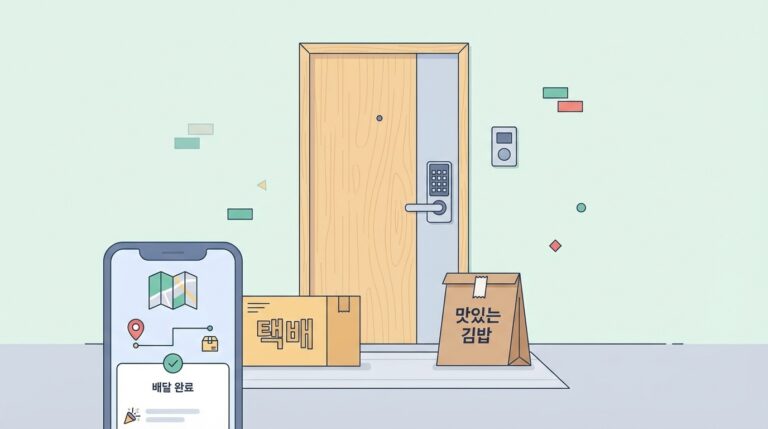
Phase 1: The Invisible Guest — Immersive Hook
Greeting: 안녕하세요! This is your Daily Hangul Chief Editor.
Imagine this scene: You’re in your Seoul apartment, it’s 11 PM, and you’re wearing your most comfortable (and questionable) pajamas. You’ve just binge-watched three episodes of a K-Drama where the lead characters are eating Tteokbokki. Naturally, you order some too.
The app says “Arriving in 5 minutes.” The intercom rings. Do you run to the door, fling it open, and greet the rider with a beaming smile?
Absolutely not. In modern Korea, that’s almost… awkward.
Instead, you hold your breath. You wait for the thud of the plastic bag hitting the floor, the beep of the rider taking a “proof photo,” and the fading footsteps. Only then do you crack the door open like a secret agent retrieving a dossier. Welcome to the world of “Non-Contact Delivery” (비대면 배달)—a practice that started for safety but stayed for the glorious privacy.
If you don’t know how to navigate this, you might end up in an awkward face-off with a rider who just wanted to drop the food and run. Let’s master the art of the “Silent Handoff.”
Phase 2: Deep Dive into Core Expressions
Since you are at an advanced (C2) level, we won’t just learn “Leave it here.” We will look at the nuanced requests used in delivery apps.
1. 문 앞에 두고 가시면 돼요 (Mun ape dugo gasimyeon dwaeyo)
- Pronunciation: [Mun a-pe du-go ga-si-myeon dwae-yo]
- Sound-alike: Moon ah-peh doo-go gah-she-myun dwe-yo
- Meaning:
- Literal: If you put it in front of the door and go, it works.
- Nuance: “Please just leave it at the door (you don’t need to wait for me).” This is a polite but firm way to authorize the rider to leave without a handover.
- K-Culture Moment: In slice-of-life dramas, you often see a tired office worker coming home to find a stack of boxes or food bags already waiting. This phrase is the invisible command that made that scene possible.
- Editor’s Insight: The grammar
-(으)면 돼요(it works if…) is crucial here. It removes the burden from the rider. You aren’t just ordering them; you are telling them, “This condition is sufficient for a successful delivery.”- Situation Spectrum:
[🚫 Formal Meeting] ———— [⚠️ Face-to-Face] ———— [✅ App Request Box/Intercom]
- Note: This is mostly written in the “Request to Rider” (라이더님께) field in apps or spoken over the intercom.
- 🤔 Think About It: Why does Korean use “Go” (가시다) here? It emphasizes the completion of the rider’s departure, signaling that their job is done the moment they leave the item.
2. 벨 누르지 말고 노크해 주세요 (Bel nureuji malgo nokeu-hae juseyo)
- Pronunciation: [Bel nu-reu-ji mal-go no-keu-hae ju-se-yo]
- Meaning: Please knock instead of ringing the bell.
- K-Culture Moment: Essential for parents with sleeping babies (often called “Yook-ah” / parenting mode) or pet owners whose dogs go crazy at the sound of a doorbell. You’ll see this request often in “Mom Cafes” (online communities).
- Editor’s Insight: The structure
~지 말고 ~해 주세요(Don’t do A, do B) is a high-frequency pattern for modifying behavior politely. It’s direct but softened by주세요.- Situation Spectrum:
[🚫 Boss] ———— [⚠️ Stranger] ———— [✅ Delivery/Service]3. 비대면으로 부탁드립니다 (Bidaemyeoneuro butakdeurimnida)
- Pronunciation: [Bi-dae-myeo-neu-ro bu-tak-deu-rim-ni-da]
- Meaning: I request a non-contact delivery.
- K-Culture Moment: This became the standard phrase during the pandemic. Now, it’s used when you simply don’t want to encounter another human being (social battery 0%).
- Editor’s Insight: Bi-dae-myeon (비대면 / 非對面) is a Hanja word meaning “Not-Face-Face.” As a C2 learner, using Sino-Korean words like this adds a layer of formal sophistication and clarity compared to purely native phrasing.
Phase 3: Textbook vs. Real Life
| Context | 📖 Textbook Korean | 🗣️ Real Korean (App Requests) | 💡 Why the difference? |
|---|---|---|---|
| Leaving at door | 문 앞에 놓아주십시오. (Please place it at the door.) | 문 앞에 놔주세요. (Shortened, polite-casual) | Efficiency. Apps have character limits, and 놔주세요 (contracted 놓아주세요) is faster to read. |
| Password Entry | 비밀번호는 1234입니다. (The password is 1234.) | 비번 1234 / 🔔 호출 X (PW 1234 / No Bell) | Koreans love abbreviations. Bibeon is short for Bimil-beonho. Symbols are used for visual speed. |
| Finding the house | 집을 찾기 어려우시면 전화하세요. | 못 찾으시면 전화 📲 (Call if you can’t find) | Visual cues (emojis) and sentence fragments convey the message instantly to a rider on a motorbike. |
Bottom Note: In the “Request to Rider” field, brevity is kindness. Riders are driving; they can’t read a novel.
Phase 4: Cultural Deep Dive — The Trust of the Porch
4-1. The Paradox of “Ppalli-Ppalli” and Trust
Have you ever wondered why packages and expensive food deliveries sit in front of doors for hours without being stolen? This phenomenon (often shocking to Westerners) relies on CCTV Culture and a high level of Civic Safety. In Korea, the “Non-contact” delivery works because there is an implicit social contract: “I trust you to deliver it, and you trust the neighbors not to steal it.”
4-2. K-Drama Trope: The Rooftop Room (Oktapbang) Delivery
In dramas, the struggling protagonist often lives in a rooftop room. The delivery rider is shown huffing and puffing up the stairs.
* Real Life Nuance: If you live on a floor without an elevator, you might sometimes see a delivery fee surcharge or a request for you to come down. If a rider climbs 5 floors to bring your Jajangmyeon, a heartfelt “고생하셨습니다” (You suffered/worked hard) written in the review or said through the door is essentially mandatory manners.
Phase 5: Immersive Roleplay — The App Glitch
Setting: It’s raining heavily (aka “Delivery Hell”). You ordered fried chicken via ‘Baemin’ (Baedal Minjok). The app says “Delivered,” but there’s nothing at your door. You need to call the rider.
Characters:
* YOU: Hungry, slightly annoyed, but polite C2 learner.
* Rider: Stressed, wearing a wet raincoat, helmet on.
Dialogue:
YOU: (Calling via the Safe Number feature) 여보세요? 기사님, 앱에는 배달 완료라고 뜨는데 문 앞에 음식이 없어서요.
(Yeoboseyo? Gisanim, aeb-eneun baedal wallyorago tteuneunde mun ape eumsigi eopseoseoyo.)
(Hello? Driver, the app says delivery complete, but there is no food in front of the door.)
Rider: 아, 혹시 101동 304호 아니세요?
(Ah, hoksi 101-dong 304-ho aniseyo?)
(Ah, aren’t you Building 101, Unit 304?)
YOU: 아뇨, 저 102동인데요… 옆 동으로 가신 것 같아요.
(Anyo, jeo 102-dong indeyo… yeop dong-euro gasin geot gatayo.)
(No, I’m Building 102… I think you went to the building next door.)
Rider: 아이고, 죄송합니다. 비가 와서 제가 착각했네요. 금방 다시 가져다 드릴게요.
(Aigo, joesonghamnida. Biga waseo jaega chak-gak-haet-neyo. Geumbang dasi gajyeoda deurilgeyo.)
(Oh my, I’m sorry. The rain made me confused. I’ll bring it to you right away.)
🔀 Decision Point: How do you respond to the stressed rider?
- A) “네, 빨리 좀 부탁드려요. 식잖아요.” (Okay, please hurry. It’s getting cold.)
- B) “네, 빗길인데 천천히 조심히 오세요.” (Okay, the roads are wet, so please come slowly and safely.)
- C) “아… 네.” (Ah… okay.)
✅ Best Choice: B — This is the peak of Korean “Jeong” (affection/connection). Even though you are hungry, acknowledging the dangerous rain (
빗길) and telling them to be safe (조심히) relieves the rider’s stress. This often results in better service.
⚠️ Choice A Analysis: Grammatically correct, but culturally harsh. In Korea, complaining about speed during rain is seen as lacking empathy (Gapjil).
Phase 6: 10-Second Shadowing Drill
Practice the rhythm of a polite request. Notice how the pitch raises slightly at the end to sound softer.
- Emotion: Polite & Considerate (😊)
- Sentence: 문 앞에 / 놓아 주시고 / 벨은 / 누르지 말아 주세요.
- Romanization: Mun ape / no-a jusigo / bereun / nureuji mara juseyo.
- Meaning: Please leave it at the door and please do not ring the bell.
Phase 7: K-Culture Mini Glossary
| Korean | Romanization | English | Context |
|---|---|---|---|
| 안심번호 | Ansim-beonho | Safety Number | A temporary virtual phone number generated by apps to protect your real number from riders. |
| 리뷰 이벤트 | Ribyu-ibenteu | Review Event | Free sides (soda, fries) given if you promise to write a 5-star review. K-Food hack! |
| 픽업 | Pigeop | Pick-up | Ordering on the app but walking to get it yourself (to save delivery fees). |
| 배달팁 | Baedal-tip | Delivery Fee | Ironically called “Tip,” but it’s a mandatory fee, not a gratuity. |
Phase 8: Traveler’s Survival Kit (Ordering to a Hotel/Park)
Ordering delivery isn’t just for residents. Travelers do it too!
🆘 Survival Expression #1: The Lobby Handoff
* 🇰🇷 “로비에서 받을게요.” (Robi-eseo badeulgeyo.)
* 🗣️ Sound: Lo-bee-eh-so bah-dul-keh-yo
* Context: Most hotels do not allow riders to go up to guest rooms. You must meet them in the lobby.
* Pro Tip: Riders usually wear helmets and hold a phone. Look for eye contact!🆘 Survival Expression #2: The Han River Zone
* 🇰🇷 “배달존 2번으로 와주세요.” (Baedal-jon i-beon-euro wajuseyo.)
* Context: If you are picnicking at Han River, you can’t say “under the big tree.” You must go to designated Delivery Zones.
Phase 9: Think Deeper — Critical Thinking
🧠 Topic: The Disconnect of Convenience
While non-contact delivery is efficient, some sociologists argue it deepens the “Atomization” (개인화) of Korean society. We interact with an interface, not a person. The rider becomes an invisible mechanic rather than a neighbor.
Interestingly, the language has shifted too. We use passive, object-focused language (“문 앞에 둠” – Placed at door) rather than subject-focused language (“I received it”).
💬 Your Turn: In your culture, would leaving food on the floor be considered rude, or efficient? How does your language handle the balance between service speed and human connection?
Phase 10: FAQ & Troubleshooting
- Q: Should I tip the delivery rider in person?
- A: Generally, No. The delivery fee is already paid in the app. Handing cash can be awkward. However, during extreme weather (snowstorms), some people leave a small drink or snack at the door with a note. That is strictly “Jeong,” not a financial obligation.
- Q: Can I ask them to throw away my trash?
- A: Absolutely NOT. This is a huge taboo. Riders are not cleaners. Asking this is considered extremely rude (Gapjil).
- Common Mistake #1: Thinking “Delivery Tip” (배달팁) in the app goes 100% to the rider.
- Reality: It’s often split between the platform and the delivery agency. Don’t assume the rider is getting rich off that fee.
Phase 11: Wrap-up & Action Items
One-Liner: “Mastering the non-contact delivery request is your key to enjoying Korean food with maximum privacy and manners.”
🚀 Action Missions:
* 🥉 Bronze: Open a Korean delivery app (Baemin/Yogiyo/Coupang Eats) and find the “Request to Rider” field.
* 🥈 Silver: Practice typing “문 앞에 두시고 문자 주세요” (Leave at door and text me) without looking at a translator.
* 🥇 Gold: Order something to a specific location (like a park or a friend’s lobby) and successfully navigate the meetup using the text feature!
K-Culture Mission: Watch a scene in a drama where someone receives a delivery. Do they open the door immediately? Or do they check the monitor first? Spot the “Safety” nuances!
Phase 12: Interactive Quiz
1. Which request is most appropriate if you have a sleeping baby?
* A) 빨리 와주세요. (Come quickly.)
* B) 도착해서 전화 주세요. (Call when you arrive.)
* C) 벨 누르지 말고 노크해 주세요. (Knock instead of ringing bell.)
2. True or False?
* “In Korea, it is polite to invite the delivery rider inside for a glass of water.”
* (Toggle for Answer) -> FALSE! For safety and efficiency, riders expect to stay outside the threshold. Offering water is kind, but inviting them in is culturally unusual and awkward for both parties.
3. Fill in the blank:
* To ask for a non-contact delivery, you say: “_____으로 부탁드립니다.”
* (Answer: 비대면)
Frequently Asked Questions (FAQ)
Q: What does "문 앞에 두고 가시면 돼요 (Mun ape dugo gasimyeon dwaeyo)" mean in Korean and how do you pronounce it?
A: In Korean, "문 앞에 두고 가시면 돼요 (Mun ape dugo gasimyeon dwaeyo)" is pronounced [Mun a-pe du-go ga-si-myeon dwae-yo] and means: Literal: If you put it in front of the door and go, it works.
Q: What does "벨 누르지 말고 노크해 주세요 (Bel nureuji malgo nokeu-hae juseyo)" mean in Korean and how do you pronounce it?
A: In Korean, "벨 누르지 말고 노크해 주세요 (Bel nureuji malgo nokeu-hae juseyo)" is pronounced [Bel nu-reu-ji mal-go no-keu-hae ju-se-yo] and means: Please knock instead of ringing the bell.
Q: What does "비대면으로 부탁드립니다 (Bidaemyeoneuro butakdeurimnida)" mean in Korean and how do you pronounce it?
A: In Korean, "비대면으로 부탁드립니다 (Bidaemyeoneuro butakdeurimnida)" is pronounced [Bi-dae-myeo-neu-ro bu-tak-deu-rim-ni-da] and means: I request a non-contact delivery.







