

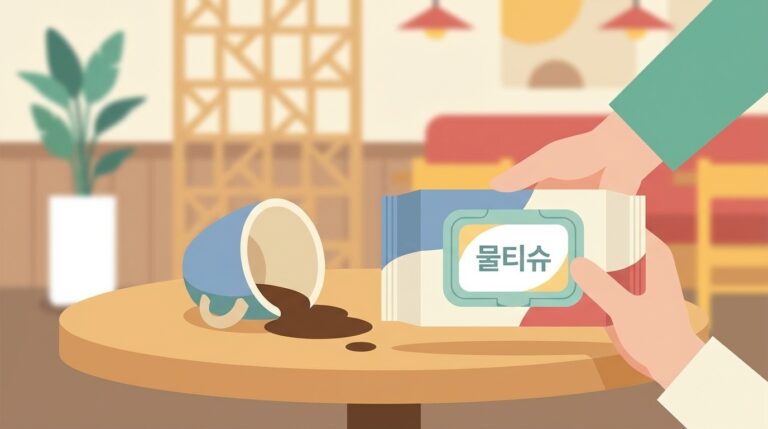
Phase 1: Help! I Spilled My Coffee! ☕️💦
Hello, Daily Hangul family! It’s your editor, the one who always spills something on a white shirt.
Picture this: You are in a trendy cafe in Seoul (maybe the one you saw in Itaewon Class?). You are enjoying a delicious Einspanner coffee. Suddenly—splat! A drop of cream lands on your table. You look around for a napkin, but… the table is empty. Panic sets in.
In K-Dramas, this is the moment a handsome lead character silently hands over a handkerchief. But in reality? You need to find a ‘Hyu-ji’ (Tissue) fast, or that stain is permanent!
Today, we aren’t just learning words; we are saving your outfit. We will learn how to ask for napkins and, more importantly, where they are hiding in Korean restaurants (hint: check under the table!).
Phase 2: The “Cleanup Crew” Vocabulary 🧻
Let’s master the three lifesavers you need when things get messy.
1. 휴지 (Hyu-ji)
- Pronunciation: [Hyu-ji]
- Hyu sounds like ‘Hugh’ Jackman.
- ji sounds like the letter ‘G’.
- Meaning: Tissue / Dry Napkin
- K-Culture Moment: In Korea, we rarely use the English word “Napkin.” Whether it’s a toilet roll or a fancy table napkin, we usually call it all Hyu-ji.
- Situation Spectrum:
[🚫 Formal Banquet] ———— [✅ Everywhere Else] ———— [✅ Casual]- 🤔 Think About It: Why does Korean use one word for toilet paper and facial tissue? It reflects a pragmatic culture where function matters more than form!
2. 물티슈 (Mul-ti-syu)
- Pronunciation: [Mul-ti-syu]
- Mul means Water.
- Ti-syu is ‘Tissue’.
- Meaning: Wet Wipe / Wet Tissue
- Editor’s Insight: This is the Holy Grail of Korean dining. Fried chicken? BBQ? You need this. It cleans everything.
- Situation Spectrum:
[✅ Essential in Restaurants] ———— [✅ Cafes] ———— [⚠️ Fancy Fine Dining]3. 주세요 (Ju-se-yo)
- Pronunciation: [Ju-se-yo]
- Sounds like saying “Juice? Say yo!” quickly.
- Meaning: Please give me.
- Grammar Tip: Just put the noun before this word.
- Hyu-ji + Juseyo = Please give me tissues.
- 🤔 Think About It: Korean puts the verb at the end. Instead of “Give me tissue,” you say “Tissue give.” Why? Because the object (what you want) is the most important information!
Phase 3: Textbook vs. Real Life 🗣️
In a busy Hongdae cafe, formal sentences might feel too slow.
| Situation | 📖 Textbook Korean | 🗣️ Real Street Korean | 💡 Why? |
|---|---|---|---|
| Asking for a napkin | 냅킨 좀 주시겠어요? (Naep-kin jom ju-si-ge-sseo-yo?) | 휴지 좀 주세요. (Hyu-ji jom ju-se-yo.) | “Napkin” sounds like a hotel; “Hyu-ji” is everyday language. |
| Asking for wet wipes | 물수건 있나요? (Mul-su-geon it-na-yo?) | 물티슈 있어요? (Mul-ti-syu i-sseo-yo?) | “Mul-su-geon” is an old-school towel; “Mul-ti-syu” is the modern disposable wipe. |
| Pointing at the empty dispenser | 휴지가 없습니다. (Hyu-ji-ga eop-seum-ni-da.) | 여기 휴지 없어요. (Yeo-gi hyu-ji eop-seo-yo.) | Simpler is better in a noisy cafe. |
Bottom Note: As a beginner (A1), stick to “[Item] Ju-se-yo”. It works 100% of the time and is polite enough for everyone!
Phase 4: Cultural Deep Dive — The Secret Drawer 🕵️♀️
4-1. The Magic Drawer (Su-jeo-tong)
Have you ever sat at a Korean restaurant, looking for a spoon and napkin, and the table is completely bare? Don’t panic!
Reach under the side of the table.
In 90% of casual Korean restaurants, there is a hidden drawer built into the table. It holds spoons, chopsticks, and Hyu-ji.
* Pro Tip: If you open it for yourself, take out spoons and napkins for everyone at your table. This is good Nunchi (social sense)!
4-2. The “Self-Bar” Culture
In many modern cafes (like Mega Coffee or Paik’s Coffee), staff won’t bring you napkins. Look for a station labeled “Self” (셀프) or “Pick Up.” That is where you find water, syrup, straws, and napkins.
- K-Drama Connection: Notice how characters in dramas often grab a huge stack of napkins when they cry or spill something? They are usually at the “Self-Bar.”
Phase 5: Roleplay — The Spill Crisis 🎬
Setting: A crowded cafe in Gangnam. You just spilled a little bit of your latte on the counter.
Characters:
– YOU: A caffeine-deprived traveler.
– Staff: A busy part-timer wearing a green apron.
Dialogue:
YOU: (Raising hand slightly) 저기요!
(Jeo-gi-yo!)
(Excuse me!)
Staff: 네, 도와드릴까요?
(Ne, do-wa-deu-ril-kka-yo?)
(Yes, can I help you?)
YOU: 죄송한데, 물티슈 있어요?
(Joe-song-han-de, mul-ti-syu i-sseo-yo?)
(Sorry, but do you have wet wipes?)
Staff: 아, 네! 잠시만요. (Hands you a wipe)
(Ah, ne! Jam-si-man-yo.)
(Ah, yes! Just a moment.)
🔀 Decision Point! The staff handed it to you with two hands. How do you accept it?
- A) Grab it with one hand and wipe immediately.
- B) Receive it with two hands and say “Gamsahamnida.”
- C) Give them a high-five.
✅ Best Choice: B. In Korea, giving and receiving with two hands shows respect.
⚠️ Choice A Analysis: It’s not “rude,” but two hands make you look like a culturally aware pro!
Phase 6: 10-Second Shadowing Drill 🎧
Let’s practice! Read the sentiment tags to get the acting right.
- (🥺 Urgent/Polite)
휴지 / 좀 / 주세요!
(Hyu-ji / jom / ju-se-yo!) -
(🤔 Curious)
물티슈 / 있어요?
(Mul-ti-syu / i-sseo-yo?) -
(💡 Realization – Finding the drawer)
아! / 여기 / 있네요.
(Ah! / yeo-gi / it-ne-yo.)
Phase 7: K-Culture Mini Glossary 📖
| Korean | Romanization | Meaning | Context |
|---|---|---|---|
| 셀프 | Sel-peu | Self-service | You must get water and napkins yourself. |
| 수저통 | Su-jeo-tong | Cutlery Box | The hidden drawer under the table! |
| 화장실 | Hwa-jang-sil | Restroom | Often, toilet paper is found outside the stall near the entrance in older buildings. |
Phase 8: Traveler’s Survival Kit 🆘
If you are traveling in Korea, “Where is it?” is your best friend.
🆘 Survival Expression #1
– 🇰🇷 “쓰레기통 어디예요?” (Sseu-re-gi-tong eo-di-ye-yo?)
– 🗣️ Meaning: Where is the trash can?
– 📍 Use: After you wipe your spill, you need to throw the tissue away!
– 💡 Pro Tip: Trash cans are rare on Korean streets. You usually have to throw it away inside the cafe.📌 Editor’s Travel Note
– Carrying Tissues: Public restrooms in subway stations usually have toilet paper, but older buildings might not. Always keep a small pack of tissues (pocket tissues) in your bag. You can buy them at any convenience store (CU, GS25) for 1,000 won!
Phase 9: Think Deeper — “Why Self-Service?” 🧠
Topic: Pali-Pali (Hurry-Hurry) Culture & Efficiency
Have you noticed how many things are “Self-Service” in Korea? Water, side dishes (Kimchi), and napkins are often things you get yourself. Why?
It’s connected to Korea’s “Pali-Pali” (Quickly, Quickly) culture. Waiting for a waiter to bring a single napkin feels inefficient to many Koreans. Getting it yourself is faster for you and lets the staff focus on cooking or making coffee. It’s not bad service; it’s optimized service.
💬 Your Turn: Does your country prefer full service, or do you like grabbing things yourself? Let me know in the comments!
Phase 10: FAQ & Troubleshooting 🛠️
Q: Can I take a handful of napkins from the cafe to keep in my bag?
A: Maybe, but be careful. Taking 2-3 extra is fine. Taking a huge stack (like 20) is considered rude or “lacking manners” (jin-sang). Take only what you need!
Q: I asked for a napkin, but they gave me a toilet roll. Is this a joke?
A: Nope! In many casual Korean restaurants (especially old-school ones), a roll of toilet paper on the table is perfectly normal. It’s used as napkins. Don’t be shocked—it’s just practical!
❌ Common Mistake:
Asking for “Napkin” (냅킨) at a street food stall.
✅ Fix: Use “Hyu-ji” (휴지). They might not understand “Napkin” or think you are asking for something fancy.
Phase 11: Wrap-up & Action Mission 🚀
Summary: Today we learned Hyu-ji (Dry tissue) and Mul-ti-syu (Wet wipe), and the magic phrase Ju-se-yo (Please give me).
Your Mission:
– 🥉 Bronze: Say “Mul-ti-syu Ju-se-yo” three times in the shower.
– 🥈 Silver: Next time you watch a K-Drama eating scene, look for the tissue box or the hidden table drawer!
– 🥇 Gold: Go to a Korean restaurant in your city. Try to find the spoon/napkin drawer under the table without asking the waiter. If you find it, smile and say “Ah! Yeo-gi it-ne!” (Ah! Here it is!)
Phase 12: Quiz — Spot the Napkin! 🧩
- Situation: You just finished eating spicy tteokbokki and your hands are sticky. What do you ask for?
- A) 휴지 주세요 (Hyu-ji juseyo)
- B) 물티슈 주세요 (Mul-ti-syu juseyo)
- Culture: You sit down at a BBQ place, but the table top is empty. Where is the most likely place for the napkins?
- A) In the kitchen
- B) In a drawer under the table
- C) The waiter is hiding them
- True or False: It is rude to use toilet paper rolls as napkins in a casual Korean restaurant.
- (True / False)
Answers:
1. B (Sticky needs wet wipes!)
2. B (Check the drawer!)
3. False (It is very common and accepted in casual places!)
Frequently Asked Questions (FAQ)
Q: What does "휴지 (Hyu-ji)" mean in Korean and how do you pronounce it?
A: In Korean, "휴지 (Hyu-ji)" is pronounced [Hyu-ji] and means: a key conversational Korean expression covered in this lesson.
Q: What does "물티슈 (Mul-ti-syu)" mean in Korean and how do you pronounce it?
A: In Korean, "물티슈 (Mul-ti-syu)" is pronounced [Mul-ti-syu] and means: a key conversational Korean expression covered in this lesson.
Q: What does "주세요 (Ju-se-yo)" mean in Korean and how do you pronounce it?
A: In Korean, "주세요 (Ju-se-yo)" is pronounced [Ju-se-yo] and means: a key conversational Korean expression covered in this lesson.







