

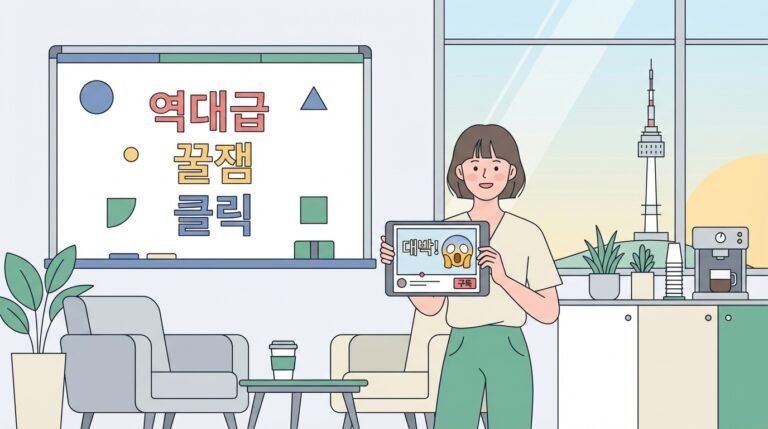
Clickbait or Art? Mastering Korean Headlines & Copywriting like a Pro
Phase 1: Immersive Hook
Greeting: 안녕하세요! This is your Daily Hangul Editor, reporting from a buzzing cafe in Seongsu-dong, the Brooklyn of Seoul.
The Scene: Picture this. You’re watching a K-Drama like Search: WWW or Start-Up. The marketing team is huddled in a glass meeting room, stressed out. The product launch is tomorrow. The team leader slams the table and sighs, “This headline has no impact. It doesn’t make me want to click! Where is the gamseong (emotion)?”
In the fierce world of Korean content—whether it’s a YouTube thumbnail, a Webtoon episode title, or an Instagram caption—boring is a sin. If you translate standard English headlines directly into Korean, they often sound like a dry encyclopedia entry. To survive in the K-Internet sphere, you need to know how to “pull aggro” (draw attention) effectively.
The ‘Why’: At C1 level, you aren’t just communicating information; you are persuading, seducing, and connecting. Mastering these copywriting nuances will not only help you understand why certain K-Pop videos go viral but also allow you to write Korean that feels “alive” and trendy. Let’s turn your Korean from “textbook correct” to “click-worthy.”
Phase 2: Deep Dive into Killer Copy
Here are three high-level expressions used constantly in Korean marketing and digital headlines to grab attention.
1. 역대급 (Yeokdaegeup)
- Pronunciation: [Yeok-dae-geup] + [Sounds like ‘Yuck’ but with a clear ‘Yeo’, ‘dae’ as in ‘day’, ‘geup’ implies a sudden stop]
- Meaning: Literal: “All-time class/level” → Real Nuance: “Legendary,” “Unprecedented,” “Best ever.”
- K-Culture Moment: You’ll see this on every movie trailer: “역대급 스케일” (Unprecedented scale). Or when a K-Pop idol has a visual transformation: “이번 비주얼 역대급이다” (These visuals are legendary).
- Editor’s Insight: Koreans love superlatives. ‘Good’ is not enough. It has to be the best in history. It creates a sense of FOMO (Fear Of Missing Out).
- Situation Spectrum:
[🚫 Formal Report] ———— [⚠️ Semi-formal Ad] ———— [✅ Social Media]- 🤔 Think About It: Why does Korean society favor such extreme superlatives? Does the competitive nature of the society demand that everything be “the best ever” to be noticed?
2. ~는 못 참지 (~neun mot chamji)
- Pronunciation: [~neun mot cham-ji]
- Meaning: Literal: “I cannot tolerate ~” → Real Nuance: “I can’t resist ~,” “I have to have/do ~,” “This is irresistible.”
- K-Culture Moment: A Mukbang YouTuber sees spicy tteokbokki: “야식으로 떡볶이는 못 참지!” (I can’t resist tteokbokki for a late-night snack!). It implies a universal agreement that this thing is too good to pass up.
- Editor’s Insight: This phrase builds a consensus. It assumes the reader agrees with you. It creates an instant “us vs. them” bond—we are the people who get why this is irresistible.
- Situation Spectrum:
[🚫 Boss] ———— [⚠️ Colleagues] ———— [✅ Friends/Instagram]3. 폼 미쳤다 (Pom michyeotda)
- Pronunciation: [Pom mi-chyeot-da]
- Meaning: Literal: “The form is crazy.” → Real Nuance: “Class is permanent,” “They are killing it,” “Performance is at its peak.”
- K-Culture Moment: Originally from sports (soccer) commentary regarding a player’s condition, now used for everything. When an actor acts perfectly: “연기 폼 미쳤다.” When a restaurant’s food is amazing: “여기 안주 폼 미쳤다.”
- Editor’s Insight: “Crazy” (미쳤다) is often a compliment in modern Korean slang. It signifies exceeding expectations to a shocking degree.
- Situation Spectrum:
[🚫 Elders] ———— [⚠️ Casual Ad copy] ———— [✅ Internet Comment]
Phase 3: Textbook vs. Real Life
| Situation | 📖 Textbook Korean | 🗣️ Real Copywriting | 💡 Why the difference? |
|---|---|---|---|
| Promoting a Sale | 50% 할인을 진행합니다. (We are proceeding with a 50% discount.) | 반값 할인 실화냐? ㄷㄷ (Half-price discount, is this real life? [shivering]) | The internet generation values shock value and reaction over dry facts. ‘ㄷㄷ’ adds visual trembling/excitement. |
| Introducing New Food | 이 음식은 정말 맛있는 조합입니다. (This food is a really delicious combination.) | 맛없없 조합 (Mat-eop-eop Johap) | Efficiency. ‘맛없없’ stands for ‘맛이 없을 수 없는’ (Impossible not to be tasty). Abbreviations signal trendiness. |
| Posting a Travel Photo | 경치가 아주 아름답습니다. (The scenery is very beautiful.) | 풍경 찢었다… (Tore the scenery apart…) | Using aggressive verbs like ‘찢다’ (to tear/rip) to mean ‘dominated/slayed’ adds dramatic flair popular in hip-hop culture. |
Bottom Note: As a C1 learner, avoid overusing slang like ‘찢었다’ in professional emails, but definitely use ‘역대급’ in presentation titles to grab attention!
Phase 4: Cultural Context — K-Culture Deep Dive
4-1. The Art of “Aggro” (어그로)
In Korean internet culture, “Aggro” (from the English ‘aggravation’) doesn’t just mean annoying. To “drag aggro” (어그로를 끌다) means to successfully draw attention through controversy, curiosity, or shock. In K-Marketing, a little bit of ‘good aggro’ is essential. It’s the art of the “Thumb-gwan-jong” (Thumbnail + Attention Seeker).
4-2. K-Drama Connection: The “Ending Fairy” (엔딩요정)
Just like K-Pop performances have an “Ending Fairy” (the member who gets the final close-up shot), your headline needs an “Ending.” A popular copywriting structure is “결국 ~엔딩” (Eventually ~ ending).
- Example: “Diet started today… eventually Chicken Ending.” (Started a diet, but ended up eating chicken).
- Usage: Use this to tell a relatable, often self-deprecating story in just two words.
Phase 5: Immersive Roleplay
Setting: Friday, 4 PM. A trendy shared office in Gangnam. You are a Senior Editor at a lifestyle magazine. You are brainstorming a title for an article about a new, incredibly spicy ramyun release.
Characters:
– YOU: The creative genius trying to bridge foreign and Korean trends.
– Min-ji (26): Gen Z intern. Obsessed with TikTok trends. Speaks in short slang.
Dialogue:
Min-ji: 에디터님, 이번 라면 기사 제목 어떻게 뽑죠? 그냥 ‘매운 라면 출시’는 너무 노잼인데요. 🙄
(Editor-nim, ibeon ramyeon gisa jemok eotteoke ppopjyo? Geunyang ‘maeun ramyeon chulsi’neun neomu nojaem-indeyo.)
[Editor, how should we pick the title for this ramyun article? Just ‘Spicy Ramyun Release’ is too no-fun.]
YOU: (Thinking: We need something stronger…) 음, 맞아. 사람들이 클릭하게 만들어야지.
(Eum, maja. Saramdeuri keullikhage mandeureoyaji.)
[Hmm, right. We need to make people click.]
Min-ji: ‘맵찔이들은 절대 금지’ 어때요? 좀 도발적으로요.
(‘Maepjjirideureun jeoldae geumji’ eottaeyo? Jom dobaljeogeuroyo.)
[‘No Spice-Cowards Allowed’ how about that? A bit provocatively.]
🔀 Your Turn! How do you refine this headline?
- A) “좋아. ‘매운 거 못 먹는 사람은 사지 마세요’라고 쓰자.” (Too literal/boring)
- B) “그거 좋다! ‘맵찔이 오열각? 지옥에서 온 라면 등판’ 어때?” (Great! ‘Spice-cowards gonna cry? Ramyun from hell has arrived’?)
- C) “너무 공격적이야. 그냥 ‘맛있는 라면’으로 해.” (Too safe)
✅ Best Choice: B
Why? You used ‘오열각’ (Angle/probability of sobbing) and ‘등판’ (baseball term for pitching/appearing). This is C1 level “Inssa” (Insider) copywriting!
Phase 6: 10-Second Shadowing Drill
Let’s practice reading headlines with the right punch.
- Shock/Awe:
😲 이 가격 / 실화냐? / 사장님이 / 미쳤어요! (I ga-gyeok / sil-hwa-nya? / Sa-jang-nim-i / mi-chyeoss-eo-yo!)
[Is this price for real? The boss is crazy!] -
Irresistible:
😤 퇴근 후 / 치맥은 / 못 참지! (Toe-geun hu / chi-maek-eun / mot cham-ji!)
[Chicken and beer after work is irresistible!] -
Legendary:
✨ 이번 신곡 / 라이브 / 폼 미쳤다… (I-beon sin-gok / ra-i-beu / pom mi-chyeot-da…)
[This new song’s live performance class is crazy…]
Phase 7: K-Culture Mini Glossary (Copywriting Edition)
| Korean | Romanization | English | Context |
|---|---|---|---|
| 낚시 | Nak-si | Fishing (Clickbait) | When a headline promises something but the content doesn’t deliver. “낚였다” (I got fished/tricked). |
| 떡상 | Tteok-sang | Skyrocketing | Originally a crypto/stock term. Used when views or popularity explodes. “This video is going to tteok-sang.” |
| 좌표 | Jwa-pyo | Coordinates (Link) | “좌표 찍어주세요” means “Give me the link/source.” |
| 팩폭 | Paek-pok | Fact Violence | Hitting someone with facts so hard it hurts. Brutally honest copy. |
| 후방주의 | Hu-bang ju-ui | Watch your back (NSFW) | Used in titles when the content is risky to view in public/office. |
Phase 8: Traveler’s Survival Kit — Reading Street Signs
Even if you aren’t a marketer, you need to read “Marketing Korean” to survive shopping and dining.
🆘 Survival Marketing Terms
– 🇰🇷 1+1 (One plus One): Buy one get one free. (We say “One-pul-one”).
– 🇰🇷 오픈런 (Open Run): Running into a store as soon as it opens. If you see a line at a bagel shop, it’s an “Open Run.”
– 🇰🇷 마감임박 (Ma-gam im-bak): Deadline imminent / Closing soon. If you see this on a home shopping channel or travel site, buy now.📌 Editor’s Note: Korean signs often use Cho-seong (Initial Consonants) like ‘ㅈㅁㅌ’ (JMT – John-Mat-Taeng / Very delicious) or ‘ㅂㅂㅂG’ (Bye-Bye-Bad-Girl / Example of creative acronyms). If you see random consonants, it’s likely an abbreviation!
Phase 9: Think Deeper — “Why so intense?”
The “Palli-Palli” (Hurry-Hurry) Effect on Language:
Korean headlines are getting shorter and more intense. Why? Because of the “Palli-Palli” culture. Koreans consume information at lightning speed. A headline has less than 0.5 seconds to work. This has led to the evolution of “compressed words” (Jul-im-mal) and intense emotional triggers.
🧠 Think Deeper: In your culture, is clickbait considered purely negative, or is it accepted as a necessary evil of the internet age? How does your language shorten words for efficiency?
Phase 10: FAQ & Troubleshooting
Q: Can I use words like ‘미쳤다’ (Crazy) or ‘존맛’ (JMT) in a business email to my boss?
A: 🚫 NO. Absolutely not. These are powerful for consumer-facing copy (B2C), social media, or casual conversation. In a business email, use ‘파격적인’ (Unconventional/Shocking) instead of ‘미친’, and ‘매우 훌륭한’ (Excellent) instead of ‘존맛’.
Q: Is ‘Aggro’ always bad?
A: Not in marketing. ‘성공한 어그로’ (Successful aggro) is a compliment for a marketer. It means you managed to get attention in a noisy world. But ‘끌다’ (to drag) aggro without substance is ‘낚시’ (fishing), which makes people angry.
Phase 11: Wrap-up & Action Mission
One-Liner Summary: To write Korean headlines that get clicks, use exaggerations (역대급), emphasize irresistibility (못 참지), and embrace trendy slang (폼 미쳤다) while respecting the platform’s formality.
🚀 Action Mission:
– 🥉 Bronze: Look at the thumbnail of your favorite K-Pop MV. Describe it out loud using “비주얼 폼 미쳤다.”
– 🥈 Silver: Go to a Korean YouTube channel. Find a video with over 1M views. Translate the title in the comments below!
– 🥇 Gold: Post a photo of your lunch on social media with the caption: “오늘 점심 메뉴 선정 역대급… 다이어트는 내일부터!” (Today’s lunch menu selection is legendary… diet starts tomorrow!)
Phase 12: Quiz — Spot the “Aggro”
Which of the following titles is the MOST likely to be clicked by a young Korean on YouTube? (And why?)
- Option A: 맛있는 김치찌개 만드는 법 (How to make delicious Kimchi-jjigae)
- Option B: 한국인이 좋아하는 김치찌개 레시피 (Kimchi-jjigae recipe Koreans like)
- Option C: “이것” 넣었더니 맛집 사장님이 고소하겠답니다 ㄷㄷ (Put “THIS” in and the famous restaurant owner said he’d sue me [shivering])
🔽 Answer (Toggle):
Correct: Option C.
Why? It uses Curiosity Gap (“This”), Story/Conflict (Getting sued by a pro), and Emotional visual (ㄷㄷ). It creates a narrative that you have to check. Option A and B are too textbook.
Frequently Asked Questions (FAQ)
Q: What does "역대급 (Yeokdaegeup)" mean in Korean and how do you pronounce it?
A: In Korean, "역대급 (Yeokdaegeup)" is pronounced [Yeok-dae-geup] and means: Literal: "All-time class/level" → Real Nuance: "Legendary," "Unprecedented," "Best ever."
Q: What does "~는 못 참지 (~neun mot chamji)" mean in Korean and how do you pronounce it?
A: In Korean, "~는 못 참지 (~neun mot chamji)" is pronounced [~neun mot cham-ji] and means: Literal: "I cannot tolerate ~" → Real Nuance: "I can't resist ~," "I have to have/do ~," "This is irresistible."
Q: What does "폼 미쳤다 (Pom michyeotda)" mean in Korean and how do you pronounce it?
A: In Korean, "폼 미쳤다 (Pom michyeotda)" is pronounced [Pom mi-chyeot-da] and means: Literal: "The form is crazy." → Real Nuance: "Class is permanent," "They are killing it," "Performance is at its peak."







