

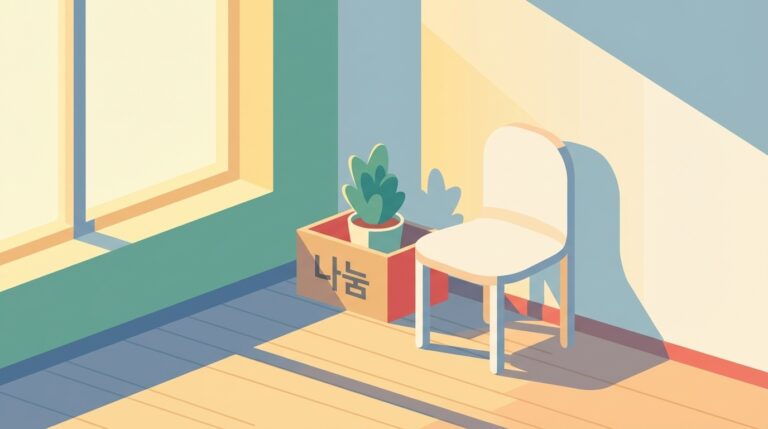
Phase 1: The Immersive Hook
Greeting: 안녕하세요! This is your Daily Hangul Senior Editor. 👋
The Scene: You’re sitting in a small, cozy cafe in Hongdae, scrolling through your phone. Suddenly, a very distinct notification sound chirps from the phones of three different people around you: “Dang-geun!” 🥕
If you’ve watched recent K-Dramas depicting realistic urban life, you might recognize this. It’s not a text message; it’s the heartbeat of modern Korean minimalism. It’s the sound of someone letting go of their past to make space for the future. In a country where trends move at light speed and living spaces in Seoul are notoriously compact, “decluttering” (becoming minimal) isn’t just a chore—it’s a lifestyle movement.
Today, we are going beyond simple buying and selling. We are talking about the art of “Nanum” (Sharing/Giveaways) and the philosophy of emptying one’s space. At C1 level, you shouldn’t just say “I threw it away.” You should be able to say, “I am practicing a minimalist life by sharing my cherished items.”
Why this matters: If you use the word ‘throwing away’ (버리다) for perfectly good items, Koreans might look at you with waste-guilt eyes. But if you say ‘Nanum’ (나눔), you become a generous, eco-conscious trendsetter. Let’s dive in.
Phase 2: Deep Dive into Core Expressions
1. [비우다 / 정리하다]
- Pronunciation: [bi-u-da / jeong-ni-ha-da]
(Think of ‘bi’ as in ‘be’ and ‘u’ like ‘moon’. ‘Jeong-ni’ sounds like ‘Johnny’ with a soft ‘J’.)- Meaning:
- Literal: To empty / To organize
- Real Nuance: To declutter; to purge possessions for mental clarity. 비우다 is the poetic/philosophical term used in minimalism. 정리하다 is the practical act.
- K-Culture Moment: In reality TV shows like The House Detox (신박한 정리), the host doesn’t tell celebrities to “throw junk away.” They ask, “마음을 비우고 공간을 정리해볼까요?” (Shall we empty our minds and organize the space?)
- Editor’s Insight: Use 비우다 when you want to sound sophisticated about your minimalism. Use 버리다 (to throw away) only for actual trash.
- Situation Spectrum:
[🚫 Formal Report] ———— [⚠️ Semi-formal] ———— [✅ Casual/Daily]
(Both are widely safe, but ‘비우다’ sounds more emotional/personal.)- 🤔 Think About It: Why does Korean use the word “empty” (비우다) instead of “remove”? Does it imply that the space itself has value that needs to be reclaimed?
2. [무료 나눔 (나눔하다)]
- Pronunciation: [muryo nanum]
(Sounds like ‘Moo-ryo Na-noom’. ‘Na’ as in ‘Nada’.)- Meaning:
- Literal: Free sharing
- Real Nuance: Giving away good quality items for free to neighbors. It carries a sense of community warmth rather than just “getting rid of junk.”
- K-Culture Moment: On the Karrot Market (Danggeun) app, items marked ‘나눔’ disappear in seconds. It’s a fierce battlefield! You might see a K-Pop fan ‘sharing’ duplicate albums to spread the love for their idol.
- Editor’s Insight: Never say “이거 공짜예요?” (Is this free/dirt cheap?) in this context. It sounds tacky. ask “혹시 나눔이신가요?” (Is this a sharing act?) to sound respectful.
- Situation Spectrum:
[🚫 Business Contract] ———— [⚠️ Stranger] ———— [✅ Neighbors/Online]3. [홀가분하다]
- Pronunciation: [hol-ga-bun-ha-da]
- Meaning:
- Literal: To be lighthearted
- Real Nuance: The specific feeling of relief and freedom after you finish a difficult task or get rid of a burden (mental or physical).
- K-Culture Moment: A protagonist in a drama finally breaks up with a toxic partner or quits a terrible job, walks out into the sunlight, stretches, and says, “아, 진짜 홀가분하다!”
- Editor’s Insight: This is the emotional goal of minimalism. You don’t declutter to have an empty room; you do it to feel 홀가분하다.
- 🤔 Think About It: Is there a single word in English that captures both the physical lightness and mental relief of finishing a burden like this?
Phase 3: Textbook vs. Real Life
| Situation | 📖 Textbook Korean | 🗣️ Real Korean (C1 Level) | 💡 Why the difference? |
|---|---|---|---|
| Giving things away | 이거 필요 없어서 버려요. (I don’t need this, so I’m throwing it away.) | 미니멀 라이프 실천하느라 비우고 있어요. (I’m emptying things out to practice a minimal life.) | The latter frames the action as a lifestyle choice, not waste. |
| Posting a free item | 무료로 드립니다. (I give this for free.) | 아끼던 건데 나눔합니다. (I cherished this, but I am sharing it.) | Adding “cherished” (아끼던) increases the item’s perceived value and the receiver’s gratitude. |
| After selling | 기분이 좋아요. (I feel good.) | 속이 다 시원하네요 / 홀가분해요. (My insides are cool / I feel unburdened.) | Koreans often express emotions through physical sensations (insides cooling down = relief). |
Phase 4: Cultural Deep Dive — The “Jeong” Paradox
4-1. Non-verbal: The “Doorstep Delivery” (문고리 거래)
In the age of extreme efficiency (and introversion), many Koreans prefer 문고리 거래 (Door-handle trading). You hang the item on your doorknob, send a photo, and the receiver picks it up without ever meeting you.
* Nuance: It respects privacy. If you meet face-to-face for a free item (Nanum), a slight bow and a very quiet “Thank you” is the norm. Don’t be too loud; neighbors are listening.
4-2. K-Culture Connection: The Struggle of “Jeong” (정)
Why is minimalism a trend? Because traditional Korean culture is built on Jeong (attachment/bond). We attach feelings to objects. Your grandmother’s old spoon, a fan letter from 5 years ago—throwing these away feels like betraying the memory.
* Contrast: The modern “Minimal Life” trend is a direct counter-reaction to the suffocating accumulation of “Jeong” items in small urban apartments. It is a generational shift from “keeping is caring” to “letting go is self-care.”
Phase 5: Immersive Roleplay Scenario
Setting: A clean, modern officetel hallway in Gangnam. Saturday, 2 PM. You are giving away a perfectly good air fryer because you’re moving to a smaller place.
Characters:
* YOU: An expat practicing minimalism before a move.
* Min-ji (Neighbor): A university student living on the floor below, looking for appliances.
(Dialogue)
Min-ji: (Hesitantly approaching) 저기… 혹시 당근에서 오셨나요?
(Excuse me… are you perhaps from Danggeun?)
YOU: 네, 맞아요! 에어프라이어 나눔 받으러 오신 분이죠?
(Yes, that’s right! You’re the one here to receive the air fryer sharing, right?)
Min-ji: 네! 세상에, 상태가 너무 좋은데요? 진짜 그냥 주셔도 돼요?
(Yes! My goodness, it’s in such good condition. Are you sure I can just take this?)
YOU: 물론이죠. 이사 가느라 짐을 좀 비우는 중이거든요.
(Of course. I’m in the middle of emptying out my load because I’m moving.)
Min-ji: 와, 감사합니다. 저 자취 시작해서 필요했거든요. 잘 쓸게요!
(Wow, thank you. I just started living alone and needed one. I’ll use it well!)
🔀 Decision Point: How do you respond to her gratitude?
- A) “아니에요, 쓰레기 버리는 것보다 낫죠.” (No, it’s better than throwing away trash.)
- B) “좋은 주인 만나서 다행이네요. 예쁘게 쓰세요!” (I’m glad it met a good owner. Please use it beautifully!)
- C) “다음에 밥 한 번 사세요.” (Buy me a meal next time.)
✅ Best Choice: B — This is the quintessential “Danggeun” phrase. It personifies the object and shows you care about where it goes.
⚠️ Choice A Analysis: Calling it “better than trash” insults the item and potentially the receiver.
🚫 Choice C Analysis: Too burdensome for a stranger transaction.
YOU (Option B): 좋은 주인 만나서 다행이네요. 예쁘게 쓰세요!
Min-ji: (Smiling brightly) 네, 복 받으실 거예요! 조심히 가세요!
(Yes, you will receive blessings! Go safely!)
Phase 6: 10-Second Shadowing Drill
Let’s practice the feeling of relief after decluttering.
Sentiment: 😌 Relieved, airy, lighthearted.
“짐을 다 비우니까 / 마음이 한결 / 홀가분해졌어요.”
(Romanization) Jimeul da bi-u-ni-kka / ma-eumi han-gyeol / hol-ga-bun-hae-jyeo-sseo-yo.
(Translation) Now that I’ve emptied all the loads / my mind has become / so much lighter.
Phase 7: K-Culture Mini Glossary (Resale & Sharing)
| Korean | Rom. | Meaning | Context |
|---|---|---|---|
| 득템 | Deuk-tem | Item Get! | Slang for getting a great item (often cheap or free). From gaming “Item Get”. |
| 무나 | Mu-na | Free Sharing | Short for 무료 나눔. Used in titles. “Table Muna.” |
| 쿨거래 | Kul-geo-rae | Cool Deal | A transaction with no haggling, no drama, quick and clean. |
| 반려하다 | Ban-ryeo-ha-da | To return/reject | Often used jokingly for items you can’t throw away. “My cat rejected the new house.” |
| 당근 | Dang-geun | Karrot | Literally “Carrot”, but refers to the app “Danggeun Market”. Also “Of course!” |
Phase 8: Traveler’s Survival Kit — The “One-Month Stay” Edition
Even if you are traveling, you might need to get rid of things (luggage overload!) or pick up cheap essentials.
🆘 Survival Expression: Offering Leftovers
– 🇰🇷 “여행 마지막 날이라 나눔하고 싶어요.”
(Yeohaeng majimak narira nanum-hago sipeoyo.)
– 🗣️ Meaning: “It’s my last day of travel, so I want to share/give this away.”
– 📍 Use: Hostels, Guest House common rooms, or local community chats.
– 💡 Pro Tip: If you leave food/shampoo in a hostel common area, attach a sticky note saying “Free to take / 나눔”. Otherwise, Koreans won’t touch it out of respect.
Phase 9: Think Deeper — Language & Capitalism
🧠 Topic: “Selling” vs. “Adopting”
In the Korean resale community, people often use the phrase “입양 보낸다” (sending for adoption) when selling objects like cameras, instruments, or plants. They don’t just “sell” (팔다); they find a new guardian.
This anthropomorphism (giving human traits to objects) reflects a high-context culture where relationships—even with objects—are valued over cold transactions. Does your language have a way to soften the coldness of capitalism? Or is a sale just a sale?
Phase 10: FAQ & Troubleshooting
- Q: Can I use “버리다” (throw away) when I’m just donating clothes to a bin?
- A: Yes, grammatically. But “의류 수거함에 넣다” (put in the clothing collection bin) is more precise. Saying “옷을 버렸다” implies it went into the trash can.
- Q: I saw “네고 불가” on a post. What does it mean?
- A: It stands for “Negotiation Impossible” (No haggling). Do not ask for a discount here; it’s considered rude (Jin-sang behavior).
- ❌ Common Mistake: Asking “Why are you giving this away? is something wrong with it?”
- ✅ Better Approach: Koreans give away things to clear space quickly. Just say “상태가 좋은데 나눔해주셔서 감사합니다” (Thank you for sharing even though it’s in good condition). Don’t look a gift horse in the mouth!
Phase 11: Wrap-up & Action Mission
One-Liner: Minimalism in Korea isn’t just about empty space; it’s about filling that space with ‘Holgabun’ (relief) and ‘Nanum’ (community sharing).
Action Missions:
– 🥉 Bronze: Look at one item in your room you don’t need. Say out loud: “이건 비워야겠어.” (I should empty this out.)
– 🥈 Silver: Go to a Korean community forum (or Reddit r/Korea) and find a “For Sale” post. See if you can spot polite keywords like ‘입양’ or ‘정리’.
– 🥇 Gold: If you are in Korea, try listing a small item on Danggeun Market as ‘무료 나눔’ (Free Sharing). Experience the speed of Korean click-wars!
K-Culture Mission: Watch an episode of The House Detox (신박한 정리) on YouTube clips. Notice how the hosts use the word ‘비우다’ repeatedly!
Phase 12: Quiz — Situational Judgment
Scenario: You met a neighbor to give them your old toaster for free. They hand you a small drink (banana milk) in return.
Q: What is the most culturally appropriate reaction?
- Refuse it: “No, this was free. I cannot accept payment.” 🙅♂️
- Accept it warmly: “Aigoo, you didn’t have to… Thank you, I’ll drink it well!” 🍌
- Pay for it: “How much is this milk? Let me pay you back.” 💸
Correct Answer: 2
Why? This is the culture of Jeong (정). Even in a free trade (Nanum), Koreans often feel ‘sorry’ to take something for nothing, so they bring a small treat. Refusing it stiffly breaks the warm atmosphere. Just accept the gratitude!
Frequently Asked Questions (FAQ)
Q: What does "[비우다 / 정리하다]" mean in Korean and how do you pronounce it?
A: In Korean, "[비우다 / 정리하다]" is pronounced [bi-u-da / jeong-ni-ha-da] and means: Literal: To empty / To organize
Q: What does "[무료 나눔 (나눔하다)]" mean in Korean and how do you pronounce it?
A: In Korean, "[무료 나눔 (나눔하다)]" is pronounced [muryo nanum] and means: Literal: Free sharing
Q: What does "[홀가분하다]" mean in Korean and how do you pronounce it?
A: In Korean, "[홀가분하다]" is pronounced [hol-ga-bun-ha-da] and means: Literal: To be lighthearted







