

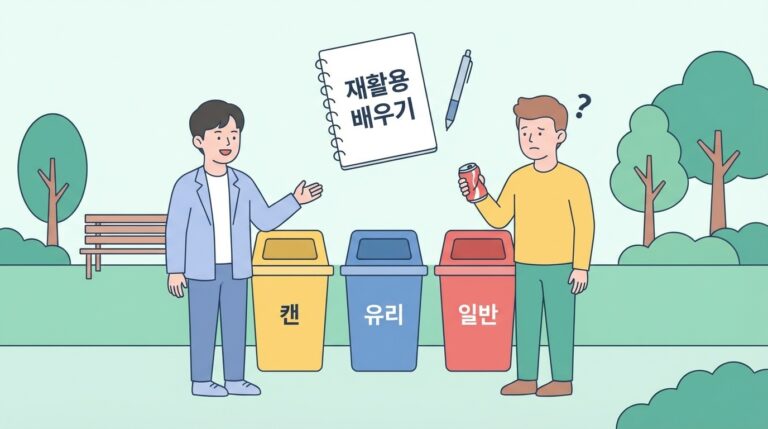
Don’t Be a “Trash Villain”: How to Recycle Cans & Bottles in Korea 🇰🇷
Phase 1: Immersive Hook — The “Han River Panic”
Greeting: 안녕하세요! Hello, Daily Hangul family! This is your editor, back with another survival guide.
Picture this: You are at the Han River Park (Hangang), living your best K-Drama life. You’ve just finished a delicious Chimaek (Chicken + Maekju/Beer) picnic. The sunset is beautiful, and BTS is playing on your portable speaker. Perfect, right?
But then, it’s time to leave. You are holding an empty beer can and a soju bottle. You walk to the trash area and freeze. 😱
There isn’t just one bin. There are five. People are crushing cans, peeling labels, and separating caps with the precision of a surgeon. You panic. “Can I just throw this in the ‘General Waste’?”
Stop! If you do that, you might get the “laser eyes” (judging stares) from the locals. Recycling in Korea isn’t just a rule; it’s a community ritual. Today, let’s learn how to handle your empty cans and bottles like a true Seoulite.
Phase 2: Deep Dive — Key Expressions
Here are the top 3 phrases you need when you are standing in front of those confusing bins.
1. 이거 어디에 버려요? (Where do I throw this away?)
- Pronunciation: [I-geo eo-di-e beo-ryeo-yo?]
- Sound-alike: “E-go Au-dee-eh Buh-ryuh-yo?”
- Meaning: Where do I throw this away? (Survival Phrase!)
- K-Culture Moment: You are at a guest house or an Airbnb. You have empty glass bottles. You don’t see a bin. You ask your host this question.
- Editor’s Insight: This is the magic key. Koreans love it when you ask instead of guessing and making a mess. It shows you respect their system.
- Situation Spectrum:
[🚫 Formal Speech] ———— [✅ Standard/Polite] ———— [⚠️ Casual]
(This phrase is polite enough for strangers, neighbors, and staff!)- 🤔 Think About It: Why is “where” so important? In many Western countries, you might just look for any trash can. In Korea, location = categorization.
2. 헹궈서 버려주세요. (Please rinse and throw it away.)
- Pronunciation: [Heng-gwo-seo beo-ryeo-ju-se-yo]
- Sound-alike: “Heng-gwo-saw…”
- Meaning: Please rinse it before throwing it away.
- K-Culture Moment: You’ll often see office workers in K-Dramas rinsing their iced coffee cups in the restroom before tossing them. It’s not just about empty; it’s about clean.
- Editor’s Insight: Leftover sugary drink makes the recycling bin smell and attract bugs. This phrase reflects the Korean value of “Nam-eul baeryeo-haneun maeum” (Consideration for others).
- Situation Spectrum:
Commonly seen on signs or heard from older people.- 🤔 Think About It: Does your country require washing trash? How does this change your relationship with what you consume?
3. 뚜껑은 따로 버리세요. (Throw the cap away separately.)
- Pronunciation: [Ttu-kkeong-eun tta-ro beo-ryeo-se-yo]
- Sound-alike: “Tu-kkung-eun…” (The ‘Tu’ is strong, like spitting a seed!)
- Meaning: Please dispose of the lid/cap separately.
- K-Culture Moment: Watching a K-Pop idol on a reality show cleaning up their dorm. They obsessively separate the plastic cap from the glass bottle. It’s a habit ingrained since elementary school!
- Editor’s Insight: Glass and metal recycle differently than plastic caps. Mixing them ruins the batch!
Phase 3: Textbook vs. Real Life
| Situation | 📖 Textbook Korean | 🗣️ Real Korean (Daily Life) | 💡 Why is it different? |
|---|---|---|---|
| Holding a can | 분리수거함에 넣으세요. (Please put it in the recycling bin.) |
캔은 저기요. (Cans, over there.) |
Koreans love efficiency. We drop the verb if the noun + gesture is enough! |
| Confused | 쓰레기통이 어디에 있습니까? (Where is the trash can?) |
쓰레기통 어디예요? (Trash can, where?) |
“-e iss-seub-ni-kka” is too stiff for a convenience store. |
| Apologizing | 죄송합니다. 몰랐습니다. (I apologize. I did not know.) |
아! 몰랐어요. (Ah! I didn’t know.) |
A genuine reaction (“Ah!”) feels more sincere than a formal sentence. |
💡 Bottom Note: In a busy convenience store, just holding up the can and looking confused will usually get you a pointed finger and a “Here!” (Yeogi-yo!).
Phase 4: Cultural Deep Dive — The “Nunchi” of Recycling
4-1. Non-verbal Communication: The “Crush” Move
In Korea, volume matters. Garbage bags cost money (Yes, you have to buy specific bags!).
* Cans: CRUSH them flat. Step on them if you have to. If you throw a round, empty can into a bin, you look like a novice.
* Glass: Place them gently. Do not break them. Broken glass is a safety hazard for the elderly workers who sort trash.
4-2. K-Culture Connection: The “Pyeon-u-jeom” (Convenience Store) Solo Drink
- Drama Context: You know that scene where the main character drinks beer alone outside a convenience store after a hard day? Notice what happens when they leave. They never leave the can on the table. They clean the table and sort the trash.
- Travel Reality: In Korea, convenience stores are semi-public spaces. Leaving your trash on the table is considered very rude (Jin-sang). Even if you are a foreigner, try to find the bins labeled 캔 (Can) and 유리 (Glass/Bottle).
Phase 5: Immersive Roleplay — Han River Picnic
Setting: Friday night, Han River Park. You and your Korean friend, Min-su, just finished fried chicken and cola. You are holding an empty Cola can.
Characters:
* YOU: A tourist who wants to follow the rules.
* Min-su (28): Your helpful Korean friend who is fastidious about cleanliness.
(Dialogue)
Min-su: 배부르다! 이제 슬슬 갈까?
(Bae-bu-reu-da! I-je seul-seul gal-kka?)
I’m full! Shall we head out now?
YOU: 응, 그래. 이 캔은 어디에 버려?
(Eung, geu-rae. I kaen-eun eo-di-e beo-ryeo?)
Yeah, okay. Where do I throw this can?
Min-su: 저기 분리수거장 있어. 잠깐만!
(Jeo-gi bun-li-su-geo-jang i-sseo. Jam-kkan-man!)
There is a recycling area over there. Wait a second!
(🎭 Stage Direction: Min-su points at your can, which still has some cola inside.)
Min-su: 안에 내용물 남았어?
(An-e nae-yong-mul na-ma-sseo?)
Is there stuff left inside?
🔀 Decision Point: How do you respond?
A) “Just a little. It’s fine.” (Throw it away)
B) “Uh… yes. Should I pour it out?”
C) “I’ll drink it later.” (Put it in your bag)
✅ Best Choice: B
* Why? In Korea, liquids create a huge mess in public bins. Min-su will likely say: “응, 비우고 찌그러트려야 돼.” (Yes, empty it and crush it.)
⚠️ Choice A Analysis: If you throw a heavy can with liquid, it might leak on the person cleaning it later. Min-su might frown and say, “Aigu…” (Oh dear…).
Phase 6: 10-Second Shadowing Drill
Let’s practice the magic phrase to ask for help. Don’t be shy!
Emotion: 🤔 Confused but polite (tilt your head slightly).
이거 / 어디에 / 버려요?
[I-geo / eo-di-e / beo-ryeo-yo?]
Can I / throw this / where?
(Repeat 3 times! Speed up a little each time.)
Phase 7: K-Culture Mini Glossary
| Korean | Romanization | English | Context |
|---|---|---|---|
| 분리수거 | Bun-li-su-geo | Recycling | Literally “Separate Collection.” The holy grail of Korean trash culture. |
| 일반 쓰레기 | Il-ban sseu-re-gi | General Waste | Things that cannot be recycled (dirty tissues, wrappers). |
| 캔 / 병 | Kaen / Byeong | Can / Bottle | Usually found on bin labels. Memorize these shapes! |
| 내용물 | Nae-yong-mul | Contents | What’s inside the bottle/can. Must be empty! |
Phase 8: Traveler’s Survival Kit (Recycling Edition)
Heading to a convenience store or park? Keep this card in mind.
🆘 Survival Phrases TOP 3
1. “여기 버려도 돼요?” (Yeo-gi beo-ryeo-do dwae-yo?) – Can I throw this here? (Use when you are unsure about a bin).
2. “쓰레기통 없어요?” (Sseu-re-gi-tong eop-seo-yo?) – Is there no trash can? (Use when you can’t find one—they are rare on streets!).
3. “분리수거예요?” (Bun-li-su-geo-ye-yo?) – Is this for recycling?💡 Pro Tip:
Can’t find a trash can on the street? Korea removed many street bins to reduce waste. Head to the nearest subway station toilet or bring your trash back to your hotel/accommodation. Do NOT stuff it into a random pile on the street!
Phase 9: Think Deeper — “Why so complicated?”
The Logic of “Community”
You might wonder, “Why is Korea so strict about separating cans, glass, and caps? It’s annoying!”
Think About It: Korea is a small peninsula with a high population density and very limited land for landfills. Recycling isn’t just an “eco-friendly trend” here; it’s a survival strategy for the country. When you see a grandmother carefully peeling the label off a glass bottle, she isn’t just following rules—she’s participating in a collective effort to keep the land clean for the next generation.
💬 Your Turn: How does your country handle glass and cans? Do you crush them? Let us know in the comments!
Phase 10: FAQ & Troubleshooting
Q: I bought a drink with my favorite K-Pop idol’s face on the can. I want to keep it! Is that weird?
A: Not at all! This is K-Culture 101. However, do not leave it with liquid inside. Wash it thoroughly (헹구세요), dry it, and display it. If you throw it away, please crush it—even if it hurts to crush your idol’s face!
Q: The bin says “Glass,” but I have a broken glass cup. Can I put it there?
A: NO! ❌ The “Glass” (병) bin is for bottles that can be reused or melted. Broken glass/ceramics usually go into special sacks (pp-u-dae) or wrapped carefully in newspaper and put in General Waste to protect workers.
❌ Common Mistake: Putting a soda can inside a plastic cup and throwing them together.
✅ Fix: Separate them! Can goes to [Can], Cup goes to [Plastic].
Phase 11: Wrap-up & Action Mission
One-Liner: When in Korea, Empty, Rinse, and Crush before you throw!
🚀 Your Action Mission:
* 🥉 Bronze: Look at a bottle near you. Find the recycling symbol. Practice saying “Byeong” (Bottle).
* 🥈 Silver: Next time you finish a drink, practice the “Rinse” (Heng-gwo) motion and say “Kkae-kkeut-ha-da!” (It’s clean!).
* 🥇 Gold: Go to a Korean convenience store, buy a canned drink, finish it, and confidently put it in the correct bin while crushing it. Feel the local vibe!
K-Culture Mission: Watch a K-Drama scene where they are eating at a Pojangmacha (Tent bar). Do they leave the bottles on the table? (Spoiler: Usually yes, in restaurants/bars, the staff clears it. But at convenience stores, YOU do it!)
Phase 12: Quiz — Are you a Recycling Master?
- Situation: You are holding a glass Soju bottle. You see a bin labeled ‘캔/류 (Can)’. Should you throw it there?
- (A) Yes, they are both hard materials.
- (B) No, look for ‘병/류 (Glass/Bottle)’.
- True or False: In Korea, it is polite to leave your leftover coffee in the cup when you throw it away so the cleaners know what it was.
- (True / False)
- Real Talk: You can’t find a trash can on the street in Myeongdong. What do you do?
- (A) Leave it on a bus stop bench.
- (B) Carry it until you find a subway station or your hotel.
(Answers below!)
⬇️ Click to see answers
- (B) Never mix glass and cans! Glass breaks.
- False! Always empty (bi-u-se-yo) the contents. Liquids make a mess.
- (B) Please carry it. Leaving trash on benches is considered very rude.
Frequently Asked Questions (FAQ)
Q: What does "이거 어디에 버려요? (Where do I throw this away?)" mean in Korean and how do you pronounce it?
A: In Korean, "이거 어디에 버려요? (Where do I throw this away?)" is pronounced [I-geo eo-di-e beo-ryeo-yo?] and means: Where do I throw this away? (Survival Phrase!)
Q: What does "헹궈서 버려주세요. (Please rinse and throw it away.)" mean in Korean and how do you pronounce it?
A: In Korean, "헹궈서 버려주세요. (Please rinse and throw it away.)" is pronounced [Heng-gwo-seo beo-ryeo-ju-se-yo] and means: Please rinse it before throwing it away.
Q: What does "뚜껑은 따로 버리세요. (Throw the cap away separately.)" mean in Korean and how do you pronounce it?
A: In Korean, "뚜껑은 따로 버리세요. (Throw the cap away separately.)" is pronounced [Ttu-kkeong-eun tta-ro beo-ryeo-se-yo] and means: Please dispose of the lid/cap separately.







