

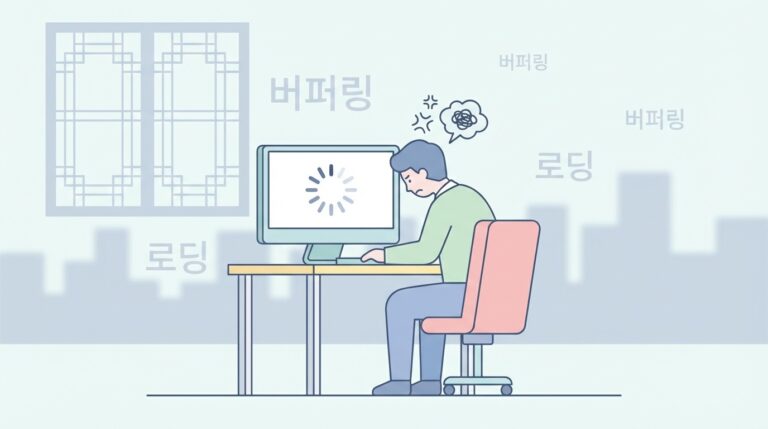
Buffering is a Sin? Mastering Korean Network Troubleshooting 📡
Phase 1: Immersive Hook 🎧
Greeting: 안녕하세요! This is your Daily Hangul Editor, reporting live from a PC Bang (Internet Cafe) in Seoul.
Imagine this: It’s 7:59 PM. You are sitting in front of your computer. In exactly one minute, ticket sales open for the BTS or BLACKPINK comeback concert. Your finger is hovering over the mouse. Your heart is racing. Suddenly… the spinning wheel of death appears. 😱
In Korea, the land of the world’s fastest internet, a slow connection isn’t just an inconvenience; it’s a catastrophe. Whether you are trying to secure concert tickets, ordering delivery food (Baedal), or submitting a report to your boss, knowing how to describe network issues is a survival skill.
Today, we move beyond the textbook “The internet is slow” and dive into the real IT vocabulary used by frustrated office workers and gamers alike. Let’s get your connection back up to speed!
Phase 2: Deep Dive into Key Expressions 🧐
1. 와이파이가 안 터져요 (Waipai-ga an teojyeoyo)
- Pronunciation: [Waipai-ga an tuh-juh-yo]
- Sound Analogy: “Tuh” sounds like the tough sound you make when you are frustrated.
- Meaning:
- Literal: The Wi-Fi isn’t bursting/popping.
- Real Nuance: The Wi-Fi signal isn’t working or connecting.
- K-Culture Moment: You’ll hear this in cafes constantly. A customer walks to the counter, phone in hand, looking distressed. “Sajangnim (Owner), the Wi-Fi isn’t popping!”
- Editor’s Insight: Why “burst” (터지다)? Koreans visualize invisible signals (like phone reception or data) as something that needs to “burst out” with energy. If it doesn’t “burst,” it’s dead.
- Situation Spectrum:
[🚫 Formal Presentation] ———— [✅ Office/Cafe/Friends] - 🤔 Think About It: In English, we say the internet is “down” (directional). In Korean, it fails to “burst” (action). Does this reflect a view of technology as an active force rather than a static utility?
2. 연결이 자꾸 끊겨요 (Yeongyeoli jakku kkeunkyeoyo)
- Pronunciation: [Yeon-gyuhl-ee jak-koo kkeun-kyuh-yo]
- Sound Analogy: “Kkeun” sounds like you are abruptly cutting a rope.
- Meaning: The connection keeps getting cut off/dropping.
- K-Drama Context: The classic video call scene. The lead actor is about to confess his love from overseas, and suddenly—pixelation. He shouts, “Yeoboseyo? Can you hear me? Ah, it keeps cutting off!”
- Editor’s Insight: “자꾸 (jakku)” is a magic word meaning “repeatedly/keeps doing.” It adds a nuance of annoyance. You aren’t just reporting a fact; you are complaining about the inconvenience.
- Situation Spectrum:
[⚠️ Very Formal Report] ———— [✅ IT Helpdesk/Colleagues]
3. 인터넷이 먹통이에요 (Intorenet-i meoktong-ieyo)
- Pronunciation: [In-tuh-net-ee muk-tong-ee-eh-yo]
- Sound Analogy: “Muk” sounds like muck or mud.
- Meaning:
- Literal: The internet is an ink stick/inkwell.
- Real Nuance: The internet is completely dead/frozen/unresponsive.
- Editor’s Insight: This is B2+ level vocabulary! “Meoktong” originally refers to the blackened tools used by carpenters or ink holders. If something is “meoktong,” it’s pitch black—meaning no signal, no hope, completely bricked.
- Situation Spectrum:
[🚫 CEO Report] ———— [⚠️ Senior Colleague] ———— [✅ IT Support/Peers]
Phase 3: Textbook vs. Real Life 🥊
| Situation | 📖 Textbook Korean | 🗣️ Real Korean (In the Office) | 💡 Why the difference? |
|---|---|---|---|
| Internet is slow | 인터넷 속도가 느립니다. (Internet speed is slow.) | 렉 걸려요. (It’s lagging.) | “Lag” (Jeck) is a loanword from gaming culture that is now standard for any slow tech. |
| No Signal | 신호가 잡히지 않습니다. (Signal is not caught.) | 안 터져요. (It won’t burst.) | Koreans prefer dynamic verbs (bursting) over passive descriptions. |
| Server Down | 서버에 문제가 생겼습니다. (Problem occurred in server.) | 서버 터졌어요. (The server exploded.) | Again, the “burst/explode” metaphor. Used when too many people click at once (like ticketing). |
💡 Editor’s Note: “렉 걸리다” (Lagging) is essential. If your video call freezes, don’t say “Internet slow.” Say “Ah, recki geol-ryeo-yo (It’s lagging).” You will sound very native.
Phase 4: Cultural Deep Dive 🌏
4-1. Non-verbal: The “Refresh” Ritual
When complaining about the internet to an IT support person or a colleague, do not just sit still. You must aggressively click your mouse or tap your phone screen to visually demonstrate your frustration. Korean communication is often multimodal!
4-2. The “Pali-Pali” (Hurry-Hurry) Infrastructure
Why is network troubleshooting such a hot topic? Because Korea lives on the “Pali-Pali” culture.
* Context: Korea consistently ranks in the top tier for internet speeds. A page loading in 3 seconds is acceptable in many countries; in Korea, 3 seconds feels like an eternity.
* Critical View: This need for speed drives efficiency but also creates high stress. If the network is down in a Korean office, it’s not “break time”; it’s a crisis because the workflow stops.
* PC Bang Connection: The “PC Bang” (Internet Cafe) is the temple of this culture. High-end gaming requires zero latency. If you want to understand the standard for “good internet” in Korea, visit a PC Bang. If the ping is high there, there would be a riot.
Phase 5: Immersive Roleplay 🎭
Scenario A: The Office Crisis
Setting: Monday morning, 9:30 AM. A busy office in Gangnam. Everyone is typing furiously. You need to upload a large file for a meeting in 10 minutes.
Characters:
* YOU: Foreign Marketing Manager.
* Min-su: IT Support Team member (Friendly but overworked).
Dialogue:
YOU: (Clicking mouse rapidly) 아, 진짜… 민수 씨, 잠시만요!
(Ah, jinja… Minsu-ssi, jamsimanyo!) -> Ah, seriously… Minsu, do you have a second?
Min-su: 네? 무슨 일 있으세요?
(Ne? Museun il isseuseyo?) -> Yes? Is something wrong?
YOU: [Choose your response below]
🔀 Decision Point: How do you describe the problem?
* A) 인터넷이 안 돼요. (Internet doesn’t work.) [Too basic/Vague]
* B) 와이파이가 자꾸 끊기고 속도가 너무 느려요. (Wi-Fi keeps dropping and speed is too slow.) [Specific & Natural]
* C) 인터넷이 죽었어요. (The internet died.) [A bit dramatic, maybe for close friends]
✅ Best Choice: B
Min-su: (Looking at your screen) 아, 저런. 재부팅은 해보셨어요?
(Ah, jeoreon. Jaebuting-eun haebosyeosseoyo?) -> Oh dear. Have you tried rebooting?
YOU: 네, 벌써 두 번이나 했는데 먹통이에요.
(Ne, beolsseo du beon-ina haenneunde meoktong-ieyo.) -> Yes, I did it twice already, but it’s completely frozen.
Min-su: 랜선 문제인 것 같네요. 제가 봐드릴게요.
(Lan-seon munje-in geot ganneyo. Jega bwadeurilgeyo.) -> Seems like a LAN cable issue. I’ll take a look.
Scenario B: Bonus – The Cafe Wi-Fi Hunter ☕
Setting: A hip cafe in Hongdae. You bought an Iced Americano.
YOU: 저기요, 와이파이 비밀번호가 뭐예요?
(Jeogiyo, waipai bimilbeonho-ga mwoyeyo?) -> Excuse me, what is the Wi-Fi password?
Staff: 영수증 하단에 나와 있습니다!
(Yeongsujeung hadan-e nawa isseumnida!) -> It is listed at the bottom of the receipt!
Phase 6: 10-Second Shadowing Drill 🗣️
Practice these lines to build muscle memory! Pay attention to the emotion tags.
- 😤 Frustrated: 연결이 / 자꾸 / 끊겨서 / 일을 못 하겠어요!
(Yeongyeoli / jakku / kkeunkyeoseo / ireul mot hagesseoyo!)
“The connection keeps dropping, so I can’t work!” -
🥺 Desperate: 제발… / 와이파이 좀 / 터져라!
(Jebal… / waipai jom / teojyeora!)
“Please… let the Wi-Fi work (burst)!” -
🤔 Analytical: 재부팅 했는데도 / 화면이 / 먹통이에요.
(Jaebuting haenneundedo / hwamyeoni / meoktong-ieyo.)
“Even though I rebooted, the screen is frozen/dead.”
Phase 7: K-Culture Mini Glossary 📘
| Korean | Romanization | English | Context |
|---|---|---|---|
| 데이터 거지 | Data Geoji | Data Beggar | Someone who always asks for Wi-Fi or Hotspots because they have no mobile data left. |
| 광클 | Gwang-keul | Crazy Clicking | Clicking the mouse at light speed (essential for ticketing or gaming). |
| 핫스팟 | Hat-seu-pat | Hotspot | Mobile hotspot. “Hotspot jom kyeojwo” (Turn on your hotspot for me). |
| 비번 | Bi-beon | Password | Short for Bimil-beonho. Used frequently: “Waipai bibeon mwoya?” |
Phase 8: Traveler’s Survival Kit 🧳
Even if you aren’t working in IT, you need internet to travel.
🆘 Survival Expression #1
* 🇰🇷 “와이파이 비밀번호 어디에 써 있어요?” (Waipai bimilbeonho eodie sseo isseoyo?)
* 🗣️ Pronunciation: [Waipai bee-mil-bun-ho uh-dee-eh suh-ee-ssuh-yo?]
* 📍 Where: Cafes, Restaurants, Airbnbs.
* 💡 Pro Tip: In 90% of Korean cafes, the password is printed on your receipt (Yeongsujeung). Don’t throw it away!📌 Editor’s Tech Note
* Public Wi-Fi: Seoul has excellent public Wi-Fi on subways and buses. Look for “Public WiFi Secure” networks.
* Security: Korean websites often require many “.exe” security plugins (ActiveX legacy). If a Korean site isn’t working on Chrome, try it on a different browser or PC.
Phase 9: Think Deeper — Technology & Identity 🧠
Topic: The “PC Bang” as a Social Hub
In many Western cultures, computer gaming is often seen as a solitary activity done in a bedroom. In Korea, the PC Bang (Internet Cafe) is a highly social space. Friends go there together to sit in rows, eat ramen, and play games on a high-speed local network.
Think Deeper: Why did Korea develop a culture of “going out” to use the internet, even when home internet is fast? It suggests that for Koreans, digital spaces are also physical gathering points. The “network” connects people not just digitally, but spatially.
💬 Your Turn: Does your country have a place like a PC Bang? Or is gaming strictly a home activity?
Phase 10: FAQ & Troubleshooting 🛠️
- Q: Can I ask a stranger to turn on their Hotspot for me?
- A: Generally No. Unless it’s a dire emergency, asking a stranger for their data is considered rude and invasive (Data is money!). Stick to cafes.
- Q: Is it rude to complain about slow internet to staff?
- A: If you are polite (“Excuse me, the Wi-Fi seems a bit slow”), it is fine. But don’t get angry. Usually, they will just restart the router.
- ❌ Common Mistake: Saying “Open the internet” (Internet yeol-eo-juseyo).
- ✅ Correction: Say “Connect to the internet” (Internet yeongyeol-haejuseyo) or “Turn on the PC” (PC kyeo-juseyo).
Phase 11: Wrap-up & Action Mission 🎬
One-Liner: In Korea, the internet doesn’t just “work”—it must “burst” (터지다) with energy!
🚀 Action Missions:
* 🥉 Bronze: Say “와이파이가 안 터져요” three times while looking at your phone with a frown.
* 🥈 Silver: Go to a Korean cafe (or any cafe) and actively look for the Wi-Fi password on the receipt before asking.
* 🥇 Gold: If you have a Korean friend, ask them jokingly, “Are you a Data Geoji?” (Only if you are close!)
K-Culture Mission: Watch a K-Pop ticketing video on YouTube (Search: “티켓팅 브이로그” / Ticketing Vlog). Observe the “Gwang-keul” (Crazy Clicking) and the despair when the server crashes.
Phase 12: Quiz — Interactive Challenge 📝
1. Situational Judgment:
Your boss asks why the report isn’t uploaded yet. The internet is completely dead. What is the most natural excuse?
* A) 인터넷이 졸려요. (The internet is sleepy.)
* B) 인터넷이 먹통이라서 연결이 안 됩니다. (The internet is ‘meoktong’ so it won’t connect.)
* C) 와이파이가 싫어요. (I hate Wi-Fi.)
2. Fill in the Blank:
“Wait, don’t hang up! The video call keeps ________!”
* Korean: “잠깐만! 영상 통화가 자꾸 ______!”
* Hint: (Cut off / Drop)
3. True or False:
* “Meoktong” originally refers to a traditional Korean rice cake. (T/F)
Click to see answers
- B (Meoktong is the perfect word for a dead connection.)
- 끊겨요 (Kkeunkyeoyo)
- False (It refers to an ink stick/inkwell used by carpenters, implying pitch black/darkness.)
Frequently Asked Questions (FAQ)
Q: What does "와이파이가 안 터져요 (Waipai-ga an teojyeoyo)" mean in Korean and how do you pronounce it?
A: In Korean, "와이파이가 안 터져요 (Waipai-ga an teojyeoyo)" is pronounced [Waipai-ga an tuh-juh-yo] and means: a key conversational Korean expression covered in this lesson.
Q: What does "연결이 자꾸 끊겨요 (Yeongyeoli jakku kkeunkyeoyo)" mean in Korean and how do you pronounce it?
A: In Korean, "연결이 자꾸 끊겨요 (Yeongyeoli jakku kkeunkyeoyo)" is pronounced [Yeon-gyuhl-ee jak-koo kkeun-kyuh-yo] and means: a key conversational Korean expression covered in this lesson.
Q: What does "인터넷이 먹통이에요 (Intorenet-i meoktong-ieyo)" mean in Korean and how do you pronounce it?
A: In Korean, "인터넷이 먹통이에요 (Intorenet-i meoktong-ieyo)" is pronounced [In-tuh-net-ee muk-tong-ee-eh-yo] and means: a key conversational Korean expression covered in this lesson.







