

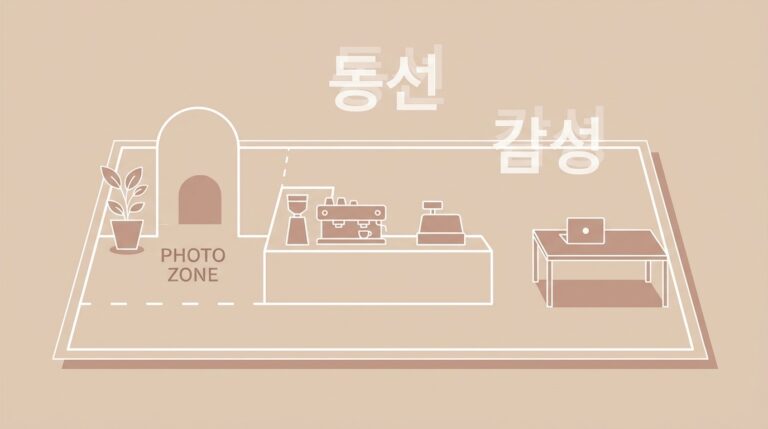
Beyond Just Tables: Mastering the Art of Korean Cafe “Vibes” & Layouts
Phase 1: The Immersive Hook
Hello, Daily Hangul readers! This is your Senior Editor.
Picture this: You are in Seongsu-dong, the so-called “Brooklyn of Seoul.” You walk into a renovated factory that is now a bakery cafe. The smell of basil scones hits you. But look around. Why is everyone taking photos of a specific crumbling brick wall? Why is there a long queue just to sit at a window seat that looks uncomfortable but has perfect lighting?
In the world of Korean cafes, coffee is secondary. The primary product is the Space (Gonggan) and the Vibe (Gamseong).
If you are planning a cafe startup in Korea, or just want to understand why Korean cafes are designed the way they are, you need to master the language of “Interior & Dongseon (Flow).” Today, we aren’t just learning words; we are learning the architecture of Korean social life.
Phase 2: Deep Dive into Core Expressions
Here are the three architectural pillars of K-Cafe vocabulary.
1. 동선 (Dongseon)
- Pronunciation: [Dong-seon] + (Think of “Dong” as in “Ding-Dong” + “Seon” like “Sun”)
- Meaning: Movement Flow / Traffic Line / Circulation Path
- K-Culture Moment: Watch any episode of Coffee Prince or a cafe vlog. The manager will always point at the bar and say, “The Dongseon is a mess!” implying the staff are bumping into each other.
- Editor’s Insight: In Korea, efficiency is a virtue. A “bad Dongseon” (동선이 꼬이다) means the layout makes you waste time or energy. It applies to customers (ordering -> picking up -> sitting) and staff (brewing -> washing).
- Situation Spectrum:
[🚫 Formal Only] ———— [✅ Universal] ———— [🚫 Slang]
- This is a professional term used in business, architecture, and even military strategy, but commonly used by cafe owners.
- 🤔 Think About It: Why is “efficiency” (getting your coffee fast) sometimes more important than “relaxation” in the Korean cafe experience?
2. 감성 (Gamseong)
- Pronunciation: [Gam-seong] + (G as in Go, S as in Song)
- Meaning: Vibe / Sentiment / Aesthetic / Emotional Atmosphere
- K-Culture Moment: You see a photo on Instagram of a single dried flower in a vase with a shadow. The caption? “Gamseong…” It’s the defining word of the MZ generation’s consumption habits.
- Editor’s Insight: Translating this as just “emotion” is wrong. In a cafe context, it refers to that specific, often nostalgic or minimalist aesthetic that makes people want to take photos. A “Gamseong Cafe” is usually trendy, slightly uncomfortable, but beautiful.
- Situation Spectrum:
[🚫 Formal Report] ———— [✅ Social Media/Casual] ———— [⚠️ Business]
- Use it in business to describe the concept (e.g., “We need more Gamseong”).
- 🤔 Think About It: Is Gamseong a genuine artistic expression or a commercial tool to attract social media influencers?
3. 공간감 (Gonggangam)
- Pronunciation: [Gong-gan-gam]
- Meaning: Sense of Space / Spatialosity
- K-Culture Moment: When a tiny room in a K-Drama looks huge because of mirrors and high ceilings, they are utilizing Gonggangam.
- Editor’s Insight: Since real estate in Seoul is expensive, cafes are often small. Maximizing Gonggangam (making it feel wider than it is) is a critical skill for interior designers.
- Situation Spectrum:
[✅ Professional/Design] ———— [⚠️ Casual]
- Mostly used when discussing architecture or interior design.
Phase 3: Textbook vs. Real Life
| Situation | 📖 Textbook Korean | 🗣️ Real Professional Korean | 💡 Why the difference? |
|---|---|---|---|
| Describing a layout | 배치가 좋아요. (The arrangement is good.) | 동선이 효율적이에요. (The flow is efficient.) | Professionals focus on function and movement, not just static placement. |
| Talking about style | 인테리어가 예뻐요. (The interior is pretty.) | 감성 터지네요. (The vibe is exploding/bursting.) | “Pretty” is generic. “Exploding with Gamseong” implies it hits the trend perfect. |
| Asking for outlets | 전기 코드 있어요? (Do you have an electric cord?) | 콘센트 자리가 어디죠? (Where are the outlet seats?) | “Code” refers to the wire. “Consent” (Konglish) is the socket. Crucial for the “Cagong-jok” (Cafe-studying tribe). |
Bottom Note: In C1 level, using specific jargon like efficiency and socket marks you as an insider, not a tourist.
Phase 4: Cultural Deep Dive
4-1. Non-verbal: The “Bag” Reservation System
In a crowded Seoul cafe, if you see a bag on a chair but no person, do not sit there. It is occupied. Koreans have high trust; they leave laptops and phones on tables to reserve spots while ordering. Moving someone’s “reservation object” is a huge breach of etiquette.
4-2. K-Culture Connection: The “Photo Zone” (포토존)
K-Travel & K-Food: When designing a cafe, owners deliberately create a “Photo Zone.” This is often a specific wall, a mirror, or a seat with the best lighting.
– The Rule: You don’t sit in the Photo Zone to drink coffee for 2 hours. You take your photo quickly and leave, or sit there only if the cafe is empty. If you hog the Photo Zone without taking pictures, you might feel the burning gaze of others waiting for their turn.
– Critical View: This reflects the “Showable Life” culture. The cafe isn’t just for drinking; it’s a studio to prove you were there.
Phase 5: Immersive Roleplay
Scenario: You are a prospective cafe owner meeting with an Interior Designer (Director Kim) in a raw, empty concrete space in Hongdae.
Characters:
– YOU: A client who wants a trendy but practical cafe.
– Director Kim: A confident, artistic designer who loves “Gamseong” but ignores practicality.
Dialogue:
Director Kim: (Gesturing to a narrow corner) 여기는 조명을 낮게 달아서 아늑한 감성을 살리죠.
(Yeogineun jomyeongeul natge daraseo aneukhan gamseongeul sallijyo.)
(Let’s hang the lights low here to bring out a cozy vibe.)
YOU: 감성은 좋은데… 직원들 동선이 꼬이지 않을까요?
(Gamseongeun joeunde… jigwondeul dongseon-i kkoiji aneulkkayo?)
(The vibe is good, but won’t the staff’s movement flow get tangled?)
Director Kim: 에이, 사장님. 요즘은 불편해도 예쁜 게 먼저입니다.
(Ei, sajangnim. Yojeumeun bulpyeonhaedo yeppeun ge meonjeo-imnida.)
(Come on, Boss. These days, being pretty comes first, even if it’s uncomfortable.)
🔀 Decision Point! How do you assert your business needs?
- A) “그래도 효율성이 중요해요.” (Still, efficiency is important.) – Standard & polite.
- B) “회전율 생각하면 동선이 짧아야죠.” (Considering turnover rate, the flow needs to be short.) – Professional Business Logic.
- C) “아니요, 저는 싫어요.” (No, I hate it.) – Too blunt/Rude.
✅ Best Choice: B. mentioning Turnover rate (회전율) proves you understand the cafe business. Director Kim will take you seriously.
Phase 6: 10-Second Shadowing Drill
Let’s practice sounding like a picky cafe owner.
😤 Serious/Professional Tone
손님들이 / 불편하지 않게 / 좌석 간격을 / 좀 더 넓혀주세요.
(Sonnindeuri / bulpyeonhaji anke / jwaseok gangyeok-eul / jom deo neolpyeojuseyo.)
Please widen the seat spacing / so the customers / don’t feel uncomfortable.
Phase 7: K-Culture Mini Glossary
| Korean | Romanization | Meaning | Context |
|---|---|---|---|
| 마감 | Magam | Finishing/Closing | In interiors: “The finishing materials.” In business: “Closing time.” |
| 노출 콘크리트 | Nochul Concrete | Exposed Concrete | The most popular “industrial” interior style in Korea. |
| 가벽 | Gabyeok | Fake/Temporary Wall | Used to create separate spaces or photo zones cheaply. |
| 카공족 | Cagong-jok | Cafe-Studying Tribe | Customers who study in cafes for hours. You need outlets for them. |
| 회전율 | Hoejeonyul | Turnover Rate | How fast customers leave so new ones can enter. Crucial for small cafes. |
Phase 8: Traveler’s Survival Kit (Cafe Edition)
Even if you aren’t opening a cafe, you will visit one. Here is how to survive the sophisticated Seoul cafe scene.
🆘 Survival Expression #1: Finding the Power
– 🇰🇷 “혹시 콘센트 있는 자리가 있나요?” (Hoksi consent inneun jariga innayo?)
– 🗣️ Sound Analogy: Consent sounds like “Con-sent” (agreeing).
– 📍 Use when: You have a laptop and low battery.📌 Editor’s Travel Note
– Wifi: Usually written on the receipt (영수증) or a tiny sticker on the buzzers/vibrating bells (진동벨). Don’t shout “Wifi password!” immediately.
– Toilet Key: Many cafes in older buildings have toilets outside the shop. You might need to take a key (often attached to a funny object like a spoon or doll) or memorize a door code.
Phase 9: Think Deeper — “The Architecture of Appearance”
Topic: Media vs. Reality
In Korea, cafe interiors often prioritize visuals over comfort. You will find low tables (barely knee-height) that force you to hunch over to drink. Why? Because low furniture creates a better Gonggangam (Sense of space) in photos and makes the ceiling look higher. This is a physical manifestation of how “Instagrammability” shapes physical reality in Korea. The space is designed for the lens, not the body.
💬 Your Turn: In your country, do cafes prioritize comfort (sofas) or style (minimalism)? Let us know in the comments!
Phase 10: FAQ & Troubleshooting
Q: What is a “No Kids Zone” (노키즈존)?
A: Some cafes ban children to preserve a quiet or safe atmosphere. This is controversial but common in “Gamseong” cafes with expensive breakable interiors. Always check the door sign.
Q: Can I stay for 4 hours with one coffee?
A: In a franchise (Starbucks), yes. In a small private cafe, it’s considered rude (No Nunchi!). If you stay longer than 2-3 hours, it’s polite to order a second drink or dessert.
❌ Common Mistake: Asking “Where is the bathroom?” using “Hwajangsil” implies a room with a toilet.
✅ Pro Tip: In fancy cafes, look for signs saying “Restroom” or just ask for the “Key” if it’s an old building. Use “Hwajangsil” is fine, but checking for the key first shows you know the system.
Phase 11: Wrap-up & Mission
- Summary: Today we learned that a Korean cafe is defined by efficient flow (Dongseon), emotional vibe (Gamseong), and spatial tricks (Gonggangam).
-
Action Missions:
- 🥉 Bronze: Look at your own room. Is the Dongseon good? Say it out loud: “Dongseon-i an joa.” (The flow is bad.)
- 🥈 Silver: Go to a local cafe. Find the “Photo Zone.” Post a picture of it on social media with the hashtag #Gamseong.
- 🥇 Gold: Visit a Korean-style cafe (or a Korean bakery) and ask, “Do you have a seat with an outlet?” in Korean.
- K-Culture Mission: Watch a “Seoul Cafe Vlog” on YouTube. Count how many times they mention the word “Yeppeuda” (Pretty) or “Bunwigi” (Atmosphere/Vibe).
Phase 12: Quiz — Interactive Challenge
-
Situation Judgment: You are the owner. A customer is complaining that the tables are too close together. What concept is failing here?
- a) Gamseong (Vibe)
- b) Gonggangam (Sense of Space)
- c) Dongseon (Flow)
- True or False: In Korea, “Gamseong” simply means “feeling happy.”
- (True / False)
- Fill in the blank: To increase sales, we need a faster ______ (turnover rate).
- Answer: [______]
(Answers: 1-b or c depending on context, but ‘b’ affects comfort most directly, 2-False [It implies a specific aesthetic], 3-Hoejeonyul)
Frequently Asked Questions (FAQ)
Q: What does "동선 (Dongseon)" mean in Korean and how do you pronounce it?
A: In Korean, "동선 (Dongseon)" is pronounced [Dong-seon] and means: Movement Flow / Traffic Line / Circulation Path
Q: What does "감성 (Gamseong)" mean in Korean and how do you pronounce it?
A: In Korean, "감성 (Gamseong)" is pronounced [Gam-seong] and means: Vibe / Sentiment / Aesthetic / Emotional Atmosphere
Q: What does "공간감 (Gonggangam)" mean in Korean and how do you pronounce it?
A: In Korean, "공간감 (Gonggangam)" is pronounced [Gong-gan-gam] and means: Sense of Space / Spatialosity







