

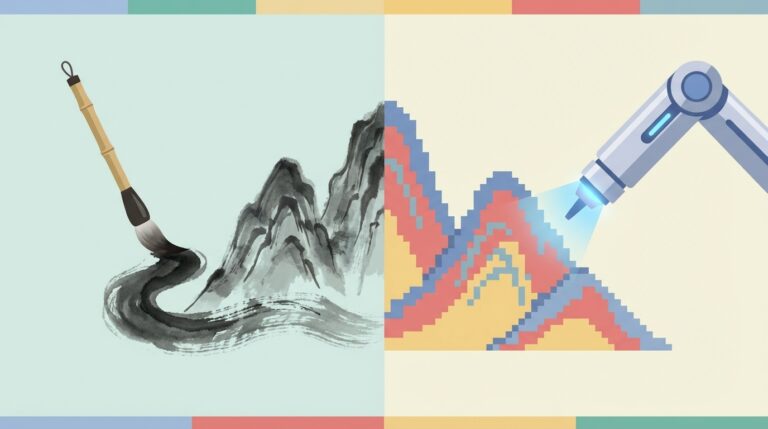
Is It Art or an Algorithm? Debating AI Copyright in Korea 🎨🤖
Phase 1: The Immersive Hook
Greeting: 안녕하세요! Welcome back to Daily Hangul. It’s your editor, the one who spends too much time analyzing the philosophy behind K-Drama plot twists.
Imagine this: You’re scrolling through YouTube, and you find a cover of NewJeans’ “Hype Boy” sung by… Freddie Mercury? Or perhaps you see a stunning webtoon panel that looks too perfect, completed in seconds. The comments section is a war zone. One side screams “Innovation!” while the other cries “Theft!”
This isn’t just a global debate; it is a hot potato (뜨거운 감자) in Korea’s bustling creative industries—from K-Pop’s AI covers to Webtoon backgrounds. As a C2 learner, you aren’t just ordering bibimbap anymore; you are engaging in intellectual debates about the soul of art. Today, we dive into the murky waters of copyright in the age of generative AI, equipping you with the sophisticated vocabulary needed to hold your own in a Gangnam seminar or a Hongdae art critique.
Phase 2: Deep Dive into Core Expressions
Here are the heavy-hitters you need to discuss legal and aesthetic ethics in Korean.
1. 창작의 고통 (Chang-jag-ui go-tong)
- Pronunciation: [Chang-jag-ui go-tong] + (Sounds like “Chang-jog-we go-tongue”)
- Meaning: The agony of creation / The pain of creating.
- K-Culture Moment: Think of that K-Drama scene where the genius songwriter (maybe BTS’s Suga in a documentary context) is slumped over a desk at 4 AM, surrounded by crumpled papers. That suffering defines the value of the work.
- Editor’s Insight: In the AI debate, this is your strongest weapon. You use this to argue why human art has value. “AI doesn’t feel pain; therefore, can it create art?”
- Situation Spectrum:
[🚫 Casual Slang] ———— [⚠️ Semi-formal] ———— [✅ Intellectual/Formal]
- Used in serious discussions, critiques, or expressing deep empathy for artists.
- 🤔 Think About It: Koreans value ‘Han’ (deep sorrow/resentment) as a source of artistic energy. If an AI has never suffered Chang-jag-ui go-tong, can it possess ‘Han’?
2. 회색지대 (Hoe-saek-ji-dae)
- Pronunciation: [Hoe-saek-ji-dae] + (Think “Hay-sack” + “G-Day”)
- Meaning: Gray area.
- K-Culture Moment: Legal dramas like Extraordinary Attorney Woo. The law is black and white, but reality is often a Hoe-saek-ji-dae.
- Editor’s Insight: This is a high-level metaphor. Use it when acknowledging that the current laws (copyright acts) haven’t caught up with technology yet. It makes you sound objective and nuanced.
- Situation Spectrum:
[🚫 Casual Chat] ———— [⚠️ Debate] ———— [✅ Professional Analysis]
- Ideal for business meetings or academic discussions.
- 🤔 Think About It: Why does Korean society often push for clear-cut answers (Yes/No), yet uses the term “Gray Area” so frequently in politics and law?
3. 저작권 침해 (Jeo-jak-gwon chim-hae)
- Pronunciation: [Jeo-jak-gwon chim-hae] + (chim-hae sounds like “chimpanzee’s hair” without the ‘panzee’s’)
- Meaning: Copyright infringement.
- K-Culture Moment: Every time a new K-Pop song drops and sounds slightly like an old hit, this phrase trends on Twitter/X.
- Editor’s Insight: This is the legal term. If you want to sound softer, you might use 표절 (pyo-jeol – plagiarism), but Jeo-jak-gwon chim-hae implies legal consequences.
- Situation Spectrum:
[🚫 Joking] ———— [⚠️ Accusation] ———— [✅ Legal/Formal]
- Use with caution. Accusing someone of this is a serious matter in Korea.
Phase 3: Textbook vs. Real Life
| Situation | 📖 Textbook Korean | 🗣️ Real Korean (Debate/Internet) | 💡 Why the difference? |
|---|---|---|---|
| Claiming theft | 저작권을 위반했습니다. (You violated copyright.) | 완전 도둑질 아니에요? (Isn’t this total theft?) | “Theft” (도둑질) carries a stronger emotional punch than “violation.” |
| Defending AI | 기술의 발전입니다. (It is the advancement of technology.) | 어차피 막을 수 없는 흐름이죠. (It’s a flow you can’t stop anyway.) | Real speech emphasizes inevitability and fatalism (흐름 – flow). |
| Critiquing quality | 감정이 느껴지지 않습니다. (I cannot feel emotions.) | 영혼이 없네요. (It has no soul.) | Koreans prioritize “soul” (영혼) or “sincerity” (정성) over technical perfection. |
Phase 4: Cultural Deep Dive
4-1. The “Handmade” Premium (손맛 – Son-mat)
In Korean food culture, we talk about 손맛 (Son-mat), literally “hand taste.” It means the unique flavor that comes from a mother’s or chef’s specific touch. This concept extends to art. Koreans often reject AI art because it lacks Son-mat. In a high-tech society like Seoul, the paradox is that the analog, the clumsy, and the human are becoming more expensive and valued. When arguing against AI, mention that it lacks Son-mat.
4-2. Webtoons and the “Assistant” Controversy
Korean Webtoons are a massive industry. Recently, readers have boycotted comics that use AI for backgrounds because they feel the artist isn’t putting in “Sincerity” (정성). In Korea, effort is often valued as much as the result. Using AI can be seen as “cheating” the hard work expected of a master (장인 spirit).
Phase 5: Immersive Roleplay Scenario
Setting: A trendy gallery cafe in Hannam-dong, Sunday afternoon. The walls are lined with abstract portraits. You are discussing the exhibition with Ji-hoon, a tech-savvy graphic designer, and So-yeon, a traditional painter.
Characters:
* YOU: An art enthusiast with a C2 level Korean proficiency.
* Ji-hoon (NPC): Believes AI is a tool like Photoshop.
* So-yeon (NPC): Believes AI is stealing from human artists.
The Dialogue:
Ji-hoon: 솔직히, 이 그림이 사람이 그린 건지 AI가 그린 건지 구별할 수 있어? 결과물만 좋으면 그만이지.
(Honestly, can you distinguish if this was drawn by a human or AI? As long as the result is good, that’s enough.)
So-yeon: 무슨 소리야. 과정이 생략된 결과물이 무슨 의미가 있어? 그건 창작의 고통 없이 얻은 껍데기일 뿐이야.
(What are you talking about? What meaning does a result have if the process is skipped? That’s just a shell obtained without the agony of creation.)
🔀 Your Turn! How do you mediate or take a side?
- Option A: “법적으로 아직 회색지대라서 판단하기 어려운 문제 같아요.” (Neutral/Intellectual)
- Option B: “맞아요. 저작권 침해 문제를 해결하지 않고는 예술로 인정하기 힘들죠.” (Siding with Artist)
- Option C: “하지만 사진기가 처음 나왔을 때도 화가들은 반대했잖아요?” (Historical Counter-argument)
✅ Best Choice for a C2 Learner: Option A. It uses the advanced vocabulary (Hoe-saek-ji-dae) and acknowledges the complexity, showing you understand the nuance of the situation rather than just picking a fight.
Phase 6: 10-Second Shadowing Drill
Let’s practice a sentence that makes you sound like an art critic.
🗣️ Drill:
“기술이 발전해도 / 예술의 본질은 / 인간의 감정을 / 위로하는 데에 있다고 생각해요.”
[Gi-sul-i bal-jeon-hae-do / ye-sul-ui bon-jil-eun / in-gan-ui gam-jeong-eul / wi-ro-ha-neun de-e it-da-go saeng-gak-hae-yo.]Meaning: “Even if technology advances, I believe the essence of art lies in comforting human emotions.”
🎭 Emotion: 🤔 Thoughtful & Serious (Pause slightly at the slashes).
Phase 7: K-Culture Mini Glossary
| Korean | Romanization | English | Context |
|---|---|---|---|
| 표절 | Pyo-jeol | Plagiarism | Used for songs, thesis papers, and art. |
| 오마주 | O-ma-ju | Homage | The “good” version of copying. |
| 짜집기 | Jja-jip-gi | Patchwork/Collage | Often used negatively to describe AI “stitching” images together. |
| 공정 이용 | Gong-jeong i-yong | Fair Use | A legal defense often cited in AI debates. |
| 2차 창작물 | 2-cha chang-jak-mul | Derivative Work | Fan art or AI art based on existing characters. |
Phase 8: Traveler’s Survival Kit (The Art Lover Edition)
Even if you aren’t debating AI, you might visit galleries (Leeum, MMCA) or buy souvenirs.
🆘 Survival Expressions
– 🇰🇷 “이거 작가님이 직접 그리신 건가요?” (Did the artist draw this personally?)
– Use this to verify authenticity without being rude.
– 🇰🇷 “복제본인가요, 원본인가요?” (Is this a reproduction or the original?)
– 🇰🇷 “사진 촬영 가능한가요?” (Is photography allowed?)
– Many Korean galleries are strict about copyright/cameras.📌 Editor’s Travel Note:
In areas like Insadong, asking about the origin of a craft is respectful. But asking “Is this AI?” directly to a street artist might be offensive. Stick to “Did you make this yourself?” (직접 만드신 거예요?)
Phase 9: Think Deeper — “Soul vs. Algorithm”
Topic: The Concept of ‘Jeong’ (정) in Art
Korean culture places immense value on Jeong (attachment/bond/affection). We believe that an object or artwork carries the Jeong of its creator. When a grandmother knits a sweater, her Jeong is in it. The skepticism toward AI art in Korea isn’t just about copyright laws; it’s a metaphysical question: “Can an algorithm contain Jeong?” If art is a medium to transfer emotion from creator to viewer, does AI art break that connection?
💬 Your Turn: In your culture, is art valued more for the skill (technical perfection) or the spirit (artist’s intent)? Tell us in the comments!
Phase 10: FAQ & Troubleshooting
Q: Can I use AI-generated fan art for my K-Pop bias on a Korean forum?
A: Proceed with caution (⚠️). While some fans enjoy it, many hardcore fandoms consider it disrespectful to the idol’s image rights (초상권 – Cho-sang-gwon). It’s safer to post something you drew badly yourself—fans will appreciate the Sincerity (정성) more than a perfect AI image.
Q: Is it rude to ask a webtoon artist if they used AI?
A: Yes, it can be sensitive. Unless you are a close friend or a critique partner, asking this abruptly can imply they are lazy or cutting corners.
❌ Common Mistake: Confusing 패러디 (Parody) with 표절 (Plagiarism).
✅ Fix: Parody implies humor and obvious reference. Plagiarism hides the source. Be clear which one you mean when critiquing.
Phase 11: Wrap-up & Mission
One-Liner: Art without agony might be efficient, but in Korea, it lacks the “taste of the hand” (Son-mat).
Action Missions:
– 🥉 Bronze: Stand before a mirror and practice the “Chang-jag-ui go-tong” pronunciation until you sound suitably dramatic.
– 🥈 Silver: Find a Korean news article about AI art (search keyword: ‘생성형 AI 저작권’) and read just the headline and first paragraph.
– 🥇 Gold: Visit a Korean art community (like a Twitter thread or Reddit) and leave a comment using “회색지대” (gray area) regarding a controversy.
K-Culture Mission: Search for “AI Cover Kpop” on YouTube. Listen to an AI cover of a deceased singer (like Kim Kwang-seok). Read the Korean comments. Do people find it touching (감동) or creepy (소름)?
Phase 12: Interactive Quiz
- Situational Judgment: You are at a business meeting discussing a new logo design. The boss asks why we can’t just use AI to save money. You want to politely mention legal risks. What do you say?
- A) “사장님, 그건 도둑질입니다.” (Sir, that is theft.)
- B) “저작권 침해의 소지가 있어 회색지대인 것 같습니다.” (There is a possibility of copyright infringement, so it seems to be a gray area.)
- C) “AI는 영혼이 없어서 안 됩니다.” (AI has no soul, so no.)
- True or False: In Korea, “Parody” and “Plagiarism” are considered the same thing legally.
Answers:
1. B. A is too aggressive for a boss. C is too abstract for business. B is professional and cautious.
2. False. Parody is often protected under fair use or freedom of expression, whereas Plagiarism is a violation of rights.
Frequently Asked Questions (FAQ)
Q: What does "창작의 고통 (Chang-jag-ui go-tong)" mean in Korean and how do you pronounce it?
A: In Korean, "창작의 고통 (Chang-jag-ui go-tong)" is pronounced [Chang-jag-ui go-tong] and means: The agony of creation / The pain of creating.
Q: What does "회색지대 (Hoe-saek-ji-dae)" mean in Korean and how do you pronounce it?
A: In Korean, "회색지대 (Hoe-saek-ji-dae)" is pronounced [Hoe-saek-ji-dae] and means: Gray area.
Q: What does "저작권 침해 (Jeo-jak-gwon chim-hae)" mean in Korean and how do you pronounce it?
A: In Korean, "저작권 침해 (Jeo-jak-gwon chim-hae)" is pronounced [Jeo-jak-gwon chim-hae] and means: Copyright infringement.







