

Surviving Korean Noraebang: How to Find the Latest Hits Like a Pro
Hello! I’m the Lead Editor of Daily Hangul.
Picture this: You just finished a delicious dinner of K-BBQ (삼겹살) with your Korean friends. The vibe is great, the soju was flowing, and suddenly someone shouts, “Let’s go to Noraebang (노래방)!”
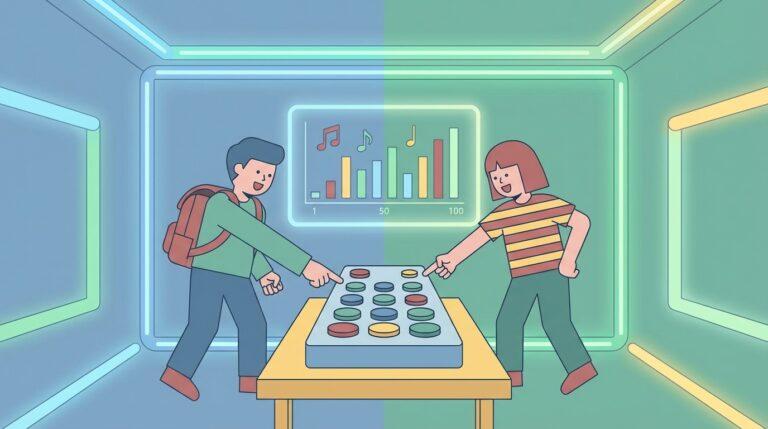
Cut to ten minutes later. You’re sitting in a neon-lit room with disco balls flashing. Someone shoves a massive remote control—which looks more like a spaceship dashboard—into your hands. They look at you expectantly. You want to sing that new K-Pop song you’ve been listening to on repeat, but all you see is a sea of Korean buttons. Panic mode activated.
Don’t worry! Every Korean learner has been there. Knowing how to navigate the Noraebang remote and search for the latest charts isn’t just about singing; it’s about holding your own in one of Korea’s most important social rituals. Today, we’re going to turn you from a deer in the headlights into the ultimate Noraebang DJ.
Phase 2: Core Expressions Deep Dive 🎤
Let’s break down the essential phrases you need when you’re staring at that giant remote control.
1. 인기 차트 띄워줄래?
- Pronunciation: [in-gi cha-teu tti-wo-jul-lae?] (in-gee cha-teu ttee-wo-jul-leh?)
- Meaning: Literal: Can you float the popular chart? / Real nuance: Can you pull up the top 100 chart?
- K-Culture Moment: The “Popular Chart” (인기 차트) button is the most clicked button in any Noraebang. If nobody knows what to sing, pulling up the Top 100 is the ultimate icebreaker.
- Editor’s Insight: The verb ‘띄우다’ literally means ‘to float’, but in digital contexts, it means ‘to pull up on the screen’. It sounds much more natural than saying ‘보여주세요’ (show me).
- Situation Spectrum:
[🚫 Never] ———— [⚠️ Be Careful] ———— [✅ Freely]
- Close friends (Casual): ✅ (띄워줄래? / 띄워봐)
- Co-workers (Semi-formal): ⚠️ (띄워주시겠어요?)
- Boss/Elders (Formal): 🚫 (Let them choose the song first!)
- 🤔 Think About It: Why does every Noraebang machine have a dedicated ‘Popular Chart’ button? It reflects Korea’s strong “trend-sharing” culture. Knowing what’s popular and enjoying it together is a big part of social bonding here.
2. 최신곡으로 검색해 줘.
- Pronunciation: [choe-sin-go-geu-ro geom-sae-kae jwo.] (chweh-shin-gok-eu-ro gum-sek-heh jwo.)
- Meaning: Literal: Search by newest song, please. / Real nuance: Look up the latest songs.
- K-Culture Moment: K-Pop moves fast. A song that came out yesterday is already on the Noraebang machines today. Fans often rush to Noraebang just to practice the “fanchants” (팬챈트) for a newly released comeback track.
- Editor’s Insight: ‘최신’ (Choesin) means ‘newest/latest’ and ‘곡’ (Gok) means ‘song’. You can attach ‘최신’ to anything to sound like a local: 최신 유행 (latest trend), 최신 폰 (newest phone).
- Situation Spectrum:
[🚫 Never] ———— [⚠️ Be Careful] ———— [✅ Freely]
- Close friends (Casual): ✅
- Co-workers (Semi-formal): ✅ (검색해 주세요)
- Boss/Elders (Formal): ⚠️
- 🤔 Think About It: Does your culture update its karaoke machines daily? In Korea, speed (빨리빨리 culture) applies even to entertainment!
3. 나 이거 예약할게!
- Pronunciation: [na i-geo ye-ya-kal-ge!] (na ee-geo ye-yahk-hal-geh!)
- Meaning: Literal: I will reserve this! / Real nuance: I’m putting this song in the queue!
- K-Culture Moment: You found your song! Now you press the glorious ‘예약’ (Reserve) button. In a K-Drama, this is the moment the confident lead character smirks and queues up a power ballad to show off their vocals.
- Editor’s Insight: This is the most crucial survival word: 예약 (Reservation). Never press 시작 (Start) if someone is already singing, or you will cut their song off and become the villain of the night.
- Situation Spectrum:
[🚫 Never] ———— [⚠️ Be Careful] ———— [✅ Freely]
- Close friends (Casual): ✅
- Co-workers (Semi-formal): ✅ (저 이거 예약할게요!)
- Boss/Elders (Formal): ⚠️ (Ask first: “예약해도 될까요?” – May I reserve a song?)
Phase 3: Textbook vs. Real Life 📖 vs 🗣️
| Situation | 📖 Textbook Korean | 🗣️ Real Korean | 💡 Why the difference? |
|---|---|---|---|
| Looking for new songs | 가장 최근에 나온 노래가 무엇입니까? | 야, 신곡 뭐 있냐? (Hey, any new songs?) | Noraebang is high-energy! Sentences become shorter and use slang like ‘신곡’ (new song). |
| Queuing a song | 제가 노래를 예약하겠습니다. | 나 예약 누른다! (I’m pressing reserve!) | Stating your physical action (“pressing”) makes it sound more urgent and casual. |
| Asking for the remote | 리모컨을 저에게 주시겠어요? | 리모컨 좀 패스해 줘. (Pass the remote, please.) | Konglish (패스 – pass) is heavily used in casual, fast-paced environments. |
Phase 4: Cultural Deep Dive — The K-Culture of Noraebang 🇰🇷
4-1. The “Nunchi” of the Remote Control
In Korea, the Noraebang remote isn’t just a tool; it’s a scepter of power, but also a symbol of service. At a company dinner (회식 – Hoesik), the youngest employee (막내 – Maknae) usually sits next to the machine. Their job? To use their 눈치 (Nunchi – situational awareness) to queue up popular songs, hand out tambourines, and ensure there’s never an awkward silence between songs. If you take the remote, you’re taking on the role of the DJ.
4-2. The K-Pop Connection: Ttechang (떼창)
When you search the latest charts and put on a mega-hit K-Pop song, don’t expect to sing it alone. Koreans love 떼창 (Ttechang – singalong). Even if it’s “your” reserved song, when the chorus hits, everyone in the room will grab a tambourine or a spare mic and scream the lyrics with you. It’s not rude; it’s the ultimate sign of solidarity and hype!
Phase 5: Immersive Roleplay — Your Turn! 🎭
Setting: Friday night, 9 PM. You and your Korean coworkers are at a luxury Noraebang in Gangnam. The screen is flashing, and Minsoo (your friendly, outgoing coworker) tosses you the massive remote.
Minsoo: 자, 첫 곡은 누가 할래? (Right, who’s doing the first song?)
YOU: 제가 먼저 할까요? (Shall I go first?)
Minsoo: 오~ 좋아! 리모컨 거기 있어. 무슨 노래 부를 거야?
(Oh~ nice! The remote is right there. What song are you going to sing?)
YOU: 음… 아직 못 정했어요. (Hmm… I haven’t decided yet.)
Minsoo: 그럼 내가 도와줄까? (Should I help you?)
🔀 Your Turn! How should you respond to find a good song?
– A) “최근 노래가 무엇입니까?” (What are the recent songs?)
– B) “인기 차트 좀 띄워주실래요?” (Could you pull up the popular chart?)
– C) “아무거나 시작 눌러주세요.” (Please press start on anything.)✅ Best Choice: B — It’s natural, polite (with ~실래요), and gets the Top 100 on screen so everyone can look together.
⚠️ Choice C Analysis: NEVER press ‘Start’ (시작) randomly. You might accidentally trigger a 1990s Trot song you don’t know!
(Continuing with B)
Minsoo: (Presses the button) 자, 인기 차트 띄웠어! 발라드? 댄스? (Here, I pulled up the popular chart! Ballad? Dance?)
YOU: 댄스곡으로 할게요. 아! 이 노래 예약할게요! (I’ll do a dance song. Ah! I’ll reserve this one!)
Minsoo: 나이스! 내가 탬버린 친다! (Nice! I’ll play the tambourine!)
🎁 Bonus Scenario: The Magic of “Service”
If you see the machine’s timer hit 00:00, don’t leave yet! Suddenly, the screen might flash “15:00” again.
Owner (over intercom): 서비스 드렸습니다~ (I gave you some ‘service’~)
YOU: 와, 대박! 우리 최신곡 하나 더 검색하자! (Wow, awesome! Let’s search for one more new song!)
Note: ‘Service’ (서비스) in Korea means something given for free. In Noraebang, it means bonus time!
Phase 6: 10-Second Shadowing Drill 🗣️
Let’s practice saying you want to search for a new song with the right rhythm and emotion.
😊 우리 / 최신곡으로 / 한번 검색해 볼까?
(u-ri / choe-sin-go-geu-ro / han-beon geom-sae-kae bol-kka?)
“Shall we try searching for the latest songs?”
Pro-Tip: Make your voice go slightly up at the end on “볼까?” to sound friendly and suggestive!
Phase 7: K-Culture Glossary 📚
| Korean | Romanization | English | Context |
|---|---|---|---|
| 노래방 | noraebang | Karaoke | Lit. “Song room”. The heart of Korean nightlife. |
| 리모컨 | rimokeon | Remote control | Konglish for remote control. The DJ’s weapon. |
| 예약 | yeyak | Reserve/Queue | The button you press to line up your song. |
| 취소 | chwiso | Cancel | Press this if you queued the wrong song! |
| 떼창 | ttechang | Singalong | Singing the chorus together in a massive group. |
| 서비스 | seobiseu | Freebie / Bonus time | Extra minutes the owner gives you for free. |
Phase 8: Traveler’s Survival Kit 🧳
If you are traveling in Korea, you might visit a Coin Noraebang (코인 노래방 or 코노), which is perfect for solo travelers or small groups!
🆘 Survival Phrases for Coin Noraebang
– 🇰🇷 “한 곡에 얼마예요?” (han go-ge eol-ma-ye-yo?)
– 🗣️ Meaning: How much is it for one song?
– 🇰🇷 “지폐 교환기 어디 있어요?” (ji-pye gyo-hwan-gi eo-di i-sseo-yo?)
– 🗣️ Meaning: Where is the bill exchanger?📌 Editor’s Travel Note:
Most modern Coin Noraebangs accept credit cards directly at the machine! Just look for the “카드 결제” (Card Payment) button on the screen. Also, a quick tip: 1 song is usually 500 KRW, but 1,000 KRW gets you 3 songs. Always go for the 1,000 won bill!
Phase 9: Think Deeper — “One Step Further” 🧠
Language & Power: The Great Equalizer
In standard Korean culture, age and job titles dictate how people interact. The office hierarchy is strict. However, the Noraebang during a Hoesik (company dinner) acts as a magical equalizer. When the music gets loud, titles melt away. The shy intern might sing a trending rap song perfectly, and the stoic boss might shake the tambourine for them. The language inside the Noraebang becomes surprisingly informal and collaborative. It’s one of the few places in Korean society where “vibe” (분위기) overrides “status” (지위).
💬 Your Turn: Is there a place or activity in your culture where social hierarchies completely disappear? Share it in the comments!
Phase 10: FAQ & Troubleshooting 🛠️
Q: “Can I sing English pop songs at a Korean Noraebang?”
Yes! Grab the remote and look for the button that says 팝송 (Pop Song). They have a massive library of Billboard hits.
Q: “I accidentally pressed 시작 (Start) instead of 예약 (Reserve) while my friend was singing. What do I do?”
Apologize immediately! “미안해! 잘못 눌렀어!” (Sorry! I pressed the wrong thing!) This cuts their song off entirely. It’s the ultimate party foul.
❌ Common Mistake #1: Staring at the Korean lyrics on screen trying to read them fast enough.
✅ Do this instead: Most modern machines allow you to change the lyric display to Romanization! Ask the staff or look for the ‘로마자’ (Romanization) setting.
Phase 11: Wrap-up & Action Items 🎬
One-Liner Summary: To rule the Noraebang, remember three things: pull up the popular chart (인기 차트), search for new songs (최신곡), and always press RESERVE (예약)!
Your 3-Step Action Mission:
– 🥉 Bronze (Solo): Look at a photo of a Korean Noraebang remote on Google Images and try to spot the ‘예약’ button.
– 🥈 Silver (Online): Go to YouTube, search “K-Pop Noraebang” and sing along to one song using the on-screen lyrics.
– 🥇 Gold (Real Life): Visit a local karaoke place, pull up the Korean charts, and actually sing a song using the queuing system!
K-Culture Mission: Next time you watch a K-Drama, pay attention to the Noraebang scenes. Can you spot who is holding the remote? (Hint: It says a lot about their character’s social status!)
Phase 12: Interactive Quiz 🏆
1. You are at a Noraebang and your friend asks what you want to sing. You want to see the Top 100. What do you say?
A) 최신곡 검색해 줘.
B) 인기 차트 띄워줄래?
C) 리모컨 패스해 줘.
2. Fill in the blank: Before you sing, never press _______ if someone else is already singing! Always press 예약.
A) 취소 (Cancel)
B) 시작 (Start)
C) 인기 (Popular)
3. True or False: If the Noraebang timer hits 00:00, you must leave the room immediately.
(Check your answers by highlighting the text below!)
Click here for answers!
1. B (인기 차트 띄워줄래? means “Can you pull up the popular chart?”)
2. B (시작 means Start. Pressing it will cut off the current song!)
3. False! Wait a few seconds. The owner might give you “Service” (서비스) – extra free time!
Did you enjoy this guide? What song are you going to queue up first at your next Noraebang session? Let me know in the comments below! 😊🎶
Frequently Asked Questions (FAQ)
Q: What does "인기 차트 띄워줄래?" mean in Korean and how do you pronounce it?
A: In Korean, "인기 차트 띄워줄래?" is pronounced [in-gi cha-teu tti-wo-jul-lae?] and means: Literal: Can you float the popular chart? / Real nuance: Can you pull up the top 100 chart?
Q: What does "최신곡으로 검색해 줘." mean in Korean and how do you pronounce it?
A: In Korean, "최신곡으로 검색해 줘." is pronounced [choe-sin-go-geu-ro geom-sae-kae jwo.] and means: Literal: Search by newest song, please. / Real nuance: Look up the latest songs.
Q: What does "나 이거 예약할게!" mean in Korean and how do you pronounce it?
A: In Korean, "나 이거 예약할게!" is pronounced [na i-geo ye-ya-kal-ge!] and means: Literal: I will reserve this! / Real nuance: I'm putting this song in the queue!







