

Phase 1: Empathy — Immersive Opening (Immersive Hook)
Hello there! It’s your Daily Hangul Editor.
Picture this: You finally managed to score a VIP ticket to one of the hottest musicals in Seoul. The lights dim, the orchestra swells, and the lead actor is just about to hit that breathtaking, tear-jerking high note. The entire theater is holding its breath. And then… BZZZ. BZZZ.
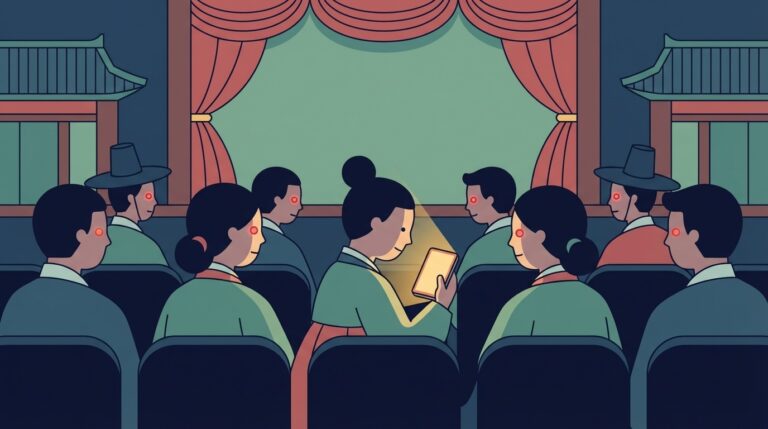
A blinding white light erupts from the row in front of you. Someone is checking their KakaoTalk messages. The collective, silent rage of 1,500 audience members instantly pierces through the dark.
Welcome to the intense, hyper-focused world of Korean theater etiquette. If you thought K-Pop fandoms were passionate, wait until you meet Korean musical fans. In Korea, ruining someone’s theater experience isn’t just a minor annoyance; it’s a social crime known as 관크 (Gwan-keu).
As an advanced (C1) Korean learner, simply knowing how to say “Please be quiet” isn’t enough. You need to understand the cultural weight of the shared space in Korea. Today, we are diving deep into the unspoken rules of the Korean theater, the slang that locals use, and how to handle a nuisance without causing an even bigger scene. Let’s make sure you get the ultimate “Insider” treatment on your next trip to Daehak-ro or the Seoul Arts Center!
Phase 2: Deep Dive into Core Expressions
Let’s unpack the most crucial vocabulary you’ll need to survive and thrive in the Korean performing arts scene.
1. 관크 (Gwan-keu) / 관크 당하다 (To suffer from Gwan-keu)
- Pronunciation: [gwan-keu] / [gwan-keu dang-ha-da]
Sound guide: ‘Gwan’ sounds like ‘Guan’ in iguana. ‘Keu’ sounds like the ‘coo’ in cook, but shorter and sharper.- Meaning: Literal: Audience Critical (damage). Real nuance: Any nuisance or disruptive behavior caused by another audience member that ruins your viewing experience.
- K-Culture Moment: You’ll see this all over Korean Twitter (X) or musical forums after a show. Fans will vent: “오늘 내 옆자리 아저씨 때문에 완전 관크 당했어!” (I totally suffered from gwan-keu today because of the middle-aged man next to me!)
- Editor’s Insight: This word comes from gaming slang (“critical hit”). Taking a “critical hit” from the audience means your immersion was completely shattered. It’s a noun, but often used with the verb 당하다 (to suffer/experience).
- Situation Spectrum:
[🚫 Absolute Ban] ———— [⚠️ Caution] ———— [✅ Freely]
- Casual (Friends): ✅
- Semi-formal (Colleagues): ⚠️ (Only if they are familiar with internet slang)
- Formal (Boss/Elders): 🚫
- 🤔 Think About It: Why did Koreans combine a formal word “관객” (audience) with a gaming term “크리티컬” (critical) to describe bad etiquette? What does this tell you about the demographic that drives the Korean musical industry?
2. 시체관극 (Siche-gwan-geuk)
- Pronunciation: [si-che-gwan-geuk]
Sound guide: ‘Si-che’ sounds like ‘she-che’ (meaning corpse).- Meaning: Literal: Corpse viewing. Real nuance: Sitting completely motionless and silent, like a corpse, to ensure absolute zero distraction for others.
- K-Culture Moment: In Western theaters, people lean on armrests, whisper, or react audibly. In Korea, Siche-gwan-geuk is the unwritten law. If you lean forward or shift your weight too often, you will get tapped on the shoulder.
- Editor’s Insight: This is a highly debated term even among Koreans. Some believe it’s the ultimate form of respect; others think it’s too suffocating. But as a visitor, it’s safer to follow the “corpse” rule.
- Situation Spectrum:
[🚫 Absolute Ban] ———— [⚠️ Caution] ———— [✅ Freely]
- Casual: ✅
- Semi-formal: ✅
- Formal: ⚠️
- 🤔 Think About It: Do you think Siche-gwan-geuk is about respecting the actors on stage, or about respecting the expensive ticket price your fellow audience members paid?
3. 수그리 (Su-geu-ri) & 폰딧불이 (Pon-dit-bul-i)
- Pronunciation: [su-geu-ri] & [pon-dit-bul-i]
Sound guide: ‘Pon’ (Phone) + ‘dit-bul-i’ (sounds like firefly).- Meaning:
- Su-geu-ri: The act of leaning your upper body forward, blocking the view of the person behind you.
- Pon-dit-bul-i: “Phone firefly.” Someone who turns on their phone screen in the dark theater.
- K-Culture Moment: During the intermission, you might hear someone whisper to their friend: “앞 사람 수그리 장난 아니야… 시야 다 가려.” (The person in front is doing a crazy su-geu-ri… blocking my whole view.)
- Editor’s Insight: These are highly specific, witty slangs born from absolute frustration. They are perfectly descriptive and used extensively in the Korean performing arts community.
- Situation Spectrum:
[🚫 Absolute Ban] ———— [⚠️ Caution] ———— [✅ Freely]
- Casual: ✅
- Semi-formal: ⚠️
- Formal: 🚫
Phase 3: Textbook vs. Real Life Korean
Let’s look at how formal warnings differ from what locals actually text each other during intermission.
| Situation | 📖 Textbook Korean | 🗣️ Real Korean | 💡 Why the difference? |
|---|---|---|---|
| Telling someone their phone is bright | 관람 중에는 휴대폰 전원을 꺼주시기 바랍니다. (Please turn off your phone during the performance.) | 아, 또 폰딧불이… 눈 뽕 오져. (Ugh, another phone firefly… the glare is blinding.) | “눈 뽕” (blinding glare) and “오지다” (extreme) are aggressive slang used to express visceral frustration online. |
| Complaining about someone talking | 조용히 해주세요. (Please be quiet.) | 옆 사람 수다리 관크 미쳤음. (The chatter gwan-keu next to me is insane.) | Using “미쳤음” (insane/crazy) instead of formal adjectives emphasizes the emotional damage taken. |
| Asking someone not to lean forward | 등을 의자에 기대어 앉아주세요. (Please sit with your back against the chair.) | 앞사람 수그리 좀 안 했으면. (I really wish the person in front would stop doing su-geu-ri.) | The nounification of actions (수그리 from 수그리다) makes it easier to label and critique bad behavior. |
Bottom Note for C1 Learners: While it’s fun to know “눈 뽕 오져” (blinding glare is insane), keep it to your private texts. If you actually need to confront someone, stick to the polite but firm expressions we’ll cover in the Roleplay section.
Phase 4: Cultural Deep Dive — K-Culture Context
4-1. Non-verbal Communication: The Power of the Nunchi Laser
In a Korean theater, silence is golden, but body language speaks volumes. If you commit a Gwan-keu, you will likely not be yelled at immediately. Instead, you will experience the 눈치 레이저 (Nunchi Laser)—a sharp, collective glare from the people around you.
Direct confrontation during a show is considered another form of Gwan-keu. Therefore, Koreans rely heavily on aggressive throat-clearing, deep sighs, or intense staring to make the offender realize their mistake. If you feel a sudden drop in temperature and multiple eyes burning into the side of your head, freeze and check your posture or your phone!
4-2. The Dissonance: K-Pop vs. K-Musical
If you’ve been to a K-Pop concert, you know it’s a festival of screaming, fan-chants (응원법), and glowing lightsticks.
However, walking into a K-Musical with that same energy is a recipe for disaster. The Korean musical scene demands reverence. Even cheering after a magnificent solo number is often restricted until the 커튼콜 (Curtain Call). This duality showcases a fascinating aspect of Korean culture: we have strictly designated “zones” for letting loose (K-Pop, Hoesik) and “zones” for absolute discipline (Musicals, Classical concerts). Knowing how to read the room (Nunchi) is your greatest asset here.
Phase 5: Immersive Roleplay Scenario
Scenario A: The Intermission Confrontation
Setting: Saturday afternoon, 3:15 PM. The bustling lobby of the Blue Square theater in Itaewon. You are watching Jekyll & Hyde with your Korean friend, Min-ji. During the first act, the person in front of you kept leaning forward (수그리), completely blocking your view of the stage.
Characters:
– YOU: A musical enthusiast visiting Seoul, holding a C1 level in Korean but nervous about confrontation.
– Min-ji (28): Your Korean friend. A hardcore musical fan who takes theater etiquette very seriously.
(Dialogue)
Min-ji: 1막 어땠어? 조승우 배우님 연기 미치지 않았어? 🤩
(1-mak eottaesseo? Jo Seung-woo baeu-nim yeongi michiji anasseo?)
[How was Act 1? Wasn’t actor Cho Seung-woo’s acting insane?]
YOU: 연기는 진짜 최고였는데… 나 앞 사람 때문에 집중을 하나도 못 했어.
(Yeongi-neun jinjja choego-yeonneunde… na ap saram ttaemune jipjung-eul hana-do mot haesseo.)
[The acting was truly the best, but… I couldn’t focus at all because of the person in front of me.]
Min-ji: 헐, 왜? 앞 사람이 관크했어?
(Heol, wae? Ap saram-i gwan-keu-haesseo?)
[OMG, why? Did the person in front do a gwan-keu?]
YOU: 응, 계속 수그리 자세로 봐서 무대 오른쪽이 아예 안 보였어.
(Eung, gyesok su-geu-ri jase-ro bwaseo mudae oreunjjok-i aye an boyeosseo.)
[Yeah, they kept watching in a leaned-forward position, so I couldn’t see the right side of the stage at all.]
Min-ji: 아, 진짜 짜증나겠다. 2막 시작하기 전에 말하는 게 낫지 않을까?
(Ah, jinjja jjajeung-nagetta. 2-mak sijak-hagi jeone mal-haneun ge natji aneulkka?)
[Ah, that must be so annoying. Shouldn’t we say something before Act 2 starts?]
🔀 YOUR TURN! How should you handle this?
– A) (Directly tap the person) “저기요, 등 좀 기대고 보세요!” (Excuse me, lean your back against the seat!)
– B) (Ask the Usher) “어셔(안내원)한테 가서 앞 사람 주의 좀 달라고 부탁할까?” (Should we go to the usher and ask them to give a warning to the person in front?)
– C) (Suffer in silence) “그냥 참을게. 괜히 싸움 날까 봐 무서워.” (I’ll just endure it. I’m scared it might start a fight.)✅ Best Choice: B — Why? In Korea, directly confronting another audience member is highly discouraged and can lead to a bigger argument, ruining the vibe for everyone. The standard protocol is to ask the 어셔 (Usher/House Manager) to handle it. They are trained to gently correct posture before the next act begins.
⚠️ Choice A Analysis: While grammatically perfect, directly ordering someone can sound aggressive and might put you in an uncomfortable situation.
YOU: 어셔(안내원)한테 가서 앞 사람 주의 좀 달라고 부탁할까?
(Eosyeo-hante gaseo ap saram ju-ui jom dallago butak-halkka?)
[Should we go to the usher and ask them to give a warning to the person in front?]
Min-ji: 오, 똑똑한데? 내가 같이 가줄게. 저기 안내원 있다, 가자!
(Oh, ttokttok-hande? Naega gachi gajulge. Jeogi annaewon itda, gaja!)
[Oh, smart! I’ll go with you. There’s an usher over there, let’s go!]
(🎭 Stage Direction: You approach the polite usher holding a flashlight.)
YOU: 저기요, 제가 J열 15번 앉는데요, 앞자리 분이 자꾸 몸을 숙이셔서 시야가 가려져요.
(Jeogiyo, je-ga J-yeol 15-beon anneundeyo, apjari bun-i jakku mom-eul sugisyeoseo siya-ga garyeojyeoyo.)
[Excuse me, I’m sitting in row J, seat 15. The person in front of me keeps leaning forward, blocking my view.]
Usher: 아, 불편을 드려 죄송합니다. 2막 시작 전에 저희가 정중히 안내해 드리겠습니다.
(Ah, bulpyeon-eul deuryeo joesong-hamnida. 2-mak sijak jeone jeohui-ga jeongjung-hi an-nae-hae deurigetseumnida.)
[Ah, I apologize for the inconvenience. We will politely inform them before Act 2 begins.]
Scenario B: The Curtain Call Trap
(The musical ends. The actors come out for their final bows. You pull out your phone to take a picture of the standing ovation.)
Min-ji: (Quickly grabs your arm) 앗! 지금 사진 찍으면 안 돼!
(At! Jigeum sajin jjigeumyeon an dwae!)
[Ah! You can’t take pictures right now!]
YOU: 어? 커튼콜인데 안 돼?
(Eo? Keoteunkol-inde an dwae?)
[Huh? It’s the curtain call, is it not allowed?]
Min-ji: 응, 한국은 ‘커튼콜 데이’라고 정해진 날에만 촬영할 수 있어. 평소엔 절대 금지야!
(Eung, Hanguk-eun ‘Keoteunkol dei’-rago jeonghae-jin nar-eman chwaryeong-hal su isseo. Pyeongso-en jeoldae geumjiya!)
[Yeah, in Korea, you can only film on designated ‘Curtain Call Days’. Normally, it’s strictly prohibited!]
Phase 6: 10-Second Shadowing Drill
Time to practice! If you must speak to the person directly because there is no usher around, use this polite but firm sentence. Pay attention to the pauses and intonation.
😤 (Polite but firm)
저기요, / 등 좀 / 기대고 보실래요? / 시야가 / 가려져서요.
(jeogiyo, / deung jom / gidaego bosillaeyo? / siya-ga / garyeojyeoseoyo.)
Excuse me, / could you / lean your back? / My view / is being blocked.
Phase 7: K-Culture Glossary (Mini Dictionary)
| 한국어 (Korean) | Romanization | English | Cultural Context |
|---|---|---|---|
| 관크 | gwan-keu | Audience nuisance | Any behavior that ruins the viewing experience (phones, talking, kicking seats). |
| 어셔 | eo-syeo | Usher / House Manager | The absolute authorities inside a Korean theater. Always go to them for disputes. |
| 수그리 | su-geu-ri | Leaning forward | Bending forward in your seat, which blocks the sightline of the row behind you. |
| 시체관극 | siche-gwan-geuk | Corpse viewing | The strict Korean etiquette of sitting perfectly still during a performance. |
| 커튼콜 데이 | keoteunkol dei | Curtain Call Day | Specific dates when taking photos/videos during the final bows is permitted. |
| 눈치 | nunchi | Social awareness | The art of reading the room. Crucial for surviving in tight, shared spaces like theaters. |
Phase 8: Traveler’s Survival Kit
If you plan to watch a musical, concert, or indie performance in Korea, memorize these survival phrases!
🆘 Survival Phrases for the Theater
– 🇰🇷 “오늘 커튼콜 촬영 가능한가요?” (oneul keoteunkol chwaryeong ganeung-hangayo?)
– 🗣️ English: Is curtain call photography allowed today?
– 💡 Pro Tip: Ask this at the ticket booth before entering. If they say no, keep your phone deep in your bag.
- 🇰🇷 “빈자리로 옮겨도 되나요?” (binjari-ro omgyeodo doenayo?)
- 🗣️ English: Can I move to an empty seat?
- 💡 Pro Tip: The answer in Korea is almost always NO. Seating is strictly enforced due to ticketing tiers and COVID-era legacy rules. Don’t move even if the seat in front of you is empty!
🇰🇷 “어셔(안내원) 분 어디 계신가요?” (eo-syeo bun eodi gyesingayo?)
- 🗣️ English: Where is the usher?
📌 Editor’s Travel Note:
When buying theater tickets in Korea, foreigners often struggle with local sites like Interpark or Melon Ticket due to identity verification requirements. Look for the “Global” versions of these sites. Also, do not buy from scalpers (암표 – ampyo); Korean theaters strictly check your ID against the name on the ticket!
Phase 9: Think Deeper — “One Step Further”
🧠 Think Deeper: Culture, Collectivism, and Personal Space
The strict rules of Siche-gwan-geuk (corpse viewing) offer a fascinating glimpse into modern Korean society. Traditionally, Korea is known for a collective culture that values harmony. However, in the realm of high-priced cultural consumption (like $150 VIP musical tickets), this collectivism transforms into “hyper-vigilance.” Everyone agrees to suppress their individual reactions (laughing out loud, leaning, gasping) to protect the “perfect experience” of the collective whole. It’s a unique blend of extreme consideration for others and an intense defense of one’s own consumer rights.💬 Your Turn: Does your culture treat the theater as a lively, interactive space (like pantomimes in the UK) or a sacred, silent sanctuary? Share your thoughts in the comments!
Phase 10: Troubleshooting & FAQ
Q: Someone’s phone went off, but the actors made a joke about it to lighten the mood. Can I laugh?
Yes! If the actors break the fourth wall to address a Gwan-keu and make a joke, the audience is allowed to laugh. But the offender will still feel the crushing weight of a thousand Nunchi Lasers.
Q: I’m really tall. Am I committing su-geu-ri just by sitting normally?
No, you cannot help your height! However, if you notice the person behind you struggling, simply sitting back as deeply into your chair as possible is the best courtesy. Don’t slouch forward.
❌ Common Mistake #1: Taking a photo of the empty stage before the show starts.
✅ How to fix it: In Broadway or the West End, taking photos of the beautiful set before the show is normal. In Korea, stage design is highly protected by copyright. Ushers will actively run down the aisles yelling, “셀카 및 무대 촬영 안 됩니다!” (No selfies or stage photography!). Always assume taking pictures is banned unless specifically told otherwise.
Phase 11: Wrap-up & Action Items
🔍 One-Liner Summary: In the Korean theater, absolute stillness (Siche-gwan-geuk) is respect, and any disruption is a Gwan-keu best handled by the ushers, not by direct confrontation.
🎯 Action Mission 3 Steps:
– 🥉 Bronze (Solo): Say “저기요, 등 좀 기대고 보실래요?” out loud 3 times with a polite but firm tone.
– 🥈 Silver (Online): Go to a Korean musical YouTube video (like a Frankenstein or Rebecca curtain call) and see if you can spot the word “관크” or “어셔” in the comments!
– 🥇 Gold (Real Life): Next time you are at a cinema or theater in Korea, locate the Usher (어셔) before the show starts, just so you know where they are in an emergency.
🎭 K-Culture Mission:
Visit the Interpark Ticket Global website, click on any popular Korean musical, and scroll down to the “관람 유의사항” (Viewing Etiquette) section. See how many “No photography” and “No late entry” warnings you can read in Korean!
Phase 12: Interactive Quiz
Test your knowledge of the Korean theater survival guide!
1. Fill in the blank:
The person next to you keeps turning on their smartwatch during the dark scenes. They are being a total ( _______ ).
A) 수그리 (Su-geu-ri)
B) 어셔 (Eo-syeo)
C) 폰딧불이 (Pon-dit-bul-i)
2. Situational Judgment:
The person behind you keeps kicking your seat. What is the most “Korean” and polite way to handle this during Act 1?
A) Turn around and yell, “관크 그만 하세요!” (Stop your gwan-keu!)
B) Stare at them intensely (Nunchi laser) and if it continues, ask the usher during intermission.
C) Kick the seat of the person in front of you to pass the anger forward.
3. True or False – K-Culture Edition:
In Korea, it is totally fine to snap a quick selfie with the stage background before the musical begins, as long as the actors aren’t on stage yet. (T/F)
▼ Answers below! ▼
Click to reveal answers
1. C) 폰딧불이 (Phone firefly – someone who creates light pollution in the theater).
2. B) Using the Nunchi laser, then involving the Usher (어셔), is the socially acceptable way to resolve conflicts without causing a scene.
3. False. Stage designs are under strict copyright in Korea. Ushers will tell you to delete the photo immediately!
Frequently Asked Questions (FAQ)
Q: What does "관크 (Gwan-keu) / 관크 당하다 (To suffer from Gwan-keu)" mean in Korean and how do you pronounce it?
A: In Korean, "관크 (Gwan-keu) / 관크 당하다 (To suffer from Gwan-keu)" is pronounced [gwan-keu] and means: Literal: Audience Critical (damage). Real nuance: Any nuisance or disruptive behavior caused by another audience member that ruins your viewing experience.
Q: What does "시체관극 (Siche-gwan-geuk)" mean in Korean and how do you pronounce it?
A: In Korean, "시체관극 (Siche-gwan-geuk)" is pronounced [si-che-gwan-geuk] and means: Literal: Corpse viewing. Real nuance: Sitting completely motionless and silent, like a corpse, to ensure absolute zero distraction for others.
Q: What does "수그리 (Su-geu-ri) & 폰딧불이 (Pon-dit-bul-i)" mean in Korean and how do you pronounce it?
A: In Korean, "수그리 (Su-geu-ri) & 폰딧불이 (Pon-dit-bul-i)" is pronounced [su-geu-ri] and means: Su-geu-ri: The act of leaning your upper body forward, blocking the view of the person behind you.







