

Hello there! I’m the Lead Editor at Daily Hangul.
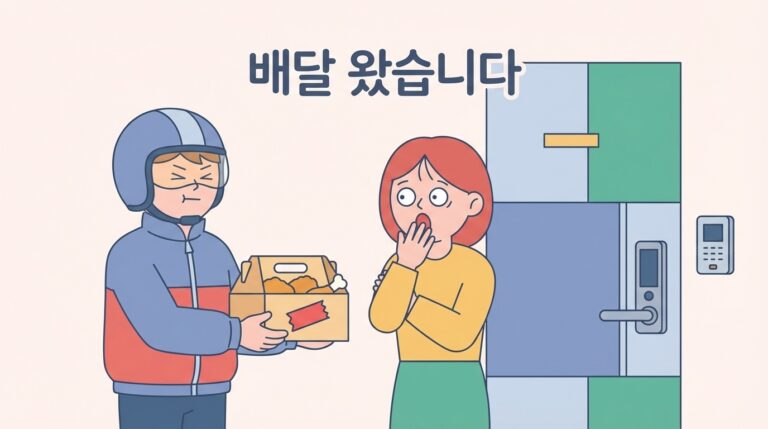
Picture this: It’s 10 PM on a Friday in Seoul. You’ve just survived a grueling week, and the only cure is a piping hot box of Korean fried chicken. You fire up your Baemin (배달의민족) app, wait 45 minutes, and finally, the doorbell rings. You eagerly open the box, but wait… Doesn’t this box look a little… empty? Is that a bone missing its meat? Did someone… take a bite?
Welcome to the dark side of Korea’s ultra-convenient delivery culture. Today, we are diving deep into the infamous ‘배달 거지’ (Delivery Beggar) controversy that shook the K-Food scene, and the ingenious solution born from it: the ‘안심 스티커’ (Safety Sticker).
As a C2-level learner, you already know how to order food. Now, it’s time to learn how to navigate consumer disputes, understand the socio-economic shifts in the gig economy, and express complex suspicions and relief like a true Seoulite. Let’s get into it!
Phase 2: Core Expressions Deep Dive
1. 배달 거지 (Baedal geoji)
- Pronunciation: [Bae-dal geo-ji]
- Meaning: Literal: Delivery beggar. Real Nuance: A derogatory term for a delivery rider who secretly eats a portion of the customer’s food during transit.
- K-Culture Moment: You’ll see this word plastered all over Korean internet forums (like Blind or Everytime) accompanied by photos of chicken boxes with noticeably missing pieces or half-eaten French fries.
- Editor’s Insight: The word ‘거지’ (beggar) is highly insulting in Korean. By combining it with ‘배달’, consumers expressed their absolute disgust not just at the theft, but at the sheer pettiness of stealing a single piece of fried chicken.
- Situation Spectrum:
[🚫 절대 금지] ———— [⚠️ 주의] ———— [✅ 자유롭게]
- Close friends (Casual ranting): ✅
- Online forums: ✅
- Saying it directly to a rider: 🚫 (Never do this; it’s extremely aggressive and could lead to legal issues like defamation).
- 🤔 Think About It: Why did this specific phenomenon cause such outrage in Korea? Food is inherently communal and sacred in Korean culture (정 – Jeong). To mess with someone’s food is to break a profound social contract.
2. 빼먹다 (Ppaemeokda)
- Pronunciation: [Ppae-meok-tta] (The ‘ㅃ’ sounds like the tense ‘p’ in ‘spa’)
- Meaning: Literal: To pull out and eat. Real Nuance: To secretly snatch a bite, or idiomatically, to skip/omit something entirely (like skipping class).
- K-Culture Moment: “야, 내 감자튀김 누가 빼먹었어?” (Hey, who snuck a bite of my fries?)
- Editor’s Insight: This verb perfectly captures the stealthy, surgical removal of a single piece of food. It’s an essential advanced compound verb (빼다 + 먹다).
- Situation Spectrum:
[🚫 절대 금지] ———— [⚠️ 주의] ———— [✅ 자유롭게]
- Friends/Family: ✅
- Customer Service (Complaining): ✅ (e.g., “음식을 빼먹은 것 같아요”)
- Formal Business: 🚫
- 🤔 Think About It: Korean has many compound verbs ending in ‘~먹다’ that imply doing something thoroughly or for one’s own selfish benefit (e.g., 떼먹다 – to embezzle/skip out on paying). How does the verb ‘먹다’ expand beyond literal eating in Korean?
3. 안심 스티커 (Ansim seutikeo)
- Pronunciation: [An-sim seu-ti-keo]
- Meaning: Literal: Peace of mind sticker. Real Nuance: Tamper-evident seal/sticker placed on delivery containers.
- K-Culture Moment: You’ll often see restaurants boast on Baemin: “저희 매장은 100% 안심 스티커를 부착합니다!” (Our store attaches safety stickers 100% of the time!).
- Editor’s Insight: Notice how it’s not called a ‘Security’ sticker (보안 스티커) but a ‘Peace of Mind’ sticker (안심 스티커). It highlights the emotional state of the consumer. Korean marketing heavily relies on emotional reassurance.
- Situation Spectrum:
[🚫 절대 금지] ———— [⚠️ 주의] ———— [✅ 자유롭게]
- Universal: ✅
- 🤔 Think About It: Korea is often cited as a ‘High-Trust Society’ (you can leave your laptop at a cafe, and no one will steal it). Why did a low-trust mechanism like the Ansim Sticker become necessary for food delivery?
Phase 3: Textbook vs. Real Life Korean
| Situation | 📖 Textbook Korean | 🗣️ Real Korean (C2 Level) | 💡 Why the difference? |
|---|---|---|---|
| Realizing food is missing | 음식이 조금 없어졌습니다. (The food is slightly gone.) | 헐, 이거 누가 빼먹은 거 아니야? (WTF, didn’t someone snatch a bite of this?) | Natural suspicion uses the rhetorical “~한 거 아니야?” rather than a flat statement. |
| Checking the seal | 스티커가 찢어졌습니다. (The sticker is torn.) | 안심 스티커 훼손돼서 왔는데요. (The safety sticker arrived damaged.) | “훼손되다” (to be damaged/tampered with) is the standard, objective vocabulary used when filing a formal complaint. |
| Leaving a review | 배달원이 음식을 먹었습니다. 별로입니다. (The deliveryman ate the food. It’s not good.) | 배달 거지 당한 듯요;; 스티커 뜯겨있고 양도 묘하게 빔. (Seems like I got hit by a delivery beggar;; Sticker is peeled and the portion is weirdly empty.) | Netizens use “~당하다” (to suffer an incident) and omit final verbs for brevity. |
Phase 4: Cultural Deep Dive
4-1. Non-verbal Communication: The ‘Unboxing’ Ritual
When a delivery arrives nowadays, Koreans don’t just rip it open. There’s a quick, silent ritual: checking the 안심 스티커. If the sticker is slightly torn or re-attached (you can tell by the wrinkled edges), the immediate response is to grab a smartphone and take a photo. In Korea’s digital age, ‘사진 증거’ (photographic evidence) is everything when dealing with platform customer service.
4-2. The Gig Economy & ‘Platform’ Accountability
In older K-Dramas (think Reply 1988), the delivery guy was usually the restaurant owner’s son or a direct employee. They knew where you lived, and you recognized them. There was accountability and community. Fast forward to today: restaurants outsource deliveries to gig-economy platforms (Baemin, Yogiyo, Coupang Eats). The rider is an anonymous freelancer. This structural shift erased the social bond, creating a loophole where a few bad apples felt emboldened to ‘snack’ on deliveries, leading to the birth of the 안심 스티커.
Phase 5: Immersive Roleplay Scenario
Setting: Saturday night, 11:30 PM. Your officetel in Gangnam. You ordered premium Jokbal (braised pig’s trotters) for 40,000 won. The delivery finally arrives. You bring the bag inside, but you notice the ‘안심 스티커’ on the plastic container is neatly sliced in half, and the meat looks suspiciously shuffled.
Characters:
– YOU: A savvy expat who knows their rights.
– 사장님 (Restaurant Owner): Stressed, dealing with Saturday night rush.
Dialogue:
YOU: 여보세요, 방금 족발 배달받은 사람인데요.
(Yeoboseyo, banggeum jokbal baedal-badeun saram-indeyo.)
[Hello, I’m the person who just received the Jokbal delivery.]
사장님: 아 네 고객님! 맛있게 드세요~ 혹시 무슨 문제 있으신가요?
(A ne gogaengnim! Masitge deuseyo~ Hoksi museun munje isseusingayo?)
[Ah yes, customer! Enjoy your meal~ Is there any problem by chance?]
YOU: 그게 아니라, 음식 용기에 붙은 안심 스티커가 칼로 그은 것처럼 훼손돼서 와서요.
(Geuge anira, eum-sik yong-gi-e buteun ansim seutikeo-ga kallo geueun geot-cheoreom hwesondwaeseo waseoyo.)
[Actually, the safety sticker on the food container arrived tampered with, like it was sliced with a knife.]
사장님: 헉, 정말요? 저희는 출발할 때 무조건 스티커 꽉 붙여서 내보내거든요. 기사님이 배정된 거라…
(Heok, jeongmallyo? Jeohuineun chulbalhal ttae mujogeon seutikeo kkwak buchyeoseo naebonaegeodeunyo. Gisa-nim-i baejeongdoen geora…)
[Gasp, really? We always make sure the stickers are attached tightly before sending them out. Since a rider was assigned to it…]
🔀 Your Turn! How do you respond?
– A) “기사님이 제 족발 빼먹은 거 확실해요! 당장 환불해 주세요!” (I’m sure the rider ate my Jokbal! Refund me right now!)
– B) “아… 그럼 이건 배민 고객센터에 문의하는 게 빠를까요?” (Ah… Then would it be faster to contact Baemin customer service regarding this?)
– C) “사장님이 거짓말하시는 거 아니에요?” (Aren’t you lying, boss?)✅ Best Choice: B — Reason: In Korea’s platform delivery structure, if the food leaves the restaurant intact, the liability often falls on the delivery platform. Directly attacking the restaurant owner (A or C) will just cause mutual frustration. Suggesting you’ll contact the platform shows you understand the system, and often, the owner will help expedite the claim for you.
Phase 6: 10-Second Shadowing Drill
Time to practice your polite but firm complaining tone. You want to sound reasonable, not hysterical.
😤 단호하지만 정중하게 (Firm but polite):
사장님, / 배달이 방금 왔는데요, / 안심 스티커가 / 뜯겨 있어서요. / 혹시 확인 좀 / 가능할까요?
(Sajangnim, / baedali banggeum wan-neun-de-yo, / ansim seutikeo-ga / tteut-gyeo isseoseoyo. / Hoksi hwagin jom / ganeung-halkkayo?)
[Boss, the delivery just arrived, but the safety sticker is torn. Is it possible to check on this?]
Phase 7: K-Culture Glossary
| 한국어 | Romanization | English | Contextual Explanation |
|---|---|---|---|
| 라이더 | raideo | Delivery Rider | The standard term for gig-economy delivery drivers in Korea. |
| 별점 테러 | byeoljeom tereo | Review Bombing | Leaving a 1-star review out of spite, often ruining a restaurant’s rating. |
| 단건 배달 | dangeon baedal | Single-order Delivery | Premium delivery service where the rider only delivers your food (no batching), reducing the chance of tampering or cold food. |
| 고객센터 | gogaek senteo | Customer Service | The vital hub for resolving any app-related disputes in Korea. |
| 리뷰 이벤트 | ribyu ibenteu | Review Event | Restaurants offer freebies (like cheese balls) in exchange for a promised 5-star review. |
Phase 8: Traveler’s Survival Kit
Even as a traveler ordering to your Airbnb or hotel, you need to know how to navigate delivery apps. Here are your C2-level survival phrases for when things go wrong.
🆘 Survival Phrase #1: The Missing Item
– 🇰🇷 “주문한 메뉴 중에 하나가 누락된 것 같아요.”
– 🗣️ (Jumunhan menyu jung-e hanaga nurak-doen geot gatayo.)
– 📍 When to use: When they forgot your Coke or side dish.
– 💡 Pro Tip: Using the Sino-Korean word ‘누락되다’ (to be omitted/missing) sounds much more professional and native than saying ‘없어요’ (not here).🆘 Survival Phrase #2: The Wrong Order
– 🇰🇷 “음식이 다른 데랑 바뀐 것 같은데요.”
– 🗣️ (Eumsig-i dareun de-rang bakkwin geot gateundeyo.)
– 📍 When to use: You ordered Sushi, but you got spicy Maratang.
📌 Editor’s Travel Note:
– If you don’t have a Korean ARC (Alien Registration Card), you might not be able to pay in-app on Baemin. Choose ‘만나서 결제’ (Pay upon meeting) or ‘만나서 카드결제’ (Pay by card upon meeting) and hand your foreign card to the rider. Just remember, tipping delivery drivers is NOT a thing in Korea. If you try to give them extra cash, they will likely be confused and try to give it back!
Phase 9: Think Deeper — K-Culture Critical Analysis
🧠 Think Deeper: Language, Trust, and the Gig Economy
Korea has long been celebrated as a ‘High-Trust Society’ (고신뢰 사회). It’s a country where people leave their smartphones on cafe tables to reserve seats. So why did the ‘Delivery Beggar’ phenomenon cause such intense national anxiety? It marks a clash between traditional communal trust and modern, anonymous gig-economy systems. When interactions shift from face-to-face neighborhood relationships to algorithmic, anonymous transactions, that inherent trust breaks down. The ‘안심 스티커’ (Safety Sticker) is essentially a physical manifestation of a society trying to artificially rebuild trust in an increasingly disconnected, digital-first economy. It’s fascinating how a piece of tape represents a profound sociological shift in modern Korea.💬 Your Turn: Have gig economy apps (like UberEats or DoorDash) changed the level of trust between consumers and workers in your home country? Have you ever experienced a ‘Delivery Beggar’ moment?
Phase 10: FAQ & Troubleshooting
Q: If I suspect someone ate my food, should I call the police?
No. In Korea, calling the police for a minor food dispute is seen as a severe overreaction and a waste of public resources. Your first step is to take photos, contact the restaurant, and then file a claim with the delivery platform’s 고객센터 (Customer Service).
Q: Can I use the word ‘배달 거지’ jokingly with a delivery rider if we are friendly?
Absolutely not. The term ‘거지’ carries a heavy stigma. It would be equivalent to calling a service worker a ‘thief’ or ‘trash’ to their face. Reserve this term strictly for internet rants or gossiping with close friends.
❌ Common Mistake: Blaming the restaurant immediately with anger.
✅ Do This Instead: Approach it factually. “스티커가 훼손되어 있습니다. 배달 과정에서 문제가 생긴 것 같습니다.” (The sticker is tampered with. It seems a problem occurred during delivery.) This aligns you with the restaurant owner against the platform, making the owner your ally in getting a refund.
Phase 11: Wrap-up & Action Items
One-Liner Summary: In Korea’s modern delivery ecosystem, the ‘안심 스티커’ (Safety Sticker) is the ultimate guardian of trust against the dreaded ‘배달 거지’ (Delivery Beggars).
Action Mission:
– 🥉 Bronze: Stand in front of a mirror and practice the phrase: “안심 스티커가 뜯겨 있어요” (The safety sticker is torn) with a serious face.
– 🥈 Silver: Search ‘배달 거지’ on Twitter or YouTube and try to read one Korean comment expressing frustration.
– 🥇 Gold: The next time you order delivery in Korea, inspect the box. Find the 안심 스티커 and mentally thank it for its service!
Phase 12: Interactive Quiz
1. Situational Judgment: You receive your Baemin order, and the Ansim Sticker is sliced open, and some food is missing. What is the most culturally appropriate and effective first step?
– A) Eat the rest of the food and leave a 1-star review complaining about the restaurant’s cooking.
– B) Run outside to chase the delivery rider and yell “배달 거지!”
– C) Take clear photos of the sliced sticker and the food layout before touching anything.
– Answer: C. Evidence is king in Korea’s platform dispute resolution.
2. Fill in the Blank:
“내 치킨 누가 ____ 먹었어?!” (Who snuck a bite of my chicken?!)
– Answer: 빼 (빼먹었어)
3. True or False – K-Culture Edition:
Because the delivery rider braved the cold weather, you should give them a 5,000 won tip in cash when they arrive.
– Answer: False. Tipping is not part of Korean culture and the delivery fee (배달비) is already included or paid via the app. Offering a cash tip might cause awkwardness.
Frequently Asked Questions (FAQ)
Q: What does "배달 거지 (Baedal geoji)" mean in Korean and how do you pronounce it?
A: In Korean, "배달 거지 (Baedal geoji)" is pronounced [Bae-dal geo-ji] and means: Literal: Delivery beggar. Real Nuance: A derogatory term for a delivery rider who secretly eats a portion of the customer's food during transit.
Q: What does "빼먹다 (Ppaemeokda)" mean in Korean and how do you pronounce it?
A: In Korean, "빼먹다 (Ppaemeokda)" is pronounced [Ppae-meok-tta] and means: Literal: To pull out and eat. Real Nuance: To secretly snatch a bite, or idiomatically, to skip/omit something entirely (like skipping class).
Q: What does "안심 스티커 (Ansim seutikeo)" mean in Korean and how do you pronounce it?
A: In Korean, "안심 스티커 (Ansim seutikeo)" is pronounced [An-sim seu-ti-keo] and means: Literal: Peace of mind sticker. Real Nuance: Tamper-evident seal/sticker placed on delivery containers.







