

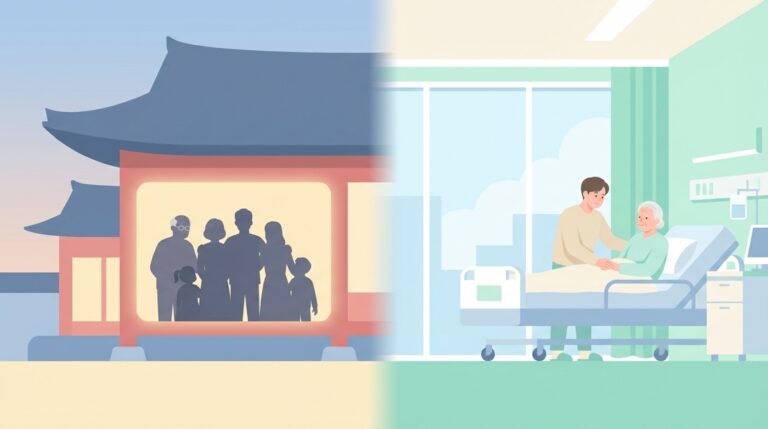
The Weight of Filial Piety: Navigating Korea’s Caregiving Crisis
Phase 1: Immersive Hook — The Scene You’ve Seen a Thousand Times
Greeting: 안녕하세요! This is your Daily Hangul Senior Editor.
K-Drama Cold Open: You know that scene. The hospital corridor is stark white. The protagonist, usually the eldest son or daughter, is leaning against the wall, head in hands. The doctor just walked away after delivering “bad news.” A sibling runs up, breathless, asking, “How is she?” The silence speaks volumes.
In K-Dramas like Hospital Playlist or family epics like My Golden Life, these scenes aren’t just about medical emergencies. They are about the crushing weight of caregiving (간병) in a society where respect for elders is paramount, but the modern workforce leaves no time to stay by a bedside.
The ‘Why’: As a C1 learner, you can order food and chat about hobbies. But can you discuss deep social issues? Understanding the terminology of Korea’s aging society—and the guilt associated with it—will give you profound insight into the “Han” (deep sorrow/resentment) often depicted in Korean media. It’s the difference between being a tourist and understanding the Korean soul.
Transparency: This guide tackles a heavy but necessary topic based on real conversations Koreans have as their parents age.
Phase 2: Deep Dive into Core Expressions
Here are three high-level expressions that capture the reality of Korea’s “Silver Tsunami.”
1. 긴 병에 효자 없다 (Gin byeong-e hyoja eopda)
- Pronunciation: [Gin byeong-e hyoja eopda] (Sounds like: Gin as in Guinness + byeong + eh + hyo-ja + up-da)
- Meaning: (Literal) There is no dutiful son during a long illness. / (Real Nuance) Even the most devoted child will eventually become exhausted and resentful if a parent is sick for a long time.
- K-Culture Moment: This is the line a neighbor or relative whispers at a funeral when the children look relieved rather than devastated. It absolves the children of guilt while acknowledging the brutality of long-term care.
- Editor’s Insight: This proverb is crucial. It’s used to comfort someone who is burning out from caregiving. It acknowledges that human patience has limits.
- Situation Spectrum:
[🚫 Formal Speech/Eulogy] ———— [✅ Private/Deep Conversation] ———— [✅ Casual Venting]- 🤔 Think About It: Why does Korean culture need a proverb to forgive children for being tired? Does your culture have a saying that validates caregiver burnout?
2. 요양병원 vs. 요양원 (Yoyang-byeongwon vs. Yoyangwon)
- Pronunciation: [Yoyang-byeongwon] / [Yoyangwon]
- Meaning:
- 요양병원: Convalescent/Geriatric Hospital (Medical facility with doctors).
- 요양원: Nursing Home (Residential facility, mostly caregivers).
- K-Culture Moment: In dramas, the conflict often peaks here. Sending a parent to a Yoyangwon is often dramatized as “abandoning” them (modern Goryeojang), whereas a Yoyang-byeongwon is seen as a medical necessity.
- Editor’s Insight: Knowing the distinction is vital. Suggesting a Yoyangwon can be offensive if the family believes medical treatment is still possible. It’s a sensitive topic loaded with financial and emotional implications.
- Situation Spectrum:
[✅ Medical Context] ———— [⚠️ Family Disputes] ———— [✅ Social Debate]3. 간병인 (Ganbyeongin)
- Pronunciation: [Ganbyeongin]
- Meaning: Professional Caregiver / Personal Care Assistant
- K-Culture Moment: Often depicted in media as a financially draining necessity. You might hear, “간병비 때문에 허리가 휜다” (My back is breaking because of caregiving costs).
- Editor’s Insight: Unlike nurses (Ganho-sa), Ganbyeongin help with eating, washing, and moving. In Korea, families used to do this. Now, hiring a Ganbyeongin is common, but expensive.
- 🤔 Think About It: In Korea, family members often sleep on a cot in the hospital room to care for the patient. How does this compare to the visiting hours and nurse duties in your country?
Phase 3: Textbook vs. Real Life
| Situation | 📖 Textbook Korean | 🗣️ Real Korean (C1 Level) | 💡 Why the difference? |
|---|---|---|---|
| Discussing cost | 치료비가 많이 들어요. (Treatment is expensive.) |
간병비 폭탄을 맞았어요. (I got hit with a ‘caregiving fee bomb’.) |
“Bomb” (poktan) emphasizes the sudden, devastating financial shock common in news and daily chat. |
| Caregiving difficulty | 부모님 돌보기가 힘들어요. (It is hard to care for parents.) |
독박 간병하다가 병나겠어요. (I’ll get sick from ‘exclusive/solo’ caregiving.) |
“Dokbak” comes from Go-Stop (card game) meaning taking the full penalty alone. It implies unfair burden distribution among siblings. |
| Aging Society | 고령화 사회가 문제입니다. (Aging society is a problem.) |
초고령 사회 진입이 코앞이에요. (Entering a ‘super-aged society’ is right under our noses.) |
Using precise sociological terms (Super-aged) shows C1 proficiency and awareness of current affairs. |
Bottom Note: Terms like “Dokbak” (독박) are very common in internet communities and casual complaints but should be used carefully in formal settings.
Phase 4: Cultural Deep Dive — The Twilight of “Hyo” (Filial Piety)
4-1. The “Nunchi” of Hospital Visits
In Korea, if a friend’s parent is hospitalized, Nunchi (situational awareness) is key.
– Don’t just ask “Are they okay?” lightly.
– Do ask, “Are you managing the caregiving okay?” (간병은 어떻게 하고 있어?). This shows you understand the burden falls on the family, not just the patient.
4-2. K-Drama Connection: The “Eldest Son” Trope
Historically, the eldest son (Jangnam) inherited the most but was solely responsible for the parents’ old age.
– Drama Reality: You often see the eldest daughter-in-law (Myeoneuri) doing the actual work while the son works.
– Modern Shift: Now, daughters often take on the role, or siblings share the cost of a Ganbyeongin. Watch for this tension in dramas—who pays vs. who physically cares.
4-3. K-Food Connection: “Juk” (Porridge)
When someone is sick or elderly, Juk (죽) is the universal language of love. Bonjuk (a famous chain) gift cards are the standard “I hope you get better” gift. Bringing heavy, greasy food to a hospital is a Nunchi failure. Always bring soy milk (duyu) or fruit juice sets.
Phase 5: Immersive Roleplay Scenario
Scenario A: The Difficult Decision
Setting: A quiet cafe corner, Sunday afternoon. The atmosphere is heavy. You are meeting your older brother, Min-seok, to discuss your mother’s deteriorating dementia.
Characters:
– YOU: The younger sibling, working full-time.
– Min-seok (40s): The eldest son, feeling the pressure of tradition but financially strained.
Dialogue:
Min-seok: 엄마 상태가 더 나빠지신 것 같아. 어제는 가스불 끄는 것도 잊으셨더라.
(Eomma sangtaega deo nappajisin geot gata. Eojeneun gaseubul kkeuneun geotdo ijeusyeotdeora.)
(Mom’s condition seems to have gotten worse. Yesterday, she even forgot to turn off the gas stove.)
(🎭 Min-seok rubs his temples, looking exhausted.)
YOU: 형수님도 힘드실 텐데… 우리가 언제까지 집에서 모실 수 있을까?
(Hyeongsunimdo himdeusil tende… uriga eonjekkaji jibeseo mosil su isseulkka?)
(Sister-in-law must be struggling too… How long can we take care of her at home?)
Min-seok: 사실 아내가… 이제 한계라고 하더라. 요양병원을 알아봐야 할 것 같아.
(Sasil anaega… ije hangyerago hadeora. Yoyang-byeongwoneul arabwaya hal geot gata.)
(Actually, my wife said… she’s at her limit. I think we need to look into a nursing hospital.)
🔀 Your Turn! How do you respond?
– A) “요양병원은 좀 그렇지 않아? 남들 보기에…” (Pushing back with tradition/guilt)
– B) “형이 그동안 고생 많았어. 내가 비용을 좀 더 낼게.” (Realistic, supportive acceptance)
– C) “정부 지원금은 알아봤어?” (Practical/Cold approach)✅ Best Choice: B.
Why? Option A uses guilt (Chemyon/Face) which is cruel given the situation. Option C is too cold for the immediate reaction. Option B acknowledges his struggle (Gosaeng) and offers practical help, which is the most mature, “adult” Korean response.
Scenario B: Bonus K-Culture Moment
Situation: You are visiting a friend’s grandmother in the hospital.
Friend: 와줘서 고마워. 할머니가 정신이 좀 없으셔.
YOU: (Handing over a drink set) 이거 두유야. 간병하느라 너도 힘들지? 이거 마시고 힘내.
(Meaning: This is soy milk. It’s hard for you too, doing the caregiving, right? Drink this and cheer up.)
Note: Acknowledging the caregiver is the hallmark of a high-level speaker.
Phase 6: 10-Second Shadowing Drill
Practice this sentence to express empathy regarding aging parents. Focus on the sorrowful yet accepting tone.
🥺 Emotion: Sympathetic & Resigned
Korean: 마음은 / 직접 모시고 싶은데, / 현실적으로 / 너무 어렵네요.
Romanization: Maeum-eun / jikjeop mosigo sipeunde, / hyeonsil-jeogeuro / neomu eoryeom-neyo.
Meaning: My heart wants / to care for them personally, / but realistically / it is too difficult.
Phase 7: K-Culture Mini Glossary
| Korean | Romanization | English | Context |
|---|---|---|---|
| 효도 | Hyodo | Filial Duty | The supreme virtue of caring for parents. |
| 간병 지옥 | Ganbyeong Jiok | Caregiving Hell | A social term describing the extreme physical/financial pain of caregiving. |
| 독거 노인 | Dokgeo Noin | Senior Citizen Living Alone | A major social issue keyword in news regarding the elderly. |
| 보호자 | Bohoja | Guardian/Protector | The person responsible for the patient (usually family). You hear this constantly in hospitals. |
| 치매 | Chimae | Dementia | A common theme in dramas involving elderly parents. |
Phase 8: Traveler’s Survival Kit — Hospital Visit Edition
Even as a traveler, you might need to visit a clinic or accompany a friend.
🆘 Survival Expression #1
– 🇰🇷 “면회 시간이 어떻게 되나요?” (Myeonhoe sigani eotteoke doenayo?)
– Meaning: What are the visiting hours?
– 📍 Where: Hospital reception / Nurse station.🆘 Survival Expression #2
– 🇰🇷 “보호자 대기실이 어디예요?” (Bohoja daegisiri eodiyeyo?)
– Meaning: Where is the guardian waiting room?
– 💡 Pro Tip: Korean hospitals often have specific rooms where family members sleep or wait.📌 Editor’s Travel Note: Hospital Etiquette
– Shoes: In many Korean hospital rooms (especially shared ones with floor heating), you take off your shoes at the room entrance.
– Food: Do not bring flowers (pollen allergies/bugs are banned in many wards). Bring boxed juices, fruit cups, or envelopes of cash (Consolation money) if you are close family.
Phase 9: Think Deeper — “The Burden of longevity”
Topic: Media vs. Reality — The Changing Face of “Hyo”
In K-Dramas, children often fight over who gets to take care of the parents to prove their loyalty, or conversely, the villainous in-law refuses to do it. However, in reality, Korea is becoming a “Super-Aged Society” faster than any other nation. The traditional large family structure has collapsed into nuclear families, making the old model of Hyodo physically impossible.
Modern Koreans are redefining filial piety: is it “Hyo” to keep a parent at home with inadequate care, or is it “Hyo” to pay for a professional facility where they are safe? This cognitive dissonance causes immense guilt for the younger generation.
💬 Your Turn: How does your country handle elderly care? Is it the family’s duty or the state’s responsibility? Tell us in the comments!
Phase 10: FAQ & Troubleshooting
Q: Can I use the word “노인 (Noin)” to an elderly person’s face?
A: No! While Noin means “elderly person,” using it directly is rude (like saying “Hey, old person”). Use 어르신 (Eoreusin) instead. It’s a respectful title for an elder you don’t know.
Q: Should I offer my seat to an older person on the subway?
A: Absolutely. Even if you are C1 level fluent, sitting in the “Priority Seat” (노약자석) when an elder is standing is a major cultural faux pas. Even regular seats should be offered.
❌ Common Mistake: Confusing 병문안 (Visiting a sick person) with 문상 (Visiting a funeral).
✅ Correct: “친구 아버지가 입원하셔서 병문안 가요.” (Friend’s dad is hospitalized, so I’m going for a visit.)
✅ Correct: “친구 아버지가 돌아가셔서 문상 가요.” (Friend’s dad passed away, so I’m going to pay respects.)
Phase 11: Wrap-up & Action Items
One-Liner Summary: Today we learned how to discuss the sensitive reality of caregiving using terms like 간병인, 요양병원, and the proverb 긴 병에 효자 없다.
Action Missions:
– 🥉 Bronze: Look in the mirror and practice the phrase “간병하시느라 고생 많으세요” (You are working hard with caregiving).
– 🥈 Silver: Watch a clip of the drama Dear My Friends (디어 마이 프렌즈) and listen for the word “요양원.”
– 🥇 Gold: If you have a Korean friend, ask them deeply: “What is the general perception of nursing homes in Korea these days?” (한국에서는 요즘 요양병원에 대해 어떻게 생각해요?)
K-Culture Mission: Search for “Bonjuk menu” (본죽 메뉴) online. Look at the “Boyang” (Health/Energy) section. Pick which porridge you would buy for a sick friend. (Hint: Abalone porridge / Jeonbok-juk is the top tier choice!)
Phase 12: Quiz — Cultural Logic Challenge
Situation: You are at a hospital visiting a friend’s mother. You want to leave, but your friend looks exhausted.
Q1. What is the most culturally appropriate parting message?
1. “안녕히 계세요. 빨리 나으세요.” (Goodbye. Get well soon.) – Standard.
2. “제가 내일 또 올게요.” (I will come again tomorrow.) – Burden.
3. “간병하느라 힘들지? 밥이라도 잘 챙겨 먹어.” (Caregiving is hard, right? Make sure you eat well.)
4. “의사 선생님이 잘 고쳐주실 거야.” (The doctor will fix it well.) – Detached.
Correct Answer: 3.
Why? While #1 is polite, #3 shows Jeong (affection) and empathy for the caregiver’s struggle, which is the mark of a true friend and a fluent speaker.
Frequently Asked Questions (FAQ)
Q: What does "긴 병에 효자 없다 (Gin byeong-e hyoja eopda)" mean in Korean and how do you pronounce it?
A: In Korean, "긴 병에 효자 없다 (Gin byeong-e hyoja eopda)" is pronounced [Gin byeong-e hyoja eopda] and means: (Literal) There is no dutiful son during a long illness. / (Real Nuance) Even the most devoted child will eventually become exhausted and resentful if a parent is sick for a long time.
Q: What does "요양병원 vs. 요양원 (Yoyang-byeongwon vs. Yoyangwon)" mean in Korean and how do you pronounce it?
A: In Korean, "요양병원 vs. 요양원 (Yoyang-byeongwon vs. Yoyangwon)" is pronounced [Yoyang-byeongwon] and means: 요양병원: Convalescent/Geriatric Hospital (Medical facility with doctors).
Q: What does "간병인 (Ganbyeongin)" mean in Korean and how do you pronounce it?
A: In Korean, "간병인 (Ganbyeongin)" is pronounced [Ganbyeongin] and means: Professional Caregiver / Personal Care Assistant







