

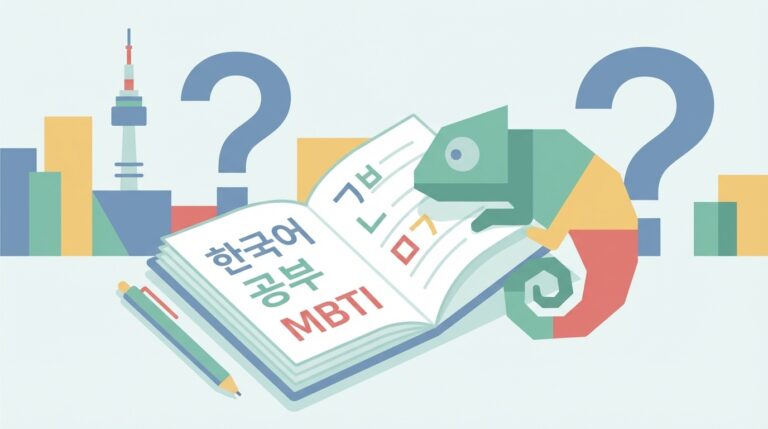
Phase 1: — Immersive Hook
Greeting: 안녕하세요! This is your Daily Hangul Editor, here to decode the Korean mind.
K-Culture Cold Open: Picture this: You are watching a live stream of your favorite K-Pop idol. They suddenly gasp and announce, “Guys, I retook the test… I’m an ‘I’ now!” The chat goes wild. Wait, can your personality just flip like a pancake?
In Korea, the answer is a resounding YES.
While the West sees MBTI as a fixed psychological profile, in Seoul, it’s more like a “current vibe check.” If you don’t know how to talk about your changing results, you’re missing out on 50% of the conversation at a Hongdae cafe.
The ‘Why’: Understanding that personality is fluid in Korea will save you from confusion when your loud Korean friend claims they are actually an Introvert. Let’s learn how to navigate this shifting landscape!
Transparency: This guide is based on real conversations I hear every day in Seongsu-dong cafes and office break rooms.
Phase 2: Deep Dive — Core Expressions
1. [바뀌다]
- Pronunciation: [bakkwida] + Sounds like ‘Bah-kwi’ (like a wheel) + ‘da’
- Meaning: To change / To be changed (Passive verb)
- K-Culture Moment: In K-Dramas, when the bad boy lead suddenly starts being nice, the heroine might whisper, “사람이 어떻게 하루아침에 바뀌어?” (How can a person change overnight?)
- Editor’s Insight: You use this when the result happened to you. You didn’t force it; it just happened.
- Situation Spectrum:
[🚫 Don't Use] ———— [⚠️ Caution] ———— [✅ Go Ahead]
- Casual/Friends: ✅ (나 MBTI 바뀌었어!)
- Formal/Boss: ✅ (Just add ‘yo’: 바뀌었어요)
- 🤔 Think About It: Why does Korean grammar prefer the passive “It changed” over “I changed it”? Does it suggest outside forces influence us?
2. [다시 하다]
- Pronunciation: [dasi hada] + ‘Dasi’ implies ‘again’, ‘hada’ is ‘to do’
- Meaning: To do again / To retake
- K-Culture Moment: Think of survival shows like Produce 101. When a trainee messes up a dance move, they desperately shout, “다시 하겠습니다!” (I will do it again!)
- Editor’s Insight: In the context of MBTI, you will hear “다시 해봐” (Try doing it again) constantly if your behavior doesn’t match your letter.
- Situation Spectrum:
- Friends: ✅ (다시 해봐!)
- Elders: ⚠️ (Use ‘다시 해보세요’)
- 🤔 Think About It: Is the pressure to “redo” the test a sign that people want you to fit a specific image?
3. [상황에 따라 달라요]
- Pronunciation: [sang-hwang-e ttara dallayo]
- Meaning: It depends on the situation.
- K-Culture Moment: An interview with a K-Pop star. Q: “Are you shy?” A: “It depends on the situation.” This is the ultimate Korean answer.
- Editor’s Insight: Korea is a high-context society. You act differently with your grandma than with your drinking buddies. This phrase explains why your MBTI changed.
- Situation Spectrum:
- All Situations: ✅ (Very safe and useful phrase)
- 🤔 Think About It: In English, being “consistent” is a virtue. In Korean culture, being “adaptable” (changing with the situation) is often seen as social intelligence.
Phase 3: Textbook vs. Real Life
| Situation | 📖 Textbook Korean | 🗣️ Real Korean (Insa Style) | 💡 Why different? |
|---|---|---|---|
| Telling friends your result changed | 제 성격 유형이 변했습니다. (My personality type has changed.) | 나 MBTI 다시 검사했는데 바뀌었어. (I retested MBTI and it changed.) | ‘변하다’ is poetic/serious; ‘바뀌다’ is for updates/switching. |
| Explaining variability | 상황에 따라서 다릅니다. (It differs according to the situation.) | 그때그때 달라요 / 케바케야. (It changes moment to moment / It’s case-by-case.) | Koreans love abbreviations. ‘Ke-ba-ke’ (Case-by-case) is legendary slang. |
| Disagreeing with a result | 이 결과는 저와 맞지 않습니다. (This result does not fit me.) | 나 이거 아닌 것 같아. (I don’t think this is me.) | Indirect speech (‘gat-a’) is softer and more humble. |
Bottom Note: B1 learners, try using “케바케 (Ke-ba-ke)” with friends. It instantly makes you sound like a local!
Phase 4: Cultural Deep Dive — The Fluid Self
4-1. Nunchi (눈치) & The Chameleon Effect
In the West, if you are an Extrovert at a party but an Introvert at work, you might feel “fake.” In Korea, this is just good Nunchi.
- The Context: If you are the youngest (maknae) in a strict office, you must listen (Introverted behavior). If you are the leader of a club, you must lead (Extroverted behavior).
- The Result: Your MBTI changes because your environment changed. When Koreans say “My MBTI changed,” they often mean “My lifestyle/job changed.”
4-2. K-Pop Connection: The “E” to “I” Shift
Many idols (like Jungkook of BTS) have famously shared that they switched from E (Extrovert) to I (Introvert).
* Why? They spend all day performing (using ‘E’ energy) and become quiet off-stage to recharge.
* Fan Culture: Fans love this because it shows the “human side” behind the idol persona. It’s not seen as inconsistent; it’s seen as authentic growth.
Phase 5: Immersive Roleplay
Setting: A hip cafe in Yeonnam-dong on a Saturday afternoon. You are with Jisoo (28, your trendy Korean friend). She is looking at your phone screen.
Dialogue:
Jisoo: 헐! 너 원래 ‘E’ 아니었어? 왜 갑자기 ‘I’가 나왔어?
(Heol! Neo won-lae ‘E’ a-ni-eoss-eo? Wae gap-ja-gi ‘I’-ga na-wass-eo?)
(Whoa! Weren’t you originally an ‘E’? Why did ‘I’ suddenly come out?)
YOU:
(Option A) 몰라. 그냥 바뀌었어. (I don’t know. It just changed.)
(Option B) 요즘 너무 피곤해서 그런가 봐. (Maybe because I’m so tired these days.)
Jisoo: 맞아, 피곤하면 그럴 수 있어. 다시 해봐!
(Maja, pigonhamyeon geureol su isseo. Dasi haebwa!)
(Right, that can happen if you’re tired. Try it again!)
YOU:
(Option C) 귀찮아. 안 할래. (Annoying. I won’t do it.)
(Option D) 응, 이따가 집에서 다시 해볼게. (Yeah, I’ll try it again at home later.)
🔀 Decision Point Analysis:
* Option B (Best): Koreans attribute personality changes to condition/mood. It shows cultural understanding.
* Option D (Socially Smart): Even if you don’t want to, saying you will implies you value her suggestion. ‘Ke-ba-ke’ applies here too!
Bonus Scenario: The “T” Accusation
If you answer a sad story with logic, a Korean might say: “너 T야?” (Are you a T?)
* Your Defense: “아니, 일할 때만 T야!” (No, I’m only a T when I work!)
Phase 6: 10-Second Shadowing Drill
Let’s practice explaining your fluctuating personality.
😊 Brightly & Casually:
MBTI는 / 3개월마다 / 바뀌는 거래요!
(MBTI-neun / sam-gae-wol-mada / bakkwineun georaeyo!)
They say MBTI changes every 3 months!🤔 Thoughtfully:
상황에 따라 / 결과가 / 달라질 수 있어요.
(Sang-hwang-e ttara / gyeol-gwa-ga / dallajil su isseo-yo.)
The results can change depending on the situation.
Phase 7: K-Culture Mini Glossary
| Korean | Romanization | Meaning | Context |
|---|---|---|---|
| 반반 | Ban-ban | Half and half | Used when you are 50% E and 50% I. “나 E랑 I 반반이야.” |
| 케바케 | Ke-ba-ke | Case-by-case | Essential slang. Used when results vary by situation. |
| 과몰입 | Gwa-mol-ip | Over-immersion | Someone who takes MBTI too seriously. |
| 궁합 | Gung-hap | Compatibility | Originally for fortune telling, now used for “MBTI Chemistry.” |
Phase 8: Traveler’s Survival Kit
Situation: You are meeting new Korean friends at a guesthouse or a pub. MBTI is the #1 Icebreaker.
🆘 Survival Card: The Icebreaker
– 🇰🇷 “MBTI가 어떻게 되세요?” (MBTI-ga eotteoke doeseyo?)
– 🗣️ Meaning: What is your MBTI? (Polite)
– 📍 Where: Guesthouses, Pubs, First meetings.
– 💡 Pro Tip: If they say “I’m an I,” don’t be too loud immediately. Respect their energy!📌 Editor’s Travel Note
– App Tip: Many Korean dating apps and friend-finding apps (like HelloTalk or Meeff) have profile fields for MBTI.
– Don’t Panic: If you don’t know yours, just say “Still figuring it out” (아직 잘 모르겠어요). They will likely offer to analyze you!
Phase 9: Think Deeper — Fluidity vs. Consistency
Topic: The Chameleon Self in High-Context Culture
In Western cultures, changing your personality depending on who you are with can be seen as “two-faced” or inauthentic. We value consistency. However, in Korea, adapting your behavior (and thus your MBTI result) to fit the group’s mood is a sign of maturity and consideration (baeryeo).
🧠 Think Deeper:
If your MBTI result changes when you speak Korean versus your native language, what does that say about the “soul” of the language? Does speaking Korean make you more hierarchical or more emotional?💬 Your Turn: Have you ever felt your personality shift when you travel? Tell us in the comments!
Phase 10: FAQ & Troubleshooting
Q: Is it rude to ask a boss their MBTI?
A: Generally, NO. In fact, it’s often used in corporate workshops to “understand team dynamics.” Just use polite honorifics: “부장님은 MBTI가 어떻게 되세요?”
Q: My result changed 3 times. Do Koreans think I’m weird?
A: Not at all! They will likely say, “You have a diverse charm” (매력이 다양하시네요) or just agree that the test depends on your mood. It’s a conversation starter, not a medical diagnosis.
❌ Common Mistake: Saying “I changed my MBTI” (Active voice).
✅ Correct: “My MBTI changed” (Passive voice – MBTI가 바뀌었어요). Unless you actively manipulated the answers!
Phase 11: Wrap-up & Action Items
One-Liner: In Korea, MBTI is a mood ring, not a tattoo—it’s okay if it changes!
Action Mission:
* 🥉 Bronze: Say “케바케 (Ke-ba-ke)” to yourself when choosing what to eat for dinner.
* 🥈 Silver: Go to a Korean forum or YouTube video about MBTI and comment: “저도 결과가 바뀌었어요!” (My result changed too!)
* 🥇 Gold: Ask a Korean friend, “너도 MBTI 바뀐 적 있어?” (Have you ever had your MBTI change?)
K-Culture Mission: Search for “[Your Favorite Idol] MBTI change” on YouTube. Watch how they explain their new result. Do they say it’s because they are ‘working’ or ‘resting’?
Phase 12: Quiz — Interactive Challenge
- Situational Judgment: Your friend asks why your MBTI changed from F (Feeling) to T (Thinking). What is the most “Korean” excuse?
- a) I studied math yesterday.
- b) Social society made me cold.
- c) I was really tired when I took the test. (Correct! Physical condition is a valid reason.)
- Fill in the Blank:
- A: Is this result accurate?
- B: Well… it is __________. (케바케야 / Ke-ba-ke-ya)
- True or False:
- Koreans think personality is fixed forever. (False. It’s fluid and situational.)
Frequently Asked Questions (FAQ)
Q: What does "[바뀌다]" mean in Korean and how do you pronounce it?
A: In Korean, "[바뀌다]" is pronounced [bakkwida] and means: To change / To be changed (Passive verb)
Q: What does "[다시 하다]" mean in Korean and how do you pronounce it?
A: In Korean, "[다시 하다]" is pronounced [dasi hada] and means: To do again / To retake
Q: What does "[상황에 따라 달라요]" mean in Korean and how do you pronounce it?
A: In Korean, "[상황에 따라 달라요]" is pronounced [sang-hwang-e ttara dallayo] and means: It depends on the situation.







