

Phase 1:
Greeting: 안녕하세요! Hello, Daily Hangul family! It’s your editor, the one who’s watched enough K-Dramas to know that hypothetical questions are where true love (or a big fight) begins. 👋
The K-Culture Cold Open: Picture this: You’re watching a variety show like Running Man or a live stream of your favorite idol group (maybe BTS or SEVENTEEN). Suddenly, the mood gets serious. One member asks, “If you fell into water, who would you save first? Me or him?” Or perhaps the infamous “Perilla Leaf Debate” (깻잎 논쟁) comes up: “If my friend helps your boyfriend peel a perilla leaf… is that flirting?”
The ‘Why’: This isn’t just grammar; it’s the “Balance Game” (밸런스 게임) culture! In Korea, asking “What if…” is the ultimate way to test chemistry, check Nunchi (social sensing), or just have a laugh. If you can’t play this game, you’re missing out on 50% of the conversation at a Korean chicken-and-beer night.
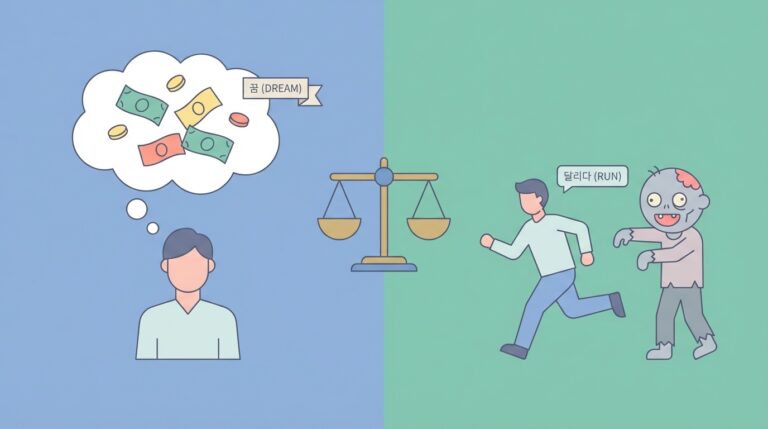
Transparency: Today’s guide answers questions I’ve received from students who froze when their Korean friends asked, “If zombies appeared right now, what would you do?” Let’s get you ready for the zombie apocalypse, Korean style. 🧟♂️
Phase 2: Deep Dive into Key Expressions 🧐
1. 만약에 [Manyage]
- Pronunciation: [Man-ya-ge] (Sounds like: “Man, ya get it?”)
- Meaning: If / In case (The magic trigger word)
- K-Culture Moment: In K-Pop ballads, this word often starts the chorus. “Manyage… we never met…” It sets the stage for a dramatic imaginary situation.
- Editor’s Insight: You can start a sentence with just this word to grab attention. It tells the listener, “Hey, enter my imaginary world for a second.”
- Situation Spectrum:
[✅ Casual] ———— [✅ Semi-formal] ———— [✅ Formal](Safe to use everywhere!)- 🤔 Think About It: Why do Koreans often add “만약에” even though the verb ending already indicates “if”? It’s about emotional preparation. It gives the listener time to switch gears from reality to fantasy.
2. -(으)면 vs. -ㄴ/는다면 [-(eu)myeon vs. -n/neundamyeon]
- Pronunciation: [-(eu)myeon] vs. [-n/neun-da-myeon]
- Meaning: Simple “If” vs. “Hypothetically If”
- Editor’s Insight: This is the game-changer.
- -(으)면: High possibility. “If it rains tomorrow…” (비가 오면…)
- -ㄴ/는다면: Low possibility / Fantasy. “If I were a billionaire…” (내가 부자라면…) or “If zombies attacked…” (좀비가 온다면…)
- K-Culture Moment: In the “Balance Game,” we almost always use -ㄴ/는다면 because the situations are extreme! (e.g., “If you had to live without Kimchi for life…”)
- Situation Spectrum:
[✅ Casual] ———— [⚠️ Semi-formal] ———— [✅ Formal]3. 어떻게 할 거야? [Eotteoke hal geoya?]
- Pronunciation: [Eo-tteo-ke hal geo-ya?]
- Meaning: What are you going to do? / What would you do?
- K-Drama Moment: The protagonist looks at the villain (or their crush) with intense eyes and asks, “So… what are you going to do now?”
- Editor’s Insight: In a game context, this is your “Your Turn” button. After setting up the crazy scenario with Manyage, you end with this.
- Situation Spectrum:
[✅ Casual (Friends)] ———— [🚫 Formal (Boss/Elders)]
(For elders, change to: 어떻게 하실 거예요?)
Phase 3: Textbook vs. Real Life 🗣️
| Situation | 📖 Textbook Korean | 🗣️ Real Street Korean | 💡 Why the difference? |
|---|---|---|---|
| Playing the Game | 만약에 10억 원이 생긴다면 무엇을 하겠습니까? (If you got 1 billion won, what would you do?) | 만약에 10억 생기면? 뭐 할 거? (If 1 billion happens? What u do?) | Efficiency! In games, speed matters. Particles are dropped, and endings are shortened. |
| Answering | 저는 집을 살 것입니다. (I will buy a house.) | 난 무조건 집 사지. (I’d unconditionally buy a house.) | 무조건 (Unconditionally) is a magic word in Korea to show certainty and strong opinion. |
Bottom Note: In B1 level conversation, try using “무조건” (mu-jo-kkeon) to sound like a local. It adds that Korean “conviction” to your answer!
Phase 4: Cultural Context — The “Nunchi” of Hypotheticals 🧠
4-1. Non-verbal: The “Look”
When asking “What if?” in Korea, especially on a date, do not blink. If you ask, “If I went to the army, would you wait for me?” and look away, it shows a lack of confidence. In K-Dramas, the character stares deeply to show sincerity.
4-2. K-Culture Connection: The “Perilla Leaf Debate” (깻잎 논쟁)
This is the ultimate B1 Level Boss Monster. The context: You, your lover, and your friend are eating. Your friend struggles to peel a marinated perilla leaf (it’s sticky). Your lover helps your friend peel it.
– Are you okay with this?
– K-Pop Connection: BTS members argued passionately about this. Jungkook said “No!” (He gets jealous). This debate isn’t about leaves; it’s about boundaries (Seon – 선). How nice can you be to others before it disrespects your partner?
Phase 5: Immersive Roleplay — The Chicken Shop Scenario 🍗
Setting: Friday night at a loud chicken joint in Hongdae. Radish cubes on the table. You are with your Korean friend, Jisoo (28, loves dramatic questions).
Jisoo: (Sipping beer) 야, 갑자기 궁금한데… 만약에 말이야.
(Ya, gapjagi gung-geum-hande… manyage mariya.)
[Translation: Hey, suddenly I’m curious… speaking of ‘what if’.]
YOU: 갑자기? 뭔데? (Suddenly? What is it?)
Jisoo: 만약에 네가 로또 1등 당첨된다면, 나한테 얼마 줄 수 있어?
(Manyage neoga lotto 1-deung dang-cheom-doen-damyeon, na-hante eolma jul su isseo?)
[Translation: If you win 1st place in the lottery, how much can you give me?]
🔀 Your Turn! How do you answer?
- A) “음… 10% 줄게!” (Hmm… I’ll give you 10%!) — Realistic & Nice.
- B) “꿈 깨!” (Wake up from your dream!) — Savage Best Friend Mode.
- C) “다 줄 수 있지!” (I can give you everything!) — Flirty/K-Drama Mode.
✅ Best Choice: B for close friends. It provokes laughter and banter (“Ya! You cheapskate!”).
⚠️ Choice C Analysis: Only use this if you want to confess your love. Otherwise, it’s too greasy (느끼해)!
Jisoo’s Reaction (to B): 와… 진짜 너무하네! 친구끼리 그럴 수 있어?
(Wow… that’s too much! Can you do that between friends?)
Phase 6: 10-Second Shadowing Drill 🎤
Let’s practice the “Dilemma” tone. Look confused but cute! 🥺
- Thinking Face: 🤔 만약에 / 내가 / 좀비가 된다면… / 날 죽일 거야?
(Manyage / naega / jombiga doendamyeon… / nal jugil geoya?)
[If / I / become a zombie… / will you kill me?] -
Confident Face: 😤 나는 / 무조건 / 너를 / 구할 거야!
(Na-neun / mujokkeon / neoreul / guhal geoya!)
[I will / unconditionally / save / you!]
Phase 7: K-Culture Mini Glossary 📘
| Korean | Romanization | English | Context |
|---|---|---|---|
| 밸런스 게임 | Balance Game | Would You Rather | The trendiest game in Korea right now. |
| 깻잎 논쟁 | Kaennip Nonjaeng | Perilla Leaf Debate | The ultimate jealousy test. |
| 이상형 | Isanghyeong | Ideal Type | Often the subject of “If” games. “If you met your ideal type…” |
| 김칫국 마시다 | Kimchitguk masida | Drinking Kimchi soup first | Counting chickens before they hatch. Used when someone answers a “What if” too seriously. |
Phase 8: Traveler’s Survival Kit 🎒
Even if you aren’t playing games, “What If” is crucial for travel emergencies!
🆘 Survival Phrases
– 🇰🇷 “만약에 버스 놓치면 어떡해요?”
(Manyage beoseu nochimyeon eotteokaeyo?)
[What if I miss the bus?]
– 🇰🇷 “만약에 길을 잃으면 전화할게요.”
(Manyage gireul ireumyeon jeonhwahal-geyo.)
[If I get lost, I will call you.]📌 Editor’s Travel Note:
Korean subway apps (KakaoMetro) are so accurate that “What if” scenarios rarely happen unless you sleep on the train! But always knowing how to ask “What if… problem?” (만약에 문제 생기면…) ensures locals can give you a Plan B.
Phase 9: Think Deeper — “Jeong” and Boundaries 💭
Food & Identity: Why is the “Perilla Leaf Debate” so heated in Korea? In many Western cultures, helping a friend with food is just polite. But in Korea, sharing food, especially banchan (side dishes), is an act of Jeong (정 – deep affection/bond). Touching someone else’s food with your chopsticks implies a level of intimacy. So, asking “What if my boyfriend helps her?” isn’t just about the leaf; it’s asking, “Does he share Jeong with her?”
💬 Your Turn: In your culture, is it okay to help a friend’s partner with their food? Tell us in the comments!
Phase 10: FAQ & Troubleshooting 🛠️
Q: Can I use 만약에 without -(으)면?
A: YES! In casual conversation, you can just say “만약에…” and pause. People will understand you are setting up a scenario. E.g., “만약에… 그 사람 안 오면?” (Suppose… he doesn’t come?)
Q: Is 혹시 (Hoksi) the same as 만약에?
A: Good catch! 혹시 is more “By any chance” (polite, used for requests). 만약에 is “In case / If” (hypothetical).
– 혹시 돈 있어요? (Do you have money by any chance?)
– 만약에 돈 있으면… (If you have money…)
❌ Common Mistake: Using -ㄴ/는다면 (Fantasy if) for simple plans.
– Wrong: 내일 비가 온다면 우산을 살게요. (Sounds like: In the rare fantasy world where it rains tomorrow…)
– Right: 내일 비가 오면 우산을 살게요.
Phase 11: Wrap-up & Action Mission 🎬
One-Liner: Use 만약에 + -(으)면 for reality, and -ㄴ/는다면 for your K-Drama fantasies!
🔥 Action Mission:
– 🥉 Bronze: Look in the mirror and ask: “만약에 내가 한국에서 산다면?” (If I lived in Korea?)
– 🥈 Silver: Go to a Korean learner group/Discord and ask: “만약에 10억 생기면 뭐 할 거예요?”
– 🥇 Gold: Ask a Korean friend (or tutor) the Perilla Leaf Question! watch their reaction closely. 👀
Phase 12: Quiz — Interactive Challenge 🧩
1. Which sentence sounds most natural for a “Zombie Apocalypse” game?
A) 만약에 좀비가 오면… (Manyage jombiga omyeon…)
B) 만약에 좀비가 온다면… (Manyage jombiga ondamyeon…)
2. True or False (K-Culture):
“In Korea, if you answer a ‘What if’ question too realistically (boringly), your friends might say you have no ‘sense’ (눈치/센스).”
3. Fill in the blank:
“______ 길을 잃으면 어떡해요?” (What if I get lost?)
⬇️ Answers:
1. B (Use -ㄴ/는다면 for low-probability fantasy!)
2. True (The goal is to have fun, not give a lecture!)
3. 만약에 (Manyage)
Frequently Asked Questions (FAQ)
Q: What does "만약에 [Manyage]" mean in Korean and how do you pronounce it?
A: In Korean, "만약에 [Manyage]" is pronounced [Man-ya-ge] and means: If / In case (The magic trigger word)
Q: What does "-(으)면 vs. -ㄴ/는다면 [-(eu)myeon vs. -n/neundamyeon]" mean in Korean and how do you pronounce it?
A: In Korean, "-(으)면 vs. -ㄴ/는다면 [-(eu)myeon vs. -n/neundamyeon]" is pronounced [-(eu] and means: Simple "If" vs. "Hypothetically If"
Q: What does "어떻게 할 거야? [Eotteoke hal geoya?]" mean in Korean and how do you pronounce it?
A: In Korean, "어떻게 할 거야? [Eotteoke hal geoya?]" is pronounced [Eo-tteo-ke hal geo-ya?] and means: What are you going to do? / What would you do?







