

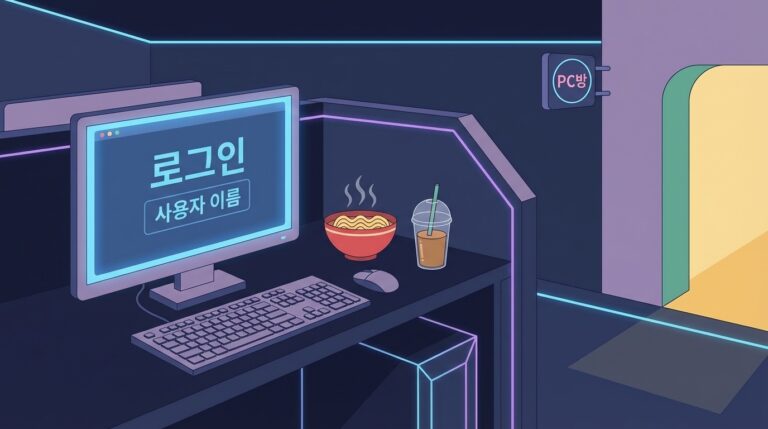
Phase 1: The Gateway to K-Gaming 🎮
Annyeonghaseyo! This is your Daily Hangul Editor. 👋
Picture this: You are in Hongdae, the heart of Seoul’s youth culture. You walk into a basement with a glowing neon sign. The air is cool, it smells faintly of spicy ramyeon, and the sound of mechanical keyboards clicking is like rain on a tin roof. You’ve entered a PC Bang (PC Room).
In K-Dramas, this is where the protagonist hides from their boss, or where the couple shares a midnight snack while gaming. For K-Pop fans, this is the battlefield where you frantically click to buy concert tickets the second they drop.
But there’s a barrier. You sit down in front of a high-end monitor, and a login screen blocks your way. It’s all in Korean. Do you need an ID? How do you pay?
Don’t panic! Today, we are going to crack the code of PC Bang Registration (Signing Up) so you can game—and eat—like a local.
Phase 2: Deep Dive into Key Expressions 🧠
To survive the login screen, you only need to recognize these three key terms.
1. 회원 가입 (Hoewon gaip)
- Pronunciation: [hoe-won ga-ip] (Sounds like: ‘Hway-won’ + ‘Guy-ip’)
- Meaning: Sign up / Membership Registration
- K-Culture Moment: You will see this button on every Korean website, from streaming K-Dramas to joining a BTS fan cafe. In a PC Bang, clicking this allows you to save your remaining time for later.
- Editor’s Insight: Think of ‘Hoewon’ as ‘Member’. If you plan to visit this PC Bang more than once, hit this button.
- Situation Spectrum:
[🚫 Formal] ———— [✅ Standard] ———— [✅ Casual]
(It’s a standard technical term used everywhere.)- 🤔 Think About It: In many countries, you just pay and play. Why do Korean services almost always ask for “Membership” first? (Hint: It’s about building a loyal community!)
2. 비회원 (Bihoewon)
- Pronunciation: [bi-hoe-won] (Sounds like: ‘Bee’ + ‘Hway-won’)
- Meaning: Non-member / Guest
- K-Culture Moment: Just like trying to buy tickets on a Korean site without an account!
- Editor’s Insight: The prefix ‘Bi (비)’ means ‘Non-‘. If you are just here for one hour to print a document or kill time, choose 비회원. It’s faster, but you can’t save your leftover time.
- Situation Spectrum:
[✅ Standard Technical Term]3. 충전해 주세요 (Chungjeonhae juseyo)
- Pronunciation: [chung-jeon-hae ju-se-yo] (Sounds like: ‘Choong-jun-heh’ + ‘Joo-say-yo’)
- Meaning: Please recharge / Please top up (my time).
- K-Culture Moment: In sci-fi movies, robots say “Recharging.” In Korea, humans say it for T-money cards (subway) and PC Bang time!
- Editor’s Insight: You aren’t buying a ‘ticket’; you are ‘charging’ time into your account.
- Situation Spectrum:
[🚫 To Friends] ———— [✅ To Staff] ———— [🚫 To Elders]
Phase 3: Textbook vs. Real Life 🗣️
How does a language book teach it versus what you actually hear in a noisy PC Bang?
| Situation | 📖 Textbook Korean | 🗣️ Real Korean | 💡 Why the difference? |
|---|---|---|---|
| Asking for a seat | “빈 자리가 있습니까?” (Bin jariga isseumnikka?) | “자리 있어요?” (Jari isseoyo?) | “Isseumnikka” is too military. “Isseoyo” is polite but friendly. |
| Paying for time | “시간을 구매하고 싶습니다.” (Siganeul gumaehago sipseumnida.) | “천 원 충전이요!” (Cheon won chungjeon-iyo!) | In busy places, we shorten sentences. “1,000 won charge, please!” |
| Calling Staff | “저기요, 도와주세요.” (Jeogiyo, dowajuseyo.) | “사장님!” (Sajangnim!) | Calling the staff/owner “Boss” (Sajangnim) is the magic word in Korea service culture. |
Bottom Note: Even if the worker is a 20-year-old student, calling them Sajangnim (Boss) makes them feel respected and might get your ramen faster! 😉
Phase 4: K-Culture Deep Dive 🎭
4-1. The “Kiosk” Culture (Non-verbal)
Most modern PC Bangs don’t have a person at the counter anymore. You will see a big touch-screen machine called a Kiosk (키오스크).
* Nunchi Tip: If there is a line behind you, don’t stand there translating every word with Papago. Step aside, translate, and then approach! Speed is a virtue in Korea (Ppal-li Ppal-li culture).
4-2. The “PC Bang Mukbang”
Did you know? PC Bangs are essentially restaurants with high-speed internet.
* K-Food Connection: You order food on your computer screen. From Kimchi Fried Rice to Iced Americano, it arrives at your seat. In dramas, characters often slurp instant noodles here. It is socially acceptable to eat noisily while gaming!
* Critical View: Why is food so important in a gaming center? Korean students spend hours here after school. It became a “third place”—not home, not school—where they can eat, play, and socialize cheaply.
Phase 5: Immersive Roleplay 🎬
Setting: A neon-lit PC Bang in Gangnam. Friday night. It’s packed. You approach the counter because the Kiosk is broken.
Characters:
* YOU: A foreign student desperate to play Overwatch.
* Alba (Staff): Min-ji (22), busy wiping a keyboard, wearing a headset.
(Dialogue Start)
Min-ji: (Takes off headset) 어서 오세요. 몇 분이세요?
(Eoseo oseyo. Myeot buniseyo?)
(English) Welcome. How many people?
YOU: 한 명이요.
(Han myeong-iyo.)
(English) Just one person.
Min-ji: 회원이세요? 아니면 비회원이세요?
(Hoewon-iseyo? Animyeon bihoewon-iseyo?)
(English) Are you a member? Or a non-member?
🔀 Decision Point: What do you say?
- A) “회원 가입 하고 싶어요.” (I want to sign up.)
- B) “비회원이요.” (Non-member, please.)
- C) “게임 하고 싶어요!” (I want to play game!)
✅ Best Choice: B (비회원)
* Why? As a foreigner, signing up (Option A) often requires a Korean phone number verification which can be tricky. Option B gets you seated instantly. Option C is too vague.
(Roleplay Continues with Choice B)
YOU: 비회원이요.
(Bihoewon-iyo.)
(English) Non-member, please.
Min-ji: 네, 키오스크 안 돼서… 여기서 해드릴게요. 얼마나 충전해 드릴까요?
(Ne. … Eolmana chungjeonhae deurilkkayo?)
(English) Okay. … How much time should I charge for you?
YOU: 두 시간 충전해 주세요.
(Du sigan chungjeonhae juseyo.)
(English) Please charge 2 hours.
Min-ji: 네, 35번 자리에 앉으세요.
(Ne, samsip-o-beon jarie anjeuseyo.)
(English) Okay, please sit at seat number 35.
Phase 6: 10-Second Shadowing Drill 🗣️
Let’s practice the most useful phrase. Repeat this while imagining you are holding your credit card.
😊 Friendly but clear:
1시간 / 충전해 / 주세요!
(Han-sigan / chung-jeon-hae / ju-se-yo!)
Please charge 1 hour!
Phase 7: K-Culture Glossary 📖
| Korean | Romanization | Meaning | Context |
|---|---|---|---|
| 알바 | Alba | Part-timer | Short for “Arbeit” (German). The young staff working there. |
| 선불 | Seonbul | Pre-paid | Most PC Bangs are ‘pay first’. |
| 먹거리 | Meokgeori | Snacks/Food | The food menu button on the computer screen. |
| 로그인 | Rogeuin | Login | Almost the same pronunciation as English! |
Phase 8: Traveler’s Survival Kit 🧳
Even if you aren’t a gamer, PC Bangs are lifesavers for printing train tickets or looking up maps when your phone dies.
🆘 Survival Card: The Kiosk
* Step 1: Look for the button 비회원 (Non-member).
* Step 2: Select time (e.g., 1시간 = 1 hour).
* Step 3: Pay (Card is usually accepted, but cash is safer in old machines).
* Step 4: Take the receipt! It has a number code (ex: 1234). You type that code into the computer as your ID to unlock it.📌 Editor’s Travel Note
* Price: Usually 1,000 to 1,500 KRW (approx $1) per hour. It’s incredibly cheap!
* Safety: Korea is very safe, but don’t leave your phone on the table when you go to the bathroom.
Phase 9: Think Deeper — Real Name Verification 🧠
Topic: The Internet Real-Name System
You might find it frustrating that you can’t just create an ID like ‘SuperGamer’ instantly. In Korea, most online accounts require Identity Verification (본인 인증) linked to your phone number or Resident ID.
Why? Korea takes cyberbullying and online security very seriously. The idea is that if people use their real names (behind the scenes), they will behave better.
💬 Your Turn: Does forcing people to use real IDs make the internet safer, or does it hurt privacy? How is it in your country?
Phase 10: FAQ & Troubleshooting 🛠️
- Q: Can I use my own Steam account?
- A: Yes! But you must log in to the PC Bang system first, then log in to Steam.
- Q: Is it rude to scream when I lose a game?
- A: Maybe. A little sigh is okay (Aigo!), but screaming loud curse words (Sh*bal!) is considered bad manners (Minpye), although you will hear Korean students doing it.
- Q: Can I sleep there?
- A: It’s not a hotel, but many people do nap. Just don’t snore loud!
❌ Common Mistake: Trying to leave without logging out.
✅ Solution: Always click “사용 종료” (End Use) or “로그아웃” (Logout) on the desktop toolbar before you leave.
Phase 11: Wrap-up & Action Mission 🚀
Summary: To use a PC Bang, remember ‘Bihoewon’ (Non-member) for easy access and ‘Chungjeon’ (Charge) to pay for time.
🔥 Your Mission:
* 🥉 Bronze: Say “Chungjeonhae juseyo” 3 times out loud.
* 🥈 Silver: Watch a YouTube video of a “Korean PC Bang Tour” and spot the ‘Member/Non-member’ button on the kiosk.
* 🥇 Gold: Visit a PC Bang in Korea (or a Korean-style one in your country), order an Iced Americano via the computer, and enjoy the vibe!
Phase 12: Interactive Quiz 🧩
1. You are at the Kiosk. You are just visiting for 1 hour. Which button do you press?
* A) 회원 가입 (Hoewon gaip)
* B) 비회원 (Bihoewon)
* C) 로그인 (Rogeuin)
2. True or False?
* “In a Korean PC Bang, you must go to the counter to order food.”
* (Answer: False! You order comfortably from your seat.)
3. Situation Check:
* The computer locked itself because your time ran out. What do you say to the staff?
* “_______해 주세요!”
* (Answer: Chungjeon / 충전)
(Scroll down for answers)
.
.
.
Answers: 1. (B), 2. (False), 3. (Chungjeon)
Frequently Asked Questions (FAQ)
Q: What does "회원 가입 (Hoewon gaip)" mean in Korean and how do you pronounce it?
A: In Korean, "회원 가입 (Hoewon gaip)" is pronounced [hoe-won ga-ip] and means: Sign up / Membership Registration
Q: What does "비회원 (Bihoewon)" mean in Korean and how do you pronounce it?
A: In Korean, "비회원 (Bihoewon)" is pronounced [bi-hoe-won] and means: Non-member / Guest
Q: What does "충전해 주세요 (Chungjeonhae juseyo)" mean in Korean and how do you pronounce it?
A: In Korean, "충전해 주세요 (Chungjeonhae juseyo)" is pronounced [chung-jeon-hae ju-se-yo] and means: Please recharge / Please top up (my time).







