

Phase 1: Immersive Hook 🎬
Greeting: Hello! This is your Daily Hangul Editor. 👋
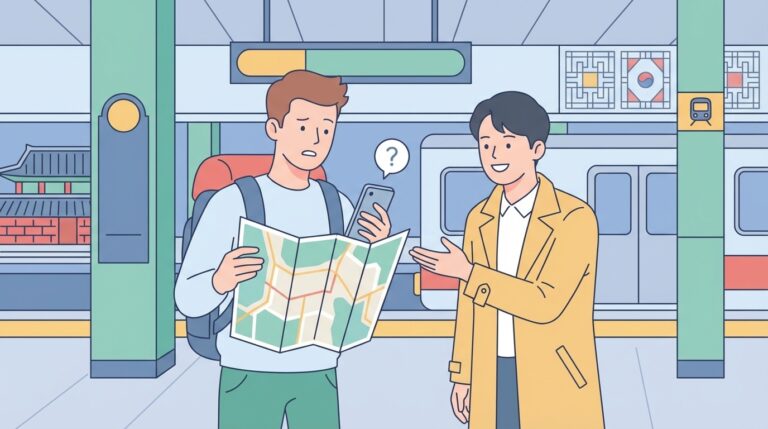
Imagine this scene from a K-Drama: The protagonist just arrived in Seoul. They are standing in the middle of a busy street, looking at a map on their phone, completely confused. The background music slows down. They look around, spot a kind-looking stranger, and hesitate. They take a deep breath and say… nothing?
Wait, in real life, there are no subtitles! 😱
Whether you are lost in the maze of Gangnam Station, struggling with a touch-screen Kiosk at a burger joint, or trying to ask a Korean fan where the concert line starts, you need the magic words. Today, we aren’t just learning “Help me.” We are learning how to ask for a favor without looking like a rude tourist. Let’s get you that “Main Character” energy!
Phase 2: Deep Dive into Core Expressions 🧠
Here are the top 3 phrases to ask for help like a local.
1. 저기요… (Jeogiyo…)
- Pronunciation: [Jeo-gi-yo] + (Sounds like ‘Jug-ee-yo’ but softer)
- Meaning: Excuse me / Hey there (Literal: Over there)
- K-Culture Moment: You see this in every restaurant scene. A hand goes up, “Jeogiyo!” to call the server. But on the street, it’s spoken softly to get a stranger’s attention.
- Editor’s Insight: This is your “knock on the door.” Don’t just start asking a question. Say this first to check if the person is listening. Use a rising intonation at the end! ↗️
- Situation Spectrum:
[🚫 To Elders/Boss] ———— [⚠️ Strangers] ———— [✅ Restaurant/Casual]
(Note: To an elder on the street, “Sillyehamnida” (Excuse me) is safer, but “Jeogiyo” is acceptable if said politely.) - 🤔 Think About It: Why do Koreans call people “Over there” (Jeogi) instead of “You”? Using “You” (Dangsin) to a stranger is actually fighting words in Korea!
2. 혹시… 시간 있으세요? (Hoksi… sigan isseuseyo?)
- Pronunciation: [Hok-shi… she-gan is-seu-seh-yo?]
- Meaning: By any chance… do you have time?
- K-Drama Moment: The shy lead character wants to ask their crush for help with studying. They fidget and ask, “Hoksi… sigan isseuseyo?”
- Editor’s Insight: “Hoksi” (By any chance) is the magic shield. It shows you know you might be bothering them. It lowers the pressure for the listener.
- Situation Spectrum:
[🚫 Boss (Use specific time)] ———— [⚠️ Strangers] ———— [✅ Friends/Colleagues]
3. 좀 도와주실 수 있으세요? (Jom dowajusil su isseuseyo?)
- Pronunciation: [Jom do-wa-ju-shil su is-seu-seh-yo?]
- Meaning: Could you please help me a little?
- Editor’s Insight: The word “Jom” (a little) is crucial. Even if you need a LOT of help, saying “Jom” makes you sound humble and polite. It softens the request.
- Situation Spectrum:
[🚫] ———— [⚠️ Formal/Polite] ———— [✅ Everyday]
Phase 3: Textbook vs. Real Life 🥊
| Situation | 📖 Textbook Korean | 🗣️ Real Korean | 💡 Why the difference? |
|---|---|---|---|
| Dropping a pen | 도와주십시오. (Dowajusipsio) | 어, 죄송한데 이것 좀… (Uh, sorry but this…) | Real Korean relies on context. Ending the sentence vaguely allows the other person to step in voluntarily. |
| Lost in subway | 길을 잃었습니다. (I am lost.) | 길 좀 여쭤봐도 될까요? (Can I ask about the way?) | Saying “I am lost” is a fact. Asking “Can I ask?” is a social interaction. |
Bottom Note: Textbook Korean sounds like a robot or a soldier. Real Korean uses “hesitation sounds” like “Uh…” or “Jeo…” to show politeness.
Phase 4: Cultural Deep Dive — The Art of ‘Nunchi’ 👀
4-1. Non-verbal Communication
When asking for help in Korea, your body language speaks louder than words.
* The “Sorry” Bow: Slight head nod or bow while approaching.
* The Hesitation: Don’t walk up and speak at full speed. Look a bit confused or hesitant. This signals, “I am harmless, but I have a problem.”
4-2. K-Travel Connection: The “Busy” Signal
In Seoul, especially in subway stations like Gangnam or Hongdae, people walk FAST. 🏃💨
* Rule of Thumb: Avoid asking people who are power-walking with headphones on. Look for someone standing still, waiting for a friend, or walking slowly.
* K-Drama Trope: In dramas, the hero always stops to help. In reality, people are kind, but they are also busy. Use “Hoksi” (By any chance) to acknowledge their busy schedule.
Phase 5: Immersive Roleplay 🎭
Setting: It is 2 PM at a trendy cafe in Seongsu-dong. You are standing in front of the self-ordering Kiosk. It is all in Korean, and the line is forming behind you. You need help.
Characters:
* YOU: A thirsty traveler craving an Iced Americano.
* Minji: A university student standing behind you, looking kind.
Dialogue:
(You turn around nervously)
YOU: 저기요… 죄송한데요.
(Jeogiyo… joesonghandeyo.)
(Excuse me… I’m sorry.)
Minji: 네? 무슨 일이세요?
(Ne? Museun ir-iseyo?)
(Yes? Is something wrong?)
YOU: 키오스크가 한국어라서요…
(Kioseukeu-ga hangugeo-raseoyo…)
(The kiosk is in Korean [so]…)
🔀 Decision Point! How do you finish the request?
- A) 도와주세요! (Help me!) – A bit dramatic!
- B) 혹시 주문 좀 도와주실 수 있으세요? (Could you help me order by any chance?) – Polite & Perfect.
- C) 이거 해줘. (Do this for me.) – Rude! Never use Banmal (casual speech) to strangers!
✅ Best Choice: B — usage of “Hoksi” and polite ending.
Minji: 아, 네! 도와드릴게요. 뭐 드시고 싶으세요?
(Ah, yes! I’ll help. What do you want to drink?)
YOU: 아이스 아메리카노 하나요. 감사합니다!
(Iced Americano, one please. Thank you!)
Phase 6: 10-Second Shadowing Drill 🗣️
Repeat after the rhythm. Follow the emotions!
- 🥺 (Shyly/Politely): 저기요 / 혹시 / 영어 하세요?
(Jeogiyo / hoksi / yeong-eo haseyo?)
“Excuse me / by any chance / do you speak English?” -
😰 (Urgent/Worried): 죄송한데 / 저 좀 / 도와주세요!
(Joesonghande / jeo jom / dowajuseyo!)
“Sorry but / me a little / please help!”
Phase 7: K-Culture Mini Glossary 📘
| Korean | Romanization | Meaning | Context |
|---|---|---|---|
| 키오스크 | Kioseukeu | Kiosk | The touch-screen ordering machines found everywhere in Korea. A common enemy for beginners! |
| 부탁 | Butak | Favor/Request | Used when asking formally: “Butak-haeyo” (I ask a favor). |
| 잠시만요 | Jamsimanyo | Just a moment | Used when passing through a crowd or asking someone to wait. |
Phase 8: Traveler’s Survival Kit 🧳
Situation: You are holding a heavy suitcase at the subway stairs (no escalator!).
🆘 Survival Phrase #1
* 🇰🇷 “이것 좀 들어주시겠어요?” (Igeot jom deureo-jusigesseoyo?)
* 🗣️ Sound: [Ee-got jom deu-ruh ju-shi-gess-uh-yo?]
* 📍 Use: Stairs, Bus stops.
* 💡 Pro Tip: Make eye contact and smile. Point to the suitcase handle.📌 Editor’s Travel Note
* Navigation Apps: Google Maps is okay, but Naver Map or KakaoMap are essential in Korea. They show which subway exit has an escalator (look for the yellow icons!).
Phase 9: Think Deeper — “Why so Indirect?” 🧠
Topic: The Culture of ‘Burden’ (Minpye)
In Western cultures, “The squeaky wheel gets the grease” (speak up to get help). In Korea, there is a strong culture of not wanting to cause Minpye (Nuisance) to others. This is why requests are often phrased as questions (“Can you…?”) or start with apologies (“Sorry, but…”).
💬 Your Turn: In your country, is it okay to ask strangers for help immediately? Or do you have to apologize first? Let me know in the comments!
Phase 10: FAQ & Troubleshooting 🛠️
- Q: Can I use “Help me” (살려주세요 / Sallyeojuseyo)?
- NO! 🛑 That means “Save my life” (like you are drowning or being chased by a zombie in Kingdom). For everyday help, use 도와주세요 (Dowajuseyo).
- Q: Can I ask a K-Pop idol for a photo if I see them in public?
- Culture Tip: It is generally considered rude to disturb their private time. If you must, approach very politely, but be prepared for a refusal from their manager. A simple “Fan-imnida” (I am a fan) and a bow is often better.
- ❌ Common Mistake: Touching someone’s arm to get attention.
- Correction: Do not touch strangers! Just say “Jeogiyo” or wave your hand slightly in their line of sight.
Phase 11: Wrap-up & Mission 🚀
Summary: Start with “Jeogiyo,” use “Hoksi” to be polite, and add “Jom” to soften your request.
🔥 Action Mission:
* 🥉 Bronze: Look in the mirror and practice the “Jeogiyo… Hoksi…” face (slightly shy/polite).
* 🥈 Silver: Watch a K-Drama episode and count how many times they say “Jeogiyo.”
* 🥇 Gold: Go to a Korean restaurant (or Asian market) and ask, “Hoksi… mul (water) jom juseyo?”
Phase 12: Interactive Quiz 📝
1. Which is the BEST way to stop a stranger to ask for directions?
* A) 야! (Ya!)
* B) 저기요, 혹시… (Jeogiyo, hoksi…)
* C) 도와줘. (Dowajwo.)
2. True or False?
* “Sallyeojuseyo” is the best word to use when you can’t figure out the kiosk machine.
* (True / False)
Click to see answers
1. B (A is for fighting, C is rude/casual).
2. False (Only use that if the machine is attacking you! Use ‘Dowajuseyo’).
Frequently Asked Questions (FAQ)
Q: What does "저기요... (Jeogiyo...)" mean in Korean and how do you pronounce it?
A: In Korean, "저기요... (Jeogiyo...)" is pronounced [Jeo-gi-yo] and means: Excuse me / Hey there (Literal: Over there)
Q: What does "혹시... 시간 있으세요? (Hoksi... sigan isseuseyo?)" mean in Korean and how do you pronounce it?
A: In Korean, "혹시... 시간 있으세요? (Hoksi... sigan isseuseyo?)" is pronounced [Hok-shi... she-gan is-seu-seh-yo?] and means: By any chance... do you have time?
Q: What does "좀 도와주실 수 있으세요? (Jom dowajusil su isseuseyo?)" mean in Korean and how do you pronounce it?
A: In Korean, "좀 도와주실 수 있으세요? (Jom dowajusil su isseuseyo?)" is pronounced [Jom do-wa-ju-shil su is-seu-seh-yo?] and means: Could you please help me a little?







