

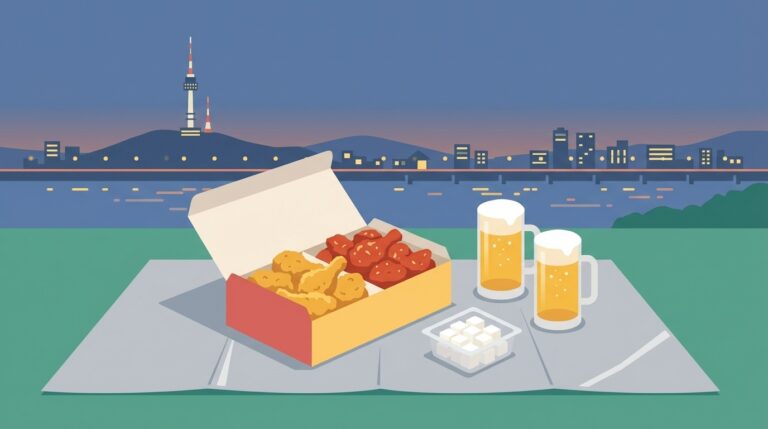
Phase 1: The Golden Hour of Seoul Nights 🍗🍺
Annyeonghaseyo! This is your Senior Editor at Daily Hangul.
Picture this: It’s a breezy Friday evening at the Han River Park (Hangang). You’re sitting on a silver mat, the Seoul skyline is glittering across the water, and all around you, you hear the simultaneous cracking of soda cans and the crunch of golden-brown batter. You aren’t just eating dinner; you are participating in a ritual.
We all remember that scene in My Love from the Star where Cheon Song-yi immortalized the combination of fried chicken and beer. But to Koreans, Chimaek (치맥) is more than a K-Drama trope—it is the fuel of social bonding, the ultimate stress reliever, and the undisputed king of Ya-sik (Late-night snacks).
However, ordering chicken in Korea isn’t just about saying “Chicken, please.” It involves navigating a complex matrix of flavors (Fried vs. Seasoned), bone structures (Bone-in vs. Boneless), and the crucial side dishes.
Today, we move beyond the textbook. We are going to explore the linguistic texture of Chimaek at a C1 (Advanced) level. Ready to dig in?
Phase 2: Deep Dive into Expressions
At the C1 level, we stop saying “I want to eat” and start expressing specific cravings and textures.
1. 땡기다 [Ddang-gi-da]
- Pronunciation: [Ddang-gi-da] (Think of a rubber band snapping: Ddang!)
- Meaning: Literal: To pull / Real Nuance: To have an intense, magnetic craving for something.
- K-Culture Moment: In almost every slice-of-life drama, after a grueling day at work, a character will loosen their tie and sigh, “Ah, oneul chimaek ddang-ginda.” (Ah, I’m really craving Chimaek today.)
- Editor’s Insight: Standard Korean uses
먹고 싶다(want to eat). But땡기다implies your body physically needs it. It connects to the verb당기다(to pull), suggesting the food is pulling you toward it.- Situation Spectrum:
[🚫 Formal Presentations] ———— [⚠️ Colleagues] ———— [✅ Friends/Family]- 🤔 Think About It: Why does Korean differentiate between a mental “want” (
~go sipda) and a physical “pull” (ddang-ginda)? Does English have a verb that captures this visceral feeling beyond just “crave”?2. 반반 무 많이 [Ban-ban Mu-mani]
- Pronunciation: [Ban-ban Moo-mah-ni]
- Meaning: Literal: Half-half, radish lots. / Real Nuance: “I want half original fried, half seasoned spicy chicken, and please give me extra pickled radish.”
- K-Culture Moment: This is the ‘Magic Spell’ of ordering. You’ll hear this shouted into phones or spoken rapidly at counters. It represents the Korean dilemma of choice—and the solution (have both!).
- Editor’s Insight: This phrase is a masterclass in Korean efficiency. It drops all particles (
-e,-reul,-juseyo) and retains only the essential nouns and adverbs.- Situation Spectrum:
[🚫 Business Meeting] ———— [⚠️ Elders] ———— [✅ Ordering Food]- 🤔 Think About It: “Ban-ban” (Half-half) reflects a culture that values variety and sharing. Why settle for one flavor when the communal dining style allows for multiple?
3. 겉바속촉 [Geot-ba-sok-chok]
- Pronunciation: [Geot-ba-sok-chok]
- Meaning: An acronym for 겉은 바삭하고 속은 촉촉하다 (Crispy on the outside, moist on the inside).
- K-Culture Moment: Every food YouTuber (Mukbang host) uses this word within the first 10 seconds of biting into chicken. It is the gold standard for delicious fried food.
- Editor’s Insight: Korean loves 4-syllable acronyms (like K-Pop group names). Using this makes you sound like a native foodie instantly. It shows you appreciate texture, which is huge in Korean gastronomy.
- Situation Spectrum:
[🚫 Funeral] ———— [⚠️ Formal Dinner] ———— [✅ Food Reviews/Casual Dining]
Phase 3: Textbook vs. Real Life
In a loud pub or busy delivery call, textbook grammar often disappears.
| Situation | 📖 Textbook Korean | 🗣️ Real Korean | 💡 Why the difference? |
|---|---|---|---|
| Choosing Menu | 양념 치킨하고 후라이드 치킨 반반 주세요. (Please give me half seasoned chicken and half fried chicken.) | 여기 반반이요! (Here, half-half!) | Efficiency. In a busy environment, context (holding the menu) replaces the object words. |
| Asking for Beer | 맥주 500cc 한 잔 더 주세요. (Please give me one more 500cc glass of beer.) | 사장님, 오백 하나 더요! (Boss, one more 500!) | We drop the unit (cc) and the object (beer) because 500 universally implies a pint of draft beer in Korea. |
| Requesting Sides | 무 좀 더 주실 수 있으세요? (Could you please give me a little more radish?) | 무 좀 더 주세요 / 무 리필이요. (Give more radish / Radish refill.) | Polite indirectness is replaced by direct requests to speed up service. |
Bottom Note: At C1 level, you can drop honorific particles (
-yo) only if you are talking to yourself or extremely close friends. When ordering, keep the-yoat the end (e.g., Ban-ban-iyo!) to maintain politeness while being concise.
Phase 4: Cultural Deep Dive — The Context of Chimaek
4-1. Non-verbal: The Art of the “Bone Bin”
In a Korean chicken restaurant, you will find a small stainless steel bucket on the table. Do not put your napkins or trash in here initially. This is exclusively for chicken bones. Mixing trash makes it harder for the staff to separate food waste (which is strictly regulated in Korea). Also, using tongs (jip-ge) in one hand and a fork in the other is the “pro” way to dissect bone-in chicken without getting your fingers greasy.
4-2. K-Food Connection: Why “Radish”?
The cubed white radish (Chicken-mu) is not a garnish; it is a physiological necessity. Korean fried chicken can be greasy and spicy. The sour, sweet, and cold radish cuts through the grease (palate cleanser) and cools down the spice. Eating chicken without radish is considered “stuffing” (goguma-dap-dap)—a situation that feels blocked and frustrating.
Phase 5: Immersive Roleplay Scenario
Setting: It’s Friday night at a popular franchise (like BHC or Kyochon) near Gangnam Station. The noise level is high. You are with Min-ji (30, your hip Korean friend) and Hyun-woo (34, a foodie colleague).
Dialogue:
Min-ji: 와, 오늘 진짜 사람 많다. 우리 일단 생맥부터 시킬까? 🍺
(Wa, oneul jinjja saram manda. Uri ildan saeng-maek-buteo sikilkka?)
(Wow, it’s really crowded today. Should we order draft beer first?)
Hyun-woo: 콜! 나는 오백. 근데 치킨은 뭐로 할래? 난 오늘 매운 게 좀 땡기는데. 🔥
(Call! Naneun obaek. Geunde chicken-eun mworo hallae? Nan oneul mae-un ge jom ddang-gi-neun-de.)
(Deal! 500cc for me. But what chicken should we get? I’m kinda craving something spicy today.)
YOU: (You want to try the spicy one, but you also want the classic crispy taste. You know the perfect solution.)
🔀 Your Turn! What do you say?
– A) “그럼 매운 것만 시키자.” (Then let’s order only spicy.)
– B) “나는 매운 거 못 먹어. 후라이드 먹자.” (I can’t eat spicy. Let’s eat fried.)
– C) “그럼 반반으로 시키자! 나도 겉바속촉 후라이드가 좀 먹고 싶거든.” (Then let’s order Half-Half! I also want to eat some crispy-outside-moist-inside fried chicken.)
✅ Best Choice: C
Analysis: Choice C uses the “Magic Spell” (Ban-ban) to satisfy everyone and utilizes the C1 vocabulary (Geot-ba-sok-chok) to explain your preference with sophistication. It shows you understand the compromise culture of Korean dining.
Min-ji: 오, 완벽해. 사장님! 여기 반반 무 많이요! 그리고 생맥 셋이요! 🙌
(Oh, perfect. Boss! Half-half and lots of radish, please! And three draft beers!)
Phase 6: 10-Second Shadowing Drill
Practice this until it rolls off your tongue. This is how you suggest Chimaek to a friend.
- Emotion: 😊 Excited & Persuasive
오늘 날씨도 좋은데 / 한강 가서 / 치맥이나 할까?
(Oneul nal-ssi-do jo-eun-de / Han-gang ga-seo / chi-maek-i-na hal-kka?)
Since the weather is nice today, shall we go to the Han River and have some Chimaek?
💡 Note: The particle -(i)na in 치맥이나 adds a nuance of “This is a light suggestion, not a heavy demand.”
Phase 7: K-Culture Mini Glossary
| Korean | Romanization | Meaning | Context |
|---|---|---|---|
| 치느님 | Chineunim | Chicken + God (Haneunim) | A slang term elevating chicken to a divine status because it’s so good. |
| 순살 | Ssun-sal | Boneless | Useful if you don’t want to deal with bones (clean eating). |
| 안주 | Anju | Side dish for alcohol | Fried chicken is technically an ‘Anju’ when served with beer. |
| 골뱅이 소면 | Golbaengi-somyeon | Sea snail salad with noodles | The classic “friend” of fried chicken at pubs. If the group is large, you order this too. |
Phase 8: Traveler’s Survival Kit — Han River Delivery Edition
Ordering delivery (Baedal) to a park is a quintessential Seoul experience. But it’s tricky.
🆘 Survival Strategy: The “Delivery Zone”
– The Problem: The Han River park is huge. The driver cannot find “you on the blue mat.”
– The Solution: Look for “배달존” (Delivery Zone) signs. They are numbered (e.g., Ttukseom Zone 2).
– The Phrase: When the driver calls, say: “뚝섬 2번(i-beon) 배달존에 있어요.” (I am at Ttukseom Delivery Zone number 2.)📌 Editor’s Travel Note
– Most delivery apps (Baemin, Yogiyo) are in Korean. If you can’t use them, look for the flyers (jeondanji) handed out at the park entrance. You can point and order if you find a staff member, or ask a friendly local to help you call!
Phase 9: Think Deeper — “Food and Jeong”
Food & Identity: Why is Korean Fried Chicken often sold as a whole chicken (or large portions) rather than individual pieces?
In Western cultures, you might order a 2-piece combo for yourself. In Korea, Chicken is inherently a communal dish. You rarely see someone eating a whole box of chicken alone at a restaurant. The concept of Ban-ban (Half-half) exists because the dish is meant to be shared by people with different tastes. It reflects Jeong (정)—the invisible bond of affection formed by sharing from the same plate. To eat Chimaek is to say, “We are a team tonight.”
💬 Your Turn: In your country, is there a specific food that represents “bonding” or “Friday Night”? Share in the comments!
Phase 10: FAQ & Troubleshooting
Q: Can I use “Ban-ban” for things other than chicken?
A: Yes! You can use it for Pizza (Half pepperoni, half cheese), Chinese food (Jjamjja-myeon: Jjamppong + Jajangmyeon), or even when asking for payment (Let’s split the bill ban-ban).
Q: Is it rude to eat the last piece of chicken?
A: Maybe. This is called the “noonchi game.” If one piece is left, don’t just grab it. Ask, “이거 먹을 사람?” (Anyone want to eat this?) first. Usually, everyone will decline, and then you can claim it!
❌ Common Mistake: Asking for “Chicken” at a traditional Korean BBQ place.
✅ Fix: Chicken places are specialized specialized. BBQ places sell raw meat you cook. They are different categories of restaurants!
Phase 11: Wrap-up & Mission
One-Liner: To master Chimaek is to master the art of Korean bonding—remember “Ban-ban Mu-mani” and “Ddang-ginda”!
🚀 Action Missions:
– 🥉 Bronze: Stand in front of a mirror and practice the “Geot-ba-sok-chok” pronunciation until you don’t stumble.
– 🥈 Silver: Watch a Mukbang video of Korean Fried Chicken and listen for the word “Ddang-ginda” or “Chineunim.”
– 🥇 Gold: Go to a Korean fried chicken restaurant (or order takeout) and confidently say, “Ban-ban, Mu-mani!” (Even if they speak English, try the Korean style!)
Phase 12: Quiz — The Chimaek Challenge
- Situation: You are holding a menu. You want spicy and non-spicy chicken. What is the most natural way to order?
- A) Yangnyeom and Fried, please.
- B) Ban-ban-iyo!
- C) I want two chickens.
- K-Culture Truth: Which statement is FALSE?
- A) You should put chicken bones in the small bin on the table.
- B) “Chineunim” means Chicken + King.
- C) Radish (Mu) helps digest the greasy chicken.
- Nuance Check: When do you use “Ddang-ginda”?
- A) When you simply need nutrition.
- B) When you have a strong, visceral craving for a specific food.
- C) When you are full.
(Answers: 1-B, 2-B [God, not King], 3-B)
Frequently Asked Questions (FAQ)
Q: What does "땡기다 [Ddang-gi-da]" mean in Korean and how do you pronounce it?
A: In Korean, "땡기다 [Ddang-gi-da]" is pronounced [Ddang-gi-da] and means: Literal: To pull / Real Nuance: To have an intense, magnetic craving for something.
Q: What does "반반 무 많이 [Ban-ban Mu-mani]" mean in Korean and how do you pronounce it?
A: In Korean, "반반 무 많이 [Ban-ban Mu-mani]" is pronounced [Ban-ban Moo-mah-ni] and means: Literal: Half-half, radish lots. / Real Nuance: "I want half original fried, half seasoned spicy chicken, and please give me extra pickled radish."
Q: What does "겉바속촉 [Geot-ba-sok-chok]" mean in Korean and how do you pronounce it?
A: In Korean, "겉바속촉 [Geot-ba-sok-chok]" is pronounced [Geot-ba-sok-chok] and means: An acronym for 겉은 바삭하고 속은 촉촉하다 (Crispy on the outside, moist on the inside).







