

Phase 1: The Hook — Why are they screaming in the alley?
Hello! This is your Daily Hangul Editor.
Picture this scene from a nostalgic K-Drama (like Reply 1988): It’s late at night in a quiet residential alley. Suddenly, a group of men appears, wearing dried squid masks over their faces. One of them carries a wooden box on his back and shouts at the top of his lungs:
“Ham saseyo! Ham saseyo!” (Buy the box! Buy the box!)
The bride’s family rushes out, trying to coax them in with money and food, but the men pretend to refuse, taking hilariously exaggerated steps backward.
If you watched this without context, you’d be terrified. But in Korea, this is the sound of a wedding approaching. While this noisy tradition—called ‘Ham (함)’—is fading in modern cities, the concepts of Yedan (Example Gifts) and Yemul (Jewelry/Gifts) remain the most intense, dramatic, and culturally deep parts of a Korean wedding.
Today, we aren’t just learning words; we are decoding the high-context tension between two families. Let’s dive into the drama.
Phase 2: Deep Dive into Core Expressions
1. 함 사세요! [Ham Sa-se-yo!]
- Pronunciation: [Ham sa-se-yo] Sounds like ‘Ham’ (the food) + ‘Sah-say-yo’.
- Meaning: “Buy the Ham (wedding gift box)!”
- K-Culture Moment: In the drama Reply 1988, this scene is portrayed with nostalgia. The ‘Ham’ carrier (usually a friend of the groom) acts difficult to enter the house, demanding payment for his steps.
- Editor’s Insight: The box contains the marriage contract and gifts. While you won’t hear this in apartment complexes often today (noise complaints!), the phrase symbolizes the playful friction before the union.
- Situation Spectrum:
[🚫 Formal/Biz] ———— [⚠️ Drama/History] ———— [✅ Cultural ref]- 🤔 Think About It: Why does the bride’s family have to “buy” the gift box meant for them? It represents the groom’s friends testing the family’s generosity and the family showing how much they value the groom.
2. 예단 & 예물 [Yedan & Yemul]
- Pronunciation: [Ye-dan] & [Ye-mul]
- Meaning:
- Yedan: Gifts from the bride’s family to the groom’s family (Silk, bedding, or these days… cash).
- Yemul: Gifts exchanged between the bride and groom (Rings, watches, bags).
- K-Culture Moment: Every Makjang (soap opera) drama has a scene where the mother-in-law looks at the Yedan list and sighs, “Is this all?” Cue the dramatic music.
- Editor’s Insight: This is where the real stress happens. It’s not just gifts; it’s about ‘Seong-ui’ (성의 – Sincerity). Even if you say “Let’s skip it,” no one really knows if you mean it.
- Situation Spectrum:
[🚫 Casual] ———— [✅ Serious Wedding Talk]3. 성의를 표하다 [Seong-ui-reul Pyo-ha-da]
- Pronunciation: [Seong-ui-reul Pyo-ha-da]
- Meaning: To show one’s sincerity (usually through a gift or money).
- Editor’s Insight: This is a B2/C1 level phrase essential for adulting in Korea. If the Yedan is small, someone might say, “There is no sincerity (성의가 없다).” It sounds polite but it cuts deep.
- 🤔 Think About It: In Western culture, a gift is “the thought that counts.” In Korea, the value and presentation of the gift are often interpreted as the measure of respect for the hierarchy.
Phase 3: Textbook vs. Real Life
| Situation | 📖 Textbook Korean | 🗣️ Real Korean (Trend) | 💡 Why the difference? |
|---|---|---|---|
| Discussing Gifts | “예단과 예물은 어떻게 합니까?” (How shall we do the Yedan and Yemul?) | “요즘은 다들 생략하는 추세야.” (Usually, the trend is to skip it these days.) | Young Koreans prefer pragmatism over tradition due to high housing costs. |
| What to give | “이불과 반상기를 준비했습니다.” (I prepared bedding and tableware.) | “그냥 현금으로 드리는 게 깔끔해.” (Just giving cash is cleaner/better.) | Efficiency. Cash avoids the “I don’t like this color” drama. |
| Groom’s Arrival | “함 사세요!” (Buy the box!) | “그냥 캐리어 끌고 왔어.” (I just came dragging a suitcase.) | Noise complaints in apartments made the shouting culture disappear. |
Bottom Note: In modern Seoul, if you scream “Ham Saseyo,” the police might come before the bride does. Most couples now do a “Simplified Wedding” (스몰 웨딩).
Phase 4: Cultural Context — K-Culture Deep Dive
4-1. The “Cash Envelope” Etiquette (Non-verbal)
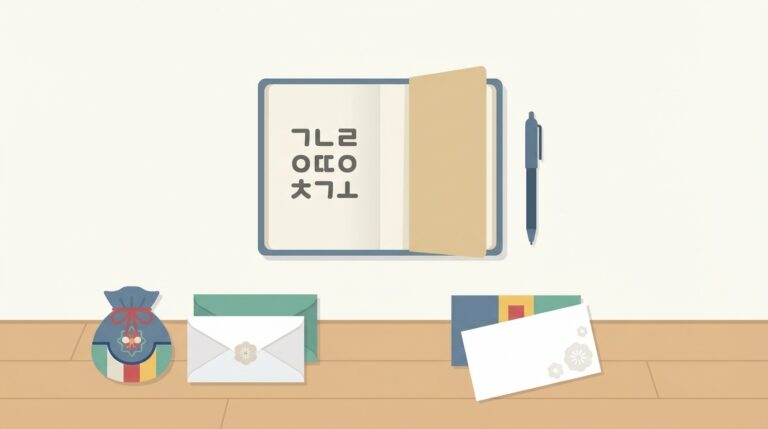
When exchanging Yedan (often cash now), you never just hand over a naked bill or a white bank envelope. It must be wrapped in a silk pouch or a fancy envelope, and handed over with two hands, often while sitting on the floor (ondol). Eye contact should be respectful, not piercing. This is the ultimate form of Nunchi—showing you respect the gravity of the union.
4-2. K-Drama Trope: The “Rejected Envelope”
We’ve all seen it. The rich mother-in-law slides a white envelope across the table.
– Scenario A: “Take this and leave my son.” (Break-up fee)
– Scenario B: “Is this all your family prepared for Yedan?” (Insulting the dowry)
Real life isn’t usually that dramatic, but the Envelope (봉투) carries immense power in Korean culture. It signifies economic power, hierarchy, and “sincerity.”
Phase 5: Immersive Roleplay Scenario
Setting: A trendy cafe in Gangnam. You are talking to Jisoo (30, Female), a close Korean friend who is getting married next month. She looks stressed.
Jisoo: 아, 결혼 준비 진짜 머리 아파. 시어머니가 예단은 생략하자고 하시는데…
(Ah, gyeolhon junbi jinjja meori apa. Sieomeoniga yedaneun saengnyakhajago hasineunde…)
(Ah, wedding prep is such a headache. My mother-in-law said to skip the Yedan, but…)
YOU:
(Option A) 진짜? 그럼 좋은 거 아니야? 돈 아끼고!
(Really? Isn’t that good? Save money!)
(Option B) 흠… 말은 그렇게 하셔도 진짜 안 하면 서운해하실 수도 있어.
(Hmm… Even if she says that, she might be disappointed if you really don’t do it.)
🔀 Decision Point:
– If you chose A: Jisoo sighs. “You don’t know Korean culture… It’s a trap!”
– If you chose B (✅ Best Choice): Jisoo nods vigorously. “Right?! That’s exactly what I’m worried about! You really get it!”
Jisoo: 맞지? 오빠(fiancé)는 눈치 없이 ‘우리 엄마는 쿨하니까 진짜 안 해도 돼’ 이러고 있다니까.
(Matji? Oppa-neun nunchi eopsi ‘uri eommaneun kulhanikka jinjja an haedo dwae’ ireogo itdanikka.)
(Right? My fiancé has no Nunchi and keeps saying ‘My mom is cool so we really don’t have to do it’.)
YOU: 남자들은 잘 모르지. 그냥 작은 성의라도 표하는 게 좋을 것 같아.
(Namjadeureun jal moreuji. Geunyang jageun seong-ui-rado pyohaneun ge joeul geot gata.)
(Men usually don’t know. I think it’s better to show just a little sincerity.)
Phase 6: 10-Second Shadowing Drill
Let’s practice a sentence that makes you sound like a wise cultural insider. Use a sympathetic tone.
“결혼은 / 둘만 하는 게 아니라 / 집안과 집안의 / 만남이잖아요.”
(Gyeolhoneun / dulman haneun ge anira / jiban-gwa jiban-ui / mannam-ijana-yo.)
😊 Emotion: Wise & Understanding (nodding head slowly)
Meaning: “Marriage isn’t just between two people; it’s a meeting of family and family.”
Phase 7: K-Culture Mini Glossary
| Korean | Rom. | Meaning | Context |
|---|---|---|---|
| 함 | Ham | Gift Box | Traditionally carried by groom’s friends to bride’s house. |
| 축의금 | Chuk-ui-geum | Congratulatory Money | The money guests pay to attend a wedding (usually 50k, 100k KRW). |
| 스드메 | Seo-Deu-Me | Studio, Dress, Makeup | The “Holy Trinity” package of Korean wedding prep. |
| 시월드 | Si-World | In-law World | Slang for the stress of dealing with the husband’s family. |
Phase 8: Traveler’s Survival Kit (Wedding Guest Edition)
Even if you aren’t getting married, you might be invited to a Korean wedding!
🆘 Survival Tips for Guests
1. Don’t bring a toaster. In Korea, we give Cash.
2. The Envelope: Write your name vertically on the back of the envelope.
3. The Amount: 50,000 KRW (approx $40) if you are an acquaintance/colleague. 100,000 KRW+ if you are close. Giving 70,000 KRW is awkward (odd numbers like 3, 5, 10 are preferred, but 7 is rare in this context).
4. Meal Ticket: You hand over the money at the entrance and get a Sik-kwon (Meal Ticket) for the buffet. Do not lose this!
Phase 9: Think Deeper — “Marriage: Individual vs. Collective”
🧠 Think Deeper:
Why is Yedan (gifts to in-laws) still such a heated topic in 2024? It highlights the clash between Korea’s Confucian roots (where marriage creates an alliance between clans) and modern individualism. When a Korean says, “Marriage is reality (결혼은 현실이야),” they often mean that love cannot completely override these family expectations and economic transactions.💬 Your Turn: In your culture, does the groom’s family expect gifts from the bride? Or is it the other way around? How much say do parents have?
Phase 10: FAQ & Troubleshooting
Q: Can I really ask a Korean friend “Did you do Yedan?”
A: ⚠️ Caution. Only if you are very close. It’s like asking, “How much did you spend on your house?” It’s a financial and sensitive topic. Better to ask generally, “Is wedding prep going well?” (결혼 준비는 잘 돼가요?)
Q: I saw “Ham” selling in a drama. Do I need to buy a squid mask?
A: No! Unless you are doing a very traditional performance, do not wear a squid mask to a friend’s house. You will scare the neighbors.
❌ Common Mistake: Wearing White to a wedding as a guest.
✅ Fix: In Korea, white is exclusively for the bride. Guests usually wear beige, pastels, or dark colors to let the bride shine.
Phase 11: Wrap-up & Action Mission
Summary: Korean weddings involve a complex dance of “Sincerity” (Yedan/Yemul), and while the noisy “Ham” tradition is fading, the family dynamics remain crucial.
🚀 Action Missions:
– 🥉 Bronze: Practice saying “Seong-ui-reul pyohada” (Show sincerity) three times.
– 🥈 Silver: Watch a clip of Reply 1988 (Ham scene) on YouTube and identify the phrase “Ham Saseyo!”
– 🥇 Gold: Ask a Korean friend: “한국 결혼식에서 제일 중요한 건 뭐예요?” (What is the most important thing in a Korean wedding?)
Phase 12: Interactive Quiz
- Situational Judgment: Your friend says her mother-in-law told her to “skip” the gifts. What is the most culturally astute interpretation?
- A) She is literally an angel. Skip everything.
- B) She means skip the heavy stuff, but a small gesture of sincerity is still expected.
- C) She hates gifts.
- True or False: You should wear a bright white dress to a Korean wedding to look festive.
- (T / F)
- Vocab: What is the word for the “Congratulatory Money” you give at the wedding entrance?
- [ ]
(Answers: 1-B (This is ‘Kibun’), 2-False (White is for the bride only!), 3-Chuk-ui-geum)
Frequently Asked Questions (FAQ)
Q: What does "함 사세요! [Ham Sa-se-yo!]" mean in Korean and how do you pronounce it?
A: In Korean, "함 사세요! [Ham Sa-se-yo!]" is pronounced [Ham sa-se-yo] and means: "Buy the Ham (wedding gift box)!"
Q: What does "예단 & 예물 [Yedan & Yemul]" mean in Korean and how do you pronounce it?
A: In Korean, "예단 & 예물 [Yedan & Yemul]" is pronounced [Ye-dan] and means: Yedan: Gifts from the bride's family to the groom's family (Silk, bedding, or these days... cash).
Q: What does "성의를 표하다 [Seong-ui-reul Pyo-ha-da]" mean in Korean and how do you pronounce it?
A: In Korean, "성의를 표하다 [Seong-ui-reul Pyo-ha-da]" is pronounced [Seong-ui-reul Pyo-ha-da] and means: To show one's sincerity (usually through a gift or money).







