

Escaping Hongdae: The Ultimate Korean Guide to Solving Puzzles 🧩
Phase 1: The Hook — Locked in a Room in Seoul 🔒
Hello! This is your Daily Hangul Editor.
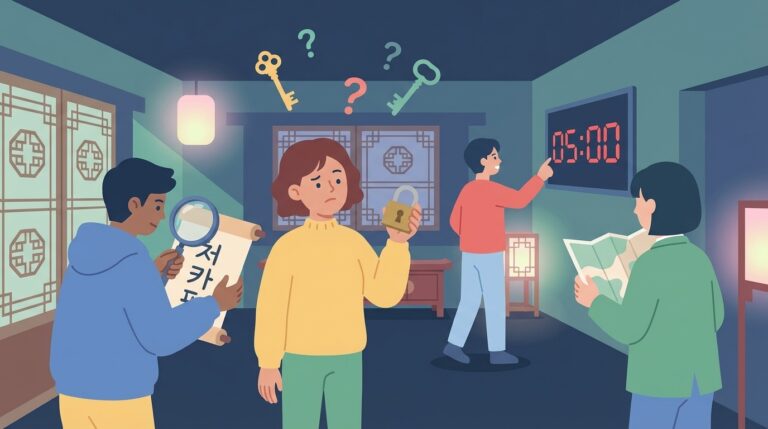
Picture this: You are in the basement of a building in Hongdae on a Friday night. The lights are dim, spooky music is playing, and a digital timer on the wall shows 05:00 minutes left.
You are in a Bangtalchul (방탈출 – Escape Room) with your new Korean friends. One friend is holding a UV light, another is shaking a locked box. Suddenly, someone shouts at you: “Igeo mwoya?”
Your heart races. Not because of the ghost theme, but because you want to help solve the puzzle! In Korea, escape rooms are serious business. It’s not just a game; it’s a test of nunchi (wits) and teamwork. If you watch K-Variety shows like The Great Escape (Daetalchul), you know the thrill.
Today, I will teach you the survival phrases to be the hero of the team, not just a bystander. Let’s unlock these expressions! 🔑
Phase 2: Deep Dive — Key Expressions 🕵️♀️
Here are the 3 phrases that will save your team from failure.
1. 이거 어떻게 해요? (Igeo eotteoke haeyo?)
- Pronunciation: [I-geo eo-tteo-ke hae-yo?]
- ‘I-geo’ sounds like ‘Ego’ without the ‘go’ stressing too much.
- ‘Haeyo’ sounds like ‘Hey-yo’.
- Meaning:
- Literal: How do (I) do this?
- Real Nuance: “I’m stuck, how does this work?” or “What’s the method here?”
- K-Culture Moment: Imagine a K-Drama scene where the lead character is struggling with a high-tech door lock or a complicated coffee machine. They turn to the lead male/female and ask this with puppy eyes.
- Editor’s Insight: This is the magic key. Use it when you hold a weird object and don’t know if it’s a magnet, a key, or just decoration.
- Situation Spectrum:
[🚫 Formal Boss] ———— [✅ Friendly/Polite] ———— [✅ Casual (Drop 'yo')]- 🤔 Think About It: Korean often omits the subject “I” or “You.” Why do you think the context is more important than the person in this phrase?
2. 힌트 좀 주세요 (Hinteu jom juseyo)
- Pronunciation: [Hin-teu jom ju-se-yo]
- ‘Hin-teu’ is Konglish for Hint! Easy!
- ‘Jom’ sounds like ‘Joam’. It softens the request.
- Meaning: Please give me a hint.
- K-Culture Moment: In variety shows, when comedians fail a quiz, they desperately beg the producer: “PD-nim! Hinteu jom juseyo!” sometimes even dancing for it.
- Editor’s Insight: The word ‘jom’ (literally: a little) is crucial. Without it, you sound demanding. With it, you sound polite and desperate.
- Situation Spectrum:
[⚠️ Boss (Use 'jom' carefully)] ———— [✅ Staff/Interphone] ———— [✅ Friends]- 🤔 Think About It: Why does adding “a little” (jom) make a sentence polite in Korean? Does your language have a “softener” word?
3. 풀었어요! (Pureosseoyo!)
- Pronunciation: [Pu-reos-seo-yo!]
- ‘Pu’ sounds like ‘Poo’ (sorry!) or ‘Pull’.
- ‘Reos’ sounds like ‘Russ’ in Russell.
- Meaning: I solved it! / I unlocked it!
- K-Culture Moment: The moment the suspense music stops and the chest opens. The hero shouts this, and everyone high-fives.
- Editor’s Insight: Use this loudly! In Korean group culture, announcing your success helps the team move to the next step immediately.
- Situation Spectrum:
[✅ Everyone]- 🤔 Think About It: The verb ‘pulda’ means ‘to solve’ but also ‘to untie’ (like a knot) or ‘to relieve’ (stress). How are these concepts connected in Korean mind?
Phase 3: Textbook vs. Real Life 🗣️
| Situation | 📖 Textbook Korean | 🗣️ Real Life Korean | 💡 Why? |
|---|---|---|---|
| Confused | 잘 모르겠습니다. (I don’t know well.) | 이게 뭐야? (Ige mwoya? – What is this?!) | Koreans react emotionally first! |
| Success | 정답입니다. (It is the correct answer.) | 대박! / 천재다! (Daebak! / Cheonjaeda! – Genius!) | Slang builds hype and energy. |
| Time’s up | 시간이 다 되었습니다. (Time is up.) | 망했다… (Mang-haet-da… – We are doomed/screwed.) | Self-deprecating humor is common. |
💡 Bottom Note: Use “대박” (Daebak) whenever your friend solves a hard puzzle. It makes you the best teammate instantly.
Phase 4: Cultural Deep Dive — The Art of ‘Nunchi’ in Games 🧠
4-1. Non-verbal Communication: The “Wait” Hand
When someone is punching in a code on a keypad, do not speak. Koreans often hold up a hand (palm out) to signal “silence.” If you talk while someone is memorizing numbers, you might break their concentration (and the team spirit!).
4-2. K-Culture Connection: The ‘Brainiac’ Character
In shows like Running Man or The Great Escape, there is always one member who is the “Brain” (Brain-sexy / 뇌섹남/녀). They solve the math problems.
* Your Role: If you aren’t good at Korean text puzzles, be the “Observer.” Look for physical keys or hidden doors. Shout “여기!” (Yeogi! – Here!) when you find something. This makes you valuable without needing fluent Korean.
Phase 5: Immersive Roleplay 🎭
Setting: A haunted hospital theme room. Dark and creepy. 👻
Characters:
* YOU: The brave explorer.
* Min-su: Your Korean friend who is easily scared.
(Dialogue)
Min-su: (Shivering) 야, 여기 너무 무서워. 뭐 찾아야 해?
(Ya, yeogi neomu museowo. Mwo chajaya hae?)
(Hey, it’s too scary here. What do we need to find?)
YOU: (Holding a strange box with a keypad)
여기 상자가 있어. 이거 어떻게 해요?
(Yeogi sangjaga isseo. Igeo eotteoke haeyo?)
(There is a box here. How do I do/open this?)
Min-su: 비밀번호 4자리를 찾아야 할 것 같은데…
(Bimil-beonho 4jarireul chajaya hal geot gateunde…)
(I think we need to find a 4-digit password…)
(5 minutes pass. You are stuck.)
🔀 Decision Point: What do you say to Min-su?
- A) “Min-su, do it quickly!” (Pushy)
- B) “인터폰으로 힌트 좀 주세요 라고 할까?” (Strategic)
- C) “I don’t know.” (Giving up)
✅ Best Choice: B — Korean escape rooms usually give 3 hints. Using them wisely is part of the strategy. Suggesting it politely (
...rago halkka?– shall we say…?) shows good teamwork.
YOU: (Picking up the interphone)
저기요, 힌트 좀 주세요!
(Jeogiyo, Hinteu jom juseyo!)
(Excuse me, please give us a hint!)
Staff (Voice): 책상 아래를 보세요.
(Look under the desk.)
YOU: (Finding a note) 찾았다! 풀었어요!
(Chajatda! Pureosseoyo!)
(Found it! I solved/unlocked it!)
Phase 6: 10-Second Shadowing Drill 🎤
Practice these emotions to sound natural!
- 🤔 Confused: 이거 / 어떻게 / 해요?
[Igeo / eotteoke / haeyo?] - 🥺 Desperate: 제발 / 힌트 좀 / 주세요!
[Jebal / hinteu jom / juseyo!] - 😤 Triumphant: 드디어 / 풀었어요!
[Deodieo / pureosseoyo!]
Phase 7: K-Culture Mini Glossary 📔
| Korean | Romanization | Meaning | Context |
|---|---|---|---|
| 자물쇠 | Jamulsoe | Lock | The enemy. You must open this. |
| 비밀번호 | Bimil-beonho | Password | Often shortened to ‘Biban’ (비번) in slang. |
| 방탈출 | Bangtalchul | Escape Room | Bang (Room) + Talchul (Escape). |
| 장치 | Jangchi | Device/Sensor | High-tech puzzles using magnets or lasers. |
| 뇌섹남 | Noesengnam | Sexy Brain Man | A slang for a smart, attractive man (often used for puzzle solvers). |
Phase 8: Traveler’s Survival Kit 🧳
Escape Rooms are a popular rainy-day activity in Korea. Many places in Hongdae and Gangnam have English themes!
🆘 Survival Phrases for the Front Desk
* 🇰🇷 “영어 테마 있어요?” (Yeong-eo tema isseoyo?)
* 🗣️ Pronunciation: [Young-uh te-ma iss-uh-yo?]
* 📍 Where: When booking or entering the shop.
* 💡 Pro Tip: Even if the theme is English, the logic might be Korean. Don’t be shy to ask for an extra hint because of the language barrier!📌 Editor’s Travel Note
* Booking: Most popular themes require online booking (Naver Booking). Walk-ins are often sold out on weekends.
* Shoes: You might need to change into slippers provided by the shop. Wear socks!
Phase 9: Think Deeper — “Palli-Palli” in Games 🏃♂️
Language & Culture: Why the rush?
You might notice your Korean friends rushing even in a game. Korea’s “Palli-Palli” (Hurry-Hurry) culture applies here too. It’s not just about escaping; it’s about escaping with time left on the clock (No-Hint Clear is the ultimate honor).
🧠 Think Deeper: In Western escape rooms, immersion and story might be more important. In Korea, “Clearing the mission” is often the priority. Does this reflect the competitive nature of modern Korean society?
💬 Your Turn: Do you prefer enjoying the story slowly or breaking the record? Tell me in the comments!
Phase 10: FAQ & Troubleshooting 🛠️
- Q: Can I use English with the staff?
- A: Mostly, yes! Use “Konglish” words like Hint, Password, Key, Sensor. They will understand.
- Q: Is it rude to yell phrases?
- A: Inside the room? No! It’s high tension. But don’t swear. Use “Aish!” (Darn it) instead of bad words.
❌ Common Mistake #1: Trying to force a lock open.
✅ Do this: If it doesn’t open easily, the code is wrong. Korean props are usually magnetic or electronic. Don’t use force (힘), use your head (머리)!
Phase 11: Wrap-up & Mission 🚀
One-Liner Summary: To survive a Korean Escape Room, politely beg for hints (Jom juseyo) and loudly celebrate victories (Pureosseoyo).
🏆 Your Action Mission:
* 🥉 Bronze: Say “Hinteu jom juseyo” while holding your hand out politely.
* 🥈 Silver: Watch an episode of The Great Escape (Daetalchul) or Running Man and count how many times they say “Mwoya?” (What is this?).
* 🥇 Gold: Go to a ‘Bangtalchul’ cafe in Korea (or your local Koreatown) and clear a theme!
Phase 12: Interactive Quiz 📝
1. Situation: You found a key, but you don’t know where to use it. What do you ask your team?
* A) 힌트 좀 주세요. (Please give me a hint.)
* B) 이거 어떻게 해요? (How do I do this?)
* C) 안녕히 계세요. (Goodbye.)
2. True or False (K-Culture):
* “In Korean Escape Rooms, it is considered polite to let the oldest person solve all the puzzles.”
* (T/F)
Correct Answers:
1. B. Use ‘Eotteoke haeyo’ to ask for method/direction. A is for asking the staff.
2. False. Escape rooms are about skill! Age doesn’t matter here. If you are good, you lead. But you still use polite language (Yo-ending)!
Frequently Asked Questions (FAQ)
Q: What does "이거 어떻게 해요? (Igeo eotteoke haeyo?)" mean in Korean and how do you pronounce it?
A: In Korean, "이거 어떻게 해요? (Igeo eotteoke haeyo?)" is pronounced [I-geo eo-tteo-ke hae-yo?] and means: a key conversational Korean expression covered in this lesson.
Q: What does "힌트 좀 주세요 (Hinteu jom juseyo)" mean in Korean and how do you pronounce it?
A: In Korean, "힌트 좀 주세요 (Hinteu jom juseyo)" is pronounced [Hin-teu jom ju-se-yo] and means: a key conversational Korean expression covered in this lesson.
Q: What does "풀었어요! (Pureosseoyo!)" mean in Korean and how do you pronounce it?
A: In Korean, "풀었어요! (Pureosseoyo!)" is pronounced [Pu-reos-seo-yo!] and means: a key conversational Korean expression covered in this lesson.







