

Help! I’m at the Wrong Place! 😱 How to Change Meeting Spots in Korea
Phase 1: Immersive Hook
Hello! This is your Daily Hangul Editor.
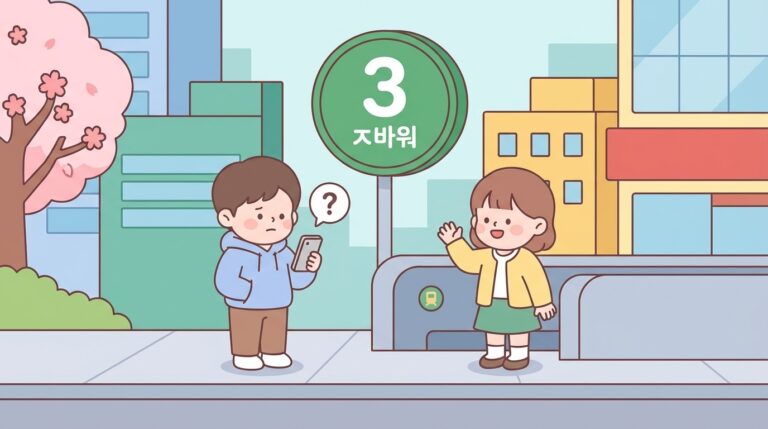
Imagine this: You are in Hongdae, the hottest district in Seoul. You agreed to meet your Korean friend at “Exit 9.” You arrive, confident and ready. But when you walk up the stairs, you see… a sea of people. Literally hundreds of them. 🌊
You check your phone. Your friend texts: “I’m here! Where are you?”
You look around. You can’t see anyone. The K-Drama moment where the main characters spot each other across the crowd? Yeah, that’s not happening today.
In Korea, especially in busy cities like Seoul, changing the meeting spot on the fly is a crucial survival skill. Maybe the restaurant line is too long (we call this a “hotplace” problem), or maybe it’s raining.
Today, I’ll teach you how to switch locations smoothly without panic. Ready to become a navigation master? Let’s go! 🚀
Phase 2: Deep Dive into Core Expressions
Here are the 3 key phrases you need when the plan needs to change.
1. 장소를 바꿔도 될까요?
(Jang-so-reul ba-kkwo-do doel-kka-yo?)
- Pronunciation: Jang-so (sounds like ‘Django’ with an S) + reul + ba-kkwo (sounds like ‘buck-whoa’) + do + doel-kka-yo?
- Meaning:
- Literal: May I change the place?
- Real Nuance: “Would it be okay if we met somewhere else?” (Polite & Standard)
- K-Culture Moment: Use this when you realize the café you picked is closed or under construction. It shows you respect the other person’s time.
- Situation Spectrum:
[🚫 Formal Boss] ———— [✅ Co-worker] ———— [✅ Friend]- 🤔 Think About It: Why does Korean use “-doel-kka-yo?” (Is it okay/possible?) instead of just “I want to change”? It’s about seeking permission to maintain harmony.
2. 거기 말고 다른 데 어때요?
(Geogi malgo dareun de eottaeyo?)
- Pronunciation: Geogi (Go-ghee) + malgo (mal-go) + dareun de (dah-reun deh) + eottaeyo?
- Meaning:
- Literal: Not there, how about another place?
- Real Nuance: “Instead of there, how about somewhere else?”
- Editor’s Insight: This is a life-saver when your friend suggests a restaurant you know has bad reviews or is too expensive!
- Situation Spectrum:
[🚫 Formal Boss] ———— [⚠️ Senior] ———— [✅ Friend]- 🤔 Think About It: Koreans often use indirect suggestions (“How about…?”) rather than direct rejections (“No, I don’t want to go there”).
3. [Place] 앞에서 만나요.
([Place] ap-e-seo man-na-yo.)
- Pronunciation: [Place] + ap-e-seo (ah-peh-saw) + man-na-yo
- Meaning: Let’s meet in front of [Place].
- K-Culture Moment: In K-Pop fan meetings or concerts, fans always designate a specific landmark. “Meet in front of the convenience store!”
- Situation Spectrum:
[✅ Formal Boss] ———— [✅ Co-worker] ———— [✅ Friend]
Phase 3: Textbook vs. Real Life
| Situation | 📖 Textbook Korean | 🗣️ Real Korean (Daily Hangul Style) | 💡 Why the difference? |
|---|---|---|---|
| Suggesting a change | 약속 장소를 변경하고 싶습니다. (I want to change the appointment place.) | 우리 딴 데 갈까? (Shall we go somewhere else?) | “딴 데” is a common contraction of “다른 데” (different place). It sounds much more natural among friends. |
| Too crowded | 사람이 너무 많아요. (There are too many people.) | 여기 사람 너무 많다! 딴 데 가자. (Too many people here! Let’s move.) | Koreans value quick decision-making (Pali-pali culture) when navigating crowds. |
Phase 4: Cultural Deep Dive — The “Station Exit” Strategy
4-1. The Art of the “Exit” (Chul-gu)
If you watch K-Dramas or travel to Seoul, you’ll notice everyone meets at a Subway Exit (출구 – Chul-gu).
- Why? Seoul subway stations are massive underground cities. Meeting “at the station” is like saying “Let’s meet in New York.” You must specify the Exit Number.
- Pro Tip: Don’t just say “Exit 3.” Say “Top of the stairs of Exit 3” or “Inside the ticket gate.”
4-2. Nunchi (Eye-measure) at Restaurants
In Korea, famous restaurants (Matjib) have huge waiting lines. If you arrive and see a 2-hour wait:
1. Use your Nunchi (read the situation quickly).
2. Don’t wait for your friend to arrive to decide.
3. Message them immediately: “줄이 너무 길어요. 딴 데 갈까요?” (The line is too long. Shall we go elsewhere?)
Phase 5: Immersive Roleplay
Setting: It’s Friday night at Gangnam Station Exit 10. It is incredibly crowded. It’s raining slightly. ☔️
Characters:
* YOU: An exchange student who just arrived at the exit.
* Minji: Your Korean friend who is running 5 minutes late.
(Phone Call)
Minji: 여보세요? 나 거의 다 왔어! 너 어디야?
(Yeoboseyo? Na geoui da wasseo! Neo eodiya?)
[Hello? I’m almost there! Where are you?]
YOU: 나 10번 출구 앞인데… 사람이 너무 많아!
(Na sip-beon chulgu ap-inde… sarami neomu mana!)
[I’m in front of Exit 10… but there are too many people!]
Minji: 아, 진짜? 비도 오는데 어떡하지?
(Ah, jinjja? Bido oneunde eotteokhaji?)
[Ah, really? It’s raining too, what should we do?]
🔀 YOUR TURN! Make a decision.
- Option A: “그냥 여기서 기다릴게.” (I’ll just wait here.)
- Option B: “장소를 바꿔도 될까요? 스타벅스 안에서 만나요.” (Can we change the place? Let’s meet inside Starbucks.)
- Option C: “비 맞아도 괜찮아!” (Getting wet is fine!)
✅ Best Choice: Option B.
* Why? Standing in the rain at a crowded exit is miserable. Suggesting a specific, dry landmark nearby (like a Starbucks) shows consideration and smarts.
Minji: 그래! 거기서 보자. 내가 커피 살게! ☕️
(Geurae! Geogiseo boja. Naega keopi salge!)
[Okay! See you there. I’ll buy the coffee!]
Phase 6: 10-Second Shadowing Drill
Practice this sentence to suggest a change smoothly. Listen to the rhythm!
Emotion: 😟 Slightly worried & polite
“여기 / 사람이 / 너~무 많아요. / 다른 데로 / 갈까요?”
- Pronunciation: Yeogi / sarami / neo~mu manayo. / dareun dero / galkkayo?
- Meaning: There are tooooo many people here. Shall we go somewhere else?
- Note: Elongate “neo~mu” (tooooo) to emphasize how crowded it is!
Phase 7: K-Culture Mini Glossary
| Korean | Romanization | Meaning | Context |
|---|---|---|---|
| 핫플 | Hat-peul | Hot Place | A very trendy, popular location (cafe/restaurant) that usually requires waiting. |
| 웨이팅 | We-i-ting | Waiting | Konglish for “waiting in line.” e.g., “웨이팅이 길어요” (The waiting is long). |
| 출구 | Chul-gu | Exit | The most important navigation point in Korean cities. |
Phase 8: Traveler’s Survival Kit 🧳
When you are lost or need to change spots in a hurry:
🆘 Survival Phrase #1
* 🇰🇷 “여기 위치가 어디예요?” (Yeogi wichiga eodiyeyo?)
* 🗣️ Meaning: Where is this location?
* 📍 Usage: When you are at a shop and need to tell your friend exactly where you are, ask the staff this, or show them your map app.📌 Editor’s Travel Note
* Google Maps vs. Naver Map: Google Maps is not very accurate for walking directions in Korea.
* Download: Naver Map or KakaoMap. They show specific subway exits and even which subway car is closest to the escalator!
Phase 9: Think Deeper — High Context Culture
Why do Koreans confirm the exact location so many times?
Korea is a “High Context Culture.” Silence or ambiguity can be uncomfortable. Also, Seoul is incredibly dense. Saying “Let’s meet at Gangnam Station” is ambiguous because the station is huge. Being specific (“Exit 10, in front of the Olive Young store”) is not just about logistics; it’s a form of consideration (baeryeo – 배려) to prevent the other person from wandering around looking for you.
💬 Your Turn: In your country, if you agree to meet “downtown,” how do you find each other? Do you have specific landmarks like the “Clock Tower”? Tell us in the comments!
Phase 10: FAQ & Troubleshooting
- Q: Can I change the meeting place 10 minutes before the time?
- A: In Korea, we have a “Pali-pali” (Hurry-hurry) culture, so plans do change fast. However, changing it 10 minutes prior is considered rude unless there is an emergency (rain, accident). If you must, say “정말 미안해요” (I’m really sorry) first.
- Q: I’m lost! What do I tell my friend?
- A: Send a photo! Take a picture of a nearby big building or store sign and send it via KakaoTalk. It’s faster than trying to read Korean signs you don’t understand.
- ❌ Common Mistake: Mixing up “Exit” (Chul-gu) and “Entrance” (Ip-gu).
- ✅ Tip: Just look for the number in the green/yellow circle on signs. That’s the Exit!
Phase 11: Wrap-up & Action Mission
Summary: Today we learned how to politely suggest changing a location using “장소를 바꿔도 될까요?” and how to navigate the chaos of Korean subway exits.
🚀 Action Mission:
* 🥉 Bronze: Say “다른 데 어때요?” (How about somewhere else?) out loud 3 times.
* 🥈 Silver: Open a Korean map app (Naver/Kakao) and find “Exit 9” of Hongik University Station.
* 🥇 Gold: Next time you meet a friend, try changing the specific meeting spot in Korean! “카페 앞에서 만나!” (Meet in front of the cafe!)
Phase 12: Interactive Quiz
1. Your friend suggests a restaurant, but you know the food is terrible there. What is the best response?
* A) 싫어! (Hate it!)
* B) 거기 맛없어. (It tastes bad there.)
* C) 거기 말고 다른 데 어때요? (How about somewhere else instead of there?)
2. True or False?
* “In Seoul, saying ‘Let’s meet at the station’ is specific enough.”
Answers:
1. C (A and B are too direct and can be rude unless you are best friends. C is polite and suggestive.)
2. False (Always specify the Exit Number or a landmark!)







