

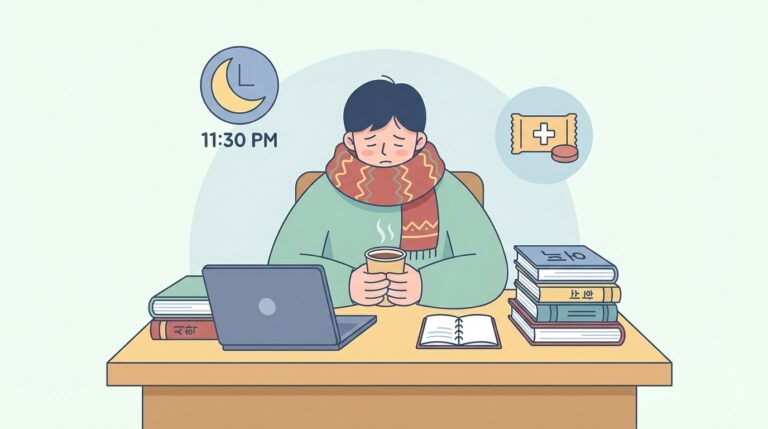
Phase 1: The ‘Husk’ Factor – Did You Pull an All-Nighter?
Hello! This is your Daily Hangul Editor.
Imagine this scene: You are the main vocalist in a K-Pop survival show. It’s the night before the final mission. You’ve been practicing the high note for 10 hours straight. The next morning, the camera zooms in on your face as you wake up. You open your mouth to say “Good morning,” but instead of a voice, a squeaky, dry whisper comes out.
Or, picture a K-Drama university scene. The diligent protagonist has been rehearsing their group presentation script until 4 AM. They walk into the lecture hall, looking pale but determined, clutching a thermos of hot citron tea (yuja-cha).
If you are a student in Korea, presentations (Balpyo) are serious business. And pushing yourself until your body protests? That’s practically a rite of passage. Today, we’re going to learn how to explain that you tried so hard that you literally lost your voice. It’s a great excuse that might just get you some sympathy points from your professor!
Phase 2: Deep Dive – “My Voice is Gone!”
Here are the three essential expressions you need when your throat betrays you.
1. 목이 쉬었다 (Mogi swieotda)
- Pronunciation: [Mogi swieotda] – Think of ‘she’ in ‘sheet’ but with a softer, breathier ‘w’ sound.
- Meaning: My voice is hoarse / I lost my voice.
- K-Culture Moment: You’ll hear this often in variety shows when comedians scream too much during a game, or after a intense Karaoke (Noraebang) session.
- Editor’s Insight: Literally, ‘목’ (mok) is neck/throat, and ‘쉬다’ (swida) in this context means to become hoarse. Don’t confuse it with the other ‘쉬다’ which means ‘to rest’! If you say “목이 쉬고 싶어요,” it means “My throat wants to take a vacation,” which is poetic but weird.
- Situation Spectrum:
[🚫 Formal Speech] ———— [⚠️ Semi-Formal] ———— [✅ Casual]- (Casual): 목 쉬었어. (Mok swieosseo.) ✅
- (Polite): 목이 쉬었어요. (Mogi swieosseoyo.) ✅
2. ~느라(고) (~neura-go)
- Pronunciation: [Neu-ra-go] – Sounds like ‘Nue’ in ‘Nu-metal’ + ‘Ra’.
- Meaning: Because of doing [Action]… (usually leading to a negative result).
- K-Culture Moment: In dramas, when a character is late, they might say, “Sorry, I was late because I was helping a grandma cross the street.” This structure is perfect for excuses.
- Editor’s Insight: This is the magic grammar point for B1 learners. It explains the reason for a negative outcome that required your energy or time. You can’t use it for positive things (e.g., “I passed the test because I studied” → Use other grammar). Use it for “I’m tired/sick/broke because I did X.”
- 🤔 Think About It: Why does Korean have a specific grammar just for “doing something that caused a negative result”? It implies that the process (the effort) justifies the unfortunate result.
3. 발표 준비 (Balpyo junbi)
- Pronunciation: [Bal-pyo jun-bi]
- Meaning: Presentation preparation.
- Editor’s Insight: Korean university life revolves around ‘Team Projects’ (Team-peul). ‘Balpyo’ is the climax of that stress. If you say you are busy with ‘Balpyo junbi,” no Korean friend will ask you to hang out. It’s the ultimate “Do Not Disturb” sign.
Phase 3: Textbook vs. Real Life
Let’s see how to sound less like a robot and more like a stressed university student.
| Situation | 📖 Textbook Korean | 🗣️ Real Korean | 💡 Why is it different? |
|---|---|---|---|
| Explaining why your voice is weird | 발표 준비를 많이 해서 목이 아파요. (I practiced the presentation a lot, so my throat hurts.) |
발표 준비하느라 목이 다 나갔어요. (My voice completely left/went out because of prep.) |
“나갔다” (went out) is a common idiom for things breaking or body parts giving up. |
| Asking for understanding | 목소리가 이상해서 죄송합니다. (I apologize that my voice is strange.) |
목 상태가 좀 안 좋아요. 양해 부탁드려요. (My throat condition isn’t good. Please understand.) |
“양해” (Yanghae) is a high-level, polite word for “understanding” used in formal settings. |
💡 Editor’s Note: Using “목이 나갔다” (My voice went out) makes you sound very native. It’s acceptable with friends and close seniors, but stick to “목이 쉬었다” or “상태가 안 좋다” with professors.
Phase 4: Cultural Deep Dive
4-1. The Art of the “Sick Voice” (Non-verbal)
In Western culture, if you are sick, you might try to hide it to look professional. In Korea, showing a little bit of suffering can actually be proof of your hard work (Nooryeok).
If you lose your voice before a presentation:
* Don’t act too cheerful.
* Do wear a scarf (even indoors) or hold a warm tumbler.
* Do clear your throat slightly (“Mm-hmm!”) before speaking to show you are trying your best despite the pain.
4-2. K-Food Connection: The Remedies
When a K-Drama character loses their voice, what does their love interest bring them?
1. Yuja-cha (Citron Tea): The gold standard for sore throats.
2. Baesuk (Steamed Pear): A traditional remedy often made by grandmothers or concerned moms.
3. Convenience Store: In real life, students run to the nearest CU or GS25 and buy Ssanghwa-tang (a dark herbal drink in a glass bottle). It tastes like liquid medicine, but it screams “I am taking care of myself.”
Phase 5: Immersive Roleplay – The Morning of the Presentation
Setting: A university hallway, 8:50 AM. You are holding your throat, looking distressed. Your team leader, Minji, approaches you.
Characters:
* YOU: An exchange student who practiced the script all night.
* Minji: The ‘Team Leader’ (3rd year student, very responsible but kind).
Dialogue:
Minji: (Worried face) 어? 얼굴이 왜 그래? 어디 아파?
(Eo? Eolguri wae geurae? Eodi apa?)
(Huh? What’s wrong with your face? Are you sick?)
YOU: (Whispering raspy) 어떡하죠? 어제 밤새 연습하느라 목이 쉬었어요.
(Eotteokhajyo? Eoje bamsae yeonseuphaneura mogi swieosseoyo.)
(What should I do? I lost my voice because I practiced all night yesterday.)
Minji: 헐… 목소리가 아예 안 나오네! 물 좀 마셔봐.
(Heol… Moksoriga aye an naone! Mul jom masyeobwa.)
(Oh my gosh… No sound is coming out at all! Drink some water.)
🔀 Your Turn! How do you respond?
- A) “발표 못 하겠어요. 민지 씨가 대신 해주세요.” (Give up immediately)
- B) “따뜻한 물 마시면 괜찮을 거예요. 할 수 있어요!” (Show fighting spirit)
- C) “목이 너무 아파요. 병원 갈게요.” (Leave immediately)
✅ Best Choice: B – Korean group culture values effort. Even if you sound like a frog, showing the will to do it (“Fighting!”) is appreciated. Minji might suggest she takes over after hearing your determination.
⚠️ Why not A? Dumping the work on the leader last minute is a major taboo in Korean universities. It’s called “Free Riding” (Bus-tada).
Phase 6: 10-Second Shadowing Drill
Let’s practice the excuse perfectly so your professor understands immediately.
- Emotion: 😷 Apologetic and distressed (touch your throat)
발표 준비하느라 / 목이 / 다 나갔어요.
(Balpyo junbi-haneura / mogi / da nagasseoyo.)
(Because of presentation prep / my voice / is completely gone.)
Phase 7: K-Culture Glossary (School Edition)
| Korean | Romanization | Meaning | Context |
|---|---|---|---|
| 팀플 | Tim-peul | Team Project | The source of all stress in Korean uni life. Short for ‘Team Play’. |
| 밤샘 | Bam-saem | Staying up all night | Often combined: “bam-saem gwaje” (all-nighter assignment). |
| 목 관리 | Mok gwalli | Throat care | Singers and students alike emphasize ‘managing’ their condition. |
| 화이팅 | Hwaiting | Fighting! | Used to encourage someone before a presentation. |
Phase 8: Traveler’s Survival Kit (Pharmacy Edition)
Even if you aren’t a student, you might lose your voice from too much cheering at a K-Pop concert or talking over loud music in Hongdae. Here is how to survive at a Pharmacy (Yakguk – 약국).
🆘 Survival Expression: At the Pharmacy
- 🇰🇷 “목이 너무 아파요. 약 주세요.”
- (Mogi neomu apayo. Yak juseyo.)
- Meaning: My throat hurts a lot. Please give me medicine.
- 🗣️ Pronunciation Tip: ‘Yak’ sounds like the ‘yak’ in ‘kayak’.
- 💡 Pro Tip: Korean pharmacists are very helpful. Point to your throat and whisper. They will usually give you a pill AND a warm drink.
Phase 9: Think Deeper – The Culture of “Hard Work”
🧠 Why is “burning out” sometimes praised?
In many Western cultures, efficiency is key—getting a good result without suffering is ideal. In Korea, however, the visible signs of effort (like losing your voice, dark circles under your eyes, or saying you stayed up all night) can sometimes be seen as a badge of honor. It shows “Jeongseong” (sincerity/heart). Using the grammar ~느라 (because of hard work…) subconsciously appeals to this cultural value. You aren’t just saying you are sick; you are saying you are sick because you cared too much.
💬 Your Turn: In your country, if you lose your voice before a big speech, is it seen as “proof of hard work” or just “bad self-management”?
Phase 10: FAQ & Troubleshooting
- Q: Can I use ‘목이 쉬었다’ to a professor?
- A: Yes, it is a neutral description of a symptom. Just make sure to add “~yo” at the end (쉬었어요). To be extra polite, add “죄송하지만” (I’m sorry but…) at the beginning.
- Q: What if I just have a cold, not from practicing?
- A: Then don’t use “~느라”. Just say: “감기에 걸려서 목이 쉬었어요.” (I caught a cold so my voice is hoarse.)
❌ Common Mistake: Don’t say “목이 잃었어요” (I lost my throat). ‘Lost’ (ilh-eot-da) is for losing keys or money. For voice, we use ‘went out’ (nagatda) or ‘became hoarse’ (swieotda).
Phase 11: Wrap-up & Action Mission
One-Liner Summary: When your voice fails you due to hard work, use “~느라 목이 쉬었어요” to gain both sympathy and respect!
🚀 Action Mission:
* 🥉 Bronze: Stand before a mirror, hold your throat, and whisper the Shadowing Drill sentence 3 times.
* 🥈 Silver: Go to a Korean cafe (or any cafe) and order a “Yujava tea” or “Lemon tea” using the phrase: “목이 아파서 따뜻한 거 주세요.” (My throat hurts so give me something hot.)
* 🥇 Gold: Next time you are late or tired, try to explain it to a Korean friend using the “~느라” grammar. (e.g., “Netflix 보느라 늦잠 잤어요” – I overslept because of watching Netflix!)
Phase 12: Interactive Quiz
1. Which sentence suggests you lost your voice due to HARD WORK?
* A) 노래방에서 노느라 목이 쉬었어요. (Playing at Karaoke)
* B) 발표 준비하느라 목이 쉬었어요. (Preparing for presentation)
* C) 아이스크림 먹느라 목이 쉬었어요. (Eating ice cream)
2. True or False?
* It is rude to wear a scarf indoors in Korea if you have a sore throat.
3. Fill in the blank:
* “Oh no, my voice completely went out!” → “목이 다 _____!”
🔻 Click to see Answers
- B (Though A is also a reason, B implies ‘work/effort’ context suitable for school/work).
- False (It shows you are taking care of yourself so you can recover quickly. Just explain why!)
- 나갔어요 (nagasseoyo)
Frequently Asked Questions (FAQ)
Q: What does "목이 쉬었다 (Mogi swieotda)" mean in Korean and how do you pronounce it?
A: In Korean, "목이 쉬었다 (Mogi swieotda)" is pronounced [Mogi swieotda] and means: My voice is hoarse / I lost my voice.
Q: What does "~느라(고) (~neura-go)" mean in Korean and how do you pronounce it?
A: In Korean, "~느라(고) (~neura-go)" is pronounced [Neu-ra-go] and means: Because of doing [Action]... (usually leading to a negative result).
Q: What does "발표 준비 (Balpyo junbi)" mean in Korean and how do you pronounce it?
A: In Korean, "발표 준비 (Balpyo junbi)" is pronounced [Bal-pyo jun-bi] and means: Presentation preparation.







