

Hello! Welcome to Daily Hangul.
I’m your editor, your local guide to the real Korea.
Picture this: You’re watching a K-Drama. The main couple decides to go on a date. Suddenly, the scene cuts to them wearing incredibly expensive, high-tech neon windbreakers, carrying hiking sticks, and standing at the bottom of a mountain that looks vertical.
Or maybe you’ve seen your favorite K-Pop idol post a vlog panting heavily while climbing stairs that seem to go on forever, only to eat a massive meal at the top.
Welcome to Korean Hiking (Deungsan) Culture.
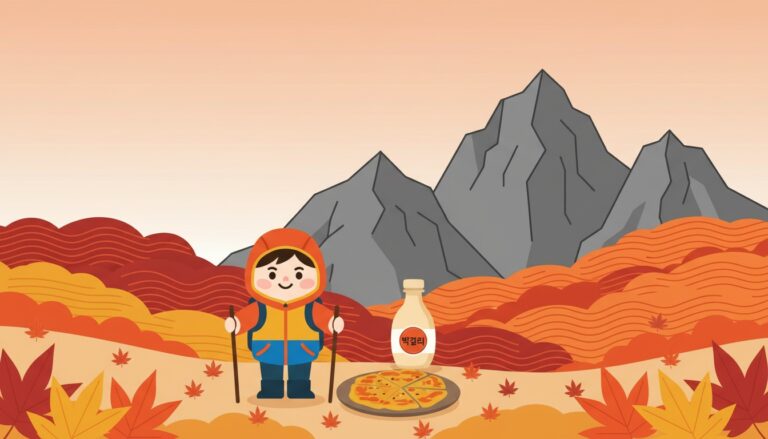
Specifically, we are talking about Seoraksan (Mt. Seorak) in autumn. In October, this isn’t just a mountain; it’s a pilgrimage site. The entire nation seems to descend upon this place to see the Danpung (autumn foliage).
If you go there without knowing the language or the unwritten rules, you might just get swept away by the sea of colorful hiking gear. But don’t worry—I’ve climbed these trails (and regretted it halfway up) many times. Let’s get you ready.
Phase 2: Deep Dive into Key Expressions
Here are the three phrases you will hear constantly on the trail.
1. 단풍이 절정이에요
- Pronunciation: [Danpung-i jeoljeong-ieyo] (Sounds like: Dan-poong-ee jul-jung-ee-eh-yo)
- Meaning:
- Literal: The autumn foliage is at its peak.
- Real Nuance: “This is the absolute best time to be here. Look at these colors!”
- K-Culture Moment: You’ll see this phrase in every news report and Instagram caption during October. It creates a sense of urgency—FOMO (Fear Of Missing Out) hits hard in Korea when the Danpung is jeoljeong.
- Editor’s Insight: Jeoljeong (climax/peak) is a strong word. Use this when the mountains are burning red and yellow. It implies beauty, but also that it will disappear soon.
- Situation Spectrum:
[🚫 Formal Only] ———— [✅ Universal]
(You can use this with anyone, from strangers on the trail to your boss.)- 🤔 Think About It: Why are Koreans so obsessed with the exact timing of flower blooming or autumn leaves? It reflects a culture that deeply values seasonality and the fleeting nature of time (and getting the perfect photo).
2. 정상까지 얼마나 남았어요?
- Pronunciation: [Jeongsang-kkaji eolmana namasseoyo?] (Sounds like: Jung-sang-kka-ji ol-ma-na na-ma-sso-yo?)
- Meaning:
- Literal: How much is left until the peak?
- Real Nuance: “Please tell me this misery is almost over.”
- K-Culture Moment: In variety shows like 2 Days & 1 Night, members ask this constantly while gasping for air.
- Editor’s Insight: Warning: If you ask a descending hiker this question, they will 100% lie to you. They will say “Da wasseoyo!” (We’re almost there!). Do not trust them. You probably have 30 minutes left. It’s a “white lie” to encourage you.
- Situation Spectrum:
[🚫 Banmal] ———— [⚠️ Polite] ———— [✅ Universal]
(Use polite language since you are asking strangers.)- 🤔 Think About It: Is the “white lie” about distance rude or encouraging? In Korea, it’s considered a form of Jeong (affection/bond)—encouraging a fellow sufferer to keep going.
3. 내려가서 막걸리 콜?
- Pronunciation: [Naeryeogaseo makgeolli col?] (Sounds like: Ne-ryeo-ga-seo mak-gol-li col?)
- Meaning:
- Literal: Makgeolli when we go down, call?
- Real Nuance: “The only reason I climbed this mountain is to drink rice wine and eat pancakes afterwards. You in?”
- K-Culture Moment: Any drama scene involving hiking ends at a restaurant at the base of the mountain. The real event isn’t the hike; it’s the feast afterward.
- Editor’s Insight: “Col?” comes from “Call” (as in ‘deal’). It’s very casual slang. If you are with a boss, say “Naeryeogaseo makgeolli hanjan hasijyo” (Let’s have a glass of makgeolli when we go down).
- Situation Spectrum:
[✅ Friends] ———— [⚠️ Coworkers] ———— [🚫 Boss]
Phase 3: Textbook vs. Real Life
| Situation | 📖 Textbook Korean | 🗣️ Real Korean | 💡 Why the difference? |
|---|---|---|---|
| Suggesting a hike | 등산하러 가요. (Let’s go hiking.) | 단풍 보러 가자! (Let’s go see the leaves!) | Koreans focus on the purpose (leaves/food) rather than the labor (hiking). |
| Feeling tired | 다리가 아파요. (My legs hurt.) | 내 다리가 내 다리가 아니야. (My legs are not my legs.) | We love dramatic emphasis to show how hard we worked. |
| Cheering someone up | 힘내세요! (Cheer up/Strength!) | 아자 아자! / 화이팅! (Aja Aja! / Fighting!) | ‘Fighting’ is the universal energy booster in Korea. |
Phase 4: Cultural Deep Dive — The “Full Gear” Phenomenon
4-1. The Fashion Runway
If you go to Seoraksan wearing jeans and a t-shirt, you will stand out—and not in a good way. In Korea, hiking is a fashion show.
– The Look: High-end brands (North Face, Black Yak), colorful windbreakers, hiking sticks, gloves, and visors.
– The Why: It’s partly about safety, but largely about “showing respect” to the hobby. Looking professional means you take the activity seriously. Also, Nun-chi (reading the room) plays a role; everyone else dresses up, so you feel you must too.
4-2. The “After-Party” (Dwipuri)
The hike is just the appetizer. The main course is the Pajeon (Green Onion Pancake) and Makgeolli (Rice Wine) waiting at the bottom.
– Food Culture: In Korea, physical exertion must be rewarded with hearty, savory food. The crispy, oily pancake pairs perfectly with the cool, fizzy rice wine after sweating.
Phase 5: Immersive Roleplay
Setting: It’s Saturday morning at the entrance of Seoraksan. The air is crisp, and the mountain is ablaze with red and orange leaves. But… it’s crowded. You are with your energetic Korean friend, Minji.
Characters:
– YOU: Slightly regretted coming because of the crowd.
– Minji: Super excited, wearing full pink hiking gear.
Dialogue:
Minji: 와, 사람 진짜 많다! 오늘 단풍이 절정이라서 그래.
(Wa, saram jinjja manta! Oneul danpung-i jeoljeong-iraseo geurae.)
(Wow, so many people! It’s because the foliage is at its peak today.)
YOU: (Staring at the endless stairs)
(Romanization) Ige… deungsan-ieyo, animyeon saram-gugyeong-ieyo?
(English) Is this… hiking, or people-watching?
Minji: ㅎㅎㅎ 그냥 즐겨! 원래 등산은 북적북적한 맛이지.
(Hahaha geunyang jeulgyeo! Wonrae deungsan-eun bukjeok-bukjeok-han masiji.)
(Haha just enjoy it! Hiking is supposed to have a bustling vibe.)
YOU: (Panting after 20 minutes)
(Romanization) Minji-ya, jeongsang-kkaji eolmana namasseo?
(English) Minji, how much is left until the peak?
Minji: 에이, 이제 시작이야! 저기 봐, 너무 예쁘지 않아?
(Ei, ije sijagiya! Jeogi bwa, neomu yeppeuji ana?)
(Hey, we just started! Look over there, isn’t it so pretty?)
🔀 Decision Point! How do you respond?
- A) “와, 진짜 예쁘다! 사진 찍자!” (Positive & Social)
- B) “예쁘긴 한데… 배고파. 파전 언제 먹어?” (Honest & Food-focused)
✅ Best Choice: B — Why? Complaining slightly about hunger establishes a closer bond. Plus, Minji is probably thinking about food too.
Minji: (Laughing) 알았어, 알았어. 얼른 올라갔다가 내려가서 막걸리 콜?
(Arasseo, arasseo. Eolleun ollagatdaga naeryeogaseo makgeolli col?)
(Okay, okay. Let’s go up quickly and then grab makgeolli down there, deal?)
Phase 6: 10-Second Shadowing Drill
Let’s practice complaining (cutely) and admiring nature.
- 😰 Tired/Whiny:
정상까지 / 도대체 / 얼마나 / 남았어요?
(jeongsang-kkaji / dodaeche / eolmana / namasseoyo?)
How much is left until the peak, seriously? -
🤩 Amazed:
와 / 색깔 봐 / 진짜 / 예술이다!
(Wa / saekkal bwa / jinjja / yesul-ida!)
Wow, look at the colors, it’s truly art!
Phase 7: K-Culture Mini Glossary
| Korean | Romanization | Meaning | Context |
|---|---|---|---|
| 등산복 | Deungsan-bok | Hiking Clothes | The colorful, high-tech gear everyone wears. Often serves as a status symbol. |
| 야호 | Yaho | Yaho (Shout) | What people used to shout at the peak. Note: Nowadays, this is discouraged to protect wildlife! |
| 김밥 | Kimbap | Seaweed Rice Roll | The #1 hiking snack. Convenient, filling, and easy to carry. |
| 돗자리 | Dotjari | Mat | What you spread out on the grass to eat your lunch. |
Phase 8: Traveler’s Survival Kit (Seoraksan Edition)
🆘 Survival Phrases
– 🇰🇷 “사진 좀 찍어주시겠어요?” (Sajin jom jjigeojusigesseoyo?)
– Could you take a picture for us? (Koreans are the world’s best photographers. They will take 10 angles for you.)
– 🇰🇷 “잠시만요! / 지나갈게요!” (Jamsimanyo! / Jinagalgeyo!)
– Excuse me! / Passing through! (Essential on narrow, crowded trails.)📌 Editor’s Travel Note
– Trash: There are NO trash cans on the mountain. You must carry your trash back down (Bring a plastic bag!).
– Water: Bring bottled water. You will see people drinking spring water (Yaksu), but stick to bottled water if your stomach is sensitive.
Phase 9: Think Deeper — Nature as Therapy?
The Mountain Escape:
Korea is a fast-paced, high-pressure society (‘Palli-Palli’ culture). Have you noticed that hiking is overwhelmingly popular among middle-aged Koreans? For many, the mountain is the only place where they can escape the hierarchy of the office and the stress of city life. The loud chatter, the drinking, and the colorful clothes are a release of suppressed energy.
🧠 Think Deeper: In your country, is hiking a solitary activity for silence, or a social party like in Korea? Why do you think that difference exists?
Phase 10: FAQ & Troubleshooting
Q: Can I wear jeans to Seoraksan?
A: Technically yes, but I don’t recommend it. Not only is it uncomfortable for steep climbs, but you will also feel out of place. You don’t need expensive gear, but wear athletic clothes (leggings or track pants).
Q: Do I have to greet people on the trail?
A: Yes! If you make eye contact on a narrow path, a light nod or a quiet “Annyeonghaseyo” is polite. It acknowledges the shared struggle of the climb.
❌ Common Mistake: Drinking alcohol while climbing.
✅ Do this: Save the Makgeolli for the restaurants at the base. Drinking on the trail is dangerous and technically restricted in many national park areas now.
Phase 11: Wrap-up & Mission
Summary: Today we learned how to ask about the peak (Jeongsang), admire the leaves (Danpung), and bribe friends with food (Makgeolli).
Your Mission:
– 🥉 Bronze: Look up “Seoraksan Autumn” on Google Images and say “Wa, Danpung-i jeoljeong-ida!” out loud.
– 🥈 Silver: Search for “Seoraksan Vlog” on YouTube. Count how many times they say “Himdeulda” (It’s hard) or eat food.
– 🥇 Gold: Go for a walk in your local park/mountain. When you finish, treat yourself to a savory pancake and say, “Naeryeogaseo makgeolli col?”
Phase 12: Interactive Quiz
1. Situation: You are hiking and a descending hiker tells you “Almost there!”
– A) Trust them completely and relax.
– B) Assume you still have 30 minutes left and keep pushing.
2. True or False:
– “In Korea, it is considered rude to wear bright colors while hiking.”
– (True / False)
3. Fill in the blank:
– “The autumn foliage is at its peak!” = “단풍이 [ ]이에요.”
Answers:
1. B (It’s a motivating white lie!)
2. False (Bright colors are the standard!)
3. 절정 (Jeoljeong)
Frequently Asked Questions (FAQ)
Q: What does "단풍이 절정이에요" mean in Korean and how do you pronounce it?
A: In Korean, "단풍이 절정이에요" is pronounced [Danpung-i jeoljeong-ieyo] and means: Literal: The autumn foliage is at its peak.
Q: What does "정상까지 얼마나 남았어요?" mean in Korean and how do you pronounce it?
A: In Korean, "정상까지 얼마나 남았어요?" is pronounced [Jeongsang-kkaji eolmana namasseoyo?] and means: Literal: How much is left until the peak?
Q: What does "내려가서 막걸리 콜?" mean in Korean and how do you pronounce it?
A: In Korean, "내려가서 막걸리 콜?" is pronounced [Naeryeogaseo makgeolli col?] and means: Literal: Makgeolli when we go down, call?







