

Phase 1: The “Vampire” Secrets of Seoul 🧛♀️
Greeting: 안녕하세요! This is your Daily Hangul editor, bringing you the secrets to surviving—and thriving—in Korea.
Imagine this: You are walking through Gangnam in the middle of July. It is humid, hot, and the sun is blazing. But look around you. Do you see anyone basking in the sun? No. You see huge visors (we call them “Darth Vader visors”), arm sleeves, and umbrellas everywhere.
In K-Dramas, the lead actress wakes up with flawless, glowing skin. Sure, part of that is expensive lighting, but a huge part is the Korean obsession with Sun Protection.
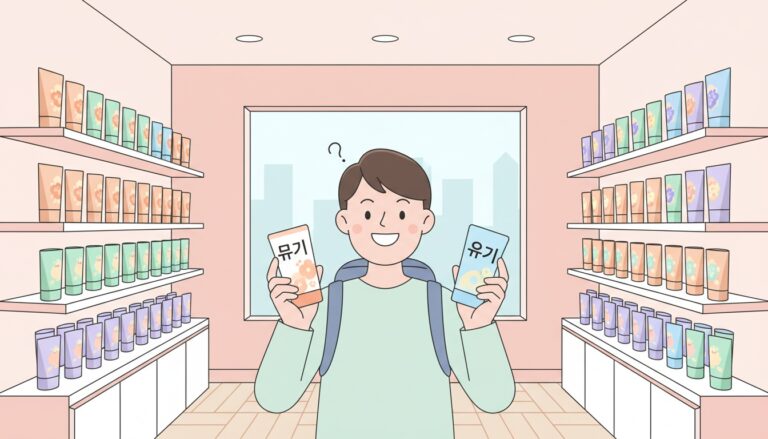
If you walk into an Olive Young (Korea’s ubiquitous beauty store) and just ask for “sunscreen,” the clerk will fire back a question that might freeze you: “Mugi or Yugi?”
If you don’t know the answer, you might end up looking like a Kabuki actor (white face) or crying tears of pain because your eyes are stinging. Today, we decode the K-Beauty sunscreen matrix so you can shop like a local pro.
Phase 2: The Holy Trinity of K-Sunscreen 🧴
Here are the three terms you absolutely must know to navigate the skincare aisle.
1. 무기자차 (Mugi-jacha)
- Pronunciation: [Mugi-jacha]
(Think of ‘Moo’ like a cow, ‘Gi’ like ‘Key’ but softer. ‘Ja-cha’ sounds like ‘Cha-cha’ dance.)- Meaning: Physical (Mineral) Sunscreen
- Context: It stands for Mugi Jabaeun Chadanje (Inorganic UV Blocker). It forms a physical shield on your skin.
- K-Culture Moment: Remember the lifeguards in Korean variety shows with white noses? That’s extreme 무기자차.
- Editor’s Insight: Think of 무기 (Mugi) as a Weapon (Mugi means weapon in Korean). It fights the sun physically! It’s great for sensitive skin but can be thick.
- Situation Spectrum:
[🚫 Formal meetings if you apply too much] ———— [✅ Beach/Hiking]- 🤔 Think About It: Why do Koreans prefer specific terms like “Inorganic/Organic” instead of just “Chemical/Physical”? It reflects a chemistry-based approach to beauty education here.
2. 유기자차 (Yugi-jacha)
- Pronunciation: [Yugi-jacha]
(Similar to above, but starts with ‘Yoo’.)- Meaning: Chemical Sunscreen
- Context: Short for Yugi Jabaeun Chadanje (Organic UV Blocker). It absorbs UV rays and turns them into heat.
- Editor’s Insight: These are popular because they apply like a lotion. No white cast! But, they can cause 눈 시림 (eye stinging) for some people.
- Situation Spectrum:
[✅ Daily Wear] ———— [✅ Under Makeup]3. 백탁 (Baektak)
- Pronunciation: [Baek-tak]
(Sounds sharp. ‘Baek’ means white.)- Meaning: White Cast
- K-Drama Moment: The comedy scene where a guy tries to look handsome for a date but applies too much sunscreen and looks like a ghost. That is 백탁.
- Editor’s Insight: This is the #1 enemy of many K-beauty fans. You will often see labels saying “백탁 없는 (No white cast).”
- 🤔 Think About It: In the West, tanning is often seen as healthy. In Korea, “white jade skin” is the ideal. How does this cultural preference change the way products are made?
Phase 3: Textbook vs. Real Life (Olive Young Edition) 💄
| Situation | 📖 Textbook Korean | 🗣️ Real Korean (Olive Young) | 💡 Why the difference? |
|---|---|---|---|
| Asking for recommendation | 자외선 차단제 추천해 주세요. (Please recommend a UV blocker.) | 이거 백탁 있어요? (Does this have a white cast?) | We care more about the finish (look) than just the function. |
| Checking irritation | 피부에 자극이 있나요? (Is there skin irritation?) | 눈 시림 없어요? (Does it not sting eyes?) | “Eye stinging” is the most common complaint for modern chemical sunscreens. |
| Asking for Physical type | 무기 자외선 차단제 있나요? | 무기자차 찾고 있어요. (Looking for Mugi-jacha.) | Koreans love abbreviating long technical terms for efficiency. |
💡 Editor’s Note: At a B2 level, don’t just ask for “sun cream.” Specify your skin type: “지성 (Oily)” or “건성 (Dry)” to get the best respect from the staff.
Phase 4: Cultural Context — The “Glass Skin” Standard ✨
4-1. The Art of “Patting” (Tok-Tok)
Have you noticed in K-Dramas or reality shows like Single’s Inferno, people don’t rub their face aggressively? When applying sunscreen, especially 무기자차, you must tap it (톡톡 두드리다) into your skin. Rubbing causes streaks (white cast). If you rub hard, a Korean friend might look at you with horror, fearing you are creating wrinkles!
4-2. The “Tone-Up” (톤업) Phenomenon
Sometimes, the white cast is intentional! It’s called 톤업 (Tone-up). Many Koreans, including men, buy sunscreens that slightly brighten their face to look cleaner and fresher. If a product says “Tone-Up Sun Cream,” it’s essentially sunscreen + mild makeup foundation.
Phase 5: Roleplay — Surviving Olive Young 🏪
Setting: It’s a busy Saturday afternoon at Olive Young in Hongdae. K-Pop is blasting. You are standing in front of a wall of 50 different sunscreens.
Characters:
* YOU: A smart shopper looking for a daily sunscreen.
* Staff (Jiwon): Helpful, fast-talking, wearing a headset.
Dialogue:
Jiwon: 찾으시는 거 있으세요? (Do you have something you are looking for?)
(Chajeusineun geo isseuseyo?)
YOU: 네, 선크림 좀 보려구요. 끈적이는 거 싫어요.
(Yes, I’m looking at sun creams. I hate sticky things.)
(Ne, seonkeurim jom boryeogyuyo. Kkeunjeogineun geo sireoyo.)
Jiwon: 아, 그럼 유기자차 쪽이 발림성이 좋아요. 이 제품 어때요?
(Ah, then chemical sunscreens have better spreadability. How about this product?)
(Ah, geureom yugijacha jjogi ballimseong-i joayo. I jepum eottaeyo?)
YOU: 음… 제가 눈이 좀 예민해서요.
(Hmm… My eyes are a bit sensitive.)
(Eum… jega nuni jom yeminhaeseoyo.)
🔀 Decision Point! How do you respond?
A) “그럼 무기자차로 보여주세요.” (Then please show me physical sunscreens.)
B) “그냥 아무거나 주세요.” (Just give me anything.)
C) “백탁은 괜찮아요!” (White cast is okay!)✅ Best Choice: A. If you have sensitive eyes, 무기자차 is the safest bet, even if it’s a bit thicker.
⚠️ Choice C Analysis: Saying white cast is okay implies you might want a tone-up effect, but it doesn’t solve the eye stinging issue!
Phase 6: 10-Second Shadowing Drill 🗣️
Practice this sentence to ensure you don’t buy a ghost-maker.
“Is this a physical sunscreen? Does it have a white cast?”
🇰🇷 이거 / 무기자차예요? / 백탁 / 심해요?
🔊 (Igeo / mugijacha-yeyo? / Baektak / simhaeyo?)Emotion Guide:
😟 Worried: asking “Baektak simhaeyo?” (Is the white cast severe?) because you don’t want to look pale.
Phase 7: K-Culture Mini Glossary 📖
| Korean | Romanization | Meaning | Context |
|---|---|---|---|
| 1+1 | Won-ppeul-won | Buy 1 Get 1 Free | The magic words of Korean shopping. Never buy full price! |
| 끈적임 | Kkeunjeogim | Stickiness | The texture everyone hates in Korean summer. |
| 발림성 | Ballimseong | Spreadability | How smoothly a product glides on the skin. |
| 혼합자차 | Honhap-jacha | Hybrid Sunscreen | A mix of Physical + Chemical. Best of both worlds? |
Phase 8: Traveler’s Survival Kit 🧳
Visiting Korea in summer? Here is your Sun-Survival guide.
🆘 Survival Expression #1
– 🇰🇷 “테스터 써봐도 돼요?” (Teseuteo sseobwado dwaeyo?)
– 🗣️ Meaning: “Can I try the tester?”
– 📍 Where: Olive Young, Chicor, Duty-Free
– 💡 Pro Tip: Don’t put the tester directly on your face! Put it on the back of your hand (son-deung) and smell it/check the texture.📌 Editor’s Travel Note
– SPF vs PA: In Korea, you will see PA++++. The ‘+’ indicates protection against UVA (Aging). The more pluses, the better protection against wrinkles!
– Sun Stick: Travelers love 선스틱 (Sun sticks). They are solid bars you swipe on. Great for reapplying over makeup without touching your face with dirty hands.
Phase 9: Think Deeper — “The White Jade Skin” 🧠
Beauty Standards & Class History:
Why is pale skin so prized in Korea? Historically, tanned skin indicated outdoor labor (farming), while pale skin indicated the nobility (Yangban class) who studied indoors. Today, this has evolved into a preference for “clear” and “clean” skin.
However, this is changing slightly with the influence of Western body-building culture, where “body profile” pictures with tanned skin are becoming trendy among the younger generation.
💬 Your Turn: Does your culture prefer tanned skin or pale skin? How does that affect the sunscreen products sold in your country?
Phase 10: FAQ & Troubleshooting 🛠️
Q: I’m a guy. Can I wear these?
A: Absolutely. Look for “For Men” (포맨) or “Lotion type” (로션 타입). These usually have zero white cast and a matte finish so you don’t look shiny.
Q: Can I just use my body sunscreen on my face?
A: You can, but Korean face sunscreens are cosmectically elegant. Body sunscreens might be too oily and cause breakouts (trouble).
❌ Common Mistake: Applying sunscreen only once in the morning.
✅ Fix: Korean packaging usually advises “3-4시간마다 덧바르세요” (Reapply every 3-4 hours). That’s why Sun Cushions (compacts) are so popular—for easy touch-ups!
Phase 11: Wrap-up & Missions 🎁
Summary: Today we learned the difference between Mugi-jacha (Shield/Physical) and Yugi-jacha (Absorb/Chemical) to avoid the dreaded Baektak (White cast).
🚀 Action Missions:
– 🥉 Bronze: Say “Mugi-jacha, Yugi-jacha” 5 times fast to get the rhythm.
– 🥈 Silver: Check your current sunscreen bottle. Look at the ingredients. Is it Mugi (Zinc/Titanium) or Yugi (Avobenzone/etc)?
– 🥇 Gold: Go to a Korean beauty store (or website like Olive Young Global) and find a product that says “Tone-Up.” Read the reviews to see if people mention “Baektak.”
K-Culture Mission: Watch a “Get Ready With Me” (GRWM) video of a K-Pop idol. Watch closely at the end of their skincare routine—do they use a stick, a cream, or a cushion for sun protection?
Phase 12: Quiz — Are You a K-Beauty Pro? 📝
- Situation: You are going on a blind date and want to look natural, NOT like a ghost. Which phrase should you look for on the bottle?
- A) 백탁 있는 (With white cast)
- B) 백탁 없는 (Without white cast)
- C) 강력한 차단 (Strong protection)
- Culture: True or False? In Korea, rubbing sunscreen hard onto your face is considered the best way to absorb it.
- (T / F)
- Vocab: What is the Korean word for “Eye Stinging”?
- [ ]
Answers:
1. B) We want NO ghost vibes today!
2. False. Tap, tap, tap! (Tok-tok). Rubbing ruins the film and causes wrinkles.
3. 눈 시림 (Nun sirim).
See you next time, and keep glowing (but not from grease)! ✨
Frequently Asked Questions (FAQ)
Q: What does "무기자차 (Mugi-jacha)" mean in Korean and how do you pronounce it?
A: In Korean, "무기자차 (Mugi-jacha)" is pronounced [Mugi-jacha] and means: Physical (Mineral) Sunscreen
Q: What does "유기자차 (Yugi-jacha)" mean in Korean and how do you pronounce it?
A: In Korean, "유기자차 (Yugi-jacha)" is pronounced [Yugi-jacha] and means: Chemical Sunscreen
Q: What does "백탁 (Baektak)" mean in Korean and how do you pronounce it?
A: In Korean, "백탁 (Baektak)" is pronounced [Baek-tak] and means: White Cast







