

Phase 1: The Warmest Welcome in a Korean Winter
Hello! Editor at Daily Hangul here.
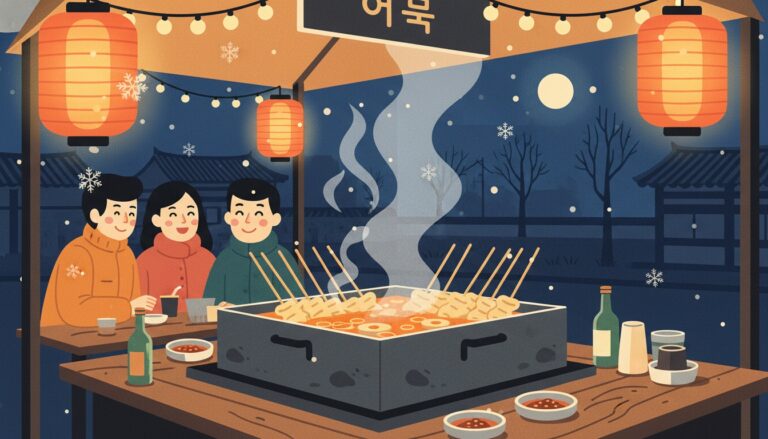
Imagine this: It’s minus 10 degrees in Seoul. Your face is freezing, your hands are numb, and you spot a glowing orange tent on the street corner—a Pojangmacha. You rush in and grab a skewer of Eomuk (fish cake). You finish the hot, savory broth in your paper cup in about three seconds. It’s heaven.
But now, your cup is empty. You want more. The ajumma (auntie/vendor) is busy counting cash. You make eye contact, hold out your cup, and… freeze.
How do you ask for more without sounding greedy or rude?
In K-Dramas, characters just boldly shout to the owner, or sometimes the owner silently pours more soup as a gesture of comfort to a crying protagonist. Real life isn’t always that dramatic, but getting that second (or third) cup of broth is a crucial survival skill in a Korean winter. Today, we’re going to fix your “empty cup anxiety.”
Phase 2: Deep Dive into the “Refill” Request
Here is the magic phrase that unlocks unlimited warmth.
1. 국물 좀 더 주세요 (Gungmul jom deo juseyo)
- Pronunciation: [Gung-mul jom deo ju-se-yo]
Tip: ‘Gung’ sounds like ‘lung’ with a G. ‘Jom’ rhymes with ‘home’.- Meaning: “Please give me a little more broth.”
- Real Nuance: Literal translation is straightforward, but the magic word here is 좀 (jom). It literally means “a little,” but in requests, it acts as a softener, like “would you mind?” or “please.” Without it, you might sound like you’re demanding soup.
- K-Culture Moment: You’ll hear this everywhere from street stalls to K-BBQ restaurants (asking for more lettuce). It’s the universal “more, please” phrase.
- Editor’s Insight: Don’t worry about the quantity. Even if you say “give me a little (jom),” Korean vendors often fill it to the brim. It’s part of the culture of Jeong (affection).
Situation Spectrum:
[🚫 Formal Biz Meeting] ———— [⚠️ Senior Boss] ———— [✅ Street Vendor/Restaurant]🤔 Think About It: Why do Koreans use “a little” (jom) even when they want a lot? It’s a linguistic strategy to reduce the burden on the listener. Does your language have “softeners” like this?
Phase 3: Textbook vs. Real Life
Let’s be real. Nobody speaks like a textbook at a street stall.
| Situation | 📖 Textbook Korean | 🗣️ Real Korean | 💡 Why the difference? |
|---|---|---|---|
| Asking for more soup | 국물을 더 주십시오. (Gungmuleul deo jusipsio) | 국물 좀 더 주세요~ (Gungmul jom deo juseyo) | The textbook version sounds like a soldier reporting to a commander. The real version is friendly and polite. |
| Self-Service situation | 제가 직접 가져가도 됩니까? (Jega jikjeop gajeogado doemnikka?) | 사장님, 이거 셀프예요? (Sajangnim, igeo sel-peu-yeyo?) | “Self” (Konglish for self-service) is the standard keyword in Korean dining. Efficient and clear. |
Bottom Note: At a busy Pojangmacha, verbal communication is often secondary. Holding out your empty cup slightly toward the owner while making eye contact often does the job without a single word!
Phase 4: Cultural Deep Dive — The Rule of the Ladle
4-1. The “Self” Culture
In many Korean eateries and street stalls, you will see a sign that says “물은 셀프” (Water is self-service). At an Eomuk stall, this often applies to the broth too.
- The Vibe Check: Look for a stack of paper cups and a ladle near the broth container. If other customers are scooping their own soup, do not ask the owner. Just do it yourself! Asking in a clearly self-service spot marks you as a confused tourist instantly.
- Hygiene Alert: NEVER sip from the cup and then use the communal ladle to refill it. That is a major social taboo. If you want a refill, hold your cup away from the pot and pour the broth from the ladle into your cup.
4-2. K-Drama Connection: The “Soju” Companion
In dramas, you often see characters drinking broth after a shot of Soju. The hot, salty broth cuts the bitterness of the alcohol. If you are drinking Soju at a stall, the broth is usually free and unlimited (an Anju that never ends). If the owner stops giving you broth, it might be a sign you’ve had enough to drink!
Phase 5: Immersive Roleplay
Setting: It’s 11 PM near Hongdae Station. A steamy food truck. You are standing with Minji (your Korean friend).
Minji: 아, 춥다. 오뎅 국물 진짜 맛있다, 그치? 🍢
(Ah, chupda. Odeng gungmul jinjja masitda, geuchi?)
(Ah, it’s cold. The fish cake broth is delicious, right?)
YOU (Select your response):
- A) “응, 더 먹고 싶어. 국물 리필!” (Eung, deo meokgo sipeo. Gungmul ri-pil!)
- B) “응. 근데 다 마셨어. 사장님, 국물 좀 더 주세요~” (Eung. Geunde da masyeosseo. Sajangnim, gungmul jom deo juseyo~)
- C) (Silently hold the cup out to Minji)
🔀 Decision Analysis:
* Choice A: “Refill” is understood, but shouting it like a command is a bit abrupt.
* ✅ Choice B: Perfect. You acknowledge the situation to your friend and then politely ask the vendor using the magic phrase.
* Choice C: Also valid if you are very close with Minji! In Korea, friends often take care of each other’s refills.
Vendor (Sajangnim): 아이고, 여기 있어요. 뜨거우니까 조심해요.
(Aigo, yeogi isseoyo. Tteugeounikka josimhaeyo.)
(Oh my, here you go. It’s hot, so be careful.)
Phase 6: 10-Second Shadowing Drill
Practice this until it rolls off your tongue. The intonation should be pleading but bright.
- Situation: You are handing over your empty cup.
- Emotion: 😊 Friendly & Slightly Apologetic
사장님, / 국물 좀 / 더 주세요~
(Sa-jang-nim, / gung-mul jom / deo ju-se-yo~)
Phase 7: K-Culture Mini Glossary
| Korean | Romanization | English | Context |
|---|---|---|---|
| 어묵 (오뎅) | Eomuk (Odeng) | Fish Cake | The winter snack MVP. ‘Odeng’ is from Japanese, but widely used. |
| 국물 | Gungmul | Broth/Soup | The liquid soul of Korean cuisine. |
| 서비스 | Seobisu | Service (Freebie) | Anything given for free. Broth is almost always ‘service’. |
| 셀프 | Sel-peu | Self-Service | Means “Do it yourself.” |
Phase 8: Traveler’s Survival Kit
You are at a street stall. Here are three phrases you need aside from the refill.
🆘 Survival Expression #1
* 🇰🇷 “이거 얼마예요?” (Igeo eolmayeyo?)
* Meaning: “How much is this?”
* 💡 Pro Tip: Eomuk skewers are usually color-coded by price at the end of the stick! Check the colored tape.🆘 Survival Expression #2
* 🇰🇷 “간장 찍어도 돼요?” (Ganjang jjigeodo dwaeyo?)
* Meaning: “Can I dip this in soy sauce?”
* 💡 Crucial Etiquette: NO double-dipping. Most stalls now have spray bottles or brushes for hygiene. Use those instead of dipping your bitten food into the communal bowl.📌 Editor’s Travel Note:
Most street stalls prefer cash. Always carry a few 1,000 won bills. Some accept bank transfers (Kakao Pay), but cash is king for that speedy exit.
Phase 9: Think Deeper — Why is the Soup Free?
Food & Identity:
In many Western cultures, soup is a menu item you pay for. In Korea, gungmul (broth) accompanying a meal is often considered a basic right, like water or air. This stems from the Korean communal dining history where boiling a large pot of soup was the most efficient way to share limited ingredients with many people. The broth represents the “warmth” of the provider. Charging for a simple anchovy broth at a street stall would feel… heartless (jeong-eopda) to most Koreans. It’s a fascinating look at how “generosity” is codified into culinary expectations.
💬 Your Turn: Is there any food or drink that is surprisingly free (or surprisingly expensive) in your culture?
Phase 10: FAQ & Troubleshooting
- Q: Can I just scoop the soup with my cup from the big pot?
- NO! 🛑 Absolute forbidden move. Your hand/cup touches the broth everyone eats. Always use the designated ladle.
- Q: Is there a limit to how many refills I can get?
- Technically no, but socially, yes. If you buy one skewer (1,000 KRW) and drink 10 cups of soup, you will get the “stink eye” (nun-chi). A good rule of thumb: 1 skewer = 2-3 cups max.
- Q: Can I take the broth to-go?
- Sometimes. If you are packing food to take home, you can ask “국물도 좀 포장해 주세요” (Please pack some broth too). They usually bag it up for you!
Phase 11: Wrap-up & Mission
One-Liner Summary: asking for more broth is about reading the room—if there’s a ladle, do it yourself; if not, use “Jom deo juseyo” with a smile.
🚀 Action Missions:
* 🥉 Bronze: Say “Gungmul jom deo juseyo” out loud 3 times right now.
* 🥈 Silver: Watch a YouTube video of a Korean street food tour and spot the ladle.
* 🥇 Gold: Go to a Korean restaurant or street stall, and successfully get a refill using Korean!
Phase 12: Quiz — Street Smart Check
Situation: You see a sign that says “물, 오뎅 국물은 셀프입니다.”
1. What should you do?
* A) Shout “Sajangnim!” loudly.
* B) Wait for the owner to serve you.
* C) Find the ladle and cups, and serve yourself.
* D) Dip your skewer into the broth pot to stir it.
Answer: C) ‘Self’ means self-service. (D is a hygiene crime!)
2. True or False?
* “It is okay to double-dip your Eomuk in the communal soy sauce bowl.”
Answer: False. Use the brush or spray bottle provided!
Frequently Asked Questions (FAQ)
Q: What does "국물 좀 더 주세요 (Gungmul jom deo juseyo)" mean in Korean and how do you pronounce it?
A: In Korean, "국물 좀 더 주세요 (Gungmul jom deo juseyo)" is pronounced [Gung-mul jom deo ju-se-yo] and means: "Please give me a little more broth."







