

Phase 1: The Invisible Script (Immersive Hook)
Hi there, Daily Hangul editor here.
Let’s be real for a second. You’re watching a K-Drama—let’s say My Liberation Notes or Misaeng. The characters aren’t saying much. They’re just sitting at a dinner table, pouring drinks, looking slightly uncomfortable. Suddenly, the youngest one turns their head away to drink. The subtitles say nothing about why.
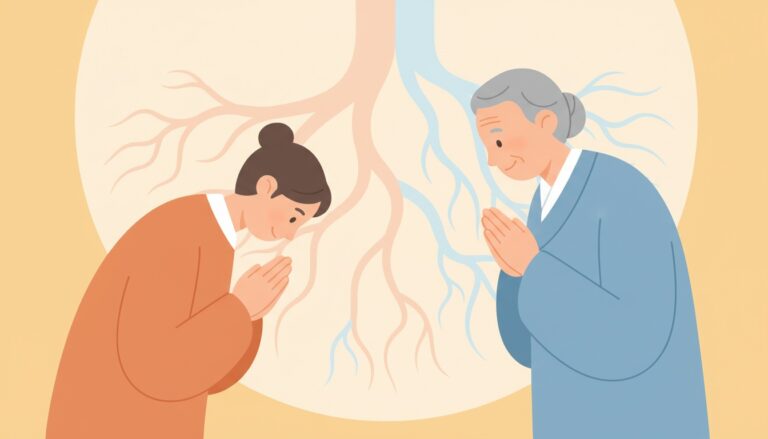
Or maybe you’re at a pocha (street stall) in Mapo-gu. You bump into someone. Instead of a quick “sorry,” you bow. They bow. You bow lower. They bow lower. It’s a polite-off.
Why? Because in Korea, you aren’t just speaking a language; you are navigating a 2,000-year-old web of Confucian hierarchy, Buddhist karma, and Taoist flow.
If you treat Korean like a simple code swap from English—ignoring these philosophical roots—you will sound like a robot. Worse, you might unintentionally insult someone’s grandmother. Today, we aren’t just learning words; we’re learning the operating system of the Korean mind.
Phase 2: Deep Dive into the Korean Soul
Here are three concepts that dictate 90% of human interaction in Korea. If you master the nuance here, you hit C1 level immediately.
1. 체면 (Chemyon) — The Art of Saving Face
- Pronunciation: [Che-myeon] (Sounds like ‘Che’ in ‘Check’ + ‘myeon’ like ‘neon’ with an m)
- Meaning: Literally “face.” It refers to one’s dignity, reputation, and social standing.
- K-Culture Moment: In Squid Game, despite being in massive debt, the characters often try to hide their financial ruin from family. That isn’t just lying; it’s preserving Chemyon.
- Editor’s Insight: You know when a Korean friend insists on paying the bill even though you know they’re broke? That’s Chemyon. It’s not about money; it’s about maintaining their role as a provider or a senior. Stripping someone of their Chemyon (embarrassing them in public) is a social death sentence.
- Situation Spectrum:
[🚫 Casual/Self-deprecation] ———— [⚠️ Be Careful] ———— [✅ Essential]
- Protecting a boss’s mistake: ✅
- Admitting a minor fault to friends: 🚫 (You can drop it here)
- 🤔 Think About It: Why is “publicly pointing out a mistake” considered helpful in some Western cultures but deeply offensive in Korea?
2. 눈치 (Nunchi) — The Confucian Radar
- Pronunciation: [Nun-chi] (Nun as in ‘noon’, chi as in ‘cheese’)
- Meaning: The subtle art of gauging the mood and responding appropriately without being told.
- K-Culture Moment: In every idol variety show, the Maknae (youngest) rushes to get water or cushions before the older members even ask. That is top-tier Nunchi.
- Editor’s Insight: Dictionaries call this “wits,” but that’s weak. It’s high-speed emotional intelligence required for social harmony. If everyone has Nunchi, the group moves like a single organism. If you don’t have it, you are “눈치 없다” (Nunchi-eopda) — clueless.
- Situation Spectrum:
[🚫 Optional] ———— [⚠️ Good to have] ———— [✅ Survival Skill]
- Family dinner: ✅
- Business meeting: ✅ (Crucial)
- Alone at home: 🚫
- 🤔 Think About It: Is Nunchi a form of empathy, or is it a survival mechanism to avoid conflict with authority?
3. 인연 (Inyeon) — The Buddhist Thread
- Pronunciation: [In-yeon]
- Meaning: Destiny, fate, relationship, or the tie that binds two people.
- K-Culture Moment: The movie Past Lives basically built its entire plot on this word. Even brushing sleeves with a stranger is said to be Inyeon from a past life.
- Editor’s Insight: Koreans use this to explain why things happen—or don’t happen. Met a great business partner? “좋은 인연입니다” (It’s a good connection). Break up with someone? “인연이 아니었나 봐” (I guess it wasn’t our destiny). It takes the blame off the individual and places it on the universe.
- Situation Spectrum:
[🚫 Business Contracts] ———— [⚠️ Casual Dating] ———— [✅ Deep Talk]
- Romantic rejection: ✅
- Explaining a lucky meeting: ✅
- 🤔 Think About It: How does believing in Inyeon change how you handle a breakup compared to a Western “move on” mentality?
Phase 3: Textbook vs. Real Life (The Philosophical Filter)
| Situation | 📖 Textbook Korean | 🗣️ Real Korean (Philosophy Mode) | 💡 Why the difference? |
|---|---|---|---|
| Refusing a drink | 아니요, 괜찮습니다. (No, I’m fine.) | (Takes the glass, touches it to lips, puts it down) | Confucianism: Direct refusal hurts the giver’s Chemyon. You accept the gesture, even if you don’t drink. |
| Asking for a favor | 저 좀 도와주세요. (Please help me.) | 혹시 시간 괜찮으실 때… (If by chance your time is okay…) | Nunchi: You must acknowledge you are burdening them. Indirectness shows respect. |
| Meeting a Senior | 안녕하세요? (Hello?) | 식사 하셨습니까? (Have you eaten?) | Confucian Care: Historically, food was scarce. Asking about meals is the ultimate form of caring for a superior’s well-being. |
Editor’s Note: At C1 level, fluency isn’t about grammar speed; it’s about how well you soften the blow of your words using these indirect methods.
Phase 4: Cultural Deep Dive — Hierarchy & Harmony
4-1. The “Eye” Contact (Non-verbal)
In the West, looking someone in the eye is a sign of honesty. In a strict Confucian setting (like with a strict boss or grandfather), prolonged eye contact can be seen as a challenge (기싸움 – battle of energy).
* Pro Tip: Look at their nose or chin, or lower your gaze slightly when listening. It signals, “I am listening, and I accept your authority.”
4-2. K-Drama Connection: The “Kneeling” Scene
We’ve all seen it. The wealthy CEO’s son kneels before his father. Or a politician kneels before the public.
* Why? This is the ultimate restoration of Chemyon and order. In Confucianism, admitting a fault requires a physical lowering of the body to restore the social balance. It’s dramatic, yes, but it communicates, “I am putting my ego beneath your feet.”
Phase 5: Immersive Roleplay — The Office Apology
Setting: A meeting room in Gwanghwamun. You (a foreign manager) accidentally pointed out a mistake made by Director Kim (50s, traditional) in front of the whole team. The air is icy. You meet him afterward to fix it.
Characters:
* You: C1 Korean learner, trying to navigate office politics.
* Director Kim: Prideful, values hierarchy, currently hurt.
(Dialogue)
Director Kim: (Staring out the window) 아까 회의 때… 할 말이 많았나 봅니다.
(Akka hoe-ui ttae… hal mari mananna bomnida.)
(English) You seemed to have a lot to say during the meeting earlier.
(Stage Direction: His back is turned to you. Bad sign.)
You: 부장님, 제가 생각이 짧았습니다.
(Bujangnim, jega saenggagi jjarbaseumnida.)
(English) Director, my thoughts were short (I was thoughtless).
(Note: This is a classic idiom for admitting lack of wisdom without admitting specific guilt.)
Director Kim: 우리 팀 분위기가 좀… 그렇네요.
(Uri tim bunwigiga jom… geureonneyo.)
(English) Our team atmosphere is a bit… you know.
🔀 Decision Point! How do you save his Chemyon?
A) “네, 제가 다음부터는 조심하겠습니다.” (Yes, I will be careful next time.)
B) “부장님 말씀이 맞습니다. 제가 아직 한국 문화가 서툴러서 실수를 했습니다.” (You are right. I am still clumsy with Korean culture, so I made a mistake.)
C) “하지만 그 숫자는 틀렸잖아요.” (But those numbers were wrong.)
✅ Best Choice: B
* Why: You validate his authority (“You are right”) and blame your own cultural ignorance (lowering yourself). This instantly restores his Chemyon while excusing your behavior. He can now “forgive” you as a mentor.
* A is okay, but a bit generic.
* C is a death wish. You are choosing facts over the relationship. In Confucian ethics, the Relationship often trumps the raw Fact.
Phase 6: 10-Second Shadowing Drill
Let’s practice the art of “lowering yourself” to raise the other person.
🙇♂️ Apologizing with dignity
제가 / 미처 / 거기까지는 / 생각하지 못했습니다.
(Je-ga / mi-cheo / geo-gi-kka-ji-neun / saeng-gak-ha-ji mo-taet-seum-ni-da.)
Meaning: I / didn’t / quite manage to think / that far.
Emotion: Humble, regretful, but professional. Stress the “Je-ga” (I) to take responsibility.
Phase 7: K-Culture Mini Glossary
| Korean | Rom. | English | Context |
|---|---|---|---|
| 효 | Hyo | Filial Piety | The absolute duty to parents. Explains why idols buy houses for parents first. |
| 한 | Han | Resentment/Sorrow | A uniquely Korean collective grief/injustice. Often the fuel for K-Drama revenge plots. |
| 정 | Jeong | Deep Bond | More than love. It’s the sticky attachment formed by time, shared suffering, and loyalty. Even enemies can have Jeong. |
| 상명하복 | Sangmyeong-habok | Obedience | “Orders from above, obedience from below.” The military/corporate mindset. |
Phase 8: Traveler’s Survival Kit (Social Edition)
Even as a traveler, you will interact with elders or people in service roles. Applying a bit of philosophy makes you a VIP guest.
🆘 Survival Expression: The “Age Check” Maneuver
Koreans need to know your age to establish the Confucian hierarchy. But asking “How old are you?” is blunt.Use this instead:
🇰🇷 “실례지만, 춘추가 어떻게 되십니까?” (Sil-lye-ji-man, chun-chu-ga eo-tteo-ke doe-sim-ni-kka?)
– Literal: Excuse me, how are your springs and autumns?
– Target: Only for clearly elderly people (60+).
– Effect: This is super high-level honorifics. You will see their face light up instantly.For people roughly your age:
🇰🇷 “혹시 나이 여쭤봐도 될까요?” (Hoksi nai yeojjwobwado doelkkayo?)
– Pro Tip: Always act surprised and say they look younger (“동안이시네요!”). It’s the law.
Phase 9: Think Deeper — Language & Power
Why does Korean grammar change based on who is in the room?
In English, “I eat lunch” is the same whether you talk to a toddler or the President. In Korean, the verb ending, the specific word for “eat” (먹다 vs 드시다 vs 잡수시다), and even the word for “I” (나 vs 저) changes.
This isn’t just grammar; it is Confucianism encoded into the tongue. The language forces you to constantly calculate your social coordinates relative to everyone else. You cannot speak a sentence without defining your place in the hierarchy.
🧠 Think Deeper: Does this constant hierarchy make it harder to be innovative or question authority in Korea? Or does it create a safer, more predictable society where everyone knows their role?
Phase 10: FAQ & Troubleshooting
Q: Can I just ignore these rules because I’m a foreigner?
A: Yes, you get the “Foreigner Card.” Koreans are generally lenient. BUT, if you are at C1 level and speak fluently, the expectations rise. If your grammar is perfect but your attitude is rude (lacking Nunchi), it’s more jarring than if you spoke broken Korean.
Q: Why do Koreans ask for my blood type or MBTI so fast?
A: It connects to the desire for Inyeon (connection) and predictability. They want to categorize you quickly to know how to fit you into the group dynamic. It’s a shortcut to harmony.
❌ Common Mistake: Pouring your own drink at a dinner.
✅ Fix: In Confucian culture, pouring for yourself implies your neighbor is neglecting you. Wait for someone to pour for you, and you pour for them. It’s a reciprocal bond.
Phase 11: Wrap-up
Bottom Line: Korean isn’t just a tool for information transfer; it’s a tool for relationship management. Chemyon, Nunchi, and Inyeon are the keys to that management.
Action Mission:
– 🥉 Bronze: Watch a K-Drama scene and identify who has the highest rank just by looking at who bows lower or pours drinks.
– 🥈 Silver: In your next Korean conversation, use “제가 생각이 짧았습니다” instead of a simple “미안해요” when you make a mistake.
– 🥇 Gold: Go to a Korean restaurant. When the server brings side dishes, bow your head slightly and say “감사합니다” with genuine eye contact (but not staring!). See if they give you extra service (Seobisu)!
Phase 12: Quiz — The Nunchi Test
Situation: You are at a team dinner. The boss makes a joke. It is not funny. It is actually quite boring. What do you do?
- Stare at your phone.
- Smile politely and continue eating.
- Laugh loudly and clap your hands.
- Tell him the joke is outdated.
Correct Answer: 3 (or at least a very enthusiastic version of 2).
Reasoning: Remember Chemyon. Your job isn’t to be a comedy critic; your job is to support the boss’s face in front of the team. A “water-seal” clap (mulg ae-gae) is the ultimate sign of good social life skill (Sahoe-saenghwal)!
Frequently Asked Questions (FAQ)
Q: What does "체면 (Chemyon) — The Art of Saving Face" mean in Korean and how do you pronounce it?
A: In Korean, "체면 (Chemyon) — The Art of Saving Face" is pronounced [Che-myeon] and means: Literally "face." It refers to one's dignity, reputation, and social standing.
Q: What does "눈치 (Nunchi) — The Confucian Radar" mean in Korean and how do you pronounce it?
A: In Korean, "눈치 (Nunchi) — The Confucian Radar" is pronounced [Nun-chi] and means: The subtle art of gauging the mood and responding appropriately without being told.
Q: What does "인연 (Inyeon) — The Buddhist Thread" mean in Korean and how do you pronounce it?
A: In Korean, "인연 (Inyeon) — The Buddhist Thread" is pronounced [In-yeon] and means: Destiny, fate, relationship, or the tie that binds two people.







