

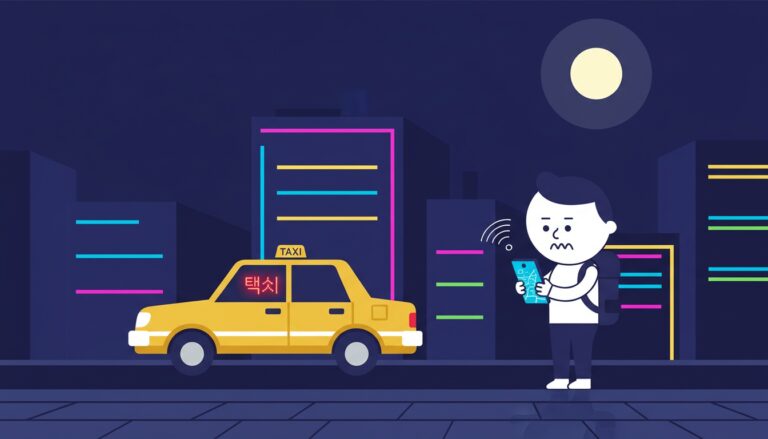
Phase 1: The “Taxi War” Realization
Hello! I’m your editor at Daily Hangul.
Let’s set the scene. It’s 1 AM on a Saturday. You are in Hongdae or Gangnam. The K-Pop music has stopped ringing in your ears, you’ve had enough Soju, and your legs are tired. You see a line of taxis. You wave your hand confidently, just like the main character in a K-Drama.
But the taxis just zoom past you. One stops, the driver rolls down the window, you say your destination, and he shakes his head and drives off.
Panic sets in. “Am I going to sleep on the street?”
If this sounds like a nightmare, don’t worry. This is the infamous Seoul “Taxi War” (택시 전쟁). In K-Dramas, the handsome lead always gets a cab instantly. In real life? You need strategy. Today, I’ll teach you how to read the glowing signs on the taxi and the one phrase that explains your frustration.
Phase 2: Decoding the Glowing Signs (Deep Dive)
Before we speak, we must read. At night, Korean taxis have glowing LED signs in the windshield. If you don’t know these two words, you will wave at the wrong cars all night.
1. 빈차 (Bin-cha)
- Pronunciation: [Bin-cha]
- Meaning: Empty Car (Available)
- Sound Analogy: Bin sounds like “Bean”; Cha sounds like “Cha-cha-cha.”
- Editor’s Insight: This is the Holy Grail. The light is usually RED. Yes, in many countries red means “stop” or “occupied,” but in Korea, RED means available.
- Situation Spectrum:
[Ignore] ———— [Look for this!] ———— [Run to it]
Result: 🏃 Run to it!
2. 예약 (Ye-yak)
- Pronunciation: [Ye-yak]
- Meaning: Reserved (Booked)
- Sound Analogy: Ye as in “Yes”; Yak as in “Yak” (the animal).
- Editor’s Insight: The light is usually BLUE or GREEN. It looks inviting, but do not wave at this taxi. It is on its way to pick up someone else (probably someone who used an app).
- Situation Spectrum:
[Ignore] ———— [Wave] ———— [Run to it]
Result: 🚫 Ignore.
3. 택시가 안 잡혀요 (Taeksi-ga an jap-hyeoyo)
- Pronunciation: [Taek-si-ga an jap-hyeo-yo]
- Meaning: I can’t catch a taxi.
- Literal Meaning: The taxi is not being caught.
- K-Culture Moment: You will hear this constantly on Friday nights in nightlife districts. People on the phone with their friends complaining: “Ah, taeksi-ga an jap-hyeoyo! I might be late.”
- 🤔 Think About It: Why do we say “catch” (잡다) a taxi? It implies the taxi is a moving target—like hunting. In Seoul at 2 AM, it certainly feels like hunting.
Phase 3: Textbook vs. Real Life
| Situation | 📖 Textbook Korean | 🗣️ Real Korean | 💡 Why different? |
|---|---|---|---|
| Complaining to a friend | 택시를 이용할 수 없습니다. (I cannot use a taxi.) |
아, 택시 진짜 안 잡히네… (Ah, taxis are really not being caught…) |
“이용하다” is robotic. “안 잡혀” expresses the frustration of the hunt. |
| Asking a driver to stop | (Waving hand politely) | (Looking at phone app desperately) | Most taxis are booked via app now. Waving is “old school.” |
Phase 4: Cultural Context — The “Kakao T” Revolution
4-1. The App is King
Here is the hard truth: In major areas like Gangnam or Itaewon at night, waving your hand is almost useless.
Why? Because of Kakao T (Kakao Taxi).
Most drivers prefer accepting passengers via the app because they can see the destination before you get in. If you are going a short distance (less money) or a direction with bad traffic, they might ignore street hails. To survive the Korean night, downloading Kakao T is not optional; it’s essential.
4-2. Nunchi (Eye Measure) in a Taxi
If you do hail a taxi on the street:
– Don’t open the door yet. Lean in the window first.
– Say your destination. If the driver nods, then get in. If he locks the door or waves his hand “no,” don’t fight it. It’s illegal for them to refuse passengers, but at 2 AM, you don’t have time to argue the law. Just let him go and find the next Bin-cha.
Phase 5: Roleplay Scenario — “Stranded in Hongdae”
Setting: It is 2:30 AM in Hongdae. The streets are packed. You are tired.
Characters:
– YOU: Tourist who just wants to go to the hotel in Myeongdong.
– Minji: Your Korean friend.
Dialogue:
Minji: 와, 사람 진짜 많다. 택시 잡을 수 있을까?
(Wa, saram jinjja manta. Taeksi jabeul su isseulkka?)
(Wow, so many people. Can we catch a taxi?)
YOU: (Looking at the street)
_____________?
(Hint: Look at the LED signs!)
🔀 Your Turn! What do you say?
– A) “Look! That one says 예약 (Ye-yak)!”
– B) “Look! That one says 빈차 (Bin-cha)!”
– C) “I will call an Uber.”✅ Best Choice: B — “빈차” is the empty one! Run for it!
⚠️ Choice A Analysis: If you run to the “Ye-yak” taxi, the door will be locked. Embarrassing!
⚠️ Choice C Analysis: Uber exists in Korea (UT), but it calls regular taxis. It’s better to know the Korean terms first.
(Stage Direction: You spot a RED sign taxi and wave. It stops!)
Driver: 어디 가세요? (Where are you going?)
YOU: 명동역이요! (Myeongdong Station, please!)
Phase 6: 10-Second Shadowing Drill
Let’s practice the emotion. You are tired and annoyed.
Emotion: Frustrated 😤
택시가 / 너~무 / 안 잡혀요!
(Taeksi-ga / neo~mu / an jap-hyeoyo!)
Taxis / are soooo / hard to catch!
Emotion: Relieved (You found one!) 😭
저기 / 빈차 / 있다!
(Jeogi / bin-cha / itda!)
Over there / empty car / there is!
Phase 7: K-Culture Mini Glossary
| Korean | Romanization | Meaning | Context |
|---|---|---|---|
| 빈차 | Bin-cha | Empty Car | RED light. The one you want. |
| 예약 | Ye-yak | Reserved | BLUE/GREEN light. Already taken. |
| 할증 | Hal-jeung | Surcharge | From 10 PM or 11 PM to 4 AM, taxi fares are 20-40% more expensive. |
| 카카오택시 | Kakao Taeksi | Kakao Taxi | The app that rules Korean transportation. |
Phase 8: Traveler’s Survival Kit
If you can’t speak Korean well, visuals are your best friend.
🆘 Survival Card #1: Show this to the driver
🇰🇷 “여기 가 주세요.” (Yeogi ga juseyo)
🗣️ [Yeo-gi ga ju-se-yo]
📍 Meaning: “Please go here.”
💡 Pro Tip: Have the address open on Naver Map or Kakao Map in big text. Don’t show a tiny English address from Google Maps; many older drivers can’t read small English text well.📌 Editor’s Travel Note
– Red Light = Go, Green Light = No: This is the opposite of traffic lights. Remember: Red text on the windshield means the taxi is available.
Phase 9: Think Deeper — “Why is it so hard?”
The “Haljeung” (Surcharge) Psychology
Have you noticed taxis disappear at 9:50 PM and reappear at 10:05 PM? Or disappear before 11 PM? This is because of the Haljeung (night surcharge). Fares increase significantly late at night. Some drivers might take a break right before the surcharge time starts to maximize their profit later. It’s simple economics, but frustrating when you are cold!
💬 Your Turn: Does your country have a specific time when taxis become more expensive? Or is it based on demand (like Uber surge pricing)?
Phase 10: FAQ & Troubleshooting
Q: A taxi stopped, but he wants a “flat rate” (extra money) instead of using the meter. Is this okay?
A: Legally? No. Practically? It happens often in heavy party areas (Hongdae/Itaewon) to foreigners. If you are desperate and the price is okay (e.g., 30,000 won for a trip that is usually 20,000 won), some people just take it. But be aware: you are being overcharged. If you want to be safe, stick to the app.
❌ Common Mistake: Opening the taxi door yourself too aggressively.
✅ Fix: Most Korean taxis have automatic back doors, or the driver controls them. But often, you do need to pull the handle. Just don’t slam it! Also, never open the door on the street side (left side), always the sidewalk side (right side).
Phase 11: Wrap-up & Mission
One-Liner: Look for the RED light (빈차) to get home, and if that fails, say “택시가 안 잡혀요!”
Action Mission:
– 🥉 Bronze: Save the words “빈차” (Empty) and “예약” (Reserved) as a note in your phone.
– 🥈 Silver: Download the “Kakao T” app and set up your account before you actually need it.
– 🥇 Gold: Next time you are out, spot a taxi and identify if it is Bin-cha or Ye-yak before it passes you!
K-Culture Mission: Watch a scene from the drama Itaewon Class. Look at the nightlife streets. Can you spot the taxis in the background? What color are their signs?
Frequently Asked Questions (FAQ)
Q: What does "빈차 (Bin-cha)" mean in Korean and how do you pronounce it?
A: In Korean, "빈차 (Bin-cha)" is pronounced [Bin-cha] and means: Empty Car (Available)
Q: What does "예약 (Ye-yak)" mean in Korean and how do you pronounce it?
A: In Korean, "예약 (Ye-yak)" is pronounced [Ye-yak] and means: Reserved (Booked)
Q: What does "택시가 안 잡혀요 (Taeksi-ga an jap-hyeoyo)" mean in Korean and how do you pronounce it?
A: In Korean, "택시가 안 잡혀요 (Taeksi-ga an jap-hyeoyo)" is pronounced [Taek-si-ga an jap-hyeo-yo] and means: I can't catch a taxi.






