

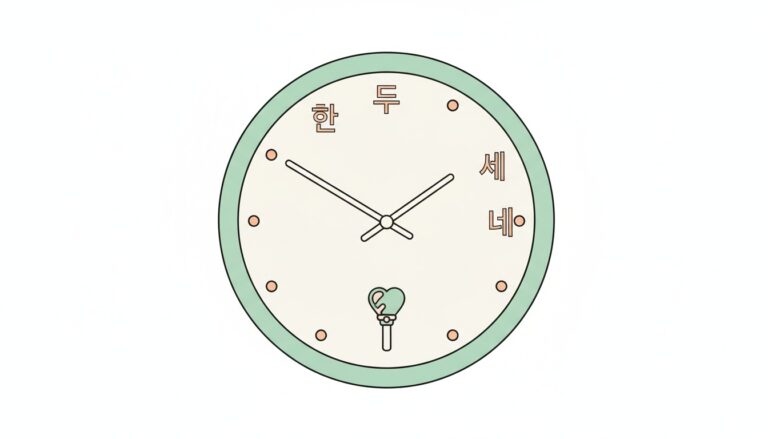
Phase 1: The “6 PM” Panic – An Immersive Opening
Hello! It’s your Daily Hangul Editor.
Picture this: You are a die-hard K-Pop fan. Your favorite group is dropping a new music video today. The announcement says “Release at 6 PM KST.”
You look at the clock. You know the numbers 1, 2, 3… Il, I, Sam… right? So you excitedly tell your Korean language exchange partner, “I’m waiting for Yuk-si (6 o’clock)!”
There is a pause. They smile awkwardly. “Ah… you mean Yeoseot-si?”
Wait, what? Isn’t 6 Yuk?
Here is the plot twist that frustrates 90% of beginners: Korean has two number systems. And for hours, we refuse to use the easy ones (Sino-Korean). We use the ancient, traditional Native Korean numbers.
If you use the wrong numbers for time, you sound like you are reading a math equation instead of checking a watch. But don’t worry—by the end of this guide, you will be telling time like a Seoul local meeting friends for Chimaek (Chicken & Beer).
Phase 2: The “Shape-Shifters” (1, 2, 3, 4)
In the world of Korean hours, numbers 1 through 4 are the troublemakers. They undergo a “cosmetic surgery” when they meet the word for “o’clock” (시, si).
1. 1 o’clock (Han-si)
- Pronunciation: [Han-si] (Sounds like “Han” Solo from Star Wars + “Sea”)
- The Shift: Hana (1) ➔ Han
- Meaning: 1 o’clock
- Editor’s Insight: You never say “Hana-si.” It’s too long! Koreans love speed (Palli-palli culture). We chop off the last vowel to make it flow faster.
- Spectrum:
[🚫 Formal: Han-si-ip-ni-da] ———— [✅ Polite: Han-si-ye-yo] ———— [✅ Casual: Han-si-ya]
2. 2 o’clock (Du-si)
- Pronunciation: [Du-si] (The “Du” sounds like “Do” in “Do it”)
- The Shift: Dul (2) ➔ Du
- Meaning: 2 o’clock
- K-Culture Moment: There is a famous Korean radio show called Du-si Talchul Cultwo Show (2 PM Escape). It airs at exactly 2 PM, the time when office workers start getting sleepy and need an “escape.”
3. 3 o’clock (Se-si) & 4 o’clock (Ne-si)
- Pronunciation: [Se-si] / [Ne-si]
- The Shift: Set (3) ➔ Se / Net (4) ➔ Ne
- Editor’s Insight: Notice a pattern? We drop the bottom consonants (Batchim). It makes the sound softer and easier to connect with si.
- 🤔 Think About It: Why do you think languages evolve to shorten words that are used frequently? Does your native language shorten numbers when counting specific things?
The “Golden Hour” Rule:
For 5 to 12, the numbers usually stay the same, but 1, 2, 3, and 4 must change shape.
Phase 3: Textbook vs. Real Life
| Situation | 📖 Textbook Korean | 🗣️ Real Korean | 💡 Why different? |
|---|---|---|---|
| Asking time | 지금 몇 시입니까? (Jigeum myeot si-im-nikka?) |
지금 몇 시예요? (Jigeum myeot si-yeyo?) |
The textbook version sounds like a military interrogation. The “Real” version is soft and polite. |
| Answering (5:00) | 다섯 시입니다. (Daseot si-im-nida) |
다섯 시야 / 다섯 시예요. (Daseot si-ya / -yeyo) |
In daily life, we rarely use the robot-like “-nida” ending unless on the news. |
| Meeting time | 우리는 6시에 만납니다. | 6시 어때? / 6시 콜? (Yeoseot-si eottae? / Call?) |
“Call?” is Konglish (Korean-English) slang meaning “Deal?” or “I’m down.” |
Phase 4: Cultural Context — The “Korean Time” Vibe
4-1. Nunchi & Punctuality
In Korea, if a meeting is at Han-si (1:00), arriving at 1:00 is technically late. The unwritten rule of Nunchi suggests you should be there by 12:50. However, for casual drinking parties (Sul-jari), “Korean Time” might apply, meaning people drift in 10-20 minutes late. But for business? Never.
4-2. K-Culture Connection: The “6 PM” Drop
Why is Yeoseot-si (6:00) so important? In the K-Pop world, 6 PM KST is the standard release time for new albums and Music Videos. Fans set alarms for Yeoseot-si. If you hear a Korean friend say, “I’m nervous about 6 o’clock,” they aren’t worried about dinner; they are worried about streaming numbers!
Phase 5: Immersive Roleplay
Setting: It is Friday. You are texting your Korean friend, Minji, to decide when to meet for dinner in Hongdae.
Characters:
* YOU: An eager student hungry for Samgyeopsal (Pork belly).
* Minji: Your cool Korean friend who knows all the good spots.
The Dialogue:
Minji: 우리 오늘 몇 시에 만날까? 📅
(Uri oneul myeot si-e mannal-kka?)
(Translation: What time shall we meet today?)
YOU: 음… 다섯 시 어때?
(Eum… Daseot si eottae?)
(Translation: Hmm… How about 5 o’clock?)
Minji: 5시는 너무 빨라. 퇴근 안 했어! 😱
(Daseot si-neun neomu ppalla. Toe-geun an haesseo!)
(Translation: 5 is too early. I haven’t got off work yet!)
🔀 Decision Point: Minji can’t make it. Suggest a later time!
- Option A: “Then, how about 7 o’clock?” (Il-gop si)
- Option B: “Then, how about 70 o’clock?” (Chil sip si) – Wait, this is wrong!
- Option C: “Okay, come when you can.” (Too passive!)
✅ Best Choice: Option A.
YOU: 그럼, 일곱 시는 어때?
(Geureom, Il-gop si-neun eottae?)Minji: 좋아! 7시에 보자! 🍗
Phase 6: 10-Second Shadowing Drill
Let’s practice the rhythm. Don’t sound flat!
😊 Brightly (Suggesting a time):
우리 / 한 시에 / 만나요!
(Uri / han si-e / mannayo!)
(Let’s meet at 1 o’clock!)
😢 Sad/Regretful (Missed the time):
벌써 / 열두 시 / 예요?
(Beolsseo / yeol-du si / yeyo?)
(Is it already 12 o’clock?)
Phase 7: K-Culture Glossary
| Korean | Romanization | Meaning | Context |
|---|---|---|---|
| 몇 시 | Myeot si | What time | The most essential phrase. “Jigeum myeot si-ya?” |
| 약속 | Yaksok | Appointment / Promise | Used for plans with friends. “I have a yaksok at 3.” |
| 칼퇴 | Kal-toe | Leaving work on time | Literally “Knife leave.” Leaving exactly at Yeoseot-si (6:00). |
| 막차 | Mak-cha | Last bus/train | The most critical time to know after a night out. |
Phase 8: Traveler’s Survival Kit
Waiting for a bus or asking a tour guide? You need these.
🆘 Survival Expression #1
* 🇰🇷 “지금 몇 시예요?” (Jigeum myeot si-yeyo?)
* 🗣️ Pronunciation: [Jee-geum myut she-yay-yo?]
* 📍 Where: Anywhere.
* 💡 Pro Tip: Show your wrist (tapping an imaginary watch) while asking. It works 100% of the time even if your pronunciation is off.📌 Editor’s Travel Note
Most digital clocks in Korea use the 24-hour system (13:00, 14:00) on tickets, but people SPEAK in the 12-hour system (1 PM, 2 PM). If your train ticket says 14:00, say “Du-si” (2 o’clock), not “Sip-sa si.”
Phase 9: Think Deeper — Why Two Number Systems?
🧠 Language & History:
Have you ever wondered why Korea holds onto two complex number systems?
Native numbers (Hana, Dul, Set…) are the original spoken language of Korea, used for counting physical objects and people—things you can touch. Time (hours) feels physical; you count the hours passing.
Sino-Korean numbers (Il, I, Sam…) came from China and are used for math, money, and minutes. Minutes are precise divisions, more like math.
💬 Your Turn: Does your language have different ways to count specific things? (Like “a pair” of shoes vs. “two” shoes?) Share in the comments!
Phase 10: FAQ & Troubleshooting
Q: Can I just use “One, Two, Three” (Il, I, Sam) for hours? It’s easier!
A: Nope. If you say “Il-si” (1 o’clock using Sino numbers), people might think you are talking about a “temporary” situation (Ilsi – 일시) or just won’t understand. Hours belong to the Native system!
❌ Common Mistake #1: Saying “Hana-si” instead of “Han-si”.
✅ Fix: Remember, numbers 1-4 lose their “weight” (last letter) to fly faster next to the word “Si.”
Q: What about 11 and 12?
A:
* 11: Yeol-hana ➔ Yeol-han si
* 12: Yeol-dul ➔ Yeol-du si
(The rule applies to the last digit!)
Phase 11: Wrap-up & Mission
One-Liner: For hours, use Native numbers (Han, Du, Se, Ne) and remember they change shape!
🔥 Action Mission:
* 🥉 Bronze: Look at your clock right now. Say the time out loud in Korean using the “Shape-Shifters.”
* 🥈 Silver: Post a photo of your lunch on Instagram stories and add the time sticker, writing the sound in Korean (e.g., “Han-si Lunch”).
* 🥇 Gold: Watch a K-Drama episode. The moment you see a clock or someone mentions a time, pause and shout it out in Korean!
K-Culture Mission: Find out what time your favorite K-Pop idol was born (or their debut date/time). Try to say that hour in Korean!
Phase 12: Quiz — Time Check!
- Situation: You are meeting a friend at 4:00. Which message is correct?
- A) Net-si-e boja! (넷시에 보자)
- B) Ne-si-e boja! (네시에 보자)
- C) Sa-si-e boja! (사시에 보자)
- True or False: On a train ticket, if it says 13:00, you should read it as “Yeol-se si.”
Answers:
1. B) Ne-si (4 loses the ‘t’). A is wrong because of the ‘t’, C is using Sino numbers (wrong system).
2. False. You would read 13:00 as Han-si (1 PM) in conversation, or strictly “Sip-sam si” only in military/official announcements. But usually, just say Han-si!
Frequently Asked Questions (FAQ)
Q: What does "1 o'clock (Han-si)" mean in Korean and how do you pronounce it?
A: In Korean, "1 o'clock (Han-si)" is pronounced [Han-si] and means: 1 o'clock
Q: What does "2 o'clock (Du-si)" mean in Korean and how do you pronounce it?
A: In Korean, "2 o'clock (Du-si)" is pronounced [Du-si] and means: 2 o'clock
Q: What does "3 o'clock (Se-si) & 4 o'clock (Ne-si)" mean in Korean and how do you pronounce it?
A: In Korean, "3 o'clock (Se-si) & 4 o'clock (Ne-si)" is pronounced [Se-si] and means: a key conversational Korean expression covered in this lesson.







