

Phase 1: The ‘Summons’ — Are You Brave Enough?
Hello! Daily Hangul editor here.
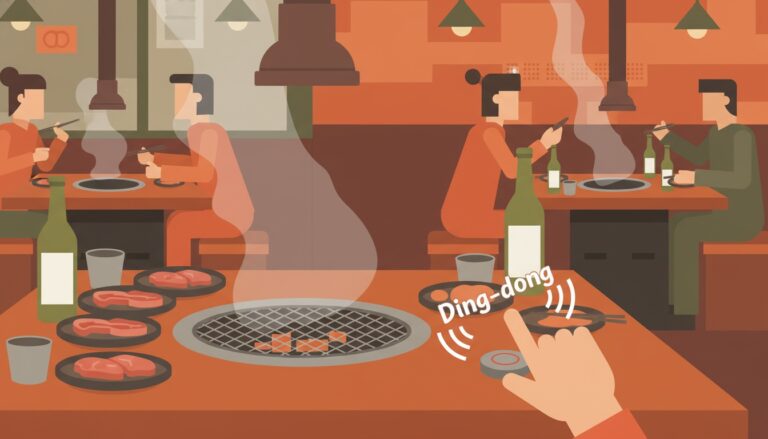
Picture this: You are in a bustling K-BBQ joint in Hongdae. The K-Pop playlist is blasting IVE’s latest hit, the grill is sizzling, and the air is thick with delicious smoke. You need more water. In New York or London, you might wait for the waiter to catch your eye. You might raise a polite finger.
Do that in Korea, and you will die of thirst.
Here, you have to vocalize. You have to shout. I’ve seen so many of my students freeze in this moment. It feels rude to their Western sensibilities to yell across a room. But in Korea? Silence is the only rude thing. If you don’t call out, the staff assumes you are happy.
But what do you shout? “Excuse me” feels too textbook. “Hey you” is a fight starter. Today, we are learning the magic words that turn you from a confused tourist into a local regular.
Phase 2: The Magic Words (Deep Dive)
Here are the three titles that will save your life.
1. 사장님 (Sajangnim)
- Pronunciation: [Sa-jang-nim] (Sounds a bit like “Sa” as in saww + “jang” + “nim”)
- Meaning: Literally “President” or “Boss.”
- Real Nuance: “I respect you enough to treat you like the owner, even if you are just a part-timer.”
- K-Culture Moment: In almost every K-Drama, when the rich CEO enters a humble soup restaurant, they still call the owner Sajangnim. It levels the playing field.
- Editor’s Insight: This is the safest bet. It creates an instant mood of flattery. Even if the person serving you is a 20-year-old student, calling them Sajangnim usually gets a smile (and maybe extra side dishes).
- Situation Spectrum:
[🚫 Formal Hotel] ———— [✅ Local Restaurant] ———— [✅ Pub/Cafe]- 🤔 Think About It: Why does Korean culture prefer calling everyone a “Boss” rather than a “Server”? It’s about elevating the other person’s status to show respect.
2. 이모 / 이모님 (Imo / Imonim)
- Pronunciation: [E-mo-nim]
- Meaning: Literally “Aunt” (mother’s sister).
- Real Nuance: “We are family here. I feel comfortable with you.”
- K-Culture Moment: You’ll see this in ‘Reply 1988’ or slice-of-life dramas. The protagonist is heartbroken, drinking soju, and yells, “Imo! One more bottle!” It implies a warm, rustic atmosphere.
- Editor’s Insight: ⚠️ Be careful. Only use this with middle-aged women in casual, old-school places (like a market stall or a gukbap house). Do not use this at a trendy pasta bar in Gangnam. It implies the place is homely and a bit rough around the edges.
- Situation Spectrum:
[🚫 Fancy Place] ———— [⚠️ Young Server] ———— [✅ Traditional Market]3. 저기요 / 여기요 (Jeogiyo / Yeogiyo)
- Pronunciation: [Jeo-gi-yo] / [Yeo-gi-yo]
- Meaning: “Over there, please” / “Here, please.”
- Real Nuance: “Excuse me!” (Functional, polite, standard).
- Editor’s Insight: If you are too shy to guess their age or status, use this. It’s dry but correct. It’s the “Vanilla Ice Cream” of summoning words. Boring, but no one hates it.
Phase 3: Textbook vs. Real Life
| Situation | 📖 Textbook Korean | 🗣️ Real Korean | 💡 Why different? |
|---|---|---|---|
| Calling a server | 종업원 (Jong-eop-won) | 사장님! (Sajangnim!) | Jong-eop-won sounds like you are reading a labor contract. It’s a job title, not a call. |
| Asking for water | 물 주세요 (Mul juseyo) | 여기 물 좀 주세요 (Yeogi mul jom juseyo) | Adding “Yeogi” (here) and “Jom” (a little) softens the demand. |
| Calling a young female server | 아가씨 (Agassi) | 저기요 / 사장님 (Jeogiyo / Sajangnim) | 🚨 STOP. Agassi has taken on a negative/rude nuance in modern Korea. Avoid it. |
Phase 4: Cultural Context — The “Ding-Dong” Culture
The Magic Button:
Before you scream Sajangnim, look at your table. Do you see a small, round button? That is the Call Bell (Huchul-bel).
In the West, ringing a bell for service is rude. In Korea, it is efficiency. Press it. You will hear a loud “Ding-dong!” and the staff will shout “Ne!” (Yes!) from the kitchen.
K-Culture Connection:
Have you noticed in K-Dramas like Itaewon Class, the staff moves with incredible speed? Korean dining culture is Ppalli-Ppalli (Hurry-Hurry). The bell saves them the time of checking on you constantly. They leave you alone until you need them. It’s not neglect; it’s privacy.
Phase 5: Immersive Roleplay
Setting: It’s Friday night at a pork belly (Samgyeopsal) restaurant in Seoul. It’s loud. You are with your Korean friend, Min-su.
Min-su: (Grilling meat) Wah, this smells amazing. But we have no lettuce left! 🥬
(Korean) Wa, naemsae daebak. Geunde sangchuga eomne!
YOU: (Noticing the staff is busy) Oh, should I ask for more?
Min-su: Yeah, go for it! Try calling them.
🔀 Decision Point: How do you get their attention?
A) Raise your hand timidly and whisper “Excuse me…”
B) Press the bell on the table (if there is one).
C) Shout “Agassi!” to the young woman passing by.
D) Raise your hand confidently and shout “Sajangnim!”
⚠️ If you chose A: No one hears you. Min-su laughs and says, “You have to be louder!”
🚫 If you chose C: The server frowns. The vibe gets awkward. Min-su whispers, “Don’t call her Agassi…”
✅ If you chose B or D:
Server: (Rushing over) 네, 필요하신 거 있으세요? (Yes, do you need anything?)
YOU: 여기 상추 좀 더 주세요! (Please give us some more lettuce here!)
Server: 네, 알겠습니다~ (Yes, understood~)
Phase 6: 10-Second Shadowing Drill
Let’s practice the “shout.” You need to project your voice, but keep the tone friendly, not angry.
Emotion: 😊 Bright & Energetic (Imagine you just want delicious food)
- 사장님~ / 여기 / 주문이요!
(Sa-jang-nim~ / yeo-gi / ju-mun-i-yo!)
Boss! / Here / Order please! -
저기요~ / 물 좀 / 주세요!
(Jeo-gi-yo~ / mul jom / ju-se-yo!)
Excuse me~ / Water (a little) / please give!
Phase 7: K-Culture Mini Glossary
| Korean | Romanization | Meaning | Context |
|---|---|---|---|
| 서비스 | Service | Freebie | If the “Sajangnim” likes you, they might give you a free soda. That’s “Service.” |
| 셀프 | Self | Self-serve | If you see this written on the water cooler, don’t call the staff. Get it yourself! |
| 띵동 | Tting-dong | Ding-dong | The sound of the call bell. Synonymous with “Service is coming.” |
Phase 8: Traveler’s Survival Kit
When you are starving and need attention:
🆘 Survival Phrase #1
– 🇰🇷 “여기 주문 할게요!” (Yeogi jumun hal-ge-yo!)
– 🗣️ “We will order here!”
– 📍 Use when: You’ve decided what to eat and need the waiter.🆘 Survival Phrase #2
– 🇰🇷 “저기요, 이거 안 시켰는데요?” (Jeogiyo, igeo an si-kyeot-neun-de-yo?)
– 🗣️ “Excuse me, we didn’t order this?”
– 📍 Use when: They bring the wrong food. (Mistakes happen!)📌 Editor’s Travel Note:
Check the table drawers! In 90% of Korean restaurants, the spoons, chopsticks, and napkins are hidden in a drawer attached to the side of the table. Don’t shout “Sajangnim, spoon!” until you check the drawer.
Phase 9: Think Deeper — Language & Family
Why do Koreans call strangers “Aunt” (Imo) or “Older Sister” (Eonni)?
This is a fascinating peek into Korean collective psychology. In English, a stranger is a stranger. In Korean, society is viewed as an extended family. By calling a server “Imo” (Aunt), you aren’t just getting their attention; you are subconsciously establishing a bond of Jeong (affection/connection).
However, this is changing. Younger generations (Gen Z) prefer the neutral Jeogiyo or Sajangnim because they value distance and privacy more than the older generation’s “forced” closeness. When you visit Korea, watch who uses which title. It tells you a lot about their age and personality.
💬 Your Turn: Does your language have a way to turn strangers into family? Or would calling a waiter “Auntie” be weird?
Phase 10: FAQ & Troubleshooting
Q: Can I call a male server ‘Oppa’ (Older brother)?
A: No. Please don’t. Oppa carries a strong nuance of personal closeness or romantic interest in modern context. Using it on a waiter feels flirtatious or overly familiar. Stick to Sajangnim or Jeogiyo.
Q: What if I shout and they ignore me?
A: Shout louder. Seriously. Korean restaurants are noisy. They aren’t ignoring you on purpose; they just didn’t hear you over the sizzling meat and loud chatter. Raise your hand high so they can see the visual cue too.
❌ Common Mistake: Waiting for the bill at the table.
✅ Fix: In most Korean casual restaurants, you take your bill (the little paper slip on your table) and walk to the exit counter to pay. Do not shout “Check please!” from your seat.
Phase 11: Wrap-up
One-Liner Summary: When in doubt, flatter them with “Sajangnim” or use the magic “Ding-Dong” button.
Action Mission:
– 🥉 Bronze: Say “Sajangnim” out loud 3 times right now. Get used to the sound.
– 🥈 Silver: Watch a scene from a K-Drama set in a restaurant (e.g., Weightlifting Fairy Kim Bok-joo eats a lot!) and listen for how they call the staff.
– 🥇 Gold: Go to a Korean restaurant in your city. Instead of waiting for eye contact, raise your hand and confidently say, “Yeogiyo!”
Phase 12: Interactive Quiz
- Situation: You are at a very fancy, expensive steakhouse in Gangnam. You need a napkin. What do you say?
- A) Imo! (Aunt!)
- B) Ya! (Hey!)
- C) Jeogiyo. (Excuse me.)
- Situation: You enter a small, cozy gukbap (soup) place run by a friendly grandma. She smiles at you. What can you call her?
- A) Agassi (Miss)
- B) Imo-nim (Auntie)
- C) You there
Answers:
1. C (A fancy place requires distance and politeness. ‘Imo’ is too rustic.)
2. B (This is the perfect time to use ‘Imo’ to build warmth!)
Frequently Asked Questions (FAQ)
Q: What does "사장님 (Sajangnim)" mean in Korean and how do you pronounce it?
A: In Korean, "사장님 (Sajangnim)" is pronounced [Sa-jang-nim] and means: Literally "President" or "Boss."
Q: What does "이모 / 이모님 (Imo / Imonim)" mean in Korean and how do you pronounce it?
A: In Korean, "이모 / 이모님 (Imo / Imonim)" is pronounced [E-mo-nim] and means: Literally "Aunt" (mother's sister).
Q: What does "저기요 / 여기요 (Jeogiyo / Yeogiyo)" mean in Korean and how do you pronounce it?
A: In Korean, "저기요 / 여기요 (Jeogiyo / Yeogiyo)" is pronounced [Jeo-gi-yo] and means: "Over there, please" / "Here, please."







