

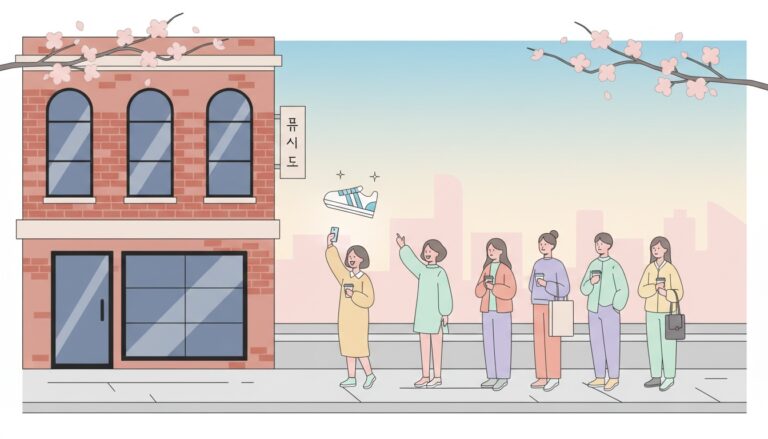
Phase 1: The Queue That Never Sleeps (Immersive Hook)
Hello, Daily Hangul readers. It’s your editor here.
Imagine this: It’s 5:00 AM on a freezing Saturday in Cheongdam-dong. The subway hasn’t even started running yet, but there’s a line of tents and camping chairs snaking around the luxury department store. These aren’t homeless shelters—they are fashion enthusiasts, resellers, and desperate boyfriends waiting for the store to unlock its doors.
In K-Dramas, you see the chaebol heiress walk in and buy the whole rack. In reality? Even if you have the money, you can’t buy it without the “Open Run” (오픈런).
Today, we are moving beyond basic shopping vocabulary like “얼마예요?” (How much is it?). We are diving into the fierce, status-driven world of Korea’s high-end street fashion scene. If you want to understand why a pair of sneakers costs as much as a used car in Seoul, or why your Korean friend is constantly checking their phone for a “draw,” you need this lesson. Let’s decode the language of Hype.
Phase 2: The Vocabulary of Hype (Deep Dive)
1. 오픈런 (Opeun-reon)
- Pronunciation: [O-peun-reon]
- Meaning: Literally “Open Run.” It refers to waiting in line before a store opens and sprinting (or power-walking) in to buy limited-edition goods.
- K-Culture Moment: You’ll see this on the news whenever a luxury brand raises prices or releases a collab with a street brand like Supreme or Stüssy. It’s a battlefield.
- Editor’s Insight: This word perfectly captures the Korean ppalli-ppalli (hurry, hurry) culture mixed with FOMO (Fear Of Missing Out). It’s not just about shopping; it’s a sport.
- Situation Spectrum:
[🚫 Formal Biz Meetings] ———— [⚠️ Semi-formal] ———— [✅ Casual/Social] - 🤔 Think About It: Does your country have a specific word for queuing overnight? In Korea, this act has its own verb. What does that say about the value of “scarcity” here?
2. 하차감 (Hacha-gam)
- Pronunciation: [Ha-cha-gam] + Sounds like ‘Ha’ as in ‘Haha’, ‘Cha’ as in ‘Cha-cha’, ‘Gam’ as in ‘Gum’.
- Meaning: Originally used for cars. Hacha means “getting off/out,” and gam means “feeling/sense.” It describes the satisfaction of being looked at when stepping out of a luxury car. Now, it applies to wearing high-end street gear that turns heads.
- K-Culture Moment: An idol stepping out of a van at the airport (Airport Fashion), wearing a limited jacket. The camera flashes explode. That sensation? That’s Hacha-gam.
- Editor’s Insight: This is a very cynical yet honest word. It acknowledges that fashion is often about validation from others’ gazes.
- Situation Spectrum:
[🚫 Elders/Formal] ———— [⚠️ Close Colleagues] ———— [✅ Friends]
3. 성지순례 (Seongji-sullye)
- Pronunciation: [Seong-ji-sul-lye]
- Meaning: Originally “religious pilgrimage.” In fashion slang, it means visiting a famous flagship store or a pop-up store (like the Dior Seongsu concept store) just to take photos and “pay respects” to the trend.
- Editor’s Insight: If you go to Seongsu-dong or Hannam-dong, you aren’t just shopping. You are on a pilgrimage. It elevates consumerism to a religion.
Phase 3: Textbook vs. Real Street Korean
| Situation | 📖 Textbook Korean | 🗣️ Real Korean (Street/Hype) | 💡 Why the difference? |
|---|---|---|---|
| Buying rare items | 희소성 있는 물건을 샀어요. (I bought a rare item.) |
득템했어요! / 레어템 건졌어요. (I ‘scored’ an item / Caught a rare item.) |
‘득템’ (Deuk-tem) combines acquiring + item. It feels like an RPG game achievement. |
| Reselling for profit | 웃돈을 얹어서 팔았어요. (I sold it by adding extra money.) |
리셀가가 떡상해서 팔았어요. (The ‘resell price’ skyrocketed, so I sold it.) |
‘Resell culture’ is an investment strategy (Resell-tech) for young Koreans. |
| Showing off | 비싼 시계를 자랑했어요. (I boasted about my expensive watch.) |
시계로 플렉스(Flex) 해버렸지 뭐야. (I just ‘Flexed’ with the watch.) |
Borrowed from Hip-hop culture, ‘Flex’ is less negative than ‘boasting’—it’s owning your success. |
💡 Editor’s Note: While “Flex” is common, be careful using it with older generations. They might see it as mere wastefulness (
과소비).
Phase 4: Cultural Deep Dive — The “Seongsu Look”
4-1. Non-verbal: The “Scan”
When you walk into a trendy cafe in Seongsu-dong, you might feel people glancing at your shoes or bag. This isn’t necessarily rude; it’s the “Scanner” (스캐너) culture. People are rapidly assessing trends and brands. Don’t shrink away; maintain confident posture. In the street fashion world, confidence is part of the outfit.
4-2. The “Mix-Match” Context
In K-Dramas like Itaewon Class, you see characters mixing a $2,000 Balenciaga hoodie with convenience store flip-flops. This “Mix-Match” (믹스매치) is the essence of modern Seoul style. It signals, “I have money, but I’m too cool to try too hard.”
Critical Insight: Why is Korea so obsessed with high-end streetwear? It’s the tension between Collectivism (wanting to fit in with the trend) and Individualism (wanting to stand out with limited items). A Supreme t-shirt satisfies both: it’s a recognized brand (fitting in) but hard to get (standing out).
Phase 5: Interactive Roleplay — The Lucky Draw
Setting: A hip cafe in Hannam-dong, Saturday afternoon. You are with Min-jun, a fashion-obsessed friend who just checked his phone.
Characters:
– YOU: An expat who likes fashion but finds the obsession intense.
– Min-jun: 28, works at a startup, spends 40% of his salary on shoes.
(Min-jun looks at his phone and gasps loud enough to turn heads)
Min-jun: 헐! 대박! 나 라플(Raffle) 당첨됐어! 미쳤다 진짜!
(Heol! Daebak! Na Rapeul dangcheom-dwaesseo! Michyeotda jinjja!)
(English) Whoa! No way! I won the raffle! This is insane!
(🎭 He shoves his phone screen in your face showing a winning notification for limited Nike sneakers)
YOU: 와, 축하해! 그거 경쟁률 엄청나지 않아?
(Wa, chukahae! Geugeo gyeongjaengnyul eomcheong-naji ana?)
(English) Wow, congrats! Isn’t the competition rate for that huge?
Min-jun: 말도 마. 저번엔 100만 대 1이었어. 와… 이거 리셀하면 최소 50만 원은 남길 텐데…
(Maldo ma. Jeobeon-en baek-man dae il-ieosseo. Wa… Igeo risel-hamyeon choeso osip-man won-eun namgil tende…)
(English) Don’t even get me started. Last time it was a million to one. Wow… if I resell this, I could make at least 500,000 won profit…
🔀 Decision Point: What do you say to Min-jun?
- A) “그냥 팔아서 맛있는 거 사 먹자!” (Just sell it and let’s eat something good!)
- B) “에이, 너 신으려고 응모한 거잖아. 그냥 ‘실착’ 해!” (Hey, you applied so you could wear them. Just ‘real-wear’ them!)
- C) “나한테 원가에 넘기면 안 돼?” (Can’t you sell it to me at the original price?)
✅ Best Choice: B. telling him to ‘실착’ (Sil-chak – Real wear) validates his taste over money. It’s the “cool” friend response.
⚠️ Choice C Analysis: Unless you are extremely close, asking for the retail price on a high-resell item is considered rude. It’s asking him to throw away free money.
Phase 6: 10-Second Shadowing Drill
Let’s practice a sentence you can use when you see someone wearing something incredible.
Emotion: 😉 Admiration mixed with a bit of playful jealousy.
Sentence:
와, 그 신발 / 지금 구하기 / 진짜 힘든 건데, / 어떻게 구했어요? 대박!
(Wa, geu sinbal / jigeum guhagi / jinjja himdeun geonde, / eotteoke guhaesseoyo? Daebak!)
Translation: Wow, those shoes / are really hard / to get right now, / how did you get them? Awesome!
Phase 7: K-Culture Mini Glossary
| Korean | Rom | Meaning | Context |
|---|---|---|---|
| 오픈런 | Opeun-reon | Open Run | Sprinting into a store at opening time. |
| 리셀테크 | Risel-teku | Resell-tech | Reselling + Investment technique. Treating fashion items like stocks. |
| 크림 (KREAM) | Keurim | KREAM | The dominant resell app in Korea. If you don’t know this app, you aren’t in the scene. |
| 실착 | Sil-chak | Real-wear | Wearing the shoes instead of keeping them in the box or selling them. |
| 공홈 | Gong-hom | Official Homepage | “I failed to buy it on the ‘Gong-hom’.” |
Phase 8: Shopper’s Survival Kit (Travel Edition)
You are at a trendy select shop in Hongdae or Apgujeong.
🆘 Survival Expression #1
– 🇰🇷 “이거 재고 남아 있나요?” (Igeo jaego nama innayo?)
– 🗣️ Ee-geo jae-go na-ma in-na-yo?
– Meaning: Is there any stock left of this?
– Use at: Any clothing store.🆘 Survival Expression #2
– 🇰🇷 “혹시 DP 상품 말고 새 상품 있나요?” (Hoksi DP sangpum malgo sae sangpum innayo?)
– Meaning: Do you have a new product, not the display one?
– Context: Koreans rarely buy the display item (DP) unless there’s a discount.📌 Editor’s Travel Note
If you visit high-end stores like Gentle Monster or Tamburins, don’t just shop—take photos. The staff expects it. In fact, if you don’t take photos, you look suspicious! These spaces are designed as art galleries first, stores second.
Phase 9: Think Deeper — “The Resell Republic?”
Media vs. Reality:
You might see news articles about Korean teenagers making millions selling sneakers. Is everyone doing this? Not exactly, but the concept of “Consumption as Investment” is deeply rooted here. Unlike in some cultures where wearing used clothes is vintage chic, in the Korean high-end street scene, “New” and “Limited” hold the highest power.
However, a fatigue is setting in. The rise of “Gorpcore” (outdoor fashion) and vintage shops in Seongsu suggests a shift. Are we moving from “showing off money” to “showing off taste”?
🧠 Think Deeper: In your country, does wearing a brand logo make you look “cool” or “tacky”? In Korea, big logos were cool, then tacky, and now (ironically) cool again. Where does this cycle stand in your culture?
Phase 10: FAQ & Troubleshooting
Q: Can I wear sweatpants to a nice restaurant in Gangnam?
A: It depends. If they are $500 designer sweatpants styled perfectly? Yes. If they are just gym gym-clothes? No. The line between “Street Fashion” and “Lazy” is thin and depends on the fit and brand.
Q: Why do staff follow me in stores?
A: In high-end street shops, they aren’t necessarily suspecting you of theft. This is aggressive customer service (밀착 응대). Just smile and say “제가 둘러볼게요” (I’ll look around myself).
❌ Common Mistake: asking for a discount (깎아주세요) at a brand flagship store or a hype beast select shop. These prices are fixed. Save your bargaining skills for the Dongdaemun markets.
Phase 11: Wrap-up & Mission
Summary: Today we learned that buying clothes in Korea is a sport (Open Run), a feeling (Hacha-gam), and an investment (Resell-tech).
Your Mission:
– 🥉 Bronze: Look up #오픈런 on Instagram and see the lines.
– 🥈 Silver: Go to the KREAM website/app and check the price of your favorite sneakers in Korea.
– 🥇 Gold: If you are in Seoul, visit a “Pop-up Store” in Seongsu-dong and ask, “이거 한정판인가요?” (Is this limited edition?).
💬 Comment Below: Would you wait in line for 4 hours to buy a t-shirt? Tell me your limit!
Frequently Asked Questions (FAQ)
Q: What does "오픈런 (Opeun-reon)" mean in Korean and how do you pronounce it?
A: In Korean, "오픈런 (Opeun-reon)" is pronounced [O-peun-reon] and means: Literally "Open Run." It refers to waiting in line before a store opens and sprinting (or power-walking) in to buy limited-edition goods.
Q: What does "하차감 (Hacha-gam)" mean in Korean and how do you pronounce it?
A: In Korean, "하차감 (Hacha-gam)" is pronounced [Ha-cha-gam] and means: Originally used for cars. Hacha means "getting off/out," and gam means "feeling/sense." It describes the satisfaction of being looked at when stepping out of a luxury car. Now, it applies to wearing high-end street gear that turns heads.
Q: What does "성지순례 (Seongji-sullye)" mean in Korean and how do you pronounce it?
A: In Korean, "성지순례 (Seongji-sullye)" is pronounced [Seong-ji-sul-lye] and means: Originally "religious pilgrimage." In fashion slang, it means visiting a famous flagship store or a pop-up store (like the Dior Seongsu concept store) just to take photos and "pay respects" to the trend.







