

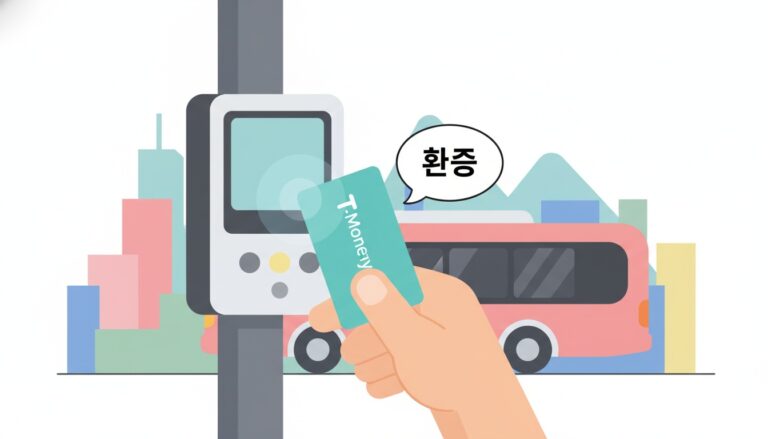
Phase 1: The “Beep” That Saves Your Wallet
Hello! This is your Daily Hangul editor.
Picture this: You are watching a K-Drama. The main character just had a dramatic breakup. They stumble onto a bus, tears in their eyes, and casually tap their card against the machine. Beep-Beep.
That sound? It’s not just a payment confirmation. It’s the sound of the Korean transport system giving you a high-five.
If you live in Korea or plan to travel here, you will hear one specific phrase from that machine that sounds like music to a local’s ears: “환승입니다” (Hwanseung-imnida).
It means “Transfer.” It means your ride is free (or heavily discounted).
But here is the catch: I have seen so many students lose money because they forgot one simple rule when getting off the bus. Today, we aren’t just learning words; we are saving your budget for more K-BBQ.
This is a real survival skill. Let’s get into it.
Phase 2: Deep Dive into the “Money-Saving” Words
1. 환승입니다 (Hwanseung-imnida)
- Pronunciation: [Hwan-seung-im-ni-da]
- Sound-alike: ‘Hwan’ like Juan + ‘Seung’ like Sung (sunglasses).
- Meaning: “It is a transfer.” (Transfer complete)
- K-Culture Moment: You usually hear this in reality shows like Running Man when members are racing across Seoul using public transport. It’s the sound of efficiency.
- Editor’s Insight: You don’t say this word; the machine says it to you. If you hear this, smile. You just saved about 1,400 KRW ($1).
- Situation Spectrum:
[🚫 Don't say it] ———— [✅ Listen for it] ———— [✅ Read it on signs]- This is mostly a passive vocabulary word. You need to recognize it to know your discount worked.
- 🤔 Think About It: In many countries, you pay for every single ride. Why do you think Korea made transfers free within 30 minutes? How does this change how people move around the city?
2. 카드 찍고 내리세요 (Kadeu jjikgo naeriseyo)
- Pronunciation: [Ka-deu jjik-go nae-ri-se-yo]
- Sound-alike: ‘Jjik’ sounds like the ‘chick’ in chicken, but with a J.
- Meaning: “Please tap your card and get off.”
- Literal: Card tap-and get off.
- K-Culture Moment: The bus driver shouts this when the bus is packed (like inside a sardine can) during rush hour and people are trying to squeeze out the back door without tapping.
- Editor’s Insight: The verb 찍다 (jjikda) is magic. You use it for taking a photo, dipping sauce (K-Food!), and tapping a card. It implies a quick, decisive contact.
- Situation Spectrum:
[🚫 To Elders] ———— [⚠️ Semi-formal] ———— [✅ Standard]- This is a polite command. You will hear drivers say it, or recorded announcements play it.
- 🤔 Think About It: Korean verbs often combine actions like “do X and do Y” (jjik-go). Does your language combine actions into one flow, or do you use separate sentences?
3. 하차 (Hacha)
- Pronunciation: [Ha-cha]
- Sound-alike: Ha (laugh) + Cha (tea).
- Meaning: Getting off (a vehicle).
- K-Culture Moment: Look at the buttons near the bus exit. They say 하차밸 (Hacha-bell) / Stop button. In K-Dramas, pushing this button for someone else is a classic “flirting” move.
- Editor’s Insight: You won’t use this in casual conversation (we usually say “naeryeoyo” for getting off). But you must be able to read this word to find the exit door or the card reader.
Phase 3: Textbook vs. Real Life
Let’s be honest. The textbook is polite, but the morning commute in Gangnam is a battlefield.
| Situation | 📖 Textbook Korean | 🗣️ Real Korean | 💡 Why the difference? |
|---|---|---|---|
| Getting off the bus | 하차하겠습니다 (I will get off now) | 내릴게요! (Naeril-geyo!) | “하차” is too formal/written. “내리다” is the spoken verb. |
| Asking driver to wait | 잠시만 기다려 주십시오. | 잠깐만요! (Jam-kkan-man-yo!) | Time is money. Short and loud gets attention faster. |
| Card error | 카드가 읽히지 않았습니다. | 안 찍혔어요? (An jjik-hyeoss-eo-yo?) | Passive voice is tricky. Locals focus on the result: “Did it not tap?” |
Bottom Note: If you scream “Hacha-hagesseumnida” on a bus, people might think you are announcing a military operation. Stick to “Naeril-geyo!”
Phase 4: Cultural Context — The “30-Minute” Rule
4-1. The Art of “Tagging Out” (Hacha Tag)
In many countries, you pay a flat fee. In Korea, distance matters.
* The Golden Rule: You must tap your card when you get OFF the bus (Hacha tag).
* Why? If you tap off, the system knows exactly where you stopped. If you transfer to a subway or another bus within 30 minutes, you are not charged the base fare again.
* The Penalty: If you forget to tap off? The next time you use transport, you might get charged a “penalty fare” (extra distance charge).
4-2. K-Travel Connection: The “Palli Palli” Transfer
Have you ever seen K-Pop fans running from a subway station to a bus stop? They aren’t just excited; they are beating the 30-minute clock.
* Scenario: You leave a concert at Gocheok Sky Dome. You take the subway, then need a bus to your Airbnb.
* Tip: Don’t stop for a snack between the subway and the bus. If 31 minutes pass, you pay double. Grab that tteokbokki after you arrive!
Phase 5: Immersive Roleplay
Setting: It is 8:50 AM on a Monday. Bus 402 is packed. You are squeezed near the back door. You need to get off at ‘Namsan Library’ to transfer to another bus.
Characters:
* YOU: A foreign student late for class.
* Driver: A busy ‘Gisa-nim’ (driver) who wants to close the doors quickly.
Dialogue:
Bus Announcement: 이번 정류장은 남산도서관입니다. (Next stop is Namsan Library.)
YOU: (Pushing towards the door, holding your T-Money card)
잠깐만요! 내릴게요!
(Jam-kkan-man-yo! Naeril-geyo!)
[Wait a moment! I’m getting off!]
(Stage Direction: You tap your card on the reader.)
Card Reader: “카드를 다시 대주세요.”
(Kadeu-reul dasi dae-juseyo)
[Please tap your card again.]
YOU: (Panic! The door is starting to close)
🔀 Decision Point: What do you say?
- Option A: Scream “STOP!” in English.
- Option B: Shout “아저씨! 안 찍혔어요!” (Sir! It didn’t scan!)
- Option C: Just jump off without scanning. (Sacrifice the discount)
✅ Best Choice: B — “아저씨 (Ajussi)” gets his attention immediately. “안 찍혔어요” explains why you are blocking the door. He will wait.
⚠️ Choice C Analysis: If you jump off without scanning, you lose the transfer discount. That is the price of a convenience store coffee gone!
Phase 6: 10-Second Shadowing Drill
Let’s practice the magic spell for when the door is closing too fast.
- Emotion: 😤 Urgent and loud (don’t be shy!)
- Korean: 기사님! / 저 / 내려요!
- Romanization: Gi-sa-nim! / jeo / nae-ryeo-yo!
- Guide: Driver! / I / am getting off!
Phase 7: K-Culture Mini Glossary
| Korean | Romanization | Meaning | Context |
|---|---|---|---|
| 티머니 | T-Money | Transport Card | The reloadable card you need for all buses/subways. Often features K-Pop idol photos. |
| 기사님 | Gisa-nim | Driver (Mr./Ms.) | The polite title for taxi or bus drivers. Never say “You” or “Hey.” |
| 마을버스 | Maeul-bus | Village Bus | The small green buses that go into deep neighborhoods/hills. Essential for “last mile” travel. |
Phase 8: Traveler’s Survival Kit
Getting around Seoul is easy, but only if you know the basics.
🆘 Survival Phrases for Transport
* 환승 되나요? (Hwan-seung doe-na-yo?)
* Meaning: “Is transfer possible?” / “Does this count for transfer?”
* 잔액이 부족합니다 (Jan-aek-i bu-jok-ham-ni-da)
* ⚠️ DANGER! This means “Insufficient balance.” If you hear this, you need to reload your card immediately.
* 문 좀 열어주세요! (Mun jom yeol-eo-ju-se-yo!)
* Meaning: “Please open the door!” (Use when the driver missed you).📌 Editor’s Travel Note
* The Apps: Google Maps is okay, but Naver Map or KakaoMap are superior in Korea. They tell you exactly which subway car door (e.g., 5-3) is closest to the stairs for a fast transfer.
* Cash? Many buses in Seoul are becoming “Cashless.” Always have a T-Money card ready.
Phase 9: Think Deeper — “Why Tag Out?”
Data vs. Privacy:
Have you wondered why the Korean government gives you a discount for tagging out? It is not just kindness. By tagging off, you are giving the system valuable data: exactly where people start and end their journeys. This helps them adjust bus routes and schedules efficiently.
💬 Your Turn: Would you trade your travel data for a cheaper fare in your home country? Or does that feel like too much tracking?
Phase 10: FAQ & Troubleshooting
Q: Can I use my T-Money card to pay for my friend too?
A: Technically, yes, on a bus. You must tell the driver “Two people” (두 명이요 / Du-myeong-i-yo) BEFORE you tap.
* Caveat: If you do this, transfers won’t work for the second person usually, or it gets complicated. It is highly recommended that everyone buys their own card (convenience stores sell them for 4,000 KRW).
❌ Common Mistake #1: Tapping your card too early before the bus stops.
✅ Fix: Drivers used to hate this, but nowadays people do it often to save time. Just make sure you actually get off, or the system might get confused!
Phase 11: Wrap-up & Action Mission
Summary: To get the discount, remember the “30-minute rule” and always, always tag off (Jjik-go nae-ri-se-yo)!
🚀 Action Missions:
* 🥉 Bronze: Say “내릴게요!” (I’m getting off) loud and clear in your room 3 times.
* 🥈 Silver: Download Naver Map, find a route from ‘Gangnam Station’ to ‘N Seoul Tower’, and see how many transfers are required.
* 🥇 Gold: Ride a local bus in Korea and successfully get the “Hwanseung” message on the screen!
K-Culture Mission: Watch a K-Pop idol’s “Vlog” on YouTube where they ride the subway (often done for birthday ads). Watch how they tap their card!
Phase 12: Interactive Quiz
- Situation: You hear the machine say “Jan-aek-i bu-jok-ham-ni-da.” What just happened?
- A) You got a free transfer.
- B) You have no money on your card.
- C) The bus is full.
- True or False: You can transfer for free even if you take a 2-hour coffee break between rides.
-
Gap Fill: To tell the driver you are getting off, you say: “__________-geyo!”
Click for Answers
- B) Your card is empty! Embarrassing!
- False. The limit is usually 30 minutes (1 hour late at night).
- Naeril (Naeril-geyo)
Frequently Asked Questions (FAQ)
Q: What does "환승입니다 (Hwanseung-imnida)" mean in Korean and how do you pronounce it?
A: In Korean, "환승입니다 (Hwanseung-imnida)" is pronounced [Hwan-seung-im-ni-da] and means: a key conversational Korean expression covered in this lesson.
Q: What does "카드 찍고 내리세요 (Kadeu jjikgo naeriseyo)" mean in Korean and how do you pronounce it?
A: In Korean, "카드 찍고 내리세요 (Kadeu jjikgo naeriseyo)" is pronounced [Ka-deu jjik-go nae-ri-se-yo] and means: a key conversational Korean expression covered in this lesson.
Q: What does "하차 (Hacha)" mean in Korean and how do you pronounce it?
A: In Korean, "하차 (Hacha)" is pronounced [Ha-cha] and means: a key conversational Korean expression covered in this lesson.







