

Master the Magic Spell: “Saehae Bok Mani Badeuseyo”
Phase 1: The Hook
Hello! This is your Daily Hangul editor.
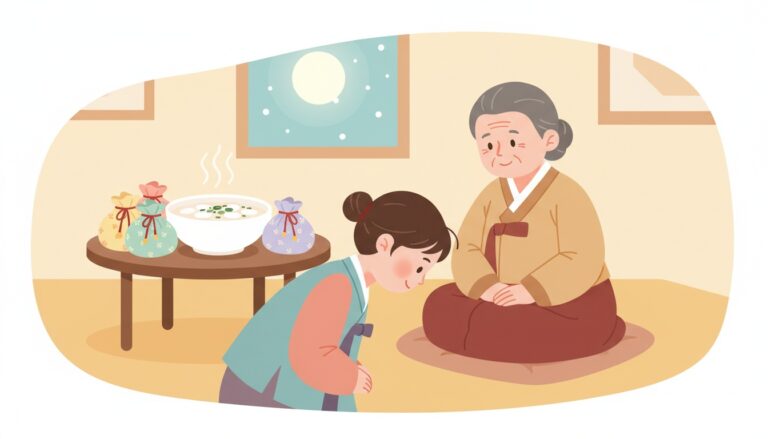
Picture this: It’s February. You’re watching your favorite K-Drama, maybe a family weekend special. The characters are all wearing colorful silk clothes (Hanbok), and the younger cast members are literally throwing themselves onto the floor in front of the grandmother.
They stand up, dust off their knees, and say a long string of syllables. Then—and this is the important part—the grandmother hands them a white envelope. The characters grin. That envelope has cash in it.
What did they say to unlock the cash? It wasn’t just “Happy New Year.”
They used the ultimate Korean blessing phrase. If you are in Korea around January or February (following the lunar calendar), or if you want to leave a comment on your bias’s Instagram that actually sounds natural, you need this phrase. Let’s decode it.
Phase 2: Deep Dive
There is really only one phrase you must know for Seollal (Lunar New Year).
1. 새해 복 많이 받으세요 (Saehae bok mani badeuseyo)
- Pronunciation: [Sae-hae bok ma-ni ba-deu-se-yo]
- Sae-hae: Sounds like “Say-Hey”
- Bok: Rhymes with “Poke” (but with a soft B, not a P)
- Mani: Sounds like “Money” (easy to remember!)
- Ba-deu-se-yo: Ba-deu-say-yo
- Meaning:
- Literal: “New Year, luck/blessings, a lot, please receive.”
- Real Nuance: “I hope you get hit by a tsunami of good fortune this year.”
- K-Culture Moment: You’ll see K-Pop idols doing a “relay greeting” video every year. They usually stand in a row, wave two hands, and shout this phrase in unison.
Editor’s Insight: Notice the grammar. You don’t “make” a happy new year; you “receive” (batda) luck (bok). In Korean culture, fortune is something granted to you, not something you forcefully take. It’s a wish for passive abundance.
Situation Spectrum:
[🚫 No] ———— [⚠️ Careful] ———— [✅ Yes]
- Friends: ✅
- Boss/Elders: ✅ (This is the golden key. It works for everyone.)
- Strangers: ✅
- 🤔 Think About It: Why does Korean emphasize “receiving” luck rather than “having” a happy year? It hints at a cultural humility—acknowledging that some things are out of our hands.
Phase 3: Textbook vs. Real Life
Textbooks are polite. Real life is… efficient.
| Situation | 📖 Textbook Korean | 🗣️ Real Korean | 💡 Why the difference? |
|---|---|---|---|
| Standard | 새해 복 많이 받으세요 (Saehae bok mani badeuseyo) |
Same! This phrase is sacred. | Even close friends use the full version to show sincerity during holidays. |
| Texting Friends | 새해 복 많이 받으세요 | 복 많이 받아! 🙇🏻♂️💰 (Bok mani bada!) |
Dropping the ‘yo’ makes it casual. The emojis do the heavy lifting. |
| The “Real” Wish | 건강하세요 (Stay healthy) |
부자 되세요 (Buja doeseyo) |
“Become rich.” Because let’s be honest, that’s the bok (luck) everyone wants. |
Bottom Note: If you are an absolute beginner (A1), stick to the full “Saehae bok mani badeuseyo.” It never fails. Using the casual version with the wrong person is awkward; using the polite version with a friend is just a bit stiff but acceptable.
Phase 4: Cultural Deep Dive
4-1. The Art of the Bow (Sebae)
Language isn’t just mouth noises; it’s body language. On Seollal, we do the Sebae (세배).
- The Move: It’s not a nod. It’s a full-on, knees-to-the-floor deep bow.
- The Rule: Men put their left hand over their right. Women put their right hand over their left. (Honestly, most young Koreans forget which hand goes on top too, so don’t stress).
- The Reward: If you do this to an elder, they usually give you Sebaetdon (New Year’s Cash). Yes, cold hard cash.
4-2. K-Food Connection: The Age Soup
In Korea, you don’t get older on your birthday (traditionally). You get older on New Year’s Day.
How do you level up? You eat Tteokguk (Rice Cake Soup).
– The Myth: If you don’t eat the soup, you don’t age.
– The Joke: “I ate three bowls of Tteokguk, so now I’m 30!” (Don’t actually do this; rice cakes are filling).
Phase 5: Immersive Roleplay
Scenario: It’s Seollal morning. You are invited to your Korean friend Min-su’s house. You walk into the living room where his mother is cutting fruit.
Characters:
– YOU: An enthusiastic foreign guest.
– Min-su’s Mom: A kind but traditional Korean mother.
Dialogue:
Min-su’s Mom: (Smiling) 어서 와요! 밖이 춥지 않아요?
(Eoseo wayo! Bakki chupji anayo?)
(Welcome! Isn’t it cold outside?)
YOU: 안녕하세요! 괜찮아요.
(Annyeonghaseyo! Gwaenchanayo.)
(Hello! I’m okay.)
(🎭 Stage Direction: You know it’s time for the big phrase. You pause, put your hands together…)
YOU: 어머니, 새해 복 많이 받으세요!
(Eomeoni, Saehae bok mani badeuseyo!)
(Mother, please receive many New Year’s blessings!)
Min-su’s Mom: (Delighted) 아이고, 고마워요! 우리 00씨도 복 많이 받아요!
(Aigo, gomawoyo! Uri [Name]-ssi-do bok mani badayo!)
(Oh my, thank you! You receive lots of luck too!)
🔀 Decision Point! Mom hands you a bowl of white soup (Tteokguk).
- A) “No thank you, I’m not hungry.”
- B) “Wow! Tteokguk! Keep the luck coming!” (Start eating)
- C) “This looks delicious. Thank you!” (Wait for her to start eating first)
✅ Best Choice: C. In Korea, you never pick up your spoon before the eldest person at the table. Even if you are starving.
⚠️ Choice A Analysis: Refusing food on Seollal is like refusing luck. Even a little bit makes the host happy.
Phase 6: 10-Second Shadowing Drill
Don’t just read it. Feel it. Say it out loud.
“Please receive a lot of luck!”
😊 Bright & Respectful:
Sae-hae / bok / ma-ni / ba-deu-se-yo!
(새해 / 복 / 많이 / 받으세요!)
Editor’s Tip: Put the stress on BOK and MA-ni. That’s the “Luck” and “Money” part. The rest can flow softly.
Phase 7: K-Culture Mini Glossary
| Korean | Romanization | Meaning | Context |
|---|---|---|---|
| 세배 | Sebae | New Year’s Bow | The deep bow you do to elders. |
| 세뱃돈 | Sebaetdon | Bowing Money | The cash you get after bowing. (Best part). |
| 떡국 | Tteokguk | Rice Cake Soup | The soup that makes you one year older. |
| 덕담 | Deokdam | Words of blessing | The wise words elders say to you (e.g., “Get married soon,” “Study hard”). |
Phase 8: Traveler’s Survival Kit
Visiting Korea during Seollal? Read this.
Most of Seoul empties out as people travel to their hometowns. But that means many shops close.
🆘 Survival Expression #1
– 🇰🇷 “오늘 영업 해요?” (Oneul yeongeop haeyo?)
– 🗣️ Sounds like: “Oh-neul young-up hey-yo?”
– Meaning: “Are you open for business today?”
– Where to use: Standing in front of a dark café or restaurant.📌 Editor’s Travel Note
– App Alert: Use Naver Map. Google Maps often gets holiday hours wrong in Korea.
– Traffic: Do NOT try to travel out of Seoul on the day before Seollal. You will be stuck on the highway for 6+ hours. Stay in the city; the palaces (Gyeongbokgung) are usually free entry!
Phase 9: Think Deeper — “Why the Obsession with Luck?”
Language & Culture:
In English, we say “Happy New Year.” It’s an emotion. In Korean, we say “Receive Luck.” It’s a transaction of energy. Historically, Korea was an agrarian society where weather and harvest were unpredictable. You couldn’t just “be happy” by will; you needed the universe to cooperate.
So when you say Saehae bok mani badeuseyo, you aren’t just being polite. You are wishing for the universe to be kind to that person. That’s a heavy, beautiful wish.
💬 Your Turn: Does your language wish for happiness (emotion) or luck (fortune)? Tell me in the comments!
Phase 10: FAQ & Troubleshooting
Q: Can I just say “Happy New Year” in English?
A: Yes! Everyone understands “Happy New Year.” But saying the Korean phrase earns you massive respect points. It shows you tried.
Q: Do I have to bow to everyone?
A: No. A handshake or a slight head bow is fine for strangers. The deep floor-bow (Sebae) is reserved for family or very close mentors.
Q: I saw a “Lunar New Year” event, is that the same?
A: Yes. Seollal is the Korean celebration of the Lunar New Year. It’s the same dates as Chinese New Year, but the traditions (food, dress, games) are uniquely Korean.
❌ Common Mistake:
Don’t pronounce Bok like “Box.” Keep it short. “Bok.”
Phase 11: Wrap-up
One-Liner: Seollal is about bowing, eating soup to get older, and wishing others passive luck.
Your Mission:
– 🥉 Bronze: Look in the mirror and say Saehae bok mani badeuseyo 3 times.
– 🥈 Silver: Go to a K-Pop idol’s Instagram post and comment: “새해 복 많이 받으세요! 🙇♂️”
– 🥇 Gold: Visit a Korean restaurant this week and say it to the staff as you leave.
Phase 12: Quiz
1. Which food makes you “one year older” in Korea?
a) Kimchi Stew
b) Tteokguk (Rice Cake Soup)
c) Bibimbap
2. True or False?
You should refuse the “Sebaetdon” (money) angrily.
3. Situation Check:
You meet your Korean friend’s grandfather. He extends his hand for a handshake. You should:
a) Slap his hand (High five)
b) Shake it with one hand while looking away
c) Shake it with two hands (or left hand supporting right arm) and bow slightly.
Answers:
1. (b) Eat the soup, gain a year!
2. False. Accept it with two hands and say thank you! (Maybe refuse once politely for show, but then take it.)
3. (c) Always use two hands with elders.
Frequently Asked Questions (FAQ)
Q: What does "새해 복 많이 받으세요 (Saehae bok mani badeuseyo)" mean in Korean and how do you pronounce it?
A: In Korean, "새해 복 많이 받으세요 (Saehae bok mani badeuseyo)" is pronounced [Sae-hae bok ma-ni ba-deu-se-yo] and means: a key conversational Korean expression covered in this lesson.







