

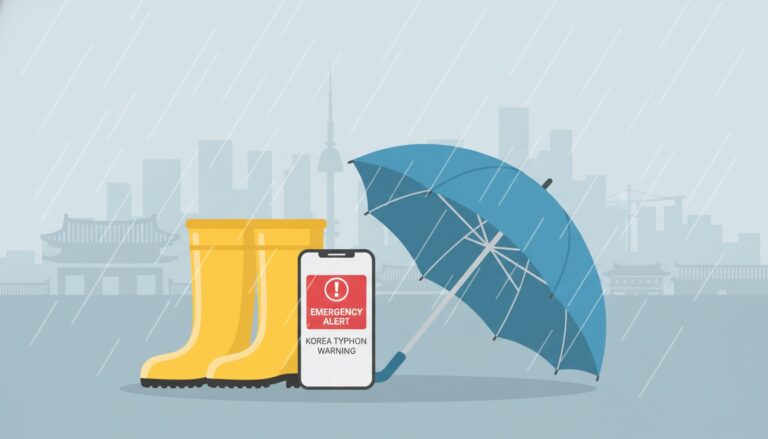
Surviving the Storm: Talking About Typhoons & Recovery in Korea
Phase 1: The Immersive Hook
안녕하세요! Daily Hangul’s Senior Editor here.
If you’ve seen the movie Parasite, you remember that scene. The Kim family desperately trying to salvage their belongings as sewage water floods their semi-basement home. While that’s cinema, the reality of Korean summer—specifically Jangma (monsoon season) and the occasional Taepung (typhoon)—is a shared cultural experience that creates a unique linguistic bond.
In Korea, a typhoon isn’t just weather; it’s a social event. Your phone screams with the distinct siren of the Safety Disaster Alert (Jae-nan Munja). Friends text each other asking if their windows are taped up. The news reporters are out there, literally tied to trees, showing us the wind speed.
But what happens after the rain stops? When the water recedes and the reality sets in? Today, we are moving past the textbook “It is raining” and stepping into the gritty, emotional, and practical language of recovery and safety. Knowing these expressions doesn’t just help you understand the news; it helps you show deep empathy (Jeong) to your Korean friends during tough times.
Phase 2: Deep Dive into Key Expressions
1. 복구 작업 (Bokgu jageop)
- Pronunciation: [Bok-gu ja-geop] (Sounds like ‘Bog’ + ‘goo’ + ‘jar’ + ‘gup’)
- Meaning: Recovery work / Restoration operations
- The Nuance: This isn’t just fixing a leaky faucet. Bokgu implies restoring something to its original state after a significant disruption. You’ll hear this constantly on the news regarding electricity, roads, or flooded homes.
- K-Culture Moment: Think of news footage showing soldiers and volunteers shoveling mud out of a market. That collective effort is Bokgu jageop.
- Situation Spectrum:
[🚫 Casual Chat] ———— [✅ News/Formal] ———— [✅ Serious Conversation] - 🤔 Think About It: Why does Korean society mobilize civilians and soldiers so quickly for Bokgu? It reflects the “Pali-pali” (Hurry, hurry) culture applied to disaster relief—normalcy must be restored immediately.
2. 침수 피해 (Chimsu pihae)
- Pronunciation: [Chim-su pi-hae]
- Meaning: Flood damage (specifically regarding immersion/submersion)
- The Nuance: Chimsu literally means “water invasion” or submersion. It’s used when cars, houses, or subway stations are underwater.
- Editor’s Insight: You wouldn’t use this for getting your shoes wet. This is for when your car turns into a submarine. It carries a heavy weight of financial and emotional loss.
- Situation Spectrum:
[🚫 Joking] ———— [⚠️ Empathy needed] ———— [✅ Reporting]
3. 안부를 묻다 (Anbu-reul mutda)
- Pronunciation: [An-bu-reul mut-da]
- Meaning: To ask after someone’s safety/well-being
- The Nuance: This is the cultural glue of Korea. During a typhoon, you must do this. It’s not just “Are you okay?”; it’s a ritual of checking in on relationships. If a typhoon hits your friend’s hometown and you don’t send a text, you might be seen as cold.
- K-Culture Moment: In dramas, the estranged lovers always text each other during a storm: “There is a typhoon coming. Be careful.” It’s a socially acceptable excuse to contact someone you miss.
- 🤔 Think About It: In an era of hyper-connectivity, why is the specific act of asking Anbu still considered a formal virtue? It suggests that safety is a collective concern, not an individual responsibility.
Phase 3: Textbook vs. Real Life
| Situation | 📖 Textbook Korean | 🗣️ Real Korean (In the streets) | 💡 Why the difference? |
|---|---|---|---|
| Seeing a flooded street | 도로가 물에 잠겼습니다. (The road is submerged.) |
와, 여기 완전 물바다네. (Wow, this is a total ocean of water.) |
“Mulbada” (Water-sea) is a vivid metaphor used to describe chaos. |
| Asking a friend’s safety | 태풍 피해는 없습니까? (Do you have any typhoon damage?) |
너네 집 괜찮아? 별일 없지? (Is your place okay? Nothing special happened?) |
Textbook phrasing sounds like an insurance adjuster. Friends use casual concern. |
| Warning someone | 외출을 자제해 주십시오. (Please refrain from going out.) |
야, 나오지 마. 날아간다. (Hey, don’t come out. You’ll fly away.) |
Koreans use hyperbole (“You’ll fly away”) to emphasize danger humorously but seriously. |
Phase 4: Cultural Deep Dive
4-1. The Ethics of Delivery (Baedal)
In Korea, you can get anything delivered anywhere. But during a typhoon, a massive social debate erupts: “Should we order food?”
- The Conflict: You are stuck at home, hungry. But ordering chicken means a delivery rider (rider-nim) has to drive a motorcycle through a storm.
- Nunchi (Read the room): If you order delivery during a typhoon warning, you might be judged as lacking empathy. Many apps now actually shut down service (Shutdown) for rider safety, but if they are open, the “conscientious consumer” creates a meal from what’s in the fridge instead.
4-2. The “Banjiha” (Semi-basement) Reality
Since the movie Parasite, the world knows about Banjiha. When news mentions “Chimsu pihae” (flood damage), Koreans immediately worry about people living in these low-lying areas. It’s not just weather news; it’s a stark reminder of housing inequality. Understanding this context adds gravity to your words when you discuss the news.
Phase 5: Immersive Roleplay
Scenario: The Aftermath
Setting: Saturday morning after a heavy typhoon. You are visiting your friend Min-jun, who runs a small cafe on the first floor. The street is muddy, and people are cleaning up debris.
Characters:
* YOU: A supportive friend stopping by to help.
* Min-jun: Tired, stressed, cleaning mud off the patio.
Dialogue:
YOU: (Approaching cautiously) 민준아, 괜찮아? 뉴스 보고 깜짝 놀랐어.
(Min-jun-a, gwaenchana? Nyuseu bogo kkamjjak nollasseo.)
[Min-jun, are you okay? I was shocked watching the news.]
Min-jun: (Sighing) 어, 왔어? 다행히 가게 안쪽은 괜찮은데, 테라스가 엉망이야.
(Eo, wasseo? Dahaenghi gage anjjogeun gwaenchande, teraseuga eongmangiya.)
[Oh, you’re here? Fortunately, the inside is fine, but the terrace is a mess.]
🔀 Decision Point: How do you offer help?
- A) “힘내세요. 나중에 커피 마시러 올게.” (Cheer up. I’ll come drink coffee later.)
- B) “장갑 줘 봐. 같이 치우자.” (Give me some gloves. Let’s clean up together.)
- C) “와, 진짜 물바다였구나. 사진 찍어도 돼?” (Wow, it really was an ocean. Can I take a photo?)
✅ Best Choice: B — Korean culture values action over words in crises. Just grabbing a broom or asking for gloves shows real Jeong.
⚠️ Choice A Analysis: It’s polite but distant. In a disaster recovery context, “Cheer up” (Him-nae) can sound hollow without action.
🚫 Choice C Analysis: Absolutely forbidden. Taking photos of someone’s misfortune (disaster tourism) shows zero Nunchi.
(Continued from B)
YOU: 장갑 줘 봐. 내가 이쪽 쓸게.
(Janggap jwo bwa. Naega ijjok sseulge.)
[Give me the gloves. I’ll sweep this side.]
Min-jun: 아냐, 옷 버린다. 괜찮아.
(Anya, ot beorinda. Gwaenchana.)
[No, you’ll ruin your clothes. It’s okay.]
YOU: 잔말 말고 줘! 끝나고 짜장면이나 사 줘.
(Janmal malgo jwo! Kkeunnago jjajangmyeon-ina sa jwo.)
[Stop talking and give it to me! Just buy me Jjajangmyeon when we’re done.]
(Note: Asking for Jjajangmyeon is a classic “moving day” or “hard labor” food tradition. It lightens the mood immediately.)
Phase 6: 10-Second Shadowing Drill
Let’s practice the “Action-Oriented Empathy” tone. Don’t be too sad; be energetic and helpful.
- Sentence: 걱정 마세요. 금방 복구될 거예요! (Geokjeong maseyo. Geumbang bokgu-doel geoyeyo!)
- Meaning: Don’t worry. It will be restored soon!
- Empathy Guide: 😤 Confident & Reassuring
걱정 마세요. / 금방 / 복구될 거예요! (Geokjeong maseyo. / Geumbang / bokgu-doel geoyeyo!)
Phase 7: K-Culture Mini Glossary
| Korean | Romanization | Meaning | Context |
|---|---|---|---|
| 이재민 | Ijaemin | Disaster victims | People displaced from their homes due to disaster. Serious term used in news. |
| 대피소 | Daepiso | Shelter | Usually schools or gyms designated for evacuation. |
| 휴교 | Hyugyo | School closure | Every student’s secret wish during a typhoon announcement. |
| 비상식량 | Bisang-sikryang | Emergency food | Often Cup Ramyeon and bottled water in Korea. |
Phase 8: Traveler’s Survival Kit (Typhoon Edition)
If you are traveling in Korea during July-August, you might meet a typhoon. Don’t panic.
🆘 Survival Expression #1
* 🇰🇷 “지금 지하철 운행해요?” (Jigeum jihacheol unhaenghaeyo?)
* 🗣️ Meaning: Is the subway running right now?
* 📍 Where: Station entrance, Hotel front desk
* 💡 Pro Tip: Subways are the last to stop. If buses stop, take the subway. If the subway stops (especially lines crossing the Han River bridges), stay inside.📌 Editor’s Travel Note
* App: Install ‘Emergency Ready App’ (Korean government app for foreigners). It pushes English alerts.
* KTX/Flights: Unlike rain, wind cancels flights and trains instantly. Check the Korail Talk app constantly.
* Shoes: Do not wear expensive leather shoes. Locals wear rain boots or “Crocs” (slippers) and carry their work shoes in a bag.
Phase 9: Think Deeper — “Crisis and Community”
The Paradox of “Pali-Pali” in Disaster
Korea is famous for its “Hurry up” culture. While this can be stressful in daily life, during a disaster like a flood, it transforms into a superpower. The speed at which electricity is restored or roads are cleared is often world-class. However, this raises a question: *Does the rush to restore normalcy (
Frequently Asked Questions (FAQ)
Q: What does "복구 작업 (Bokgu jageop)" mean in Korean and how do you pronounce it?
A: In Korean, "복구 작업 (Bokgu jageop)" is pronounced [Bok-gu ja-geop] and means: Recovery work / Restoration operations
Q: What does "침수 피해 (Chimsu pihae)" mean in Korean and how do you pronounce it?
A: In Korean, "침수 피해 (Chimsu pihae)" is pronounced [Chim-su pi-hae] and means: Flood damage (specifically regarding immersion/submersion)
Q: What does "안부를 묻다 (Anbu-reul mutda)" mean in Korean and how do you pronounce it?
A: In Korean, "안부를 묻다 (Anbu-reul mutda)" is pronounced [An-bu-reul mut-da] and means: To ask after someone's safety/well-being







