

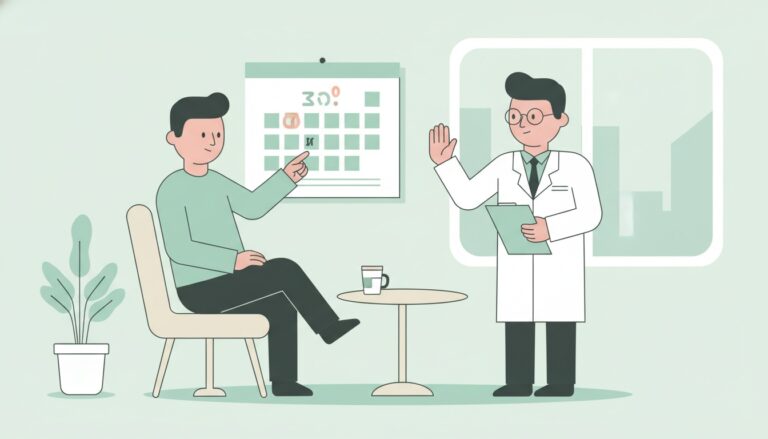
Phase 1: The “3-Minute Diagnosis” Reality Check
Hello! Daily Hangul Editor here.
So, you’ve watched Hospital Playlist or Doctor Cha. You see handsome doctors having deep, emotional conversations with patients in well-lit, spacious rooms. The vibe is calm, empathetic, and slow.
Here is the reality check: If you walk into a typical local clinic (called “uiwon” or “naegwa”) in Seoul for a cold or body ache, you experienced something… different. It’s fast. Like, really fast. You sit down, say “Ah,” the doctor types furiously, a nebulizer is shoved in your face, and suddenly you’re at the pharmacy next door holding a bag of pills.
We call this the “3-Minute Diagnosis.”
Because it happens so fast, you might panic and forget to ask the most important question: “Can I actually go to work tomorrow, or do I have a valid excuse to stay in bed and watch Netflix?”
Today, we aren’t just learning medical vocabulary. We are learning how to negotiate your recovery time in a culture that values “fighting spirit” (Tu-hon) a little too much.
Phase 2: The Phrases That Buy You Time
1. 며칠 정도 쉬어야 하나요?
- Pronunciation: [myeo-chil jeong-do swi-eo-ya ha-na-yo?] (Sounds like: Myuh-chil jung-do she-uh-ya ha-na-yo?)
- Meaning: How many days do I need to rest?
- K-Culture Moment: Imagine a K-Drama employee looking pale, holding their stomach. They ask this hoping the doctor says “A week,” but the doctor usually says, “Just take these meds and you’ll be fine tomorrow.”
- Editor’s Insight: Focus on the word 며칠 (myeochil). Even though it looks like it’s related to “myeot” (how many) + “il” (days), the pronunciation flows smoothly. This is your golden ticket question to get a specific timeline.
- Situation Spectrum:
[🚫 Boss] ———— [⚠️ Colleague] ———— [✅ Doctor]
(Use this with the doctor. Don’t ask your boss this—tell them what the doctor said!) - 🤔 Think About It: In many Western countries, doctors might say, “Rest until you feel better.” Why do Korean patients often demand a specific number of days?
2. 무리하면 안 되나요?
- Pronunciation: [mu-ri-ha-myeon an dwe-na-yo?] (Sounds like: Moo-ree-ha-myun an dway-na-yo?)
- Meaning: Should I not overexert myself? / Is pushing myself bad?
- Context: 무리 (Muri) is a concept you must understand. It means “unreasonable” or “beyond one’s power.” In a health context, it means working or playing when your body needs a break.
- Editor’s Insight: This is a leading question. You are practically begging the doctor to tell you, “Yes, don’t do anything.” You use this when you want medical backing to cancel plans.
- Situation Spectrum:
✅ Universal Use
3. 전염성이 있나요?
- Pronunciation: [jeon-yeom-seong-i in-na-yo?] (Sounds like: Jun-yum-sung-ee in-na-yo?)
- Meaning: Is it contagious?
- Editor’s Insight: Since COVID-19, this question has become essential. If the answer is “네 (Yes),” you have the ultimate “Get Out of Jail Free” card for work, school, or boring dinners.
Phase 3: Textbook vs. Real Life
Doctors are humans, too. They don’t always talk like a medical encyclopedia.
| Situation | 📖 Textbook Korean | 🗣️ Real Korean (Doctor’s Vibe) | 💡 Why different? |
|---|---|---|---|
| Prescribing Rest | 안정을 취하셔야 합니다. (You must take a rest.) | 오늘 밤은 푹 주무세요. (Sleep deeply tonight.) | “Sleep” is the most practical form of rest in Korea. |
| Dietary Advice | 자극적인 음식은 피하세요. (Avoid stimulating food.) | 술 드시지 마시고요, 매운 거 드시지 마세요. (No alcohol, no spicy stuff.) | Alcohol and spice are the two main food groups to avoid here. |
| Work Note | 진단서가 필요합니다. (I need a medical certificate.) | 회사 제출용 서류 하나 주세요. (Give me a document for company submission.) | We focus on the function (submitting to HR) rather than the document name. |
Bottom Note: B1 level learners often sound too formal. Using “술 드시지 마세요” (Don’t drink alcohol) is much more natural than “음주를 금하십시오” (Prohibit drinking).
Phase 4: Cultural Deep Dive — The “Ringer” Solution
4-1. The Magic Potion: “Ringer” (링거)
If you ask a doctor, “I need to recover FAST,” they might suggest a “링거 (Ringer).”
In many countries, IV drips are for people who are severely dehydrated or in the ER. In Korea? It’s a lunch-break activity. You’ll see office workers sleeping in clinic beds with an IV drip for 30 minutes to boost energy. It’s a mix of saline, vitamins, and sometimes garlic extract (yes, really). It’s the ultimate “Pali-pali” (Hurry hurry) cure.
4-2. The “Injection” (주사) Expectation
Koreans often feel they haven’t been treated unless they get a shot. Usually on the buttocks. The nurse will say “엉덩이 살짝 때릴게요” (I’m going to slap your butt a little) before the needle goes in. This isn’t harassment; the slap is to distract your nerves from the pain! Don’t be alarmed.
Phase 5: Roleplay — The Negotiator
Setting: A busy Internal Medicine clinic (Naegwa) in Gangnam. Monday morning. You have a throbbing headache and a fever.
Characters:
– YOU: An exhausted marketing manager.
– Dr. Kim: Fast-talking, efficient doctor who has seen 50 patients today already.
Dialogue:
Dr. Kim: 목이 많이 부었네요. 열도 좀 있고요.
(Mogi mani bueonneyo. Yeoldo jom itgoyo.)
Your throat is very swollen. You have a fever, too.
YOU: 아, 정말요? 선생님, 저 내일 출근해야 하는데…
(A, jeongmalyo? Seonsaengnim, jeo naeil chulgeunhaeya haneunde…)
Ah, really? Doctor, I have to go to work tomorrow…
Dr. Kim: 내일은 쉬시는 게 좋아요. 전염될 수도 있어요.
(Naeireun swisineun ge joayo. Jeonyeomdoel sudo isseoyo.)
It’s better to rest tomorrow. It might be contagious.
🔀 Decision Point! How do you secure your sick day?
A) “네, 알겠습니다.” (Ne, algetseumnida.) — The Passive Acceptor.
B) “회사에 내야 하는데, 진단서 써 주실 수 있나요?” (Can you write a medical certificate for my company?) — The Smart Worker.
C) “주사 맞으면 빨리 낫나요?” (Will I get better fast if I get a shot?) — The ‘Pali-pali’ Patient.
✅ Best Choice: B.
If you want to rest, you need proof. In Korea, verbal confirmation isn’t enough for most bosses. Asking for the document (Jindanseo or Sogyeonseo) right then seals the deal.
Phase 6: 10-Second Shadowing Drill
Let’s practice the sentence that gets you out of work.
Emotion: 🥺 Worried and slightly in pain (channel your inner K-Drama actor)
Sentence:
선생님, / 며칠 정도 / 쉬어야 할까요? / 무리하면 / 안 되겠죠?
(Romanization):
Seonsaengnim, / myeo-chil jeong-do / swi-eo-ya hal-kka-yo? / mu-ri-ha-myeon / an dwe-get-jyo?
Translation: Doctor, / how many days / should I rest? / I shouldn’t / overdo it, right?
Phase 7: K-Culture Mini Glossary
| Korean | Rom. | English | Context |
|---|---|---|---|
| 내과 | Naegwa | Internal Medicine | The go-to clinic for colds, stomach bugs, and flu. Not the ER. |
| 약국 | Yakguk | Pharmacy | Look for the big “약” sign. You buy meds here after the clinic. |
| 몸살 | Momsal | Body Ache/Fatigue | A specific Korean illness caused by stress/overwork. Not just a “cold.” |
| 진단서 | Jindanseo | Medical Certificate | The official paper ($10-$20 cost) proving you are sick. |
Phase 8: Traveler’s Survival Kit
Even if you aren’t living here, you might get sick while traveling. Here is how to survive without a doctor.
🆘 Survival Phrases for the Pharmacy
1. 🇰🇷 “종합감기약 주세요.” (Jonghap-gamgiyak juseyo.)
* “Give me general cold medicine.”
2. 🇰🇷 “열이 나요.” (Yeori nayo.)
* “I have a fever.”
3. 🇰🇷 “소화제 있어요?” (Sohwaje isseoyo?)
* “Do you have digestion medicine?” (Essential for overeating K-BBQ).
📌 Editor’s Travel Note:
Convenience stores (CU, GS25) sell basic medicines like Tylenol and digestion drinks (Gas-Whal-Myung-Su) 24/7. Look for the small medical shelf near the counter!
Phase 9: Think Deeper — The Paper Trail of Pain
Let’s talk about “Trust” in the workplace.
In many Western cultures, if you tell your boss, “I have the flu,” they say, “Get better soon.” In Korea, the immediate follow-up is often, “Can you submit the receipt or certificate?”
Is this a lack of trust? Maybe. But it’s also a reflection of a highly bureaucratic and competitive society where “fairness” is documented. If everyone is working through the pain (the Tu-hon spirit), your excuse to rest needs to be officially validated by a professional. The doctor’s note isn’t just medical advice; it’s your permission slip to be human for a few days.
💬 Your Turn: Does your country require a doctor’s note for a 1-2 day sick leave? Or is it based on honor?
Phase 10: FAQ & Troubleshooting
Q: Can I negotiate the number of rest days on the medical note?
A: Actually… sometimes, yes. Doctors know the work culture. If you say, “My boss is strict, can you write 3 days instead of 2?” many doctors will sympathize and help you out. It’s a human interaction, after all.
Q: What if I don’t understand the medical terms?
A: Use Papago. Korean doctors are very tech-savvy. Typing into your phone and showing them is perfectly acceptable.
❌ Common Mistake: Saying “I’m sick” as “아파요 (Apayo)” to a boss.
✅ Better Way: Use “컨디션이 안 좋아요 (My condition isn’t good)” or “몸살 기운이 있어요 (I have body ache symptoms).” “Apayo” can sound a bit childish, like a kid with a boo-boo.
Phase 11: Wrap-up & Mission
One-Liner: Ask “며칠 쉬어야 해요?” to get the timeline, and ask for a “진단서” if you need to prove it.
🚀 Your Action Mission:
– 🥉 Bronze: Stand in front of a mirror, hold your stomach, and practice saying “Muri-hamyeon an dwe-jyo?” with a sad face.
– 🥈 Silver: Go to a convenience store and find where the medicines are kept. Just spotting them is a win!
– 🥇 Gold: If you are in Korea and feeling tired, try getting a “Vitamin IV Drip” at a local clinic. It’s a quintessential modern Korean experience.
Phase 12: Quiz — The “Noonchi” Check
Scenario: You have a mild cold, but you want to leave work early on Friday.
Question: Which phrase is the riskiest to say to your Korean boss?
1. “저 병원 좀 다녀오겠습니다.” (I will go to the hospital for a bit.)
2. “의사 선생님이 전염성이 있다고 하네요.” (The doctor said it’s contagious.)
3. “오늘 그냥 좀 쉬고 싶어요.” (I just want to rest a bit today.)
Answer & Explanation:
The Risky Move is #3.
In Korea, “wanting” to rest isn’t usually a valid reason during work hours. You need a cause (symptom) and an authority (doctor). #2 is the smartest move because no boss wants the whole team to get sick!
Frequently Asked Questions (FAQ)
Q: What does "며칠 정도 쉬어야 하나요?" mean in Korean and how do you pronounce it?
A: In Korean, "며칠 정도 쉬어야 하나요?" is pronounced [myeo-chil jeong-do swi-eo-ya ha-na-yo?] and means: How many days do I need to rest?
Q: What does "무리하면 안 되나요?" mean in Korean and how do you pronounce it?
A: In Korean, "무리하면 안 되나요?" is pronounced [mu-ri-ha-myeon an dwe-na-yo?] and means: Should I not overexert myself? / Is pushing myself bad?
Q: What does "전염성이 있나요?" mean in Korean and how do you pronounce it?
A: In Korean, "전염성이 있나요?" is pronounced [jeon-yeom-seong-i in-na-yo?] and means: Is it contagious?







