

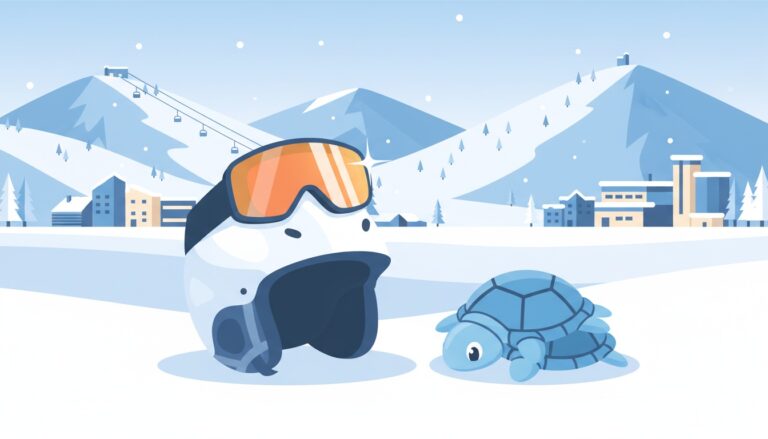
Phase 1: The “Helmet Romance” Trope
Hello! This is your Daily Hangul editor.
You know that classic scene in almost every romantic K-Drama set in winter? The main characters are at a ski resort. The snow is falling in slow motion. The male lead gently grabs the female lead’s helmet, puts it on her head, and carefully fastens the strap while looking deep into her eyes. ✨
In Drama Land, that’s a moment of heart-fluttering romance. But let’s be real—in the freezing winds of Gangwon-do, that guy is basically saying, “Please don’t crack your head open so we can eat ramyeon later.”
Winter sports in Korea are huge. From the Olympic slopes of PyeongChang to the late-night skiing culture (yes, we ski at 2 AM!), it’s a massive part of the winter lifestyle. But here’s the thing: Koreans take their gear very seriously. If you show up to a Korean ski resort in jeans and no helmet, you aren’t just risking injury—you’re sticking out like a sore thumb.
Today, let’s learn how to talk about safety gear like a local, so you can enjoy the slopes without ending up in the emergency room (or on a viral YouTube fail compilation).
Phase 2: Deep Dive into Core Expressions
1. 필수 (Pil-su)
- Pronunciation: [Pil-su] (Sounds like “Pill” + “Sue”)
- Meaning: Essential / A must (Literal: Requisite)
- K-Culture Moment: You’ll see this word on every safety banner at the resort. Also, in K-Pop survival shows, trainees often say practicing is pil-su to debut.
- Editor’s Insight: This is stronger than just “important.” It implies that if you don’t do it, you can’t participate. In Korea, wearing a helmet is becoming pil-su socially, even if it’s not always 100% legally enforced for adults on every slope.
- Situation Spectrum:
[🚫 Strict] ———— [⚠️ Caution] ———— [✅ Casual]
(Usable in all contexts, from signs to chatting with friends) - 🤔 Think About It: Why does Korean society love defining things as “Essential items” (필수템)? From skincare to safety gear, there is a strong collective pressure to have the “right” equipment.
2. 장비빨 (Jang-bi-bbal)
- Pronunciation: [Jang-bi-bbal] (The double ‘bb’ is a tense, hard sound)
- Meaning: The power of gear / Relying on equipment
- K-Culture Moment: You arrive at the ski lodge. Your friend can barely stand up on skis but is wearing a $2,000 suit and top-tier goggles. That is Jang-bi-bbal.
- Editor’s Insight: Jang-bi means equipment. Bbal is a slang suffix meaning “effect” or “power.” It’s often used jokingly. “I’m not good at skiing, but at least I have jang-bi-bbal!”
- Situation Spectrum:
[🚫 Formal] ———— [⚠️ Semi-formal] ———— [✅ Casual]
(Only use this with friends. Don’t say it to your boss unless you are very close!)
3. 답답하다 (Dap-dap-ha-da)
- Pronunciation: [Dap-dap-ha-da]
- Meaning: Feeling suffocated / Stuffy / Frustrating
- K-Culture Moment: The moment you walk into the heated cafeteria after skiing and you have your scarf, helmet, and goggles on. You sigh and say, “Ah, dap-dap-hae.”
- Editor’s Insight: This describes the physical sensation of wearing too much gear, but also the psychological feeling when a situation isn’t resolving (like a K-Drama plot that drags on!). You might complain that a helmet is dap-dap-hae, but you wear it anyway.
Phase 3: Textbook vs. Real Life
| Situation | 📖 Textbook Korean | 🗣️ Real Korean | 💡 Why the difference? |
|---|---|---|---|
| Telling someone to wear a helmet | 헬멧을 착용하세요. (Please wear a helmet.) | 헬멧 써, 안 그럼 다쳐. (Put on a helmet, or you’ll get hurt.) | “착용하다” is formal written language. In speech, we use “쓰다” (to use/wear on head). |
| Checking if gear fits | 사이즈가 맞습니까? (Is the size correct?) | 이거 딱 맞아요? (Does this fit perfectly?) | “딱” adds the nuance of fitting “just right” or “snugly,” which is crucial for safety gear. |
| Complaining about heavy gear | 장비가 너무 무겁습니다. (The equipment is too heavy.) | 아, 몸이 천근만근이야. (Ah, my body feels like a thousand pounds.) | Koreans love idioms to exaggerate physical fatigue. |
💡 Editor’s Note: In an emergency on the slopes, forget politeness. Just shout “비켜요!” (Bi-kyeo-yo! – Move!) or “조심해!” (Jo-sim-hae! – Watch out!). Safety trumps honorifics.
Phase 4: Cultural Context — The “Full Gear” Phenomenon
4-1. Nunchi & The Look
If you go hiking or skiing in Korea, you will notice something immediately: Everyone looks like a pro athlete.
Even beginners wear top-of-the-line North Face or Descente gear. This is part of the “showing sincerity” culture. Having the proper gear shows you respect the activity and are prepared. If you show up in jeans (please don’t ski in jeans), people might stare—not just because it’s dangerous, but because it shows a lack of nunchi (awareness) about the group norms.
4-2. K-Food Connection: The Post-Ski Ritual
After struggling with your heavy boots and helmet, the Korean ski experience isn’t over until you hit the cafeteria. The smell of Eomuk-tang (fish cake soup) and Tteokbokki is irresistible.
Why? Because you need to melt your frozen body. Taking off your dap-dap-han helmet and sipping hot broth is the definition of Si-won-ha-da (refreshing/relieving). It’s the reward for enduring the cold and the heavy gear.
Phase 5: Immersive Roleplay
Setting: Vivaldi Park Ski Resort Rental Shop. Saturday morning, chaotic energy. K-Pop is blasting from the speakers.
Characters:
– YOU: A exchange student trying skiing for the first time.
– Min-su: Your Korean university buddy who loves skiing and owns all his own gear.
Dialogue:
Min-su: 야, 너 헬멧은 안 빌려? 필수야, 필수!
(Ya, neo hel-met-eun an bil-lyeo? Pil-su-ya, pil-su!)
[Hey, aren’t you renting a helmet? It’s essential, essential!]
YOU: (Looking at the rental fee) 음… 그냥 모자 쓰면 안 돼?
(Eum… geu-nyang mo-ja sseu-myeon an dwae?)
[Umm… can’t I just wear a beanie?]
Min-su: (Shaking his head dramatically) 절대 안 돼. 여기 얼음판이야. 너 머리 깨지고 싶어?
(Jeol-dae an dwae. Yeo-gi eol-eum-pan-i-ya. Neo meo-ri kkae-ji-go sip-eo?)
[Absolutely not. It’s a sheet of ice out there. Do you want to crack your head open?]
YOU: 알았어. 근데 나 머리 커서 맞는 게 있을까?
(Al-ass-eo. Geun-de na meo-ri keo-seo mat-neun ge iss-eul-kka?)
[Okay. But my head is big, will there be one that fits?]
Min-su: 걱정 마. 사장님! 여기 대왕 머리 헬멧 하나 주세요!
(Geok-jeong ma. Sa-jang-nim! Yeo-gi dae-wang meo-ri hel-met ha-na ju-se-yo!)
[Don’t worry. Boss! Please give us one ‘King Size Head’ helmet here!]
🔀 Decision Point: Min-su just embarrassed you. How do you react?
- A) “야! 조용히 해!” (Hey! Be quiet!) — Standard reaction.
- B) “아, 진짜… 너 때문에 안 써!” (Ah, seriously… because of you I won’t wear it!) — Risky. Safety first!
- C) “그래, 나 머리 커서 똑똑하다, 왜!” (Yeah, my head is big because I’m smart, so what!) — Witty & Confident.
✅ Best Choice: C. Owning the joke makes you the mood maker. Plus, you still get the helmet. Safety secured.
Phase 6: 10-Second Shadowing Drill
Let’s practice sounding natural when insisting on safety. Don’t be shy—say it with authority!
Emotion: 😤 Firm & Protective (Like a nagging older sibling)
안전장비는 / 선택이 아니라 / 필수예요!
(An-jeon-jang-bi-neun / seon-taek-i a-ni-ra / pil-su-ye-yo!)
Safety gear is / not a choice / it’s a must!
Phase 7: K-Culture Mini Glossary
| Korean | Romanization | English | Context |
|---|---|---|---|
| 보호대 | bo-ho-dae | Pads/Guards | Knee pads (mu-reup), wrist guards (son-mok). Beginners usually wear “butt pads” (eong-dong-i bo-ho-dae) which look like cute turtles. |
| 고글 | go-geul | Goggles | Essential for “Jang-bi-bbal” (gear flex). |
| 핫팩 | hat-paek | Hot Pack | A disposable hand warmer. You stick these on your clothes. K-Drama survival item #1. |
| 야간 스키 | ya-gan seu-ki | Night Skiing | Skiing after sunset. Cheaper tickets, fewer people, colder wind. |
Phase 8: Traveler’s Survival Kit (Ski Resort Edition)
Going to a Korean ski resort? Here is what you need to say at the rental shop.
🆘 Survival Expression #1
– 🇰🇷 “이거 너무 꽉 껴요.” (Igeo neomu kkwak kkyeoyo.)
– 🗣️ Meaning: This is too tight.
– 📍 Use: When your boots or helmet are crushing you.
– 💡 Pro Tip: Ski boots should be tight, but if your toes are curling, say this!🆘 Survival Expression #2
– 🇰🇷 “초급자 코스가 어디예요?” (Chogeupja koseuga eodiyeyo?)
– 🗣️ Meaning: Where is the beginner course?
– 📍 Use: To avoid accidentally going up the “Black Diamond” lift.📌 Editor’s Travel Note
– Discounts: Foreigners often get discounts with passports or through travel agencies (Klook, Trazy).
– Shuttle Bus: Most resorts operate free shuttle buses from Seoul (Hongdae/Myeongdong), but you usually must reserve them online in advance!
Phase 9: Think Deeper — “Form over Function?”
The Psychology of Gear
In Korea, there’s a concept called “Gatchu-da” (갖추다), which means to be fully equipped or prepared. When you see a beginner skier decked out in $3,000 worth of gear, it’s easy to judge it as vanity. But let’s look closer.
In a collective society, looking the part is a sign of respect for the activity and the group. It says, “I am taking this seriously.” Also, Korea is a hyper-competitive society; no one wants to look like the amateur who didn’t prepare. So, while Jang-bi-bbal can be funny, it also reflects a culture that values preparation and visual harmony.
💬 Your Turn: In your country, is it common for beginners to buy expensive gear immediately? Or do people usually rent the cheapest stuff first?
Phase 10: FAQ & Troubleshooting
Q: Can I wear a helmet I bought for cycling?
A: Technically yes, but you might get “The Look.” Ski helmets have ear covers for warmth. A bike helmet with a beanie underneath is accepted for beginners, but renting a proper ski helmet is safer and cheap (about 5,000 KRW).
Q: Is it rude to tell a stranger their backpack is open?
A: Not at all! It’s an act of Jeong (affection/care). Just tap them and point, saying “가방 열렸어요” (Ga-bang yeol-lyeoss-eo-yo). They will thank you.
❌ Common Mistake: Using polite language when you are about to crash into someone.
✅ Fix: Don’t say “Jeo-gi-yo…” (Excuse me…). Scream “비켜!!” (Bi-kyeo!! – Move!!) or “악!!” (Ack!!). Survival first, manners second.
Phase 11: Wrap-up & Mission
One-Liner: Always protect your head with pil-su gear, and don’t be afraid to rely on jang-bi-bbal!
Action Mission:
– 🥉 Bronze: Look in the mirror, pretend to fasten a helmet strap, and say “안전이 필수예요!” (Safety is essential!).
– 🥈 Silver: Find a picture of a Korean celebrity skiing on Instagram and comment “장비빨 대박!” (Great gear power!) or “조심하세요!” (Be careful!).
– 🥇 Gold: Go to a sports store in your city, find the ski section, and ask a staff member (in Korean if you dare, or just mentally), “Do you have knee pads?” (Mu-reup bo-ho-dae isseoyo?)
Engagement Question: What is the most “dap-dap-han” safety gear you have ever worn? Tell us in the comments!
Phase 12: Quiz — Interactive Challenge
1. Situational Judgment:
Your friend wants to go to the “Advanced” slope on their first day because they want a cool Instagram photo.
- A) “그래, 사진이 중요하지!” (Sure, photos are important!)
- B) “야, 너 미쳤어? 절대 안 돼. 다쳐.” (Hey, are you crazy? Absolutely not. You’ll get hurt.)
- C) “화이팅!” (Fighting!)
Answer: B. Friends don’t let friends die on the advanced slope. Korean friends can be very blunt when safety is involved.
2. Fill in the Blank:
“Wow, look at his new snowboard. He isn’t good, but his
[ _____ ] is amazing!”
- A) 눈치 (Nunchi)
- B) 장비빨 (Jang-bi-bbal)
- C) 핫팩 (Hat-paek)
Answer: B. This is the perfect usage of “Gear Power.”
3. True or False:
“In an emergency collision course on the slopes, you must use high formal polite language.”
Answer: False. Scream, shout, wave your hands. Safety > Manners.
Frequently Asked Questions (FAQ)
Q: What does "필수 (Pil-su)" mean in Korean and how do you pronounce it?
A: In Korean, "필수 (Pil-su)" is pronounced [Pil-su] and means: Essential / A must (Literal: Requisite)
Q: What does "장비빨 (Jang-bi-bbal)" mean in Korean and how do you pronounce it?
A: In Korean, "장비빨 (Jang-bi-bbal)" is pronounced [Jang-bi-bbal] and means: The power of gear / Relying on equipment
Q: What does "답답하다 (Dap-dap-ha-da)" mean in Korean and how do you pronounce it?
A: In Korean, "답답하다 (Dap-dap-ha-da)" is pronounced [Dap-dap-ha-da] and means: Feeling suffocated / Stuffy / Frustrating







