

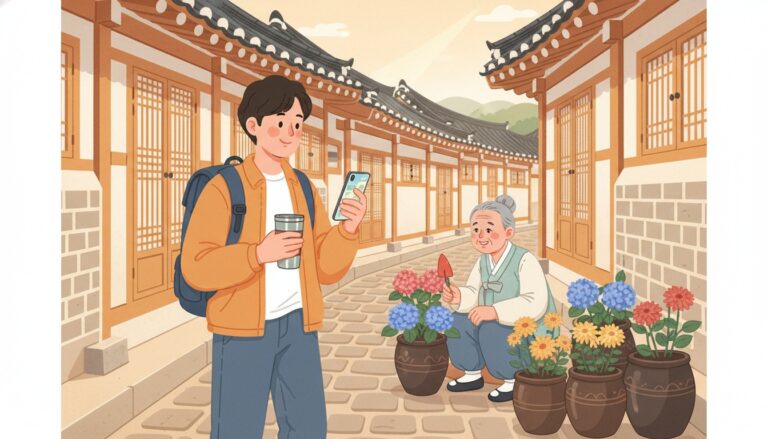
Phase 1: The New Normal — Beyond “Pali-Pali” Tours
Hello! Your Daily Hangul Editor here.
Picture this: Before 2020, Myeongdong was a battlefield of cosmetics touts and street food steam, a place where you could barely hear yourself think. Fast forward to the post-pandemic era. The crowds are back, but the vibe has shifted. We aren’t just seeing tour buses dumping groups at palaces for a 20-minute photo op anymore.
Now, travelers—and perhaps you, planning your next MICE event or solo trip—are asking different questions. It’s no longer just “Where is the cheapest duty-free shop?” It’s “Is this place real?” or “Does my money actually help this grandmother running the restaurant?”
We call this the shift from tourist to traveler, or in the MICE industry, the move toward ESG (Environmental, Social, and Governance) tourism. If you want to discuss tourism in Korea at a C2 level, you need to move beyond simple directions and talk about values.
Today, we look at the language of sustainable tourism—how to sound like a sophisticated insider who cares about the soul of the place, not just the Instagram shot.
Phase 2: Deep Dive — Words with Weight
1. 상생 (Sang-saeng)
- Pronunciation: [Sang-saeng] (Sounds like ‘Sang’ as in ‘sang a song’ + ‘saeng’ like ‘sang’ but with a distinct ‘ng’ ending)
- Meaning: Literal: Living together / Real nuance: Symbiosis; Mutual growth; Win-Win.
- K-Culture Moment: You’ll hear this in news reports about traditional markets (sijang) partnering with large marts, or in corporate K-Dramas like Start-Up when discussing business ethics. It implies that for me to survive, you must survive too.
- Editor’s Insight: This is a heavy hitter in the MICE industry. If you are proposing a corporate retreat to a rural area, don’t just say “It helps the locals.” Say, “It is a project for sang-saeng with the local community.” You instantly sound like an executive.
- Situation Spectrum:
[🚫 Casual Friends] ———— [⚠️ Colleagues] ———— [✅ Formal/Biz] - 🤔 Think About It: Korea is a hyper-competitive society. Why do you think a word like ‘Sang-saeng’ has become a buzzword in business and government policy recently? Is it a genuine desire for harmony, or a survival strategy?
2. 가치 소비 (Gachi Sobi)
- Pronunciation: [Gachi Sobi]
- Meaning: Value consumption (Conscious consumerism).
- K-Culture Moment: Think of the “Yonggi-nae” (Courage/Container) challenge on social media, where actors like Ryu Jun-yeol promoted bringing your own containers to pick up food to reduce plastic.
- Editor’s Insight: This isn’t just about saving money. It’s about spending money to prove a point. If you choose a slightly more expensive eco-friendly hotel over a cheap motel, that is gachi sobi.
- Situation Spectrum:
[✅ Casual Friends] ———— [✅ Colleagues] ———— [✅ Formal/Biz]
3. 로컬 (Local)
- Pronunciation: [Ro-keol]
- Meaning: Local (region/neighborhood).
- Editor’s Insight: Wait, isn’t this English? Yes, but in Korean, “Local” implies something hip, authentic, and non-franchise. Going to Starbucks is not “Local.” Going to a tiny cafe in Gangneung making tofu gelato? That is “Local content.” It’s a badge of honor for travelers.
- Situation Spectrum:
[✅ Casual Friends] ———— [✅ Colleagues] ———— [✅ Formal/Biz]
Phase 3: Textbook vs. Real Life
| Situation | 📖 Textbook Korean | 🗣️ Real Korean (Trend) | 💡 The Context |
|---|---|---|---|
| Explaining a trip purpose | “환경을 보호하기 위해 여행해요.” (I travel to protect the environment.) | “요즘 공정 여행에 관심이 많아서요.” (I’m really into Fair Travel these days.) | ‘Fair Travel’ is the industry term for ethical tourism. |
| Asking for eco-options | “일회용품을 주지 마세요.” (Please do not give me disposable items.) | “제로 웨이스트 실천 중이라서요.” (I’m practicing Zero Waste.) | Using the specific movement name sounds more committed and less picky. |
| Describing a rural trip | “시골에 가서 쉬고 싶어요.” (I want to go to the countryside and rest.) | “이번 휴가는 촌캉스 갈 거예요.” (I’m going on a Choncance.) | Chon (Village) + Vacance. It’s a hip trend among Gen Z to wear “granny pants” and relax in rural homes. |
Bottom Note: Slapping “-cance” (from vacance) onto words is a linguistic sport in Korea. Hocance (Hotel), Choncance (Village), Workance (Work). Use these, and you sound 10 years younger.
Phase 4: Cultural Deep Dive — The “Silence” of Etiquette
4-1. The Noise of Overtourism
We need to talk about Ihwa Mural Village. Years ago, it was a hot spot for K-Drama fans. Then, the residents—tired of the noise and trash—painted over the beautiful murals themselves.
In the post-COVID era, “Quiet Tourism” is an unspoken rule in residential areas like Bukchon Hanok Village or Seochon.
- The Look: If you see a sign that says “주민이 살고 있습니다” (Residents live here), that is your cue to whisper.
- The Nunchi: If you are taking a photo of a cool old building and an elderly person walks out, lower your camera immediately. It’s not just privacy; it’s respect.
4-2. K-Drama & Reality: Hometown Cha-Cha-Cha
The drama glamorized the seaside village life (Gongjin). In reality, after the show aired, tourists flooded the actual filming location (Pohang), entering people’s private houses thinking they were sets. The producers actually had to issue a statement begging people to stop.
Critical Insight: The fantasy of “Korean hospitality” (Jeong) conflicts with the reality of privacy. As a C2 learner, you should be able to discuss this tension. “Does tourism destroy the very ‘local vibe’ it seeks to sell?”
Phase 5: Immersive Roleplay — The MICE Pitch
Setting: A meeting room in Gwanghwamun. You are pitching a venue for an upcoming international conference to your Korean client, Team Leader Park. You want to push for a sustainable option in Jeju, but it’s expensive.
Characters:
– YOU: Foreign Consultant specializing in sustainable MICE.
– Team Leader Park: 40s, focused on budget and “safe” choices.
Dialogue:
Park: (Looking at the tablet) 제주도? 예산이 너무 초과되는데요. 서울 호텔이 편하지 않을까요?
(Jeju-do? Yesan-i neomu chogwadoeneundeyo. Seoul hoter-i pyeonhaji aneulkkayo?)
(Jeju Island? This is way over budget. Wouldn’t a Seoul hotel be more convenient?)
YOU: 물론 편하죠. 하지만 이번 행사의 핵심은 ‘가치 소비’입니다. 참가자들에게 단순한 관광이 아니라, 영감을 줘야죠.
(Mullon pyeonhajyo. Hajiman ibeon haengsa-ui haeksim-eun ‘gachi sobi’-imnida. Chamgaja-deurege dansunhan gwangwang-i anira, yeonggam-eul jwoyajyo.)
(Of course, it’s convenient. But the core of this event is ‘value consumption.’ We need to give participants inspiration, not just simple tourism.)
Park: 영감이라… 그래도 윗분들이 좋아하실지 모르겠네요.
(Yeonggamira… Geuraedo witbun-deuri joahasilji moreugenneyo.)
(Inspiration… Still, I don’t know if the higher-ups will like it.)
🔀 Decision Point: How do you persuade him?
A) “요즘 트렌드예요. 무조건 이렇게 해야 해요.” (It’s the trend these days. We must do this.)
B) “지역 사회와 상생하는 모델이라고 보고하면, 기업 이미지에도 좋지 않을까요?” (If we report it as a model of sang-saeng with the local community, wouldn’t it be good for the corporate image?)
C) “제주도 바다가 예쁘잖아요.” (The Jeju sea is pretty, you know.)
✅ Best Choice: B.
– Why: You used the magic word 상생 (Sang-saeng) and linked it to corporate image (ESG). This speaks the language of Korean business leadership. Choice A is too aggressive; Choice C is too childish for a business meeting.
Phase 6: 10 Second Shadowing
Let’s practice a sentence you can use when explaining why you prefer local travel over tourist traps.
“저는 / 유명한 곳보다 / 현지 느낌이 나는 / 골목 여행이 / 더 좋더라고요.”
(Jeo-neun / yumyeonghan gotboda / hyeonji neukkim-i naneun / golmok yeohaeng-i / deo joteoragoyo.)
Emotion: 😊 (Thoughtful & Content)
Translation: I actually prefer alleyway travel with a local vibe over famous places.
Key Sound: Stress ‘골목’ (Golmok – Alley) to highlight your preference.
Phase 7: K-Culture Glossary (Sustainable Edition)
| Korean | Romanization | English | Context |
|---|---|---|---|
| 워케이션 | Workation | Work + Vacation | Working remotely from a holiday spot (Jeju, Gangwon-do) is a huge post-COVID trend. |
| 플로깅 | Plogging | Plogging | Picking up trash while jogging. Popular CSR activity for Korean companies now. |
| 착한 소비 | Chakan Sobi | ‘Good’ Consumption | Buying from ethical businesses. Koreans love labeling things “Chakan” (Good/Kind). |
| 핫플 | Hotple | Hot Place | Trendy spots. Critique: Often creates overtourism and short-lived hype. |
| 노포 | Nopo | Old Store | A long-standing shop/restaurant. Gen Z loves these for their ‘authentic’ grit. |
Phase 8: Traveler’s Survival Kit (Eco-Friendly)
Korea generates a lot of plastic, but the recycling rules are intense. Here is how to survive the “Green” transition.
🆘 Survival Expression #1
– 🇰🇷 “텀블러 가져왔는데 할인 되나요?” (Tumbler gajyeowanneunde harin doenayo?)
– 🗣️ Meaning: “I brought my tumbler, is there a discount?”
– 📍 Where: Starbucks, Paul Bassett, and many chains.
– 💡 Pro Tip: Major chains offer 300-500 KRW off. It’s small, but it shows you have “sense” (sens-eu).📌 Editor’s Travel Note: The Trash Crisis
– You will struggle to find public trash cans in Seoul. Why? To prevent household trash dumping.
– Don’t shove your coffee cup into a bus stop crevice.
– Do carry a small “trash pouch” in your bag until you return to your accommodation or find a subway station bin.
Phase 9: Think Deeper — Gentrification vs. Regeneration
Topic: When “Local” becomes “Commercial.”
Seoul’s Seongsu-dong used to be a factory district full of handmade shoe artisans. Now, it is the “Brooklyn of Seoul,” packed with pop-up stores and luxury brands. The artisans are being pushed out by rising rents.
As a Korean learner, consider the word 젠트리피케이션 (Gentrification). It is a loan word used frequently in Korean news.
🧠 Critical Question:
Does transforming an old neighborhood into a “Hot Place” save it from disappearing, or does it kill its soul? When we say we want to experience “Real Korea,” are we actually accelerating its disappearance by turning it into a commodity?💬 Your Turn: How does your country handle the balance between tourism revenue and protecting local residents? Is there a Korean equivalent of this situation in your hometown?
Phase 10: FAQ & Troubleshooting
Q: Can I really bargain in traditional markets if I’m trying to support the locals?
A: Good question! “Traditional” bargaining (Heung-jeong) is fading. In a tourist hub like Namdaemun, it’s expected. But if you are buying vegetables from a grandma in a rural 5-day market, asking for a discount might be seen as “Jeong-eopda” (lacking heart/warmth). Instead, just pay the price, and she might throw in an extra apple as “Service” (freebie).
❌ Common Mistake: Taking photos of strangers because they look “aesthetic.”
✅ Fix: Just because an elderly person pulling a cart looks like a movie scene to you, it’s their hard reality. Always ask, or keep the camera wide enough that faces aren’t identifiable.
Phase 11: Wrap-up
One-Liner: Sustainable tourism in Korea isn’t just about eco-bags; it’s about Sang-saeng (coexistence) with the people who live there.
Action Missions:
– 🥉 Bronze: Practice saying “텀블러 할인 되나요?” three times.
– 🥈 Silver: Look up the hashtag #제로웨이스트 (Zero Waste) on Instagram and read one Korean caption.
– 🥇 Gold: Next time you visit a Korean cafe, refuse the straw by saying “빨대는 괜찮아요” (I’m okay without a straw).
K-Culture Mission: Watch an episode of Hyori’s Bed & Breakfast (Hyori-ne Minbak). Observe how they treat the guests and the environment of Jeju. It’s the bible of “Slow Life” in Korea.
Phase 12: Interactive Quiz
- Situation: You are at a trendy cafe in Seongsu-dong. You have your own cup. What do you say?
- A) 컵 깎아주세요. (Cut the cup price.)
- B) 텀블러 할인 되나요? (Is there a tumbler discount?)
- C) 이 컵은 제 것입니다. (This cup is mine.)
- Culture: Which term best describes a vacation where you stay in a rural village house?
- A) Hocance
- B) Workation
- C) Choncance
- True or False: It is polite to whisper in residential mural villages like Ihwa or Bukchon.
- (T / F)
(Answers: 1-B, 2-C, 3-T)
Frequently Asked Questions (FAQ)
Q: What does "상생 (Sang-saeng)" mean in Korean and how do you pronounce it?
A: In Korean, "상생 (Sang-saeng)" is pronounced [Sang-saeng] and means: Literal: Living together / Real nuance: Symbiosis; Mutual growth; Win-Win.
Q: What does "가치 소비 (Gachi Sobi)" mean in Korean and how do you pronounce it?
A: In Korean, "가치 소비 (Gachi Sobi)" is pronounced [Gachi Sobi] and means: Value consumption (Conscious consumerism).
Q: What does "로컬 (Local)" mean in Korean and how do you pronounce it?
A: In Korean, "로컬 (Local)" is pronounced [Ro-keol] and means: Local (region/neighborhood).







